

What makes a strong electrician isn’t just knowledge of wiring diagrams. It’s the ability to combine technical judgement with safe work habits, digital tools, and clear communication. The essential skills for modern electricians go beyond traditional hands-on knowledge. As electrical systems evolve, it helps to know which abilities matter and how classroom concepts connect to practical tasks.
This guide covers core technical skills, from reading plans and interpreting measurements to following safety procedures. It also looks at digital tools, automation, problem-solving, and communication, with practical ways to build these abilities step by step. Use it to identify a useful next learning goal and understand how the skills fit together on the job.
Key Takeaways
- The essential skills for modern electricians combine electrical fundamentals with the ability to work confidently across changing systems.
- Understanding voltage, current, resistance, power, and schematics helps connect classroom concepts to installation, inspection, and maintenance tasks.
- Digital controls, PLCs, and variable frequency drives are expanding the range of systems electricians may encounter.
- Safe judgement and clear communication help teams coordinate work, follow procedures, and respond to hazards or changing conditions.
- Build skills step by step: identify gaps, strengthen fundamentals, practise under supervision, and review your progress.
What makes an electrician’s skill set modern?
Modern electrician skills are the practical capabilities needed to install, inspect, maintain, and troubleshoot electrical systems safely and accurately as equipment and work environments change. The focus is on doing the work well, not simply knowing how to use the latest device. Electrical theory, careful measurement, and an understanding of circuits remain the foundation for sound decisions.
Some abilities are entry-level essentials: recognizing common electrical components, understanding basic circuit behaviour, following instructions, and using tools responsibly under appropriate supervision. Other capabilities develop through practice, such as diagnosing unfamiliar faults, interpreting control-system behaviour, and coordinating complex tasks. The essential skills for modern electricians build progressively: start with a reliable foundation, then develop judgement and adaptability through structured instruction and supervised experience.
How electrical work is changing
Installation and maintenance remain central to electrical work, while connected equipment and automation can add new tasks. Depending on the workplace, an electrician may encounter sensors, control panels, monitored systems, or equipment that adjusts its operation automatically. The mix varies by sector and role. The role of an electrician spans different duties and specializations, so modern skills are best understood as a flexible foundation rather than a single job description.
Digital tools can help workers view system information or interact with automated equipment, but they don’t replace electrical fundamentals. When a system behaves unexpectedly, knowledge of circuits and components helps an electrician reason about what may be happening instead of relying only on a display or alert. Technology adds another layer to the task; it doesn’t remove the need to understand the electrical system beneath it.
A balanced skill profile
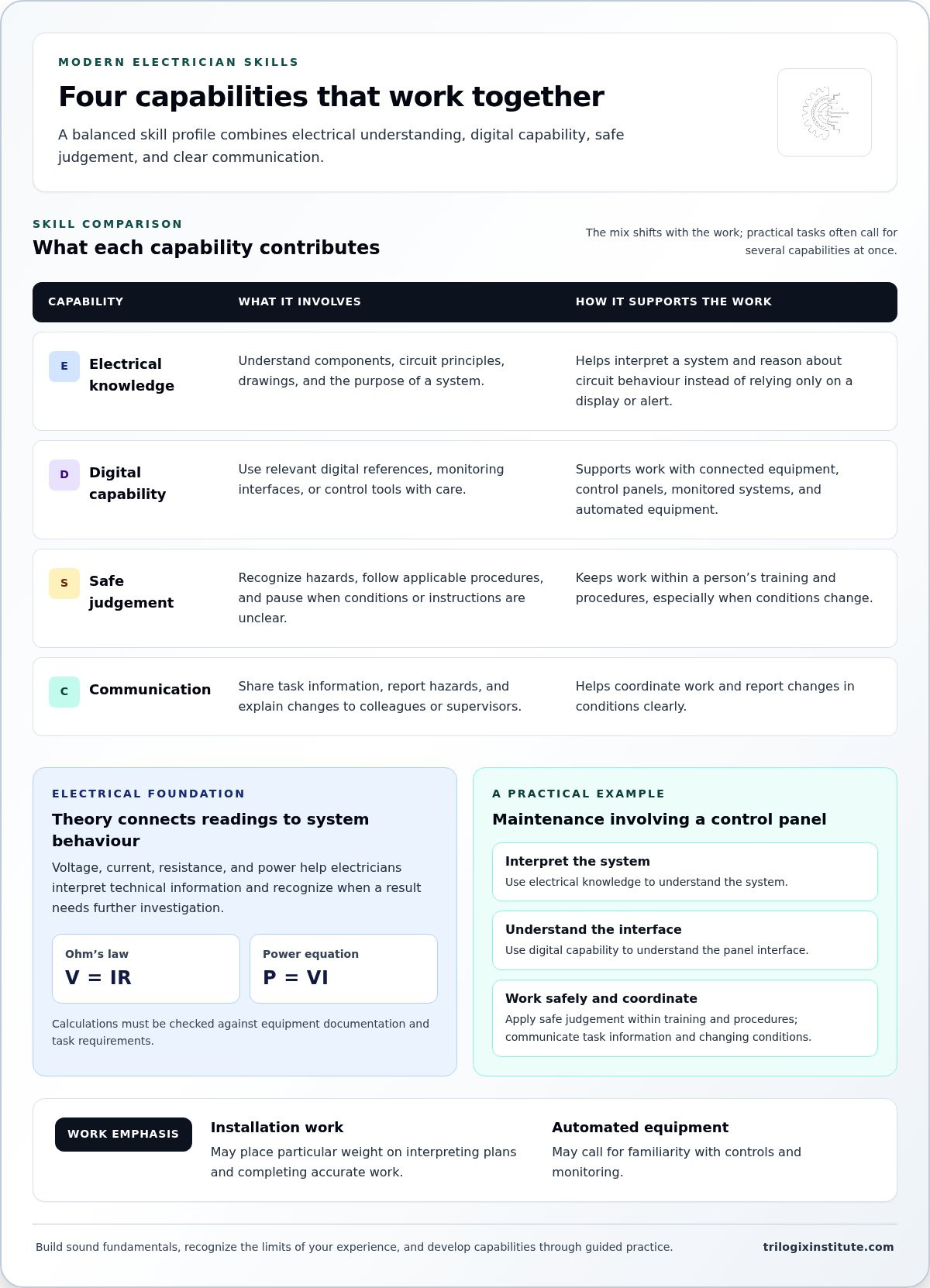
A capable electrician draws on four connected categories. Their relative importance can shift with the work, but practical tasks often call for a combination of technical understanding, safe judgement, and clear coordination.
- Electrical knowledge: Understand components, circuit principles, drawings, and the purpose of a system.
- Digital capability: Use relevant digital references, monitoring interfaces, or control tools with care.
- Safe judgement: Recognize hazards, follow applicable procedures, and pause when conditions or instructions are unclear.
- Communication: Share task information, report hazards, and explain changes to colleagues or supervisors.
Consider a maintenance task involving a control panel. The worker needs electrical knowledge to interpret the system, digital capability to understand its interface, and safe judgement to work within their training and applicable procedures. Clear communication helps coordinate the task and report changes in conditions. Each skill supports the others.
Different roles may prioritize different combinations. Installation work may place particular weight on interpreting plans and completing accurate work, while work around automated equipment may call for familiarity with controls and monitoring. The starting point is consistent: build sound fundamentals, recognize the limits of your experience, and develop new capabilities through guided practice.
Which electrical fundamentals should every modern electrician master?
Digital equipment may add new interfaces to a job, but the underlying circuit still follows electrical principles. Electricians need to understand how voltage, current, resistance, and power relate so they can interpret system behaviour, make sense of technical information, and recognize when a result needs further investigation. These fundamentals are among the essential skills for modern electricians because they support decisions across different equipment and tasks.
Consider a load connected to a circuit. Voltage describes the electrical potential difference that drives current; resistance affects how much current flows; and power describes the rate at which electrical energy is used or transferred. Ohm’s law, V = IR, and the power equation, P = VI, help learners connect these concepts to component behaviour. Calculations must still be checked against equipment documentation and the requirements of the task. A simplified example isn’t a substitute for qualified supervision or approved procedures.
Apply circuit knowledge to real tasks
Electrical quantities become useful when linked to a task. If a component or circuit isn’t behaving as expected, reason about its role, the surrounding system, and the information available rather than treating a single reading as a complete diagnosis. Installation, maintenance, and repair all rely on understanding the equipment and its intended operation. Theory helps explain what to examine, while documentation and supervision guide the work.
Accurate measurements, interpreted through electrical theory, turn readings into useful evidence for reliable fault diagnosis. Measurement is a disciplined process: identify what needs to be assessed, select an instrument suitable for the task and conditions, interpret the result in context, and record it clearly. The appropriate instrument and method depend on the work. Learners should use test equipment only within their training and under the required supervision.
Read drawings and use test instruments
Schematics show how components relate through symbols, circuit paths, labels, and references. During installation, they help a worker understand intended connections. During inspection or maintenance, they provide a map for tracing a circuit and comparing the arrangement with system documentation. Reading a drawing means following how the parts connect, not just recognizing individual symbols.
A multimeter can measure different electrical quantities, but its settings, limits, and suitability must match the task. At a conceptual level, the user identifies the measurement needed, consults the instrument and equipment instructions, and interprets the reading against relevant specifications. A value has no useful meaning without context.
Record findings so another technician can follow them: note the relevant circuit or component, the measurement and unit, the conditions or reference used, and any observation that affects interpretation. Clear records support continuity between inspection, maintenance, and follow-up work. Structured, instructor-led learning can connect these concepts with equipment-based practice. Electrical foundations training offers one route to building that base.
How do digital tools and automation change electrician skills?
Electrical work still depends on installing, inspecting, and maintaining circuits and equipment. In workplaces with controls and automation, technicians may also need to interpret system status, understand control signals, and use digital drawings or maintenance records. These tasks extend traditional electrical work rather than replace it. The essential skills for modern electricians include both sound electrical fundamentals and the ability to make sense of information from connected systems.
Digital fluency isn’t simply knowing which buttons to press. It means understanding what information a tool presents, how it relates to the equipment, and when a result needs to be checked against documentation or escalated. Roles and equipment vary by workplace, so familiarity with these concepts provides a foundation rather than a universal task list.
| Enduring skill | Technology-related extension |
|---|---|
| Interpret a circuit and its components | Understand how a controller monitors or directs equipment |
| Inspect and maintain electrical equipment | Use system status or maintenance records to add context |
| Follow drawings and equipment information | Work with digital versions and keep records organized |
Understand controls and automation concepts
A programmable logic controller, or PLC, is a controller used to manage programmed industrial processes. A variable frequency drive, or VFD, is equipment used to control motor speed. At an introductory level, an electrician should be able to identify what these devices do within a larger system and understand that inputs, signals, and programmed responses can shape equipment behaviour.
Safe work also requires recognizing role boundaries. Understanding a control panel’s purpose doesn’t automatically qualify someone to change settings or troubleshoot beyond their training. Follow applicable procedures, use equipment documentation, and work within the direction and supervision required for the task.
Build confidence with digital documentation
Digital drawings, equipment manuals, and maintenance records can help technicians locate relevant information and understand how work has been carried out. Check that a document applies to the equipment or system at hand, use labels and references consistently, and record changes through the appropriate process. Clear records help the next technician understand what was observed and support more repeatable troubleshooting.
AutoCAD is one drafting tool that may be relevant when working with or producing technical drawings, but it isn’t a universal requirement for every electrician. The practical priority is being able to read the documents needed for a task and communicate findings clearly. Instructor-led, equipment-based learning can help learners connect automation concepts to practical settings. Trilogix Institute’s technical training courses provide a structured route for developing foundational and automation-related knowledge.
Which safety and teamwork skills support reliable electrical work?
Reliable electrical work depends on more than technical knowledge. It calls for training, awareness of changing conditions, consistent use of applicable workplace procedures, and the judgement to pause when something doesn’t seem right. These habits help protect the worker and give the wider team information to make decisions. They’re among the essential skills for modern electricians because electrical tasks are often coordinated, not carried out in isolation.
Safety isn’t a checklist completed once before work begins. Conditions, equipment, or task details may differ from what was expected. If they do, stop and raise the concern with the appropriate supervisor rather than making assumptions or improvising beyond your training. Follow the instructions and procedures that apply, and seek guidance whenever the next step is unclear.
Make safety part of every task
A practical routine makes safe judgement visible. Before starting, confirm the task, understand your responsibilities, and review relevant instructions with the qualified supervisor. During the work, stay alert to changed conditions and communicate concerns promptly. At completion, report the status and any unresolved issue. This routine doesn’t replace formal training or workplace procedures; it helps workers apply them consistently.
A straightforward sequence can keep the team aligned:
- Prepare: Clarify the task, responsibilities, instructions, and known concerns before work begins.
- Communicate: Confirm who is doing what and how changes or hazards should be reported.
- Carry out: Follow applicable procedures and stay within your training and assigned role.
- Review: Report the outcome, document relevant observations, and hand over anything unresolved.
Communicate clearly across a work team
Good communication is concise and specific. Share the task status, describe an observed fault without guessing at its cause, and identify any unresolved risk. Listening matters just as much. Repeating an instruction or asking a clarifying question can reveal a difference in understanding before it leads to a poor handoff or an avoidable assumption.
Documentation supports that conversation. A useful handover identifies the equipment or task, what has been completed, what was observed, and what still needs attention. Notes should be clear enough for a colleague who wasn’t present to understand the situation. If conditions change after a handover, update the relevant people and records through the workplace’s usual process. This helps the team make decisions based on shared information rather than memory alone.
For learners, practising these habits alongside technical tasks connects knowledge with workplace expectations. Instructor-led vocational training provides a structured setting to build foundational understanding and practise with equipment. Explore electrical and automation training to strengthen your technical base while developing disciplined work habits.
How can you build essential electrician skills for the workplace?
Skill development is more effective when it starts with an honest picture of what you can do now. The essential skills for modern electricians don’t develop all at once: technical foundations, safe work habits, and confidence with equipment grow through deliberate learning and supervised practice. A clear plan turns uncertainty into manageable next steps, whether you’re beginning training or building on workplace experience.
Turn a skills gap into a learning plan
List tasks you can perform confidently, then note the concepts or activities where you need more practice. Be specific: “interpret a basic schematic” gives you a clearer target than “improve technical knowledge.” Set a goal, practise it in an appropriate learning environment, and review your progress after feedback. Skill needs differ by role and experience, so update your plan as you develop rather than treating it as a fixed checklist.
Use this four-step roadmap to make progress deliberately:
- Identify gaps: Compare your current abilities with the tasks you want to learn, and name the areas that need attention.
- Learn fundamentals: Strengthen the underlying concepts before moving to more complex systems or unfamiliar equipment.
- Practise under supervision: Apply what you’ve learned with guidance, following the instructions and boundaries set for the task.
- Review progress: Record what has improved, where you still need support, and what goal to work on next.
Connect training with practical application
Reading about a component or system builds understanding, while working with equipment can make its purpose and behaviour easier to grasp. Instructor-led, equipment-based learning connects explanations with practical tasks, gives learners a chance to ask questions, and provides guidance as they apply concepts. Choose learning activities that match your experience and intended technical direction. Someone strengthening core knowledge needs a different starting point from someone ready to explore controls or automation.
For a structured start, Trilogix Institute’s Foundation Electrical Engineering training helps learners develop foundational electrical knowledge through instructor-led vocational learning. Explore the Foundation Electrical Engineering courses and consider how the training fits your development goals. You can also use an electrical engineering course guide to compare subject areas and decide what to focus on next.
Keep expectations practical. Training supports learning, while further development comes from applying knowledge appropriately, receiving feedback, and building experience over time. You don’t need to master every technology at once. Strengthen your foundation, practise within your level of preparation, and review your goals as your interests and responsibilities evolve.
To begin your journey, explore electrical engineering training today.
Build your next skill with purpose
You don’t need to master every system before taking a useful next step. Choose one area that fits your experience and direction, then set a clear learning goal. Strengthening core knowledge first can make later exposure to controls or other technical equipment more meaningful. Progress comes from steady practice, thoughtful feedback, and knowing when to seek guidance.
The essential skills for modern electricians are built over time. Structured vocational learning gives you a focused place to connect technical concepts with practical application. Trilogix Institute offers instructor-led training, including technical courses that use real-world equipment, to support that learning process. Consider which foundation would help you move forward, then commit to developing it deliberately.
Explore Trilogix Institute’s electrical engineering training and take a practical step toward your next learning goal. Build your technical foundation through focused, instructor-led vocational learning.
Frequently Asked Questions
Is electrical work only about wiring?
No. Wiring is one part of a broader technical practice that may include installation, maintenance, inspection, controls, and documentation. For example, a worker may help install equipment, review records during maintenance, or assist with checking a system’s condition. The exact task mix depends on the workplace and role. Some electricians focus on particular types of work, so it’s better to build a flexible foundation than assume every position covers every task.
Do modern electricians need coding skills?
Not necessarily. General digital confidence, such as reading information on a system interface, is different from writing software. Some roles involve programmable controllers or automation systems, where understanding basic logic and how the system responds to inputs can be useful. The amount of programming knowledge needed depends on the job. Beginners can develop this capability progressively, starting with system concepts and learning more as their training and responsibilities expand.
How important is mathematics for an electrician?
Mathematics matters because electrical tasks can involve calculations, measurement, and interpreting values. A worker might need to compare a measurement with equipment information or apply a relevant formula as part of a supervised learning task. You don’t need to feel confident in every area before you begin. Build understanding one concept at a time, then practise problems related to electrical tasks. Accuracy and knowing when to seek guidance are important.
Can someone become an electrician without a university degree?
Yes, a university degree isn’t the only form of technical learning. Vocational education and supervised workplace experience can contribute to developing practical electrical knowledge and skills. However, education and qualification routes depend on the role and jurisdiction. Before pursuing a specific position or performing regulated work, check the applicable qualification requirements with the relevant local authority. A learning plan should match both your intended work and the requirements that apply to it.
What happens if an electrical drawing does not match the equipment on site?
Don’t assume the drawing or equipment is correct, and don’t proceed beyond your competence. Pause the task, note what differs, and raise the discrepancy through the appropriate workplace process or with your supervisor. For example, identify the drawing reference and the equipment label involved, without attempting an unapproved correction. The responsible person can determine the next step in line with site procedures and the information available.
How can beginners practise electrical skills safely?
Start with structured instruction, training equipment suited to the learning task, and supervision appropriate to your experience. Practise concepts in sequence, such as identifying components or interpreting diagrams, before moving to more demanding activities under guidance. Follow established safety procedures and the instructor’s direction throughout. Unsupervised work on live electrical systems isn’t an appropriate practice activity. Beginners can build confidence through planned exercises without taking on tasks beyond their preparation.


