

A course in foundation electrical engineering principles typically moves from circuit analysis to electrical machines, supported by core mathematics and engineering science. You learn how voltage, current, and resistance relate, how to analyse DC and AC circuits, and how magnetic effects underpin machines. A foundation year for an electrical and electronic engineering degree may also include calculus and mechanics.
Expect a mix of theory and practical problem-solving, although the balance varies by course. Understanding the fundamentals helps explain how electrical systems behave before you move on to topics such as electronics, signals, and control systems.
This guide covers the main topics, how they fit into foundation-year and first-year study, and what practical learning adds. It also helps you identify which concepts to strengthen first and how foundation study can support further learning in electrical engineering in the UAE.
Key Takeaways
- See how circuit laws, components and electrical drives help explain the behaviour of real systems.
- Understand how digital electronics and electrical machines fit into foundational study and what concepts to focus on.
- Identify the mathematics and engineering science that support first-year learning, including calculus and mechanics.
- Compare foundation-year degree study with practical technical training to choose a learning path that fits your goals.
- Explore how hands-on learning can help connect electrical theory with equipment and applied skills.
Electrical machinery, drives and circuits
These subjects connect circuit behaviour with how electrical equipment works. Begin with measurable relationships, then apply them to machines, drives, and electronic designs.
Electrical Drives and Machines
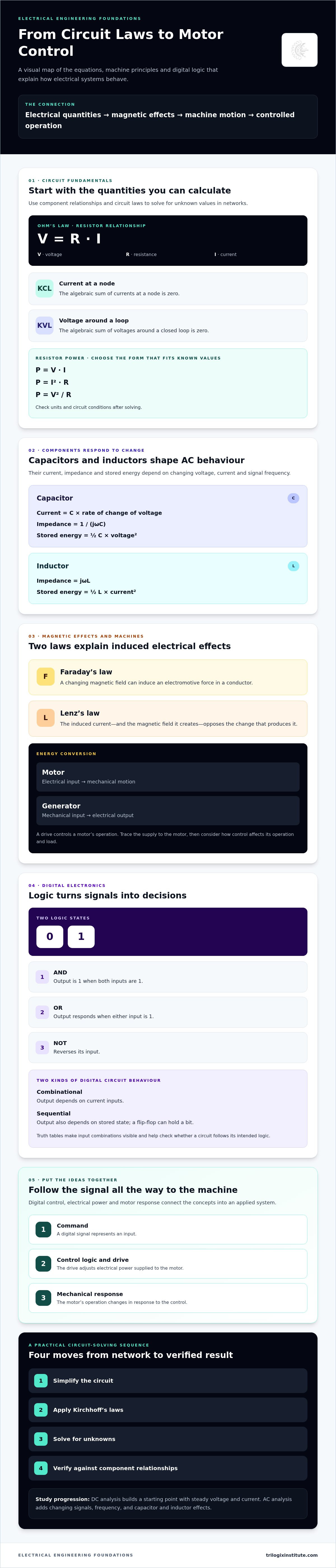
Electrical machinery converts energy through electrical and magnetic interactions, while a drive controls a motor’s operation. To study them, trace how electrical input relates to magnetic fields, motion, and load. Faraday’s law describes how a changing magnetic field can induce an electromotive force in a conductor. Lenz’s law explains that the induced current opposes the change that produces it, as does the magnetic field it creates.
For a focused study path, connect these laws to machine operation instead of memorising definitions. Stephen J. Chapman’s Electric Machinery Fundamentals is a reference on electrical machines. Use its examples to identify the machine, the relevant electrical quantities, and how changing conditions affect its behaviour. For drive problems, trace the path from supply to motor and consider how control affects operation.
Circuits, Devices, and Electromagnetics
Circuit analysis starts with relationships that help you calculate unknown quantities. For a resistor, Ohm’s law is V = R·I. Kirchhoff’s current law states that the algebraic sum of currents at a node is zero; Kirchhoff’s voltage law states that the algebraic sum of voltages around a closed loop is zero. Together, these rules help analyse circuits with multiple components and branches.
Component behaviour also changes with time and signal frequency. A capacitor’s current equals its capacitance multiplied by the rate of change of voltage, and its impedance is 1/(jωC). A capacitor stores energy equal to ½ its capacitance multiplied by voltage squared. An inductor’s impedance is jωL, and its stored energy equals ½ its inductance multiplied by current squared.
Analogue electronic circuit design applies these component relationships to continuously varying signals. In a design activity, trace the input, interactions between components, and output, then check whether the response matches the intended function. This connects device behaviour with electromagnetics and turns equations into practical analysis.
DC and AC Circuit Analysis
DC analysis is a starting point for solving networks with steady voltage and current. AC analysis also accounts for changing signals, frequency, and the effects of capacitors and inductors. For a resistor, calculate dissipated power as voltage multiplied by current, current squared multiplied by resistance, or voltage squared divided by resistance. Choose the formula that fits the known values, then check the units and circuit conditions.
Build the subject progressively: simplify a circuit, apply Kirchhoff’s laws, solve for unknowns, and verify the result against component relationships. The guide recommends mastering DC and AC circuit analysis using Alexander and Sadiku in Year 1, Semesters 1 and 2. Fundamentals of Electric Circuits by Charles K. Alexander and Matthew N. O. Sadiku is a primary text. Electric Circuits by James W. Nilsson and Susan Riedel is an alternative or supplemental source. For electronics, Thomas L. Floyd and David M. Buchla’s Electronics Fundamentals: Circuits, Devices & Applications provides another reference. Compare explanations and worked problems across sources, then practise analysis until each step is clear.
Digital electronics and electrical machines
Digital electronics represents information through two logic states, commonly written as 0 and 1. Electrical machines connect electrical behaviour with mechanical movement or energy conversion. Studying both helps a student understand how electronic decisions can control physical equipment, from a switching circuit to a motor-driven system.
Begin with logic gates. An AND gate produces an output when both inputs are 1, while an OR gate responds when either input is 1. A NOT gate reverses its input. A truth table makes each input combination visible, so students can test whether a circuit follows its intended logic before connecting that logic to a practical application.
Next, distinguish combinational logic from circuits that retain information. A combinational circuit’s output depends on its current inputs. A sequential circuit also depends on stored state, as with a flip-flop that holds a bit. Following the input, state, and output in order gives you a clear way to analyse digital behaviour without treating the circuit as a black box.
Electrical machines bring another relationship into focus. A motor converts electrical input into mechanical motion, while a generator converts mechanical input into electrical output. Compare the energy entering and leaving each machine, then identify how magnetic effects enable the conversion. This foundation connects equations to applications such as turning a shaft or generating a supply.
Control links the two areas. A digital signal can represent a command, while a drive adjusts electrical power supplied to a motor. For example, a control system can use an input signal to change motor operation. Trace the sequence from command, through control logic and drive, to mechanical response. This step-by-step view clarifies how innovation in electronics supports automated equipment across global industries.
Use reference texts to build knowledge across different parts of the subject. Thomas L. Floyd and David M. Buchla’s Electronics Fundamentals: Circuits, Devices & Applications covers electronics. Stephen J. Chapman’s Electric Machinery Fundamentals addresses electrical machines, while Richard C. Dorf and Robert H. Bishop’s Modern Control Systems is a reference on control systems. Compare examples by topic: devices, machines, then system control.
For a practical next step, connect each theoretical model to an application by sketching its signal path and identifying what changes at each stage. Explore electrical engineering course information to see how structured study can develop these foundations.
Engineering fundamentals and first-year study
First-year engineering develops the mathematical and scientific tools used to interpret technical problems. The foundation year in the Trilogix Institute electronic and electrical engineering programme includes calculus and mechanics. Calculus helps describe changing quantities, while mechanics examines forces and motion. Together, these subjects provide a framework for understanding how engineering models represent physical systems.
Use calculus to understand how a quantity changes, rather than treating equations as isolated exercises. For example, velocity describes how position changes, and acceleration describes how velocity changes. In electrical engineering, rates of change also help explain how signals vary over time. Build these skills by defining the quantity, identifying its relationship to other variables, and interpreting the result in context.
Mechanics adds a physical perspective. Consider a rotating shaft connected to a load: force, motion, and energy help describe how the system operates. This example connects electrical study with mechanical engineering instead of treating them as separate subjects. Sketch the system, label its moving parts, and identify the quantities that affect its behaviour. This process develops clear technical reasoning.
Strong study habits make learning these fundamentals more systematic. Work through each problem in sequence: identify what is given, choose the relevant principle, form the mathematical relationship, and check whether the answer makes physical sense. In a mechanics problem, for instance, draw a force diagram before calculating motion. For a changing signal, track how its value varies over time.
The degree pathway also shows how first-year subjects lead into later technologies. Signals & Systems and Electromagnetics are recommended concurrently or sequentially in Year 2, Semester 2. Signals & Systems develops ways to represent and analyse changing inputs; Electromagnetics studies relationships between electric and magnetic effects. These subjects build on mathematical reasoning and prepare students to interpret more advanced engineering systems.
Later study can deepen the connection between theory and equipment. Specialising in electrical machines and control systems is recommended in Years 3 and 4. That progression gives a student a route from calculus and mechanics toward analysing machine behaviour and system responses. For example, understanding motion first helps make the mechanical operation of a machine easier to model. Each stage adds a new layer of skills rather than replacing earlier fundamentals.
To prepare for this progression, practise explaining the reasoning behind each solution, not only reaching a final value. Use a diagram for forces, a labelled model for changing quantities, and a written interpretation of what the result means. These steps strengthen transferable analysis skills and help connect theoretical study with practical engineering applications across evolving global technologies.
Foundation-year electrical and electronic engineering degree
A foundation year can provide an academic route into an electrical and electronic engineering degree. The Dubai programme described here includes calculus and mechanics to prepare students for later technical subjects. The key decision is whether you want an academic pathway into a university degree or practical training focused on specific technical skills. These routes serve different goals and are not interchangeable.
Check how the foundation stage connects to the degree that follows. The full-time BEng (Hons) course lasts four years, starting September 2027, and the programme offers January and September start dates. Treat each date as an intake option, then map the subject sequence from foundational science into electrical and electronic engineering. A clear progression helps you understand where early mathematics and mechanics support later specialist study.
Entry requirements shape the application route. Applicants with A levels need three A levels, including Mathematics, with a typical offer of BBB to BCC. IB applicants need grades 5,5,4 at Higher Level, including Maths, and an overall score of 24. International and EU applicants require IELTS 6.0 overall, with at least 5.5 in each band for 2027/28 entry. Compare your qualifications against the relevant route before planning the application.
Budget planning depends on the intake and study mode. When comparing options, keep each entry date beside its corresponding annual fee. This avoids mixing figures from different intakes and makes the financial commitment easier to assess.
University study involves more than following lectures. Develop independent thinking by turning each lecture topic into a worked example, then explain why each step applies. In a calculus exercise, identify the changing quantity before choosing a method. In mechanics, sketch the forces before interpreting motion. These habits make your reasoning clear and help instructors identify gaps in your approach.
Later degree choices can shape the academic focus. In 2029/30, students select 40 credits of optional modules in the final year of the Dubai electronic and electrical engineering programme. The final-year Individual Research Project is worth a third of the student’s grade for that year. Consider how elective subjects and project work align with your interests, such as machine systems, electronics or control, while recognizing that final-year study requires sustained independent analysis.
Use the programme structure to decide whether this degree route matches your aims. A foundation year suits students who need an academic bridge to degree-level engineering; practical, instructor-led training serves a different purpose. Reviewing entry criteria, intake timing, tuition, and later study options gives you a concrete basis for planning your next step in the UAE.
Foundation-year engineering science and practical learning
The foundation-year Electrical and Electronic Engineering Practice module is worth 30 credits for 2027/28 entry. Its credit value signals a defined part of the academic programme, while its practice focus points to applying engineering ideas. Connect each science topic to a task: identify the principle, decide what to observe, then explain how the observation relates to the principle.
A structured activity makes the connection to practice concrete. Start with a brief describing a system, such as a motor-driven mechanism. Sketch its main parts, label the electrical input and mechanical output, and note what you need to understand. This breaks a broad engineering question into manageable steps: identify components, map their relationships, and interpret the system’s behaviour.
Engineering science supports this process by providing models of physical behaviour. For a mechanics task, draw the forces acting on a component before explaining its motion. For a changing electrical signal, describe what changes over time and how that affects the system. These examples distinguish observation from explanation: a measurement is evidence, while a model explains what it means.
Keep a clear record of practical work. Note the task objective, draw a labelled diagram, record observations in a table, and write a brief interpretation. If a result differs from the expected behaviour, review one step at a time: check the diagram, revisit the assumptions, then compare the observations with the model. This approach helps locate errors in your reasoning while preserving the evidence.
Practical learning also develops communication skills. A concise technical explanation names the system, describes the observed behaviour, and connects it to an engineering principle. For example, a report about a rotating mechanism can distinguish the motor’s electrical input from the shaft’s mechanical output. Accurate labels and a readable diagram make the relationship easier to assess.
When comparing foundation study options in the UAE, distinguish academic engineering science from applied technical training. A degree pathway develops theory alongside structured practice; vocational study focuses on targeted technical skills. Consider whether you want broad preparation for further study or direct engagement with specific equipment and tasks. To explore relevant course information, review electrical engineering course options.
Trilogix Institute: TTI Dubai Foundation Electrical Engineering
Trilogix Institute offers TTI Dubai Foundation Electrical Engineering for learners seeking a practical start in electrical engineering. It is a relevant next step if you want to develop foundational knowledge through vocational training rather than a university degree pathway. The course connects with topics discussed here, including circuits, electrical principles, and engineering fundamentals.
Choose this route when your goal is applied technical learning. For a related focus on motor control, Trilogix Institute also offers TITP Beginner Essential Industrial Motor Control. The courses serve different learning needs: one builds a foundation in electrical engineering, while the other focuses on beginner-level industrial motor control.
Explore the course and consider how it fits your learning goals by contacting Trilogix Institute or visiting trilogixinstitute.com.
Turn your interest into a learning plan
Decide what kind of progress you want: deeper academic study or practical, focused technical training. That distinction can help you choose a pathway suited to your goals and apply the foundation electrical engineering principles explored here with purpose.
For practical electrical training, Trilogix Institute offers TTI Dubai Foundation Electrical Engineering. Its wider course range also includes TTI Dubai Professional Culinary Arts and TTI Dubai Advanced AutoCad 2D & 3D, serving different learning interests. Focus on the option that best matches the skills you want to develop, then take time to understand how it fits your plans.
Contact Trilogix Institute about the course and take a considered next step toward building your technical knowledge. A clear learning goal can turn curiosity into steady progress.
Frequently Asked Questions
What’s covered in this course?
A course in foundation electrical engineering principles introduces concepts for understanding electrical systems and equipment. Topics can include circuit behaviour, electronic components, digital logic, electrical machines, mathematics, and engineering science. Trilogix Institute offers TTI Dubai Foundation Electrical Engineering as a vocational course. Use this guide’s topic list to identify what you want to learn and how it connects to your study plans or technical skills goals.
Who should attend?
This vocational course can suit people beginning technical study, recent graduates seeking applied learning, and professionals or technicians looking to strengthen their engineering knowledge. Studying foundation electrical engineering principles may be a good fit if you want structured learning about electrical concepts rather than a university degree pathway. Before choosing, define your goal: an introduction, preparation for further study, or practical technical skills. This will help you assess whether foundation-level learning fits your next step.
What are voltage, current, resistance, and power, and how are they related?
Voltage is the electrical potential difference that drives charge through a circuit; current describes the flow of charge. Resistance opposes that flow, while power describes the rate at which electrical energy is transferred or converted. For a simple resistor, Ohm’s law relates voltage, current, and resistance. Power can then be calculated from voltage and current. These quantities help explain, for example, why a component warms as it uses electrical energy.
What is Ohm’s law, and how is it used in circuit analysis?
Ohm’s law states that voltage equals resistance multiplied by current, written V = R·I. In circuit analysis, use it to find an unknown when the other two values are known. For example, if the voltage and resistance are given, divide voltage by resistance to calculate current. Compare the result with the circuit diagram and component values to catch a mismatch before continuing.
What are the differences between AC and DC circuits?
In a DC circuit, current flows in one direction with a fixed polarity. In an AC circuit, current periodically changes direction, and voltage varies over time. A battery-powered circuit is a familiar DC example; a household supply is an AC example. This distinction matters because capacitors and inductors respond differently as AC frequency changes, while basic DC analysis often assumes steady conditions.
How do series and parallel circuits behave?
In a series circuit, components share one current path, so the same current passes through each one. If a component opens that path, current stops throughout the series branch. In a parallel circuit, components connect across shared nodes and have separate paths. Compare a string of lights on one path with independent branches, where other components can continue operating if one branch opens.
What are Kirchhoff’s voltage and current laws?
Kirchhoff’s current law states that the algebraic sum of currents at a node is zero. Kirchhoff’s voltage law states that the algebraic sum of voltages around a closed loop is zero. Apply the current law at a junction to relate incoming and outgoing branch currents. Use the voltage law to account for rises and drops around a loop and solve circuits with multiple components.
What are the fundamentals of capacitors, inductors, and transformers?
A capacitor stores energy in an electric field and responds to changing voltage. An inductor stores energy in a magnetic field and responds to changing current. A transformer transfers electrical energy between windings through a changing magnetic field; the winding ratio determines how voltage changes between the primary and secondary sides. These devices support filtering, energy storage, and voltage conversion, with behaviour shaped by circuit conditions and signal frequency.


