

What if the course with the most impressive title isn’t the one that best prepares you for your next step? Choosing a vocational training institute means looking beyond the course name to how learning happens, which skills you’ll practise, and what the final certificate represents. Vocational study differs from an academic pathway, and practical quality can be hard to judge before you enrol.
Start with a clear occupational direction, then check whether the course content and teaching format fit that goal. This guide explains what vocational institutes offer, how to assess hands-on learning, and what to look for in course recognition and credentials. A certificate should not be treated as a guarantee of employment or a particular qualification. You’ll also see how instructor-led, equipment-based training can support technical learning, with Trilogix Institute’s Foundation Electrical Engineering program as one example. By the end, you’ll have a practical framework for comparing learning paths and choosing a sensible next step.
Key Takeaways
- Identify a specific work task or technical area before comparing course titles.
- Look for a learning sequence that combines instructor explanation, demonstration, guided practice, and feedback.
- Compare course outcomes, teaching format, opportunities to practise, and the information provided about credentials.
- When assessing a vocational training institute in Dubai, distinguish institute-level claims from details about the specific course you’re considering.
- Explore focused pathways, such as Foundation Electrical Engineering, in relation to your learning goals without assuming a particular career outcome.
What Does a Vocational Training Institute Offer?
A vocational training institute provides focused learning for a technical or professional field. Unlike general academic study, which may cover a broad subject area, vocational courses aim to develop defined skills through instruction and applied learning. A learner might study electrical engineering fundamentals, practise interpreting technical drawings, or develop skills in a professional field. The specific content depends on the program.
Vocational training develops targeted work skills; a university degree follows a broader academic pathway. Neither route is automatically right for everyone. Vocational education spans different fields and formats, as the overview of What is Vocational Education? illustrates. Courses may include instructor-led classes, practical exercises, or other learning formats. Course length, entry requirements, assessment methods, and credentials can also vary. Compare these details at course level, not just by provider description. Trilogix Institute’s vocational course information lets learners explore focused training options.
Who benefits from vocational training?
Vocational learning can suit beginners seeking a structured introduction, career changers building skills in a new field, and people aiming to develop or refresh occupational capabilities. The best fit depends on the work you want to understand or perform. Check the course prerequisites against your current knowledge, then consider whether its learning activities address your goal. Training can support skill development, but enrollment alone doesn’t guarantee a job, promotion, or particular career result.
How vocational courses differ from degree programs
Vocational courses typically concentrate on a defined skill area, with learning activities shaped around applying that knowledge. Degree programs generally cover a broader academic curriculum and may involve extended study across related subjects. The scope and learning methods differ, but one route doesn’t replace every purpose served by the other. Consider your target role, desired depth of study, and the credential you need. The vocational training versus university degree guide offers a further comparison.
For example, someone interested in electrical work might compare a focused foundation course with a broader academic program by checking the subjects covered, how learning is assessed, and the stated credential. This makes the decision more concrete: choose according to the knowledge and skills you want to develop, rather than assuming a course title or certificate represents the same scope everywhere.
How Practical Training Builds Job-Relevant Skills
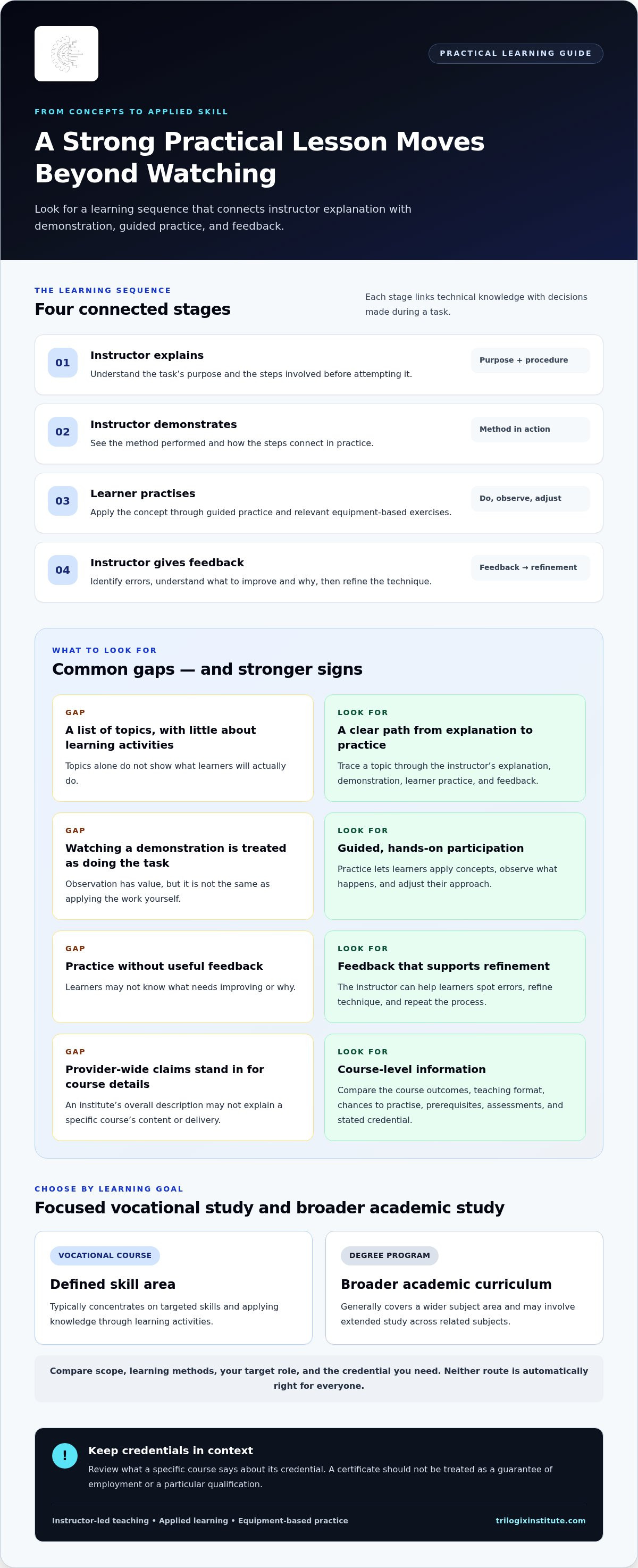
Practical training connects technical concepts with actions a learner can perform and explain. A useful lesson follows a clear sequence: the instructor explains the purpose and steps, demonstrates the task, then guides learners as they practise. Feedback helps learners spot errors and refine their technique before repeating the process. Each stage links knowledge with decisions made during a task.
Watching a demonstration has value, but it isn’t the same as doing the work. Reading can introduce terminology and procedures; guided practice lets learners apply them, observe what happens, and adjust. Equipment-based exercises can reflect realistic tasks without claiming to reproduce every workplace condition. In electrical engineering, for example, learners can connect foundational concepts with practical exercises and receive input on their approach.
Repeated guided practice turns instruction into observable skill development. Look for a course where learners do more than observe. Practice should be part of the teaching process, with feedback that explains what to improve and why.
What to look for in instructor-led learning
In instructor-led training, the educator can explain procedures, demonstrate methods, and correct errors as they arise. When reviewing a course, look for a clear description of how learners practise and receive feedback. Check whether teaching moves from explanation to demonstration and learner participation. Trilogix Institute combines instructor-led teaching with applied learning, connecting practice to the concepts being taught.
Why equipment-based practice matters
Relevant equipment gives learners a chance to rehearse technical tasks rather than only discuss them. In electrical engineering, practical exercises can help connect foundational principles with the way learners approach a task. The value lies in applying concepts and learning from feedback, not simply being present in a lab. For more context on applying this field of study, explore the electrical engineering course career-readiness guide.
To assess a course, trace a topic from explanation through demonstration, your own practice, and feedback. If the course description lists topics but says little about what learners do, look for details about its practical activities. This helps you judge whether the teaching and applied exercises suit your goal.
Trilogix Institute offers instructor-led training with equipment-based learning across technical fields. If electrical fundamentals align with your direction, explore the vocational course options and consider how the Foundation Electrical Engineering program fits your learning goals.
How to Compare Vocational Training Institutes
Compare specific courses, not just an institute’s overall description. A provider may teach across several fields, but that doesn’t tell you what a particular course covers, how learners practise, or what credential it leads to. Use the same criteria for each option to compare fit and delivery consistently.
| What to compare | What to look for |
|---|---|
| Course outcomes | Skills or tasks the course states learners will develop. |
| Teaching format | How instruction is delivered, such as instructor-led teaching or another stated format. |
| Practical work | What learners do themselves, and how practice connects to course outcomes. |
| Assessment | How learning is evaluated and whether assessment reflects the stated skills. |
| Credential information | The certificate or qualification awarded, its issuer, and any stated recognition details. |
Check course scope, practice, and assessment
Start with the skills you want to develop, then compare them with the course’s stated outcomes. A course that names a subject area broadly may not cover every task you have in mind. Look for a clear connection between learning objectives, practical activities, and assessment. For example, if a course describes technical drawing skills, its course information should help you understand what learners are expected to produce or demonstrate.
Separate specific course details from institute-wide statements. A general description of practical learning doesn’t prove that every course includes the same activities or assessment. Trilogix Institute’s course information and program overview help learners consider individual programs in relation to their intended direction.
Understand credentials and regulatory context
An institute is the provider; a course certificate records completion or achievement as defined by that course; an awarding body is the organisation that issues or oversees a qualification. These roles can differ. The UAE’s National Qualifications Center (NQC) is relevant to the country’s qualifications framework, commonly referred to as the National Qualifications Framework (NQF). The UAE government TVET overview provides broader context on technical and vocational education and training.
Recognition isn’t automatic because a course is vocational or offered by an institute. It depends on the specific qualification and its awarding arrangements. Read the credential wording carefully, including who issues it and what the stated outcome represents. When comparing options, record the precise qualification or certificate name rather than relying on general terms such as “certified” or “recognised.” This helps distinguish documented course outcomes from broader promotional claims. For learners comparing a vocational training institute in Dubai, that distinction matters as much as the subject itself.
How to Match a Vocational Course to Your Career Goal
Choose a course by working backward from the skill you want to build, not forward from the most appealing title. A broad goal such as “work in engineering” is difficult to compare with course descriptions. A target task or technical area gives you a clearer basis for assessing content, practice, prerequisites, and learning format. Use this process to narrow your options.
- Name a task or skill. Identify what you want to understand, practise, or perform. For example, are you exploring electrical fundamentals, technical drawing, motor control, or another area?
- Map it to a subject. Match the task to a technical or professional field, then shortlist courses whose stated content relates to that field.
- Compare course outcomes. Look for specific skills or learning outcomes, and consider whether the activities provide opportunities to practise them.
- Check your starting point and schedule. Review prerequisites and learner expectations. Consider the time you can commit and whether the teaching format fits how you want to learn.
- Make an informed enrollment decision. Compare course details and credential information, then decide whether the stated scope supports your learning objective.
Start with the work you want to learn
Turn an ambition into a practical learning question: “Which technical concepts do I need to understand?” or “What kind of task do I want to practise?” This helps you distinguish a genuine course fit from a title that merely sounds relevant. If your interest is electrical work, foundation electrical engineering may be a focused direction for building technical knowledge. It’s a learning pathway to consider, not a promise of a particular role or employment outcome.
Check readiness before choosing a course
Compare your current knowledge with the course’s stated prerequisites and expectations before enrolling. A beginner may need an introductory foundation, while someone with related experience may want to build on existing skills. Then consider schedule and format: instructor-led practice can suit learners who value structured teaching and applied activities, while the course’s stated timing and requirements should fit your availability.
Use published course information to assess fit. Look for details on topics, intended learner level, teaching format, practical components, assessment, and credentials. If a description leaves you unsure whether a particular outcome is included, don’t assume it from the title alone. This comparison is especially useful when reviewing a vocational training institute in Dubai, where programs can differ in purpose and scope.
Once you’ve identified a subject area and checked your readiness, explore Trilogix Institute’s course options and program details to compare focused learning paths with your goals.
Explore Trilogix Institute's Practical Training Pathways
Once you’ve identified a skill area and considered what kind of instruction suits you, compare those priorities with actual course options. Trilogix Institute provides instructor-led vocational training across technical and professional subjects, with applied instruction and equipment-based learning as part of its practical approach. Choose a course whose focus and format align with what you want to learn, rather than assuming training guarantees a particular job or career result.
Foundation Electrical Engineering is a focused option for learners interested in developing knowledge in the field. Assess it using the same criteria covered earlier: Does the subject match your learning objective? Does instructor-led teaching suit how you learn? Does the applied approach fit your expectations? Consider these points alongside the course’s published scope and credential information.
Explore Foundation Electrical Engineering
For a learner exploring electrical engineering, a foundation-level course can be a relevant starting point for focused study. It offers a route to engage with the subject through instructor-led learning and practical skill development, rather than serving as a promise of employment or a specific qualification outcome. Review the course details against your current knowledge and intended direction. The electrical engineering course career-readiness guide offers further context for considering study in this area.
Other training areas are separate pathways, not components of the electrical engineering program. Learners can also explore AutoCAD, industrial motor control, industrial automation, or professional culinary arts, each with its own subject focus. Comparing these areas can clarify whether your interest is in foundational electrical concepts, technical drawing, control systems, automation, or culinary skills. Let the task or knowledge you want to pursue guide your choice.
Take a clear next step
Before deciding, review the institute’s training approach and compare it with the specific course details. Focus on what the course covers, how instruction is delivered, where applied learning fits, and what credential information is provided. This keeps your decision grounded in the program itself rather than broad assumptions about vocational study.
If you’ve narrowed your interest to electrical engineering or another training area, contact Trilogix Institute about course pathways. Share the subject or skills you’re considering and use the course details to identify a learning direction that fits your goals. Understand the course scope and format before making an enrollment decision.
Turn Your Career Direction Into a Learning Plan
Your next step doesn’t need to settle your entire career. Start with one skill area you want to explore, then decide what evidence would help you judge whether a course fits: clear outcomes, a suitable learning format, and practice connected to your goals. This gives you a focused basis for moving forward without assuming a certificate guarantees a job or promotion.
As you consider a vocational training institute in Dubai, think about how you learn best and what kind of instruction will help you build confidence with a subject. Trilogix Institute provides instructor-led vocational training in technical and professional fields, with equipment-based practical learning as part of its approach. Consider whether these features align with your learning priorities.
Take a measured next step: explore the courses, compare their focus with your goals, and choose a pathway that makes sense for your current starting point. Explore Trilogix Institute's practical training programs and move forward with a clearer direction. Your learning plan can begin with one considered choice.
Frequently Asked Questions
What is a vocational training institute?
A vocational training institute provides focused learning for a particular occupation or technical field. Depending on the course, learners may study concepts, practise relevant activities, or combine both. For instance, someone interested in electrical engineering can look for training centred on that subject rather than a broad program in an unrelated discipline. Compare course outcomes and credential details to decide whether the scope fits your learning objectives.
How do I choose a vocational training institute?
Choose by matching a specific learning objective to the details of a particular course. Before comparing providers, write down one task or skill you want to develop, such as understanding technical drawings or practising a procedure. Then record each option’s outcomes, teaching format, assessment, prerequisites, and credential information. For a vocational training institute in Dubai, base your decision on course-level information rather than general descriptions alone.
Are vocational qualifications recognized in the UAE?
Recognition depends on the qualification, awarding arrangements, and applicable requirements, so don’t assume a course certificate has a particular status. The National Qualifications Center has a role in the UAE’s national qualifications framework and TVET sector. For a specific course, identify the exact credential, who awards it, and what the provider says it represents. A training institute and an awarding body may have different roles.
Can vocational training help me change careers?
Vocational training can help you develop focused knowledge and practical skills for exploring a new field, but it can’t guarantee a job or a successful career change. Start with a task you’d like to learn, then consider whether the course’s stated outcomes relate to it. Someone moving toward a technical field, for example, might first build foundational knowledge before deciding what further learning or experience their plans require.
What is the difference between vocational training and a university degree?
Vocational training generally targets defined occupational skills, while a university degree usually involves broader academic study within a discipline. The routes can differ in scope, assessment, duration, and credential, so compare actual programs rather than relying on labels. A focused course may suit a learner seeking targeted skill development; a degree may fit other academic or professional objectives. Choose according to your intended direction and learning needs.
Is hands-on training better than online learning?
Neither format is best for every learner or subject. For practical technical skills, equipment-based activities let learners rehearse tasks and apply concepts with instruction and feedback. Online learning may suit goals that rely more on flexible access to information. Compare the format with the skill you want to acquire: consider whether learning it requires performing a task, interpreting a result, or practising a technique.


