

What if a career change at 40 to a technical field didn’t mean starting from zero? Your experience solving problems, coordinating work, or understanding an industry can give you useful context for technical roles. Still, it’s reasonable to wonder whether employers will favour candidates with technical experience, or whether retraining will demand a degree and a complete career reset.
A practical transition starts with a specific target, not guesswork. Match your strengths and interests to a technical direction, then identify the foundational skills that role calls for. Electrical engineering, industrial automation, motor control, and AutoCAD involve different tasks, so a pathway connected to what you already know can make your next steps more focused.
This roadmap will help you assess your transferable skills, compare technical pathways, and build a manageable learning plan. You’ll also see how instructor-led, equipment-based training can help you develop practical foundations, including through Trilogix Institute’s electrical engineering, industrial automation, motor control, and Advanced AutoCAD 2D & 3D training. The goal isn’t to erase your past experience. It’s to put it to work while testing your next move one step at a time.
Key Takeaways
- A career change at 40 to a technical field can build on your existing strengths rather than require a complete professional reset.
- Compare electrical engineering, industrial automation, motor control, and CAD by the tasks and learning styles each involves.
- Use a focused self-assessment to distinguish skills you already have from technical capabilities you’ll need to develop.
- Break the transition into manageable steps: research roles, map skill gaps, practise, and document your progress.
- Structured, hands-on training can help establish technical foundations. Your next career move will still depend on role requirements and demonstrated ability.
Career change at 40 to a technical field: why your experience still counts
It’s understandable to worry that employers will favour younger applicants, experienced technicians, or candidates who already know the language of a technical workplace. Starting over can also feel daunting when you’re balancing work, family commitments, and unfamiliar material. But a career change at 40 to a technical field doesn’t mean discarding your previous experience. It means identifying what carries over, then building the technical knowledge the new role requires.
Career changes can involve practical and personal challenges as well as new opportunities. The general overview of Career Change offers useful context, but your transition needs a specific target: the role, its required skills, and the evidence you can build to show your readiness.
What changes, and what carries over, in a midlife career pivot?
Some knowledge is tied to your current industry. A process, customer base, or set of tools may not transfer directly to electrical engineering, industrial automation, motor control, or CAD drafting. Other capabilities can travel with you. Planning tasks, communicating clearly, documenting decisions, and working reliably with a team can support technical work across industries.
Consider someone who has coordinated maintenance schedules or handled customer requests. Their planning and communication habits may help them follow a technical workflow, record issues clearly, or understand how a delay affects operations. A background in manufacturing, facilities, or another hands-on environment may also provide familiarity with equipment and workplace procedures. These are useful starting points, not proof of technical competence.
Technical roles still require role-specific knowledge and practice. An employer may expect familiarity with particular drawings, systems, tools, or safety procedures. Treat your past experience as context that can help you learn and contribute, while building and demonstrating the skills the role calls for.
Is 40 too late to learn technical skills?
No. Age alone doesn’t determine whether you can learn a technical skill. What matters in practice is choosing a skill relevant to your goal and finding a workable way to learn, practise, and assess progress. Confidence may take time to catch up with effort, especially when the subject feels unfamiliar. Break learning into clear steps rather than assuming you can’t do it.
Be realistic about the conditions around your transition. Time, finances, family responsibilities, and the energy available after work all affect how quickly you can study. Set a modest weekly commitment you can maintain, then review it after a few weeks. A steady routine is more useful than an ambitious schedule that collapses when life gets busy.
Use milestones that show progress: explain a core concept in your own words, complete a guided exercise, or identify where you need more practice. Instructor-led, equipment-based learning can provide structure for building foundational capabilities in areas such as electrical engineering or motor control. It develops skills, but it doesn’t replace every employer requirement or guarantee a job. Your age is one part of your story; your demonstrated ability and fit for the role matter too.
Technical fields to consider: electrical engineering, automation, and CAD
Technical work isn’t limited to software and digital roles. Electrical engineering, industrial automation, motor control, and CAD offer different ways to work with systems, equipment, and technical information. Compare the day-to-day tasks and learning involved before choosing a direction. These are starting points for research, not complete occupational profiles or guarantees of a particular job.
Use this comparison to identify what you’d like to explore further:
- Electrical engineering foundations: Build understanding of core electrical concepts and their practical applications. Learning may combine principles with equipment-based practice. Roles can vary in how much design, testing, or field work they involve.
- Industrial automation: Explore how industrial systems and equipment are coordinated and controlled. The work may involve understanding how components interact, with learning focused on systems and their operation.
- Industrial motor control: Focus on how motors are controlled within equipment and processes. This is more specific than broad electrical foundations, with practical learning centred on control concepts and related equipment.
- CAD drafting: Use computer-aided design tools such as AutoCAD to create and interpret technical drawings. Learning is drawing-focused, with attention to representing technical information clearly and accurately.
Work settings and entry requirements differ by employer and role. A position involving technical drawings may prioritise drafting capability, while equipment-focused work can call for relevant practical knowledge. Review current job descriptions in the UAE for the specific roles you’re considering, and note which skills appear consistently.
How do hands-on engineering and automation pathways differ?
Electrical engineering foundations introduce core concepts that can help you understand electrical systems. The U.S. Bureau of Labor Statistics on Electrical and Electronics Engineers describes duties and occupational information for those roles. It’s a useful reference point, though requirements in the UAE and at individual employers can differ.
Automation and motor control narrow the focus toward equipment, systems, and control tasks. They can overlap with electrical knowledge, but they aren’t interchangeable: a foundation in electrical concepts doesn’t by itself demonstrate capability in automation or motor control. Consider whether you’re drawn to broad principles, how systems work together, or the specific control of motors. Each choice points toward different skills to practise.
Could CAD drafting be a better technical starting point?
CAD may suit you if you enjoy precise visual work, interpreting specifications, and turning information into clear drawings. Compared with equipment-based electrical or automation practice, drafting centres more on design software and technical representations. That distinction can help you test your preferences before committing to a pathway. Trilogix Institute’s Advanced AutoCAD 2D & 3D training is one route to develop drafting skills; the course doesn’t replace employer-specific requirements.
There’s no universal best entry point. Match your interests to the tasks, then compare that shortlist with job postings and the capabilities employers request. This turns “technical work” into a specific direction you can investigate and prepare for.
How to choose a technical direction without starting from zero
A good career choice starts with evidence about the work, not assumptions about what someone your age can or can’t do. For a career change at 40 to a technical field, compare three things: what holds your interest, what your previous work has prepared you to do, and what the target role still requires you to learn. This keeps the decision grounded while leaving room to develop new skills.
Try this quick self-assessment. Write down your answers, then look for patterns rather than expecting one perfect match:
- Tasks: Do you prefer drawing and precision work, investigating how equipment operates, or following a process to find a fault?
- Work setting: Would you rather spend more time at a computer, working with equipment, or communicating across a team?
- Existing strengths: Which tasks have you handled well, such as following procedures, using tools, coordinating work, or explaining technical information?
- Learning style: Do you learn best by observing a demonstration, practising a task, or studying concepts before applying them?
- Constraints: How much time can you reliably make for learning alongside your current responsibilities?
These preferences help you compare pathways without treating any strength as a replacement for technical competence. A drawing-focused route, for example, has different tools and practice demands from equipment-based electrical or automation work. Let your preferences guide the shortlist, then use the role’s actual requirements to guide your preparation.
Which parts of your past work can support a technical move?
Review recent work and list specific tasks involving troubleshooting, procedures, tools, records, or technical communication. Perhaps you followed a maintenance checklist, explained a fault to a colleague, documented a process, or used equipment safely. If you’ve worked in an industry such as manufacturing or facilities, your familiarity with its operations may help you understand the context of technical work there. Describe these experiences precisely. They can strengthen your profile, but they don’t establish skills you haven’t yet practised.
How can you test a path before committing?
Start with real job descriptions for roles in the UAE that interest you. Collect recurring tasks, tools, qualifications, and experience requirements. Separate them into two groups:
- Entry requirements: Qualifications or capabilities stated as necessary for the roles you’re targeting.
- Skills to develop: Tools or tasks you can build through instruction and deliberate practice, then demonstrate with relevant evidence.
Next, try an introductory activity that resembles the work. For a CAD direction, practise interpreting a simple drawing or completing a guided drafting exercise. For an electrical or automation interest, begin with a foundational concept or instructor-led practical activity. Notice whether you enjoy the subject and whether the method, pace, and setting fit your circumstances.
Hiring expectations vary by employer, and age alone can’t predict an outcome. Use job requirements to identify skill gaps and show how your previous experience connects to the role. If your first test feels engaging and the learning demands are manageable, you have a stronger basis for deciding what to pursue next.
A practical transition plan: from skill gaps to demonstrated ability
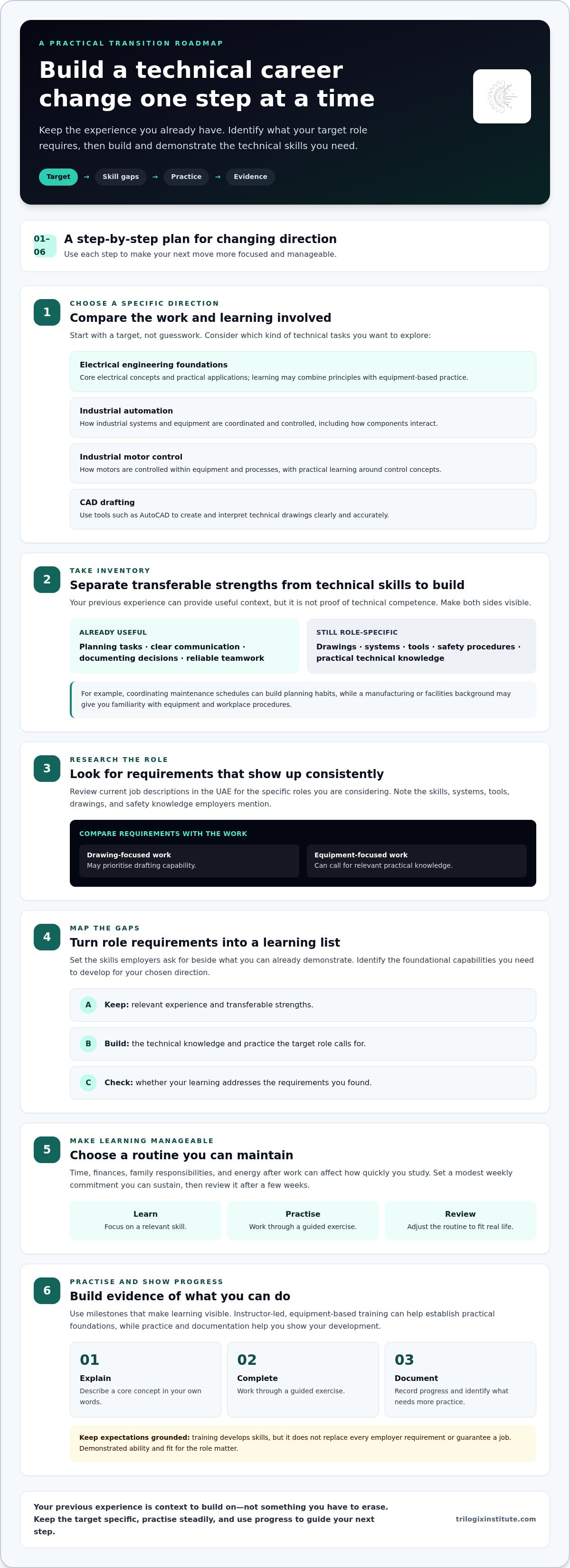
A career change becomes easier to manage when you treat it as a sequence of decisions and practice, rather than one leap. For a career change at 40 to a technical field, focus on building capability you can explain and demonstrate, while keeping the learning commitment realistic alongside your existing responsibilities.
- Research roles. Choose a target direction and review current job descriptions in the UAE. Note recurring tasks, tools, qualifications, and experience requirements, distinguishing essentials from preferences.
- Identify skill gaps. Compare those requirements with what you can already do. List specific gaps, such as interpreting technical drawings, understanding electrical concepts, or practising control tasks. Avoid vague goals like “learn engineering.”
- Choose relevant training. Select instruction that addresses the foundations and practical tasks your target requires. Instructor-led, equipment-based learning can provide structured practice in technical subjects, though it may not cover every employer’s requirements.
- Practise consistently. Set a study routine that fits your schedule and break skills into achievable milestones. A short, repeatable practice session is more useful than an intense plan you can’t sustain.
- Document progress. Keep a record of exercises, drawings, troubleshooting notes, and concepts you can now explain. Review it against the skills in your target job descriptions and use it to decide what to practise next.
What should a technical learning plan include?
Build your plan around one direction first. For example, if you’re exploring CAD, a milestone might be completing a guided drawing exercise and explaining the choices you made. For an electrical or motor-control pathway, milestones could focus on understanding a foundational concept, following a demonstration, and completing a related practical exercise. Keep each step specific enough to review.
Schedule practice and review at a pace you can maintain. At regular intervals, ask: Which task can I now complete with less guidance? What still needs repetition? Which requirement from job descriptions remains unmet? These questions track skill development more usefully than comparing your progress with someone else’s age or timeline.
How can you show employers what you have learned?
For each practice task, note its purpose, the steps you followed, and the reasoning behind your decisions. Save suitable drawings or completed exercises, and write troubleshooting notes that describe the issue and how you approached it. Keep examples accurate and clearly label them as learning work, not professional assignments.
Your previous experience can add context. A CV can show relevant reliability, communication, or problem-solving through concise examples, while a separate skills section identifies training and technical practice. Be precise about the difference between learned capability and paid work experience. That clarity helps employers assess your profile against the actual role.
Training can strengthen your technical foundation, but it can’t guarantee interviews, hiring, or a particular career outcome. To build practical skills through structured technical learning, explore Trilogix Institute’s technical courses.
Build technical foundations through practical, instructor-led training
Once you’ve identified a target role and its skill gaps, structured training can give your learning a clear sequence. Instructor-led teaching introduces technical concepts and provides direction as you work through them. Equipment-based practice helps connect those concepts to tools, systems, and procedures. Together, they offer a practical way to develop foundations, particularly if you learn best by seeing a task demonstrated and then working through it yourself.
Practice also creates opportunities to notice where your understanding is incomplete. An instructor can help clarify a concept or point out where a procedure needs closer attention. That feedback can guide what to practise next. It doesn’t make learning effortless, but it can make your practice more purposeful than studying concepts without a clear way to apply them.
What does equipment-based technical learning add?
Technical knowledge needs application. In a guided learning environment, a concept can be followed by a related exercise using equipment or technical tools. That connection helps you understand not only what a term means, but how it relates to a task or system. Repeating an exercise and reviewing your approach can also help you identify mistakes before they become habits.
Vocational training and university degrees serve different educational purposes. A focused course can support practical skill development, while a degree follows a broader academic pathway. Neither automatically satisfies every employer’s requirements. Choose a learning format based on the skills you need, the way you learn, and the qualifications required for your target roles.
How can Trilogix training fit into a career-change plan?
Use training as one step in a larger transition plan: research roles, identify recurring requirements, then select instruction that aligns with the specific skills you need to build. Trilogix Institute provides instructor-led, equipment-based vocational training for practical skill development. Its courses are vocational training rather than university degree programs, and completing a course doesn’t guarantee an interview or a particular career outcome.
Choose a direction that matches your research rather than enrolling in every subject at once. Foundation Electrical Engineering can support learning core electrical concepts. Essential Industrial Motor Control focuses on a distinct technical area, while industrial automation offers another pathway to explore. For drawing-focused work, Advanced AutoCAD 2D & 3D develops a different set of technical capabilities. Treat these as separate learning directions, then compare each with the tasks and skills in relevant job descriptions.
As you study, keep track of concepts covered and exercises completed. Use that record to identify what you can explain or demonstrate and what needs more practice. It can also help you assess whether the subject and learning approach fit your schedule before deciding on your next step.
Explore Trilogix Institute’s technical courses to find training relevant to the direction you’re considering.
Make your next move a deliberate one
A career change at 40 to a technical field doesn’t need to begin with a dramatic leap. Start with one decision you can act on: select a direction to investigate, identify the capability you want to build, and decide how you’ll make room to practise it. A focused first step can turn uncertainty into useful information about the work and your own fit for it.
Learning is an investment in capability, not a promise of a particular hiring outcome. Choose training that gives you a structured way to develop practical skills and connect learning to the demands of roles you’re considering. Trilogix Institute offers instructor-led, equipment-based vocational learning in electrical engineering, industrial motor control, industrial automation, and AutoCAD.
Explore practical technical training at Trilogix Institute and identify a learning direction that supports your next step. Your experience remains part of your foundation, and you can build from it with purpose.
Frequently Asked Questions
Is 40 too old to start a career in a technical field?
No. Age alone doesn’t determine whether you can learn technical skills or pursue a new role. A career change at 40 to a technical field is more manageable when you test your interest with a small, relevant task before making a major commitment. For example, try a basic drawing exercise or introductory electrical concept, then assess whether you enjoy the work and can make time for further learning.
Can I enter a technical field at 40 without a degree?
Possibly, depending on the role and the employer’s stated requirements. Some technical positions require a specific degree or qualification, while others may place more emphasis on relevant training and demonstrated capabilities. Read job descriptions for the roles you want, and note which qualifications are essential rather than preferred. Vocational training can build practical foundations, but it doesn’t replace a degree where an employer requires one.
What technical field is easiest to switch into at 40?
There’s no single easiest path for everyone. CAD may appeal if you enjoy precise computer-based drawing, while electrical engineering foundations, motor control, and industrial automation involve different concepts and practical tasks. Your previous experience, interests, and the requirements of roles you’re targeting all affect the fit. Rather than choosing by reputation, compare actual job duties with a small introductory learning activity in each area you’re considering.
How do I change careers to a technical field at 40?
Start by choosing one role to investigate, then examine job postings to understand its common tasks, tools, and qualifications. Identify what you can already demonstrate and what you need to learn. Set a realistic study routine, complete relevant practice activities, and keep examples of your work. Before applying, tailor your CV to the role and describe your training accurately, distinguishing learning exercises from professional experience.
Can my experience in a non-technical job help me get a technical role?
Yes, if you connect it clearly to the work you’re pursuing. For example, experience scheduling maintenance may show familiarity with operational priorities; handling customer issues could demonstrate clear communication under pressure. Use specific examples to explain what you did and the result, then pair them with evidence of your technical learning. Transferable experience adds context to your application, but it doesn’t replace role-specific skills.
Do I need to quit my current job before retraining?
No. You can often begin exploring a technical direction while remaining employed, which may help you manage income and other responsibilities during the learning stage. Consider a weekly schedule you can sustain, such as setting aside regular study periods around work and family commitments. Before making a larger change, review your budget, available time, and the qualifications required for target roles. Avoid assuming that training will lead to a particular job outcome.


