

If you hold a university degree but still feel unprepared to troubleshoot a live industrial motor, you aren't alone; you're simply facing the "theory gap" that stalls many careers in the UAE. Most aspiring engineers believe that years of academic study are the only path to a stable career. However, the reality of the 2026 job market is that employers prioritize immediate on-site performance over textbook knowledge. This guide explores how specialized electrical engineering courses across the UAE can bridge that divide, transforming you from a student into a technical expert.
We understand the frustration of knowing the math but not the machinery. This article promises to show you how to transition from abstract concepts to technical mastery using hands-on training designed for the current industrial landscape. You'll learn which certifications UAE employers actually value and how to gain control over industrial automation and motor systems. We will preview the essential skills required for DEWA-compliant installations and the most efficient route to becoming job-ready for high-demand technical roles across the Emirates.
Key Takeaways
- Identify how vocational training bridges the gap between academic theory and the practical demands of the UAE industrial sector.
- Learn to navigate the progression from basic circuitry to complex systems through the TTI Dubai Foundation Electrical Engineering program.
- Discover why the best electrical engineering courses in Dubai prioritize instructor-led sessions with real-world equipment over purely digital simulations.
- Assess your technical baseline and career goals to choose between maintenance-focused roles or advanced automation specializations.
- Understand the importance of KHDA-aligned training to ensure your skills meet the high standards required by UAE employers and regulators.
Understanding Electrical Engineering Vocational Training in the UAE
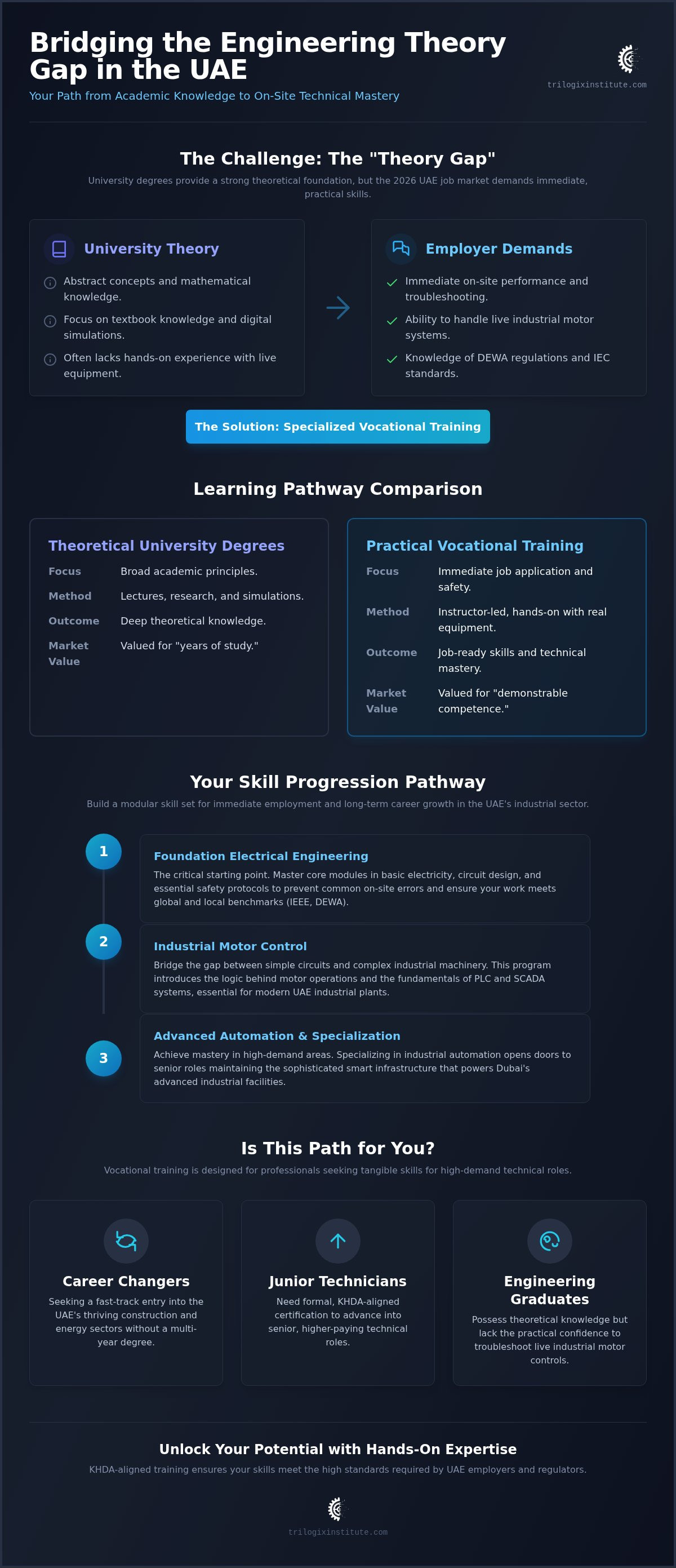
Vocational training in the UAE isn't a substitute for academic study; it's the necessary practical evolution of it. While Electrical engineering as a discipline covers everything from microscopic circuitry to massive power grids, vocational training focuses on the immediate application of these principles in a job setting. It's skill-based, job-ready instruction that prepares you to handle live equipment safely and efficiently. In a city like Dubai, where the infrastructure is evolving at a rapid pace, the demand for technicians who can perform on day one is at an all-time high.
Unlike self-paced online modules that rely on simulations, professional electrical engineering courses in Dubai emphasize instructor-led sessions. You can't learn the tension of a wire or the specific tactile feedback of a correctly seated circuit breaker through a mouse click. Real-world mastery requires real-world hardware. This is especially true when working within the strict framework of UAE technical standards. All installations must align with the Dubai Electricity and Water Authority (DEWA) regulations and international standards like the IEC 60364 series. Training that ignores these local specifics leaves you unqualified for the local market.
The Role of Technical Certification in 2026
By 2026, the UAE recruitment landscape has shifted away from valuing "years of study" toward "demonstrable competence." Technical certifications serve as a verified proof of your ability to execute tasks according to safety and efficiency protocols. They validate your on-site performance before you even step into a mechanical room. For those aiming for high-level roles in industrial automation, these foundational certifications aren't optional; they're the prerequisite for mastering complex logic controllers and motor systems.
Who Should Pursue Vocational Engineering Courses?
The path toward technical mastery is open to various professional backgrounds. High-quality electrical engineering courses in Dubai provide the specific tools needed for several distinct groups:
- Career Changers: Individuals looking for a fast-track entry into the UAE's thriving construction and energy sectors without spending years in a lecture hall.
- Junior Technicians: Workers who have picked up skills on the job but need a formal certification to move into senior, higher-paying roles.
- Engineering Graduates: Recent alumni who have the theoretical math down but lack the confidence to troubleshoot physical industrial motor controls.
Key Specializations: From Foundation to Industrial Automation
The path to becoming a senior technician in the UAE isn't a single jump; it's a series of deliberate steps. Career growth depends on mastering specific domains that match the needs of Dubai's rapid industrialization. By choosing focused electrical engineering courses in Dubai, you can build a modular skill set that allows for immediate employment in specialized technical roles. This progression ensures you aren't just learning isolated facts but are building a comprehensive toolkit for the job market.
Foundation Electrical Engineering: The First Step
The TTI Dubai Foundation Electrical Engineering course acts as the critical entry point for any aspiring professional. This program covers the core modules of basic electricity, safety protocols, and circuit design. It's a pragmatic approach to learning. A strong foundation prevents the common on-site troubleshooting errors that frequently plague junior staff. These errors aren't just technical; they're safety risks. By understanding the underlying physics and safety standards recognized by the Institute of Electrical and Electronics Engineers (IEEE), you ensure your work meets global and local benchmarks. Once you've mastered the foundation, the transition to advanced motor controls becomes significantly more intuitive.
Mastering Industrial Motor Control and Automation
Industrial facilities in the UAE are increasingly reliant on automated systems. The TITP Beginner Essential Industrial Motor Control program is designed to bridge the gap between basic circuitry and complex system orchestration. It introduces students to the logic behind motor operations and the basics of PLC and SCADA systems. This knowledge is essential for maintaining the smart infrastructure found in modern UAE industrial plants. Specializing in Industrial Automation doesn't just improve your technical capability; it directly increases your earning potential. Specialists are needed to manage the high-tech environments that drive Dubai’s economy.
Design proficiency is another vital layer of technical mastery. Integrating TTI Dubai Advanced AutoCad 2D & 3D into your training allows you to interpret and create the complex electrical layouts required for MEP projects. This skill set is highly valued in the construction and facility management sectors. If you want to see how these modules fit your career path, you can view the full curriculum at Trilogix Institute to find your starting point. Industrial Automation Specialization is the ultimate goal for those seeking to lead technical teams in 2026.
Practical Hands-On Training vs. Theoretical University Degrees
Choosing between a university degree and vocational training depends entirely on your career timeline. While accredited university electrical engineering programs provide an exhaustive scientific foundation, they often require a four-year commitment before you ever touch a live circuit. Vocational electrical engineering courses in Dubai offer a pragmatic alternative. The "Equipment-Based" model prioritizes functional mastery over abstract math, allowing students to enter the workforce in months rather than years. Employers in the UAE's industrial sector don't just ask what you know; they ask what you can do.
The Equipment-Based Advantage
True competence comes from handling real hardware. Learning on real-world switchgear, industrial motors, and control panels builds a level of confidence that a textbook cannot provide. This tactile learning approach is vital for understanding complex concepts like voltage regulation and phase sequencing. When you physically interact with the components, the theory becomes visible. Beyond that, supervised lab practice is a critical safety measure. It allows you to make mistakes and receive immediate correction in a controlled environment, which significantly reduces the risk of on-site accidents later.
Instructor-Led Learning in a Digital Age
Digital simulations have their place, but they lack the nuance of a physical lab. In 2026, the market is flooded with pre-recorded videos that offer no path for clarification. Instructor-led electrical engineering courses in Dubai provide real-time feedback that is essential for technical precision. If a connection is loose or a component is failing, an expert instructor can explain the physical signs that a computer screen would miss.
Peer collaboration in a physical lab environment also prepares you for the reality of the UAE workplace. You learn to communicate technical issues and solve problems as a team, mirroring the environment of a modern industrial plant. TTI instructors act as industry insiders, bridging the gap between theoretical standards and the daily realities of the field. They don't just teach the "how"; they emphasize the "why," ensuring you are prepared for the unpredictable nature of on-site technical roles.
How to Choose the Right Electrical Engineering Course for Your Career
Selecting from the various electrical engineering courses in Dubai requires more than just looking at a course title. It demands a strategic assessment of where you are now and where the UAE market is headed. Many institutes present exhaustive catalogs that lead to choice paralysis. Instead of browsing blindly, begin by evaluating your current technical baseline. If your math skills are strong but your tool handling is weak, you need a program that emphasizes physical lab time over classroom lectures. For working professionals, scheduling is equally critical; look for institutes that offer evening or weekend sessions to accommodate your current employment.
Your target job role should dictate your curriculum. A Maintenance Technician needs deep familiarity with industrial motor controls, while an aspiring Design Engineer must prioritize advanced CAD proficiency. Before enrolling, verify the institute's accreditation, specifically checking for KHDA approval status in 2026. Reputation in the UAE technical sector is built on the quality of graduates and the relevance of the equipment they trained on, not just the name on the certificate. Always ask to see the lab facilities before committing your time and resources.
Matching Course Modules to UAE Job Descriptions
Modern technical recruitment in the Emirates relies on specific keywords and standards. Scan local job postings for roles in MEP (Mechanical, Electrical, and Plumbing) or industrial maintenance. You'll likely see requirements for knowledge of DEWA regulations and proficiency in TTI Dubai Advanced AutoCad 2D & 3D. Ensure your chosen course doesn't just teach general engineering but aligns with these local standards. Being able to interpret a 3D electrical layout is now a standard expectation for mid-level technical roles across Dubai's construction and facility management sectors.
Red Flags When Selecting a Training Center
Pragmatic learners must be wary of digital-only promises. A major red flag is a training center that relies solely on software simulations. While software is a vital tool, it can't replicate the physical resistance of a terminal block or the specific sound of a failing relay. Avoid certificate mills that offer a qualification without a rigorous, instructor-led assessment. Finally, check for updated industrial equipment. If the lab gear is outdated, your training won't prepare you for the smart-city infrastructure and automation systems currently being deployed across the UAE.
To ensure your chosen path aligns with current industry demands, book a career consultation at Trilogix Institute to discuss your technical baseline.
Trilogix Institute: Instructor-Led Technical Training for the UAE Workforce
Trilogix Institute (TTI) operates as a specialized vocational hub in Dubai with a single mission: to bridge the gap between academic theory and technical employability. While many electrical engineering courses in Dubai prioritize digital simulations, TTI focuses on instructor-led, equipment-based mastery. This approach ensures that students don't just understand the physics of electricity but can safely and efficiently manage the hardware that powers the UAE's infrastructure. Our campus is designed to mirror the actual industrial environments you'll encounter on the job, making the transition from student to technician seamless and predictable.
The "Trilogix Way" is built on a foundation of pragmatism. We view education as a functional tool for career advancement rather than a purely academic pursuit. This is why our curriculum is modular and highly focused. By enrolling in the TTI Dubai Foundation Electrical Engineering program, you gain the essential skills required for entry-level roles. From there, you can progress to specialized modules like the Industrial Automation Specialization. This structured path allows you to build a professional portfolio of "demonstrable skills" that UAE employers actively seek in technical recruitment.
Specialized Labs and Real-World Equipment
Our Industrial Automation and Motor Control labs are the core of the TTI experience. Students work directly with real-world switchgear, control panels, and PLC systems. To ensure every participant receives the necessary attention, we maintain a low instructor-to-student ratio. This personalized coaching allows for real-time feedback and immediate correction of technical techniques. TTI's equipment-based model serves as the definitive standard for vocational excellence in 2026, ensuring every student masters the physical complexities of modern infrastructure.
Next Steps: Enrolling in TTI Dubai Programs
The application process at Trilogix Institute is designed to be straightforward and accessible. We offer flexible learning paths that accommodate both career changers looking for a fast-track entry and working professionals needing to formalize their experience. Whether you're starting with the TITP Beginner Essential Industrial Motor Control program or looking to master design through TTI Dubai Advanced AutoCad 2D & 3D, our advisors help you map a curriculum that fits your specific career goals. We don't just teach theory; we prepare you for the reality of the UAE workforce.
Transform your career with Trilogix Institute today.
Mastering the UAE Technical Landscape
The transition from a theoretical understanding of circuitry to on-site technical mastery is the defining step of a successful engineering career in the Emirates. As we've explored, the 2026 job market rewards those who can demonstrate immediate competence with industrial hardware and DEWA-aligned standards. By prioritizing specialized electrical engineering courses in Dubai, you move beyond the limitations of a lecture hall and into the high-demand sectors of automation and motor control.
Trilogix Institute provides the pragmatic, equipment-based training necessary to bridge this gap. Our instructor-led labs utilize real industrial equipment, ensuring your learning is directly transferable to the workplace. With a curriculum delivered by expert, industry-active faculty, you'll gain the vocational skills required to troubleshoot complex systems with confidence. It's time to stop studying abstract concepts and start building your technical future in a city that never stops growing.
View TTI Dubai Course Schedules and Enroll Today
Your journey toward becoming a recognized technical expert starts with a single, practical step. We're ready to help you take it.
Frequently Asked Questions
What are the best electrical engineering courses in Dubai for beginners?
The TTI Dubai Foundation Electrical Engineering program is widely considered one of the best electrical engineering courses in Dubai for beginners. It prioritizes practical competence over abstract math, allowing newcomers to master basic circuitry and safety protocols quickly. This instructor-led approach ensures you build confidence with live hardware from day one, preparing you for immediate entry into the technical sector.
Do I need a university degree to work as an electrical technician in the UAE?
You don't need a four-year university degree to secure a role as an electrical technician in the UAE. While engineering design roles often require degrees, the industrial and construction sectors actively recruit technicians with vocational certifications. These certifications prove you have the demonstrable skills needed to handle on-site maintenance and installations safely according to local regulations.
How long does a foundation electrical engineering course typically take?
Foundation courses are designed for efficiency, typically requiring a fraction of the time needed for a university degree. Most vocational programs focus on high-intensity modules that get you job-ready in months rather than years. This fast-track model is ideal for career changers who need to enter the UAE workforce quickly without the long-term commitment of academic study.
Is AutoCAD 2D & 3D training necessary for electrical engineers?
Proficiency in AutoCAD is now a standard requirement for electrical engineering roles in Dubai's construction and MEP sectors. TTI Dubai Advanced AutoCad 2D & 3D training allows you to interpret complex electrical blueprints and design system layouts. Without these skills, transitioning into design or supervisory roles within the UAE's modern infrastructure projects is significantly more difficult.
What is the difference between PLC training and industrial motor control?
Industrial motor control focuses on the physical hardware used to start and protect motors, while PLC training covers the logic and automation software. You generally need a solid understanding of motor control before moving into PLC systems. Mastering both allows you to manage the entire lifecycle of industrial automation currently being deployed across modern UAE facilities.
Are Trilogix Institute certifications recognized by UAE employers?
Trilogix Institute certifications are highly regarded by UAE employers due to our focus on pragmatic, equipment-based learning. As a KHDA-accredited institution in 2026, our programs meet the rigorous educational standards required in Dubai. Employers value our graduates because they possess verified technical skills that translate directly to on-site performance and immediate integration into technical teams.
Can I take electrical engineering courses while working a full-time job?
Yes, you can pursue electrical engineering courses in Dubai while maintaining your current employment. Trilogix Institute provides flexible scheduling options specifically for working professionals, including evening and weekend sessions. This modular approach allows you to upgrade your technical skills and obtain recognized certifications without interrupting your current income stream or professional responsibilities.
What equipment will I use during the hands-on training at Trilogix?
Students at Trilogix train on the same real-world equipment found in UAE industrial plants and infrastructure projects. This includes industrial switchgear, motor control panels, and Programmable Logic Controllers (PLCs). By using actual hardware instead of software simulations, you gain the tactile experience necessary to troubleshoot complex systems and prevent costly on-the-job accidents.


