

What if the difference between a struggling student and a master electrician isn't a high IQ, but the weight of a multimeter in their hand? Many aspiring technicians feel a genuine chill at the thought of touching a live circuit for the first time. It's also frustrating to spend hours watching online tutorials only to realize you still don't know how to wire a motor. We understand that you want more than just theory; you want the confidence that comes from a hands-on electrical engineering course.
By choosing equipment-based, instructor-led training, you transform abstract diagrams into tangible skills. This guide explores how physical labs build your expertise with industrial tools and blueprints. You'll discover exactly what to expect during your training and how this practical approach prepares you for the high-demand electrical sector in the UAE. We'll break down the transition from classroom learner to certified professional, ensuring you're ready for the workshop on day one.
Key Takeaways
- Understand why physical practice is essential for building muscle memory and overcoming the fear of working with live electricity.
- Learn to utilize professional-grade multimeters and diagnostic tools within a structured hands-on electrical technician course.
- Gain proficiency in reading complex industrial blueprints and executing precision wiring according to international safety standards.
- Identify the critical features of a high-quality training lab, including low instructor-to-student ratios and industry-standard equipment.
- Discover how equipment-based training at Trilogix Institute bridges the gap between academic theory and technical employment in the UAE.
Beyond the Textbook: Why Practical Experience Defines a Skilled Technician
In the 2026 technical job market, the definition of competence has shifted from what you know to what you can do. Many students start their journey with online simulations, believing digital clicks translate to field skills. However, a true hands-on electrical technician course prioritizes the physical reality of the workshop over the sterile environment of a screen. Physical learning isn't just an extra feature; it's the foundation of vocational readiness.
The Limitations of Theory-Only Learning
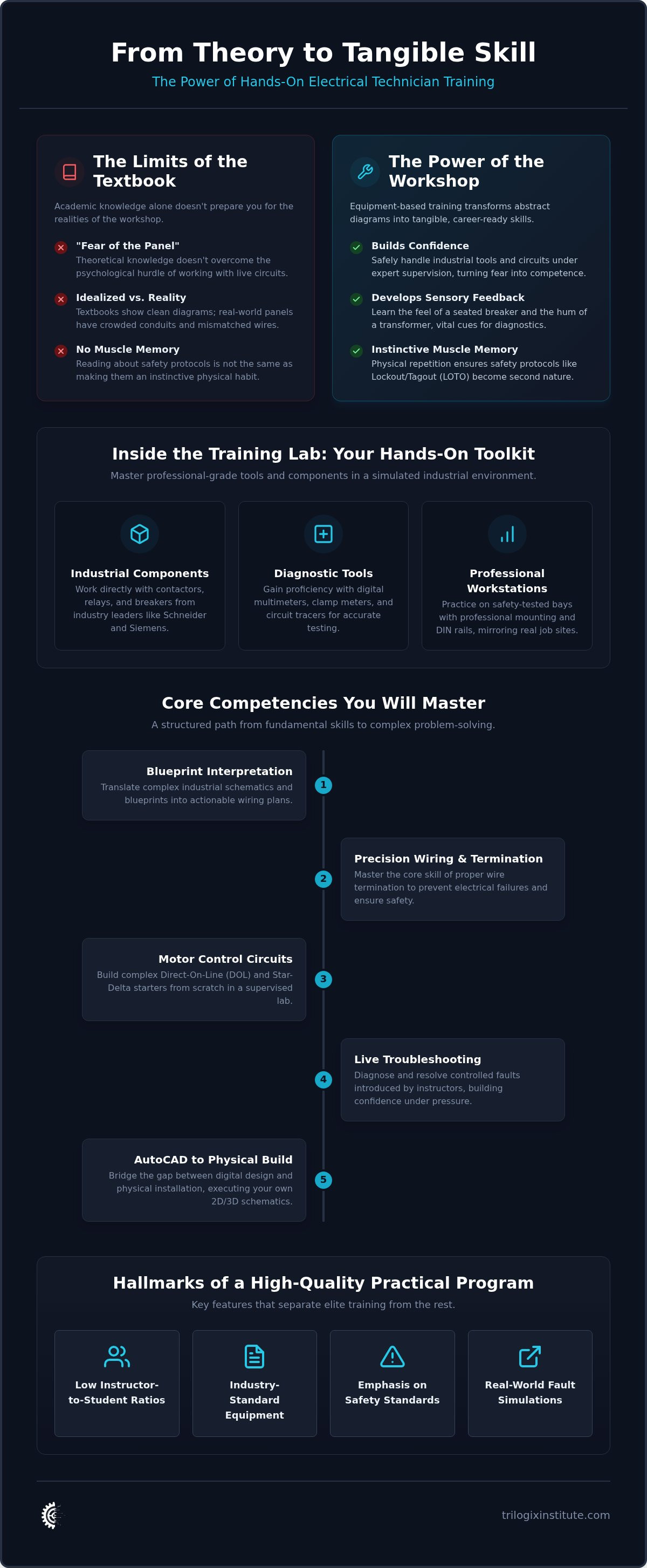
Academic excellence doesn't always guarantee technical mastery. We frequently see "A" students who can solve complex circuit equations but freeze when faced with a live distribution board. This "Fear of the Panel" is a significant psychological hurdle that online modules cannot address. Textbooks present idealized, color-coded diagrams. The real world is different. It's full of crowded conduits, mismatched wire colors, and tight spaces. Supervised physical contact allows you to bridge this gap safely. Within the scope of electrical and electronics engineering, troubleshooting requires a level of intuition that only comes from repeated, physical interaction with components.
The Psychology of Tactile Learning
Physical interaction with tools accelerates long-term skill retention through sensory feedback. When you wire a motor starter, your brain records the resistance of the wire, the specific snap of a seated breaker, and even the hum of a healthy transformer. These sensory cues are vital for diagnostics. Equipment-based training is the integration of manual dexterity and cognitive logic. This approach builds muscle memory, ensuring that safety protocols like Lockout/Tagout (LOTO) become instinctive rather than remembered from a list. Employers in the UAE distinguish between candidates who have read about electricity and those who have completed a hands-on electrical technician course. They value technicians who can step onto a job site and handle industrial tools with steady confidence, knowing the difference between a theoretical diagram and a physical installation.
Inside the Training Lab: Essential Equipment and Real-World Simulations
A professional training lab is the heartbeat of vocational education. It isn't a traditional classroom with rows of desks; it's a simulated industrial floor designed for high-stakes practice. When you enroll in a hands-on electrical technician course, you step into an environment organized into dedicated workstations and safety-tested bays. This layout mirrors the actual conditions of a UAE industrial site, allowing you to move beyond plastic breadboards to professional mounting rails and DIN rails. This physical immersion is where your transition from student to technician begins.
Mastery starts with the right equipment. You'll gain proficiency using industry-standard diagnostic tools such as digital multimeters for voltage testing and clamp meters for non-invasive current measurement. You'll also master circuit tracers to identify paths in complex panels. Beyond testing tools, you will work directly with industrial components from brands like Schneider and Siemens. This includes contactors, relays, and circuit breakers. A major focus is placed on cable types and termination methods. Learning to terminate wires properly is a core skill because loose connections are the primary cause of electrical failure. Physical practice ensures your terminations meet global safety standards every time.
Mastering Industrial Motor Controls
In the Essential Industrial Motor Control curriculum, you'll build complex systems from scratch. You'll wire Direct-On-Line (DOL) and Star-Delta starters in a controlled, supervised environment. It's one thing to see a diagram of a relay; it's another to hear the mechanical click as you energize the circuit. Instructors introduce controlled faults into these systems, challenging you to diagnose and restore power under pressure. This simulation builds the troubleshooting confidence that employers demand.
Integrating AutoCAD with Physical Installation
Precision starts on the screen but must end on the mounting rail. Students in the Advanced AutoCAD 2D & 3D program don't just draw designs; they learn to execute them. You'll take a digital schematic you've created and replicate it using physical components. This feedback loop is vital. You might discover that a design looks perfect in a 3D model but is physically impossible to wire due to bend radius constraints or space limitations. This practical reality check is a hallmark of a hands-on electrical technician course.
If you're ready to move from digital simulation to the real workshop, explore the technical programs at Trilogix Institute to start your journey.
Core Competencies: The Practical Skills You Will Master in the Workshop
Mastering the workshop requires more than just knowing where wires go. It involves the high-level ability to interpret complex electrical blueprints and industrial schematics. In a hands-on electrical technician course, you learn to translate flat, 2D lines into functional 3D physical systems. This process includes precision wiring and component mounting that adheres to international standards, such as the IEC. You'll practice mounting components on DIN rails and ensuring every connection is secure, tidy, and logically organized for future maintenance.
Before any circuit is energized, it must undergo testing and commissioning. This final phase is critical for system integrity. You will learn to perform insulation resistance tests, continuity checks, and polarity verifications. These steps ensure the circuit is safe and functional before the first watt of power flows through it. By the time you finish your training, these procedures will be second nature, allowing you to walk onto any job site in the UAE with a proven methodology for success.
The Technician’s Diagnostic Mindset
Troubleshooting is the true test of a technician’s skill. We move you away from "guessing" or "parts-swapping" toward a mindset of logical elimination. You will master systematic methods like the "Half-Split" and "Input-Output" techniques. The Half-Split method involves testing the midpoint of a circuit to quickly isolate whether a fault lies in the supply or the load side. The Input-Output method tracks the signal or power path sequentially from the source to the final component. You'll use a multimeter to verify voltage, continuity, and resistance safely at each stage. Documentation is also a key focus; you'll learn to record faults and repairs to meet industrial compliance and safety audit requirements.
Safety Protocols and Risk Management
In a simulated industrial setting, you will practice rigorous Lock-out/Tag-out (LOTO) procedures. This isn't just about following a checklist; it's about understanding the life-saving importance of isolating energy sources. We train you to identify "near-miss" scenarios. These are small errors or environmental factors that could lead to hazardous arc-flashes or electrical shocks if they aren't corrected immediately. By recognizing these risks early, you prevent accidents before they happen. Safety is not a module, but a continuous practice integrated into every lab hour. This constant vigilance ensures you develop the professional habits necessary to protect yourself and your colleagues in high-voltage environments.
Evaluating Technical Programs: What a High-Quality Practical Course Must Provide
Choosing the right training provider is a critical career decision. In the UAE's competitive industrial sector, a hands-on electrical technician course must be judged by the quality of its infrastructure and the accessibility of its faculty. High instructor-to-student ratios are not a luxury; they are a safety requirement. In a lab where students work with live power, an instructor must be able to monitor every connection in real-time. Small groups ensure that you receive personalized guidance and that no safety violation goes unnoticed.
A modernity check is equally vital. You must ensure the lab utilizes 2026-standard equipment rather than outdated relics. Technology in power control systems and energy management moves quickly. Training on obsolete hardware leaves you unprepared for the modern job site. Additionally, verify the institute's accreditation and industry recognition. A certificate is only as valuable as the reputation of the organization that issues it. High-quality programs also provide robust support systems, offering post-lab clarification to ensure that complex concepts are fully internalized before you move to the next module.
The Role of the Instructor-Mentor
The "Watch-One, Do-One, Teach-One" model remains the gold standard for vocational excellence. This superior model moves you from observation to supervised execution and finally to mastery. An instructor with real-world industrial field experience brings more than just book knowledge; they bring practical shortcuts and field-tested insights that textbooks omit. Immediate feedback in the lab is essential. It prevents the formation of bad habits that could be dangerous or costly in a professional setting. This mentorship turns a standard lesson into a career-shaping experience.
Curriculum Alignment with Job Market Demands
A comprehensive curriculum should bridge the gap between residential basics and complex industrial automation. Programs like Trilogix Institute's Foundation Electrical Engineering course provide the essential career bedrock required for any technical role. Mastery of the basics allows for a seamless transition into advanced specializations. You should always ask: does the course offer a clear path to advanced fields like Industrial Automation? Alignment with current job market demands ensures that your training remains relevant and your skills remain in high demand across the Emirates.
Ready to secure your technical future? Enroll in Trilogix Institute's Foundation Electrical Engineering program to start your journey with industry-leading mentors.
Launching Your Technical Career with Trilogix Institute Programs
Launching a career in the UAE's technical sector requires more than a certificate; it requires verified competency. At Trilogix Institute, our philosophy centers on bridging the gap between ambition and employment through rigorous, equipment-based learning. We don't believe in purely online, self-paced modules for technical trades. Instead, we provide a hands-on electrical technician course that places you in front of the same panels and circuits you'll encounter in the field. This pragmatic approach ensures that when you enter the professional engineering sector, you're not just a trainee, but a ready-to-work technician.
Our TTI Dubai Foundation Electrical Engineering program serves as the essential starting point for newcomers. It establishes the core principles of electrical safety, circuit design, and component installation. It's the bedrock of your career. For those looking to move into higher-tier roles, our specialized tracks in Industrial Automation Specialization and Motor Control offer a direct path to mastery. You'll learn to manage complex systems that power the region's infrastructure, from manufacturing plants to smart buildings. These skills are in high demand across the Emirates.
Our Equipment-First Approach
Our campuses are designed specifically for physical skill acquisition. When you tour our specialized labs, you'll see workstations equipped with industry-standard hardware from global leaders like Schneider and Siemens. Our TITP Beginner Essential Industrial Motor Control program builds immediate utility by teaching you to wire, test, and troubleshoot motor starters in real-time. This isn't a "watch and learn" environment; it's a "do and master" workshop. Every student benefits from the instructor-led difference, receiving personalized guidance that ensures every wire is terminated correctly and every safety protocol is followed.
Your Path to Enrollment
Choosing the right path depends on your current experience and career goals. Whether you're starting from scratch or looking to specialize in automation, we have a structured curriculum to meet your needs. We're currently accepting registrations for our upcoming 2026 cohorts across our UAE campuses. The process is streamlined to help you move quickly from registration to the workshop floor. Don't let your career stall in theory. Take the first step toward a practical, high-demand career today.
View our full list of hands-on technical courses at Trilogix Institute and discover the program that fits your ambition.
Power Your Future with Practical Expertise
Transitioning from a student to a professional technician requires more than reading manuals. It demands the tactile experience of wiring panels and the logical rigor of troubleshooting live circuits. This guide has shown how a hands-on electrical technician course transforms abstract diagrams into the technical confidence needed for the UAE's industrial sector. By focusing on instructor-led physical labs and industry-standard industrial equipment, you move past the limitations of digital simulations. You'll gain a diagnostic mindset that values safety and precision above all else.
True vocational readiness isn't about memorizing facts; it's about the ability to step onto a job site and execute tasks with certainty. Whether you're mastering motor controls or interpreting complex blueprints, the skills you build in a workshop are the ones that lead to long-term career growth. You have the ambition to succeed in engineering, and the right training environment provides the specific keys to unlock that potential. Don't let your career goals remain theoretical when you can start building them today.
Start your technical career today with Trilogix Institute hands-on training. We're here to help you bridge the gap between classroom theory and real-world employment.
Frequently Asked Questions
What is the difference between a hands-on electrical course and a university degree?
A hands-on course focuses on immediate job readiness and physical tool proficiency, whereas a university degree is typically centered on theoretical research and broad engineering principles. Our programs are designed to bridge the gap between ambition and employment through equipment-based training. You spend less time in a lecture hall and more time in a specialized lab working with industrial hardware.
Do I need prior experience to enroll in a beginner electrical technician course?
No prior technical experience is required to enroll in our beginner-level programs. The TTI Dubai Foundation Electrical Engineering course is specifically designed to take you from zero knowledge to a solid understanding of core electrical principles. We provide the tools and instructor-led guidance needed to build your technical skills safely from the ground up.
How long does it take to complete a hands-on electrical training program?
The duration of a hands-on electrical technician course varies depending on the specific program and the depth of specialization you choose. Most foundation modules are structured to be intensive and time-efficient, allowing you to gain practical competency in weeks rather than years. This pace reflects the fast-moving industries we represent in the UAE.
Are the certifications from Trilogix Institute recognized by employers?
Our certifications prove practical competency and are designed to meet global industry standards. Employers in the UAE value the hands-on nature of our training because it ensures the technician can handle real-world industrial equipment immediately. We focus on bridging the gap between classroom learning and the actual demands of the workplace.
Will I be working with live electricity during the practical lab sessions?
You will work with live electricity in a strictly controlled and supervised environment. Safety is integrated into every lab hour, and you will practice rigorous Lock-out/Tag-out (LOTO) procedures before any circuit is energized. This supervised exposure is essential for building the confidence needed to handle high-voltage systems in the professional field.
What tools do I need to purchase before starting my electrical course?
You don't need to purchase any industrial tools or diagnostic equipment before starting your course. Trilogix Institute provides all necessary industry-standard tools, including multimeters, clamp meters, and circuit tracers, within our specialized labs. We ensure you train on modern hardware that meets current 2026 technical standards.
Can I specialize in industrial automation after completing the foundation course?
Yes, completing the foundation course provides the necessary bedrock to move into an Industrial Automation Specialization. This progression allows you to master complex motor controls and automated systems. It's a clear path for technicians aiming for higher-tier roles in manufacturing and infrastructure across the Emirates.
How does hands-on training help with reading electrical blueprints?
Hands-on training helps you translate 2D digital schematics into functional 3D physical systems. By wiring a physical mounting rail based on an AutoCAD design, you learn to spot practical constraints that aren't obvious on a screen. This feedback loop is the fastest way to master complex electrical blueprints and industrial schematics.


