
A certificate alone won’t show that you can troubleshoot a control system. If you’re asking how to become an automation technician, build your skills in sequence and keep clear evidence of what you can do with equipment. The role calls for safe working habits, electrical and motor-control fundamentals, and a methodical approach to diagnosing faults in automated systems.
Your best starting point depends on your current knowledge and experience. A degree, vocational course, or workplace learning can each help, but theory needs to connect with practice. This guide explains the role, the technical skills to build, and how to choose a learning path without assuming a university degree is the only option.
You’ll see how to progress from electrical basics and motor control to PLCs, sensors, HMI systems, and structured troubleshooting. You’ll also learn how to show your developing skills through practical exercises and accurate records. Instructor-led learning with real-world equipment can help connect study to applied practice as you prepare to pursue automation technician opportunities.
Key Takeaways
- Understand how automation technicians help keep industrial equipment and control systems operating safely and reliably.
- Identify the technical skills that matter, from electrical fundamentals and motor control to fault-finding and communication.
- Explore how to become an automation technician through vocational training, formal education, or employer-based learning.
- Use a practical progression to build skills and show evidence of your readiness for entry-level opportunities.
- See how instructor-led, equipment-based training and an Industrial Automation Specialization can support your learning path.
What Does an Industrial Automation Technician Do?
An industrial automation technician helps keep automated machines and process systems operating reliably. The work combines observation, testing, fault-finding, and practical maintenance. Technicians monitor equipment, check whether controls respond as intended, investigate faults, and record findings so the next action is clear.
The role connects equipment with the people who operate and maintain it. Technicians may coordinate with engineers on control-system issues, operators who notice changes during production, maintenance teams responsible for equipment condition, and supervisors who prioritize work. The boundary between technician and engineer varies by employer and project. Technicians commonly test, maintain, and troubleshoot systems, while design or engineering leadership may sit with other specialists.
Typical responsibilities include:
- Monitoring machine status and responding to alarms or unusual operation.
- Testing control inputs and outputs, sensors, and other components.
- Tracing faults methodically, then reporting the cause and corrective work.
- Documenting tests, maintenance, and unresolved issues for accurate handovers.
A broad overview of the occupation is available in this Automation technician reference. Knowing what technicians do each day helps connect your studies to the work itself.
What equipment and systems might an automation technician work with?
Automated systems link components that sense conditions, make decisions, and cause movement. A programmable logic controller (PLC) runs control instructions. A human-machine interface (HMI) displays information and lets an operator interact with the system. Sensors detect conditions such as position or presence, while actuators produce an action, such as moving a valve or mechanism. A variable-frequency drive (VFD) controls an electric motor’s speed.
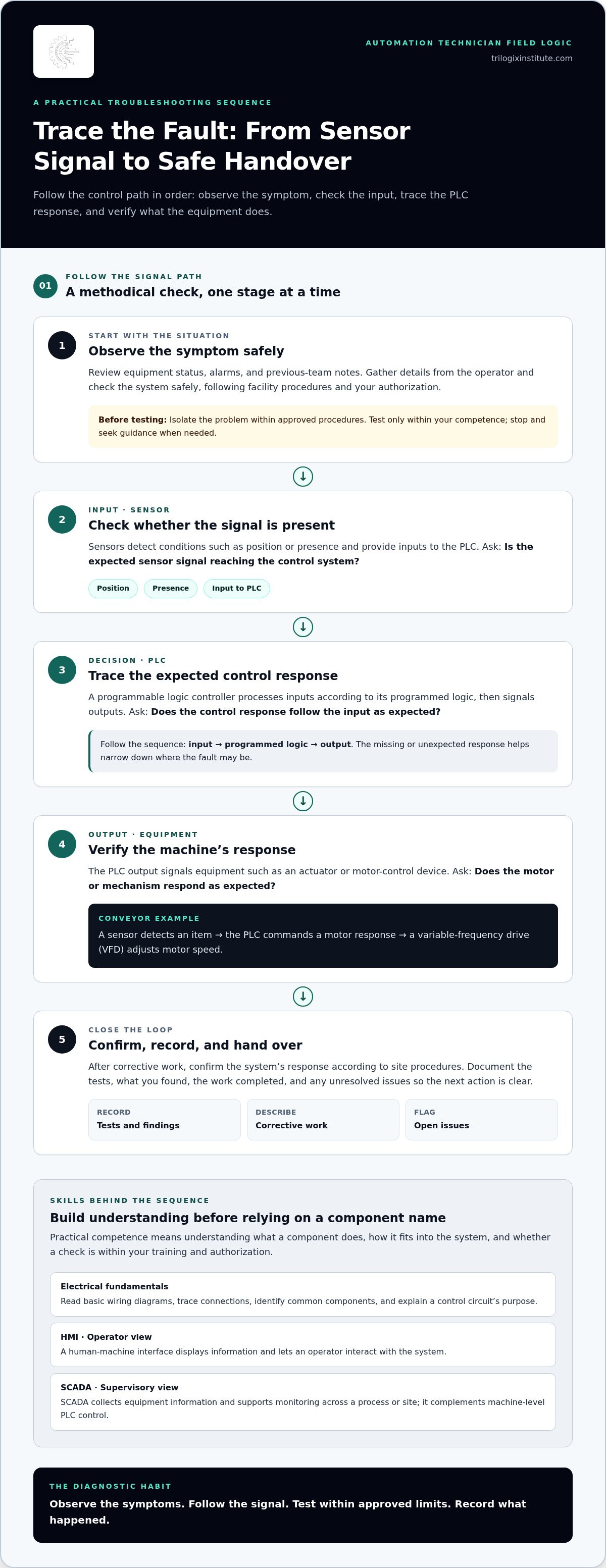
For example, a sensor detects an item arriving on a conveyor and sends a signal to the PLC. The PLC then commands a motor response, with a VFD adjusting the motor’s speed. If the conveyor behaves unexpectedly, a technician may trace the sequence by checking whether the sensor signal is present, whether the control response follows, and whether the motor responds as expected.
What does a typical workday involve?
A shift might begin with reviewing equipment status, alarms, and notes from the previous team. If a line stops unexpectedly, the technician gathers information from the operator, checks the system safely, and tests relevant components to narrow down the fault. After corrective work, they confirm the system’s response according to site procedures and document what they found, what they did, and what still needs attention.
Safety is part of every task, not a separate step. Technicians must follow facility procedures and their authorization before inspecting or testing industrial equipment. Clear records help colleagues understand what changed, what has been checked, and what remains open. Responsibilities vary with the employer, facility, equipment, and technician seniority, so one role may focus more on monitoring while another involves deeper troubleshooting.
Which Technical Skills Should You Build for Automation Technician Work?
Build from the fundamentals outward. A useful skill set combines electrical understanding, control-system knowledge, disciplined fault-finding, and clear communication. Start with components and principles used across industrial settings, then develop familiarity with technologies used in particular facilities. This helps you understand not only what a component is called, but also what it does in a system.
A PLC is a programmable controller used to automate machine operations. Recognizing a PLC, sensor, or drive is only a first step. Safely testing equipment requires knowledge of the system, suitable procedures, and an understanding of your training and authorization limits. Practical competence includes knowing when to stop and seek guidance, not just knowing which component to inspect.
Which control-system concepts are most useful to learn first?
Begin with how inputs, logic, and outputs work together. Sensors provide inputs to a PLC; the controller processes them according to programmed logic; outputs then signal devices such as actuators or motor-control equipment. When troubleshooting, trace that sequence: is the input missing, is the expected logic response absent, or is the output failing to produce the intended action?
Next, learn how an HMI presents machine status and lets operators interact with controls. A VFD adjusts motor speed, so understanding its role helps you interpret a machine’s response. SCADA operates at a supervisory level, collecting information from equipment and supporting monitoring across a process or site. It complements, rather than replaces, the machine-level control handled by a PLC.
Why do electrical and troubleshooting fundamentals matter?
Electrical foundations make control concepts usable. Practise reading basic wiring diagrams, tracing connections, identifying common components, and explaining the purpose of a control circuit. These skills help you form a testable idea about a fault instead of replacing parts based on guesswork. Identifying a component visually does not prove that you can safely test it or interpret the result.
Use a consistent diagnostic process: observe the symptoms, isolate the problem within approved procedures, test only within your competence, and record the result. In a learning environment, practise tracing a circuit or checking a simulated fault under instruction before applying the method to unfamiliar equipment. Never bypass safety procedures to speed up troubleshooting.
- Foundational skills: electrical principles, diagram reading, control logic, safe work habits, and structured fault-finding.
- Role-dependent skills: specific PLC platforms, SCADA tools, communication protocols, robotics, and maintenance software.
Employers use different equipment, so strong fundamentals are more transferable than familiarity with one platform. Clear reporting matters too: describe symptoms, tests, results, and outstanding concerns so colleagues can act on reliable information. To develop these capabilities through practical study, explore instructor-led technical courses that connect technical concepts with equipment-based learning.
Which Route to Becoming an Automation Technician Fits Your Starting Point?
There isn’t one required route for every learner. The best starting point depends on your electrical knowledge, access to workplace experience, and the depth of preparation a role requires. A degree, vocational course, or employer-based pathway can each develop relevant capabilities, but none guarantees employment on its own. Compare what you’ll learn, how you’ll practise, and how you’ll demonstrate your skills.
| Route | Strengths | Trade-offs | May suit |
|---|---|---|---|
| Vocational training | Structured instruction with a focus on practical skills and equipment. | Scope and depth depend on the course; learners may still need workplace experience. | Beginners seeking guided, applied learning. |
| Formal education | Can provide broader, staged technical foundations over a longer period. | Requires a greater time commitment; practical exposure varies by program. | Learners seeking extensive study in a related technical field. |
| Employer-based learning | Connects training to actual equipment, processes, and team routines. | Access depends on an employer and the tasks available in the role. | People already working in a technical or industrial environment. |
As you compare routes, weigh how much structured theory and supervised practice each provides. Consider the time commitment, access to equipment, and whether the learning matches the tasks you hope to take on.
Can you enter the field without an engineering degree?
Potentially. Entry requirements vary by employer, job scope, and the systems a technician will support. Some roles may call for a formal qualification or prior experience; others may value relevant technical training alongside evidence of practical ability. A course can build a foundation, but it doesn’t replace every qualification, site-specific requirement, or period of supervised workplace learning. Focus on the skills a target role expects and how you can demonstrate them.
How should you compare technical training options?
Look beyond the course title. Consider whether instructors guide your practice, whether equipment is used, whether topics progress from fundamentals to control systems, and whether you receive feedback on practical tasks. Those features help turn concepts into repeatable skills. Industrial motor-control fundamentals are useful because understanding how control circuits and motors work gives you a base for learning how automated systems direct equipment. A beginner motor-control training guide can help clarify the concepts to look for.
Instructor-led technical training with real-world equipment provides a way to practise under guidance. Trilogix Institute offers an Industrial Automation Specialization and beginner Essential Industrial Motor Control training. Explore technical training courses to consider which learning structure fits your starting point.
How to Build Automation Technician Readiness Step by Step
Turn learning into evidence of what you can do. This progression helps you identify gaps, practise within your limits, and prepare useful examples for technical job applications.
- Assess your foundations. Choose a basic electrical diagram and identify its power source, control components, and connections. You’re making progress when you can explain the circuit’s purpose and identify concepts you need to review.
- Learn control-system relationships. Trace how a sensor input, PLC logic, and an output work together. Check your understanding by describing what should happen when an input changes and what could prevent the expected response.
- Practise safely. Complete supervised exercises on training equipment, such as tracing a control circuit or observing how a motor-control setup responds. Explain each action and result while following the instructor’s procedures.
- Document your work. After every exercise, record the task, checks performed, observations, and what you learned. Make the record clear enough for someone else to follow your reasoning without relying on memory or broad claims.
- Pursue relevant roles. Compare entry-level job requirements with your training and evidence, then target roles that match your current capability. Track which requirements you can demonstrate and which need more practice.
How can beginners practise without overstating their experience?
Use training-lab tasks and supervised equipment exercises suited to your current level. Keep annotated diagrams, troubleshooting logic, test observations, and lessons learned as evidence of practice, not proof of unsupervised workplace experience. A technician portfolio should show the task, method, safety considerations, and result. Never practise on live industrial equipment without authorization and appropriate supervision.
How can you demonstrate readiness to employers?
Organize examples around a specific task, the tools or diagrams you used, the safe working habits you followed, and the outcome you observed. Explain your reasoning, including what you checked and what you would escalate. Match each example to the role’s stated requirements, and distinguish supervised training from workplace experience. Clear, accurate evidence is more persuasive than unsupported claims of expertise.
Instructor-led training can connect automation concepts with equipment practice. Trilogix Institute’s industrial automation specialization course is one pathway for developing relevant technical skills. Review the course as you plan your learning and practical development.
How Trilogix Institute Training Can Support Your Automation Technician Path
Technical concepts become more useful when you can connect them to equipment and practical tasks. Instructor-led training provides a structured setting to ask questions, observe demonstrations, and practise with guidance. This can help learners move beyond memorizing component names toward understanding how electrical and automation principles apply in working systems.
Trilogix Institute offers an Industrial Automation Specialization for learners developing automation knowledge, as well as beginner Essential Industrial Motor Control training. Motor-control fundamentals support later learning about how automated systems manage equipment. Training helps you develop technical capability, but it doesn’t guarantee employment. Career readiness also depends on your prior knowledge, participation, practice, and the requirements of the roles you pursue.
What should learners expect from practical automation training?
Expect instructor guidance, a structured learning sequence, and opportunities to apply technical concepts using real-world equipment. Practical exercises connect explanations to what you observe and do, while instructor feedback can help you correct misunderstandings. Motor-control principles provide useful context for broader automation study because controlled motors are part of many industrial systems. Your progress depends on your starting knowledge, participation, and continued practice.
Focus on explaining the reason behind each step, not just completing an exercise. Connect a control concept to the equipment response you observe, then describe what you learned from the result. This habit builds technical understanding and gives you clear examples to discuss when pursuing entry-level opportunities.
How can you take the next step toward training?
Start by listing what you already know and the skills you want to strengthen. You may need a stronger electrical foundation, more confidence with motor control, or a broader introduction to automation systems. Use that self-assessment to choose a learning direction that fits your experience, then plan how you’ll apply and reinforce each concept through practice.
Instructor-led technical learning is useful when you want guidance as you work through equipment-based tasks. Explore industrial automation courses to review relevant training pathways and identify a suitable next step. A focused course can give your learning structure; what you practise, retain, and demonstrate will shape how well that preparation supports your career goals.
To explore training pathways, review Trilogix Institute’s technical training options and choose a practical next step toward building your automation skills.
Take the Next Step Toward Automation Work
Your next move doesn’t need to answer every career question at once. Choose one skill to strengthen, find a responsible way to practise it, and record what you learn. Consistent progress can turn an interest in automation into clearer evidence of your capabilities.
If you’re deciding how to become an automation technician, make your learning practical as well as structured. Trilogix Institute’s instructor-led training includes equipment-based learning, with pathways such as the Industrial Automation Specialization and beginner Essential Industrial Motor Control training. These courses support technical learning through guided practice, while continued effort shapes how you apply it.
Review the available options and choose a learning direction that fits your experience and goals. Explore Trilogix Institute’s technical training options and take a purposeful next step toward developing your automation skills.
Frequently Asked Questions
Can I become an automation technician with no experience?
Yes, you can begin working toward the role without previous automation work, though employer requirements differ. Start with basic electrical concepts and guided practice, then seek supervised technical experience that lets you apply what you’ve learned. For example, describe a training exercise accurately on your CV and identify the task involved. Be clear about what you practised under instruction and what you’ve done independently.
Do automation technicians need to know how to code?
Some programming knowledge is useful, but the level required depends on the position. A technician might need to read PLC logic, recognize how a condition affects an output, or make an approved adjustment under workplace procedures. Other roles may focus more on inspection and maintenance. Start by explaining a simple control sequence in plain language. That shows you understand the logic before you attempt to write or change a program.
How long does it take to become an automation technician?
There isn’t one fixed timeline. It depends on your starting knowledge, the depth of training you choose, opportunities for supervised practice, and the expectations of the roles you pursue. Set milestones rather than counting months alone: explain a control sequence, complete a practical exercise safely, and present a clear record of your work. Use those milestones to decide what to study next and when to apply for suitable openings.
What qualifications are commonly requested for automation technician jobs?
Requirements vary by employer and equipment. Job postings may ask for a technical qualification in areas such as electrical engineering, mechatronics, or industrial automation, along with relevant experience. Some entry-level roles may consider foundational training and practical evidence. Read each posting closely, note repeated requirements, and map them against your education and experience. If a qualification is mandatory for a particular role, practical examples won’t replace it.
Is PLC knowledge essential for an automation technician?
PLC knowledge is valuable because these controllers are widely used to manage machine operations, but the depth expected varies by job. Some technicians mainly need to understand controller status and follow a fault’s path; others may work more directly with logic or configuration. As a beginner, learn to interpret a simple sequence and explain what an input should trigger. Avoid changing a live system unless you’re authorized and following workplace procedures.
What is the difference between an automation technician and an automation engineer?
In broad terms, technicians often focus on supporting, testing, maintaining, and troubleshooting equipment, while engineers may take on more system design, integration, or technical planning. Duties can overlap and titles differ between organizations, so the job description matters more than the label. For example, a technician might report a recurring sensor fault with test observations, while an engineer evaluates a design change to address its cause.
Can electrical or motor-control training help prepare me for automation work?
Yes. Electrical and motor-control knowledge helps you understand how control circuits relate to equipment behavior, which is useful when learning broader automation concepts. Trilogix Institute’s beginner Essential Industrial Motor Control training and Industrial Automation Specialization provide instructor-led, equipment-based technical learning. Keep notes on practical exercises and review concepts you find difficult. Training supports preparation, while experience and continued practice develop capability over time.


