

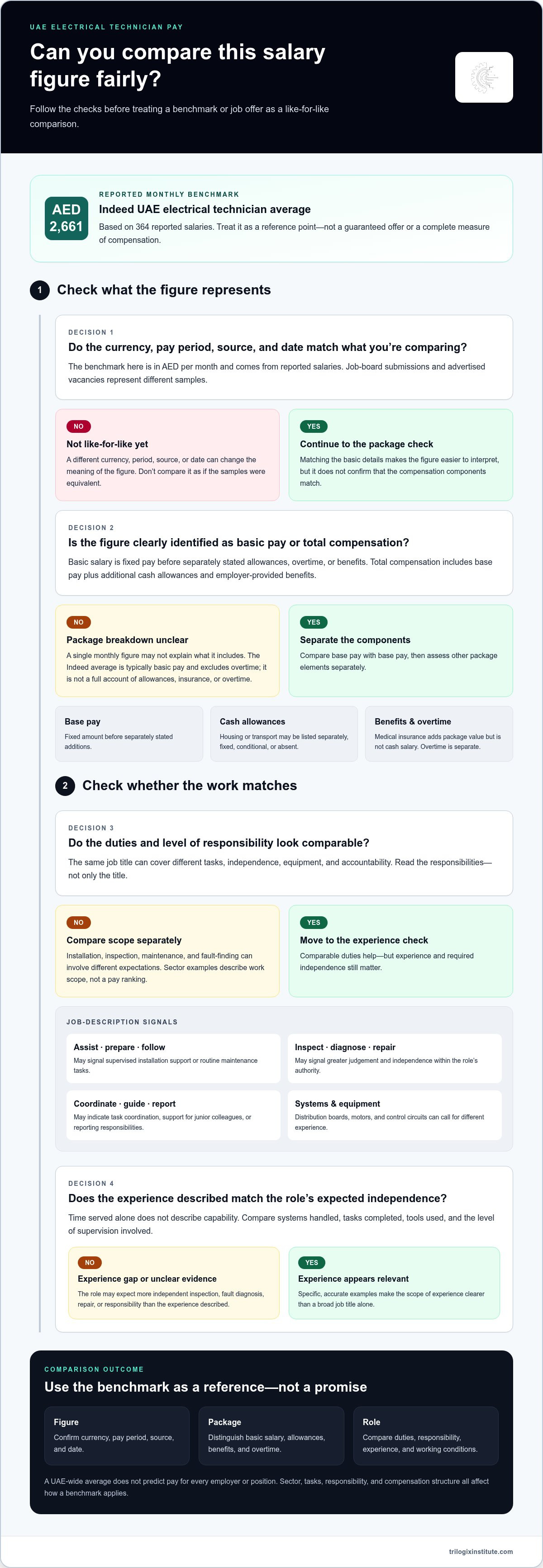
One UAE salary figure can’t tell you what an electrical technician will actually take home. Indeed reported an average electrical technician salary in UAE of AED 2,661 per month on September 25, 2026, based on 364 reported salaries. Job scope, experience, and how an employer structures compensation can all affect how that benchmark applies to you.
It’s easy to compare listings and assume they show the same thing. In practice, a figure may refer to basic pay, while housing or transport allowances, medical insurance, and overtime affect the overall package. The work itself matters too: employers may expect anything from routine maintenance support to independent fault-finding.
This guide explains how to read salary benchmarks, compare compensation packages, and assess how pay may vary by experience and role. It also shows how to identify practical skill gaps and choose a focused next step, such as instructor-led foundation electrical engineering training.
Key Takeaways
- Read the electrical technician salary in UAE in context. Distinguish basic pay from total compensation, including allowances and benefits.
- Compare roles by responsibilities and experience, not job title alone. Troubleshooting and supervisory duties differ from routine installation or maintenance work.
- Use relevant job descriptions to identify practical skill gaps, then practise and document your capabilities as you gain experience.
- Assess your strengths and choose a focused next learning step. Instructor-led foundation electrical engineering training can support practical skill development.
What does electrical technician salary in the UAE actually include?
Base salary is the fixed amount an employer pays before separately stated allowances, overtime, or benefits. Total compensation is the broader value of the employment package, combining base pay with additional cash allowances and employer-provided benefits.
That distinction matters when comparing the electrical technician salary in UAE. Two offers with similar base pay may have different overall value, while jobs with the same title may involve different duties, sectors, and levels of responsibility.
Indeed reported an average UAE electrical technician salary of AED 2,661 per month, based on 364 reported salaries and updated on September 25, 2026. These figures are typically basic pay and exclude overtime. Treat the average as a dated benchmark, not a guaranteed offer or a complete measure of every technician’s compensation.
Base salary, allowances, and benefits are not interchangeable
A housing or transport allowance is separate from base pay when an employer lists it as a distinct component. Medical insurance may add value to a package, but it isn’t cash salary. Employers don’t all provide the same combination, and an allowance may be fixed, conditional, or absent. Read the offer’s breakdown rather than assuming benefits are included in a benchmark.
For example, one vacancy might state a monthly basic salary and list housing support separately. Another may show a single monthly figure without explaining its components. You can’t compare those amounts fairly until you know what each includes. The Indeed average is a reported salary benchmark, not a complete account of respondents’ allowances, insurance, or overtime.
How to read salary figures responsibly
Before using a figure to compare careers or offers, check its currency, pay period, source, and date. The benchmark here is in AED per month, was published by Indeed, and was updated on September 25, 2026, based on 364 reported salaries. Its sample isn’t automatically equivalent to a vacancy survey or a complete record of UAE employment contracts.
Job-board salary submissions and advertised vacancies represent different samples. Submissions reflect figures reported by users, while vacancy listings show what employers advertise for specific openings. Either may provide limited detail about the role or package. Compare like with like, and don’t treat a UAE-wide average as the expected pay for every employer or position.
Scope matters as well. Electrical work can span installation, inspection, maintenance, and fault-finding; the Electrician profession overview provides general context on this breadth. A technician’s actual responsibilities depend on the job. Use the benchmark as a reference point, then assess the duties and full compensation breakdown in the specific offer.
Which factors shape an electrical technician's pay in the UAE?
A job title is only a starting point. Employers may use “electrical technician” for roles with different levels of independence, equipment, and accountability. Job scope matters alongside title because employers assess the work you can perform, the decisions you can make, and the responsibility you can safely carry.
Experience, task complexity, responsibility, and employer sector can all shape how a role is valued. These are useful comparison points, not proof that any single factor guarantees higher pay. Assess the electrical technician salary in UAE against the actual duties and requirements in the vacancy, rather than inferring pay from the title alone.
Experience and responsibility change the role's scope
An entry-level technician may assist with installations, prepare tools, follow instructions, and support routine maintenance under supervision. A more experienced worker may be expected to inspect equipment, diagnose faults, identify likely causes, carry out repairs within their authority, and record the work. The difference isn’t simply time served; it’s the level of judgement and independence the role requires.
Responsibility may also include coordinating tasks, guiding junior colleagues, or reporting safety and equipment issues. Employers can assess relevant experience more clearly when candidates describe specific work rather than listing a broad title. Keep a record of the systems you handled, tasks you completed, tools you used, and level of supervision involved. Don’t claim responsibility for work you only observed.
Sector, systems, and work environment matter
Electrical work in construction may focus on installation and project schedules, while facilities and maintenance roles may emphasize inspection, planned upkeep, and responding to faults in occupied buildings. Manufacturing environments can involve production equipment, motors, and control panels. These examples show differences in work scope, not a ranking of sectors by pay. Without comparable, current salary data, it isn’t sound to claim that one sector always pays more.
The equipment and systems matter too. A vacancy involving distribution boards, electrical motors, or control circuits may require different experience from one centred on routine checks and component replacement. Read the duties closely. Verbs such as “assist,” “inspect,” “troubleshoot,” “repair,” and “supervise” signal different expectations for independence and accountability.
Compare the working conditions and schedules described in the vacancy as well. Project-based installation work and ongoing site maintenance may differ in location, shift patterns, and workload. Construction roles may include overtime, but availability and payment depend on the employment arrangement. Don’t assume overtime is guaranteed or use it to compare base pay unless the terms are clearly stated.
To plan your skills development, match the tasks named in target vacancies to the experience you can demonstrate, then identify gaps to address through practice. Trilogix Institute provides instructor-led, equipment-based foundation electrical engineering training to support practical skill development.
How do electrical technician roles and salary benchmarks compare?
Compare the work before comparing the title. “Electrical technician,” “maintenance technician,” and “installation technician” may describe overlapping duties at one employer and distinct responsibilities at another. The table separates common task profiles from salary evidence, showing where a direct comparison is reasonable and where the available figures don’t support one.
Compare responsibilities before comparing job titles
Maintenance roles generally focus on scheduled checks and keeping equipment operational. Installation roles centre on fitting and connecting systems, while troubleshooting roles require diagnosing faults and choosing corrective steps. These task profiles can overlap, but the level of independence and experience required may differ. Read the job description for specific duties and requirements rather than assuming similar titles mean equivalent work.
| Role or benchmark | Typical scope or data | Salary benchmark and caveat |
|---|---|---|
| Electrical maintenance technician | Routine inspections, planned maintenance, component checks, and recording completed work. | No role-specific benchmark is included here. Don’t treat the UAE-wide average as a figure specific to this title. |
| Electrical installation technician | Installing, connecting, or replacing electrical components and systems; duties depend on project scope. | No role-specific benchmark is included. Compare vacancies only when duties and experience requirements are similar. |
| Electrical troubleshooting technician | Investigating faults, testing equipment, identifying causes, and carrying out repairs within assigned responsibility. | No role-specific benchmark is included. A broader scope doesn’t establish a guaranteed salary premium. |
| Electrical technician, UAE | Indeed reported an average of AED 2,661 per month from 364 reported salaries. | Indeed, updated September 25, 2026. This is a self-reported job-board benchmark, not an advertised vacancy or role-specific figure. |
| Junior electrical technician, UAE | Indeed reported an average of AED 3,447 per month from 4 reported salaries. | Indeed, updated August 18, 2026. The small sample may not represent the wider market; don’t treat it as a reliable comparison with the broader technician average. |
Make salary sources comparable
Before using a figure to evaluate an offer or estimate the electrical technician salary in UAE, note its source, collection or update date, sample size, currency, pay period, and stated experience level. The two Indeed figures above are monthly AED averages, but they cover different titles, sample sizes, and dates. They aren’t a like-for-like measure of junior versus general technician pay.
Separate advertised vacancies from self-reported salary data too. A vacancy shows what an employer is offering for a particular opening, while a job-board submission reflects a figure reported by a user. Neither automatically represents the entire UAE market. If another source gives annual pay, label the period clearly and convert it to a monthly equivalent only when the original figure and calculation are transparent. If duties, experience, sample, or pay definitions don’t align, mark the comparison as unavailable rather than estimating.
How can technicians strengthen their earning potential over time?
Career growth is easier to plan when you connect skill development to work employers actually describe. Rather than collecting training without a clear purpose, follow a repeatable cycle: assess what you can do, identify a relevant gap, practise the task, and record evidence of your capability. This can help you prepare for suitable roles, but training alone can’t guarantee employment or a salary increase.
Build skills that map to real electrical work
Start with the duties in electrical technician vacancies that match your experience level. Look for tasks such as inspections, installation support, maintenance, testing, or fault diagnosis. Compare those requirements with your knowledge and practical experience. Treat these as examples of skill areas, not a universal list of employer requirements.
- Assess: List the electrical concepts and hands-on tasks you can explain or demonstrate confidently.
- Identify gaps: Note where you need stronger fundamentals, safer work habits, or a more systematic approach to finding faults.
- Practise: Rehearse relevant tasks in a suitable learning environment. Equipment-based practice can connect electrical principles with how components and systems behave.
- Document: Record what you practised, the equipment or systems involved, and the level of guidance required.
Practical learning turns theory into a sequence of actions: understand the system, follow safe procedures, test methodically, and explain what the results indicate. Trilogix Institute’s instructor-led, equipment-based foundation electrical engineering training supports this kind of skills development. Explore foundation electrical engineering courses.
Record experience and prepare for salary discussions
A clear record makes your experience easier to assess. For each relevant task, note the system or equipment, your responsibility, whether you worked independently or under supervision, and how you completed or reported the work. Keep each description factual. Distinguish between tasks you performed, tasks you assisted with, and procedures you only observed.
Before discussing compensation, compare the role’s duties and experience requirements with the evidence you can provide. A vacancy asking for independent troubleshooting calls for different examples from one focused on assisting with routine maintenance. Use your records to explain how your experience aligns with the position, then consider the stated salary period and package components. Avoid relying on a job title alone or treating a benchmark as a guaranteed target.
Build steadily. A focused learning plan and accurate work record won’t determine an employer’s offer, but they can help you present your capabilities clearly and choose your next development step with purpose.
What is a realistic next step toward electrical technician work in the UAE?
Turn salary research into a plan you can act on. Choose a role that fits your current experience and the work you want to learn, then identify the knowledge and practical tasks it calls for. The aim isn’t to chase a salary figure in isolation. It’s to build relevant capability and present it clearly as your experience develops.
Turn salary research into a skills plan
Use job descriptions to understand what employers mean by titles such as electrical technician or maintenance technician. Focus on duties, required experience, and the level of independence expected. Then complete this short self-assessment:
- Target: Which role’s duties match your experience today, and which role would you like to work toward?
- Assess: Which electrical fundamentals and hands-on tasks can you explain or demonstrate confidently?
- Identify gaps: What knowledge, safe work practices, or practical tasks would you need to strengthen for your chosen role?
- Plan: What will you practise, and how will you record what you learn?
- Review: Revisit your plan as job descriptions and your experience change.
For example, if roles you’re considering mention maintenance checks or fault-finding, make those tasks part of your learning plan. Keep the plan specific: name the skill, decide how you’ll practise it, and note what evidence will show your progress. This gives you a clearer basis for considering opportunities and discussing your experience, without assuming a course or new skill guarantees a particular electrical technician salary in UAE.
Explore structured electrical engineering training
Trilogix Institute provides instructor-led foundation electrical engineering training with practical, equipment-based learning. It offers a structured way to develop technical understanding and connect concepts with hands-on work. The course is vocational training, not a university degree, and it does not guarantee job placement or a salary increase. Career outcomes depend on factors such as your experience, demonstrated capability, and the requirements of a specific role.
Use your self-assessment to decide whether structured learning fits your next step. If you want to strengthen electrical fundamentals through guided practical study, explore foundation electrical engineering training and consider how it aligns with the skills you’re working to build.
Make your next step practical
Your next career move doesn’t need to begin with a salary target. Choose one role that interests you, identify a skill it calls for, and decide how you’ll develop and demonstrate that capability. As your experience grows, revisit the responsibilities you’re ready to take on and use current job descriptions to guide your plan. This gives you a practical way to approach the electrical technician salary in UAE: focus on the work you can credibly perform and the value you can demonstrate.
If structured learning is the right next step, instructor-led vocational training with practical, equipment-based technical learning can help you build a stronger foundation. No course can promise a job or a particular salary. Progress comes from applying what you learn and continuing to develop relevant experience.
Explore Trilogix Institute’s practical foundation electrical engineering training and take a purposeful step toward your technical goals.
Frequently Asked Questions
Is electrical technician salary in the UAE tax-free?
UAE employment salary is generally not subject to personal income tax in the UAE, but “tax-free” doesn’t necessarily describe your overall tax position. Your country of tax residence may have its own reporting or tax rules, and individual circumstances can differ. Before making financial plans based on net pay, check current guidance from the relevant tax authorities in the UAE and any country where you have tax obligations.
Do electrical technicians in the UAE receive overtime pay?
Eligible overtime may be paid, but the terms depend on applicable rules and the employment arrangement. Overtime is paid at 125% of the basic hourly rate, or 150% on a day off, under UAE labour law. Don’t assume overtime is guaranteed or included in a quoted salary. Check how hours, rest days, and overtime are described in your employment documents, and verify current rules with an authoritative UAE source.
Can overseas electrical experience help when applying for UAE technician roles?
Yes, relevant overseas experience can help employers assess your fit, especially when you describe tasks that match the vacancy. Specify the equipment you worked on, the faults or maintenance tasks you handled, and whether you worked independently or under supervision. Keep references and records that support your account where available. Employers may also use practical trade tests, so be ready to demonstrate skills rather than relying on job titles alone.
Do electrical technicians in the UAE need a licence or qualification?
Requirements depend on the role and the work involved, so there isn’t one universal answer for every technician. Some tasks may require specific approvals, including DEWA or ADDC approval for certain work. Employers may also require relevant qualifications, permits, or examinations. Read the vacancy requirements carefully and verify any approval or licensing requirement with the relevant authority before undertaking regulated work.
What should I do if a job offer gives one salary figure but no breakdown?
Before accepting, request written clarification of what the figure covers: basic pay, any housing or transport allowance, other benefits, and how overtime is handled. Check whether the amount is monthly or for another pay period, and compare the written offer with the employment contract. Keep a copy of the final terms. A single figure can be difficult to assess until you know which components are included and which are separate.
Can an electrical technician negotiate salary in the UAE?
Yes, you can raise compensation during the hiring process, but an employer’s decision isn’t guaranteed. Prepare by matching your experience to the role’s specific duties. Bring clear examples of equipment maintained, faults diagnosed, or responsibilities handled, and explain how your experience aligns with the vacancy. Review the complete package, not just basic pay, and ask focused questions about unclear components before agreeing to terms.
What happens if salary websites show different figures for the same job?
Different figures often reflect different data and definitions rather than a direct contradiction. One site may collect self-reported salaries, while another may summarize advertised vacancies; dates, sample sizes, job-title groupings, and pay periods can also differ. Compare the methodology and role scope before drawing a conclusion. If a source doesn’t disclose enough information for a fair comparison, treat its number as a loose reference, not a dependable benchmark.


