

What if technical training misses the mark because it covers broad topics instead of the tasks employees need to perform? For teams considering corporate technical training in the United Arab Emirates, the first step is to identify which skill gaps matter most, then connect learning to those needs.
Training also has to fit around real workloads. It should give employees opportunities to apply new skills, get instructor guidance, and demonstrate what they can do, not just complete lessons. Without clear priorities and evidence of progress, it’s difficult to tell whether learning is making a difference.
This guide from Trilogix Institute explains how to build a technical employee training plan that links workplace tasks to role-specific learning goals. You’ll learn how to prioritize skill gaps, choose a format with relevant hands-on practice, and track progress through demonstrated skills. You’ll also see how to fit learning around daily responsibilities while preserving time for practice.
Key Takeaways
- Start with the tasks each role requires, then use observations, work samples, and employee input to identify capability gaps.
- Prioritize gaps by their relevance to team performance before selecting a learning approach.
- Compare training formats by instructor guidance, practical application, feedback, flexibility, and assessment needs.
- For corporate technical training Dubai, set a clear objective tied to a workplace task and plan how employees can practise and demonstrate progress.
- Match defined skill goals to relevant technical subjects, such as electrical engineering, industrial automation, AutoCAD, or motor control.
Why Corporate Technical Training Needs a Job-Task Focus
A technical course can cover useful material and still miss a team’s needs if employees can’t apply it to their responsibilities. Start by identifying a specific capability gap, then choose instruction and practice that address it. In Corporate Education, learning is connected to organizational capability. For technical teams, that connection becomes meaningful when employees can demonstrate skills through relevant workplace tasks.
A technical employee training plan links role-specific skill gaps to instruction, practice, and observable capability. Attending a course is one part of learning, not proof that an employee can follow a procedure, apply technical concepts, or complete a task consistently. Define what the employee should be able to do and what evidence would show they can do it.
What should a technical employee training plan achieve?
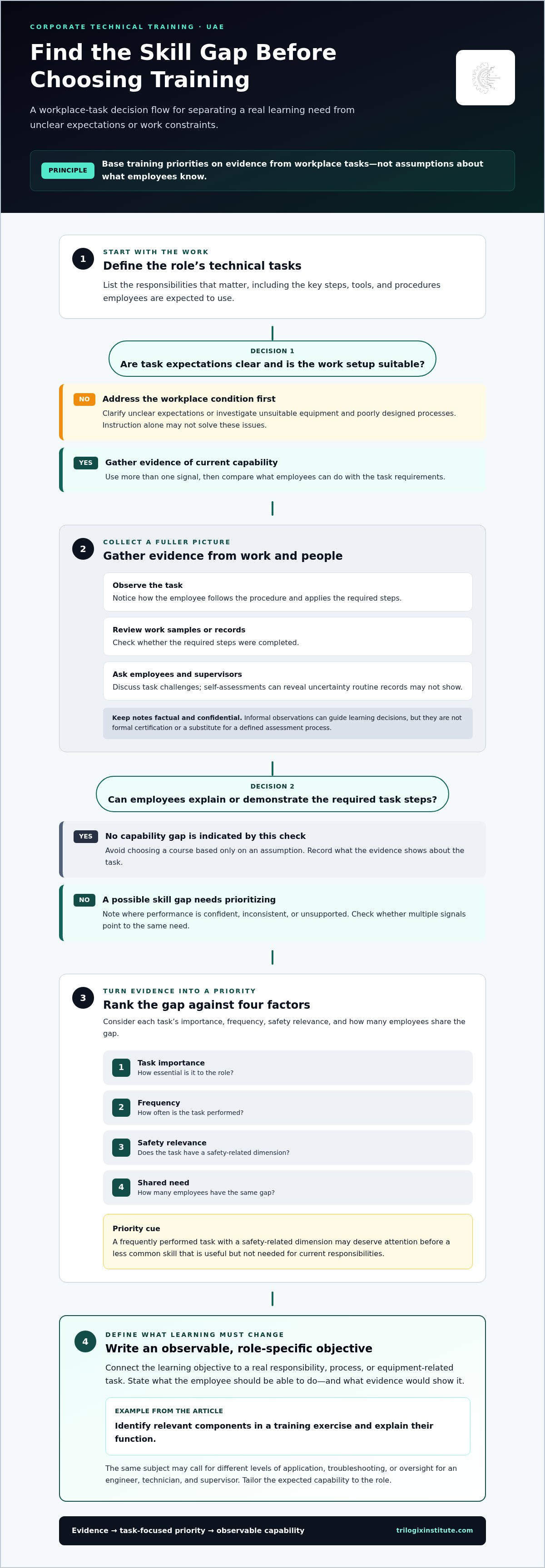
Connect each learning objective to a real responsibility, process, or equipment-related task. Replace a broad goal such as “understand electrical systems” with an observable capability, such as “identify relevant components in a training exercise and explain their function.” Tailor the objective to the employee’s role and expected responsibilities.
The same subject can call for different objectives. An engineer, technician, and supervisor may all need familiarity with industrial automation, but their roles may require different levels of application, troubleshooting, or oversight. Define the expected capability in observable terms before choosing a course or practice activity. That keeps the plan focused and makes progress easier to review.
Which workplace problems can training address?
Training may help when employees are unfamiliar with a procedure, perform a technical task inconsistently, or need stronger fundamentals for their responsibilities. First, determine whether the issue is a knowledge or skill gap. If task expectations are unclear, equipment is unsuitable, or a process is poorly designed, instruction alone may not solve the problem. Address those workplace conditions alongside learning where needed.
- Unfamiliar procedure: Provide relevant instruction and guided practice, then observe the employee applying the steps.
- Inconsistent execution: Clarify the expected method and use practice to reinforce it.
- Process or equipment constraint: Investigate the work setup rather than treating training as the only solution.
This distinction also helps clarify the role of practical technical learning compared with degree pathways. The right route depends on the capability required. A workplace task may call for focused, applied skill development, while broader academic study serves different learning aims. For corporate technical training Dubai, begin with the task and the evidence of competence you need to see.
How to Identify Technical Skill Gaps Before Choosing Training
Choosing a course before identifying the need can lead to learning that’s relevant in theory but poorly matched to the work. For corporate technical training Dubai, start with the tasks employees are expected to perform, then gather evidence of what they can currently do. This helps managers set focused priorities and distinguish a skill gap from a process or equipment issue.
Base training priorities on evidence from workplace tasks, not assumptions about what employees know. A practical assessment can be straightforward. Use a consistent sequence:
- Define role tasks. List the technical responsibilities that matter, including key steps, tools, and procedures.
- Gather evidence. Observe work, review relevant samples or records, and ask employees and supervisors about task challenges.
- Locate the gap. Compare required task steps with what employees can currently explain or demonstrate. Note where performance is confident, inconsistent, or unsupported.
- Rank priorities. Consider each task’s importance, frequency, safety relevance, and how many employees share the gap.
Which evidence helps reveal a technical skills gap?
Look for more than one signal. A supervisor might observe how an employee follows a procedure, while a work sample shows whether the required steps were completed. Self-assessments and task discussions can reveal uncertainty that routine records may not show. Compare these inputs with actual task requirements, and keep notes factual and confidential. Informal observations can guide learning decisions, but they aren’t formal certification or a substitute for a defined assessment process.
For example, if several employees report difficulty with the same procedure and supervisors also observe inconsistent execution, that shared evidence points to a possible learning need. If the procedure itself is unclear or equipment presents an obstacle, address that issue too. Training can build capability, but it can’t fix every workplace constraint.
How should managers rank training needs?
Separate essential role requirements from useful development goals. A frequently performed task with a safety-related dimension may deserve attention before a less common skill that would be beneficial but isn’t needed for current responsibilities. If several employees share a gap, a common learning objective may be efficient. Individual coaching or extra practice can still address differences in experience.
Once priorities are clear, explore technical training courses that match them. Trilogix Institute provides instructor-led training in electrical engineering, industrial automation, AutoCAD, and industrial motor control, with practical learning using real-world equipment. Choose a subject based on the capability the role requires, not simply because it appears on a training calendar.
How to Compare Technical Training Formats for Employee Needs
Choose a format by matching its learning activities to the skill employees need to demonstrate. A theory-led lesson can build understanding of principles, while a practical format gives learners a chance to apply concepts. Neither approach is automatically best for every topic. For corporate technical training Dubai, compare how each format supports instruction, practice, feedback, flexibility, and evidence of learning.
| Factor | Theory-led instruction | Instructor-led, practical learning |
|---|---|---|
| Instructor guidance | Explains concepts and frameworks; opportunities to clarify may vary by format. | Allows learners to ask questions and receive explanations during instruction. |
| Hands-on practice | May use examples or scenarios, but may offer limited direct equipment use. | Can include demonstrations and guided exercises using relevant equipment or tools. |
| Feedback | May focus on knowledge checks or discussion. | Can help learners adjust their approach as they practise a task. |
| Flexibility | May be easier to fit around work when learning can be divided into shorter parts. | Requires time for instruction and practice, so workload and attendance need planning. |
| Assessment | Can check understanding of principles and terminology. | Can include observing how a learner applies a skill, where the activity allows it. |
Procedural tasks often benefit from demonstration followed by guided practice. For example, employees learning electrical fundamentals may need to connect concepts with structured exercises. Automation learners may benefit from applying system concepts, while drafting skills can develop through drawing tasks and instructor feedback. Make the learning activity reflect the required capability, not just the course topic.
When does instructor-led, hands-on training make sense?
It’s useful when learners need to see a method demonstrated, clarify technical questions, or practise with equipment in a structured setting. An instructor can explain a concept, guide an exercise, and respond to questions as learners work through it. Trilogix Institute offers technical courses that connect learning with practical application, including instructor-led subjects in electrical engineering, industrial automation, AutoCAD, and industrial motor control.
How should employers balance learning with work schedules?
Consider workload, starting skill levels, practice time, and task complexity together. A foundational concept may need less practice than a procedure employees must perform accurately. Flexibility matters, but it doesn’t replace relevant instruction or enough time to practise. Plan around employees’ responsibilities while preserving the guidance and applied learning the target skill requires. Use equipment-based technical training or instructor-led engineering training as reference points when comparing formats, rather than assuming one approach suits every team.
How to Build a Technical Employee Training Plan Step by Step
A useful plan turns a priority skill gap into a clear objective, relevant learning, and a way to review what employees can demonstrate. For corporate technical training Dubai, make the plan specific enough to guide action but concise enough for managers to maintain as roles and responsibilities change.
- Set one measurable objective. Tie it to a priority task or capability. State what an employee should be able to explain, produce, or demonstrate after learning, rather than using a broad goal such as “improve technical knowledge.”
- Choose a relevant learning method. Match the format to the skill. A concept may call for structured instruction, while a procedural or equipment-related task may need demonstration and guided practice.
- Define practice opportunities. Specify how employees will apply the learning, such as completing a relevant exercise, working through a sample task, or practising with appropriate equipment in a structured learning setting.
- Assign support. Identify who will help the learner, answer questions, or provide feedback. Depending on the learning activity, this could be a supervisor, instructor, or another designated support person.
- Set a review point. Choose a date to review evidence of demonstrated skills, discuss remaining difficulties, and decide whether further practice or instruction is needed.
What belongs in a technical training plan template?
Use a compact record that makes the reasoning behind each training choice easy to follow. Include:
- Role and current evidence: Who performs the task, and what have observations, work samples, or discussions shown?
- Priority gap and target capability: What needs development, and what should the employee be able to do?
- Learning format and practice: Which activity fits the objective, and how will the learner apply it?
- Support, completion evidence, and review date: Who will guide the learning, what evidence will be considered, and when will progress be reviewed?
Keep the template practical, not bureaucratic. Update it when responsibilities, task requirements, or evidence of capability changes.
How can managers evaluate learning progress?
Choose evidence that reflects the objective. A task demonstration, practical exercise, or relevant work sample can show application more directly than attendance or a satisfaction rating alone. Compare what the employee demonstrates with the capability stated in the plan. If evidence reveals a remaining gap, adjust the next step, such as providing more guided practice or clarifying task expectations. Set realistic measures for the role and tasks rather than applying arbitrary numeric targets.
Once you’ve defined the skill objective, explore technical course options in subjects such as electrical engineering, industrial automation, AutoCAD, and industrial motor control to identify relevant learning for your plan.
Connect Employee Skill Goals to Trilogix Institute Technical Courses
Once a training plan identifies a specific task and target capability, use those details to explore relevant subjects. Match the learning goal to course content, then consider whether the instruction and practice relate to the skill employees need to develop. This keeps course selection grounded in the plan rather than a general interest in technical training.
Which technical subject areas may fit common workplace goals?
- Electrical engineering: Consider this area when employees need to strengthen foundational electrical knowledge relevant to their technical responsibilities. Match the learning objective to the role’s actual tasks.
- Industrial automation and motor control: Explore these subjects when a team’s learning goals involve control systems. Define the capability employees need, then compare it with the subject matter and practical learning involved.
- AutoCAD 2D and 3D: Consider drafting and technical drawing goals. A useful match connects the course subject to the drawing-related capabilities required in the role.
Trilogix Institute provides instructor-led technical learning in electrical engineering, industrial automation, AutoCAD, and industrial motor control. Its courses focus on practical skill acquisition using real-world equipment. This approach suits learning goals that call for guided application, but course attendance alone doesn’t prove that an employee can perform a workplace task. Managers can review the learning and assess appropriate workplace evidence against the objective they set.
What are the next steps for managers and employees?
Start with the objective in the training plan. Identify the task, the capability to develop, and the evidence that would show progress. Then compare those needs with the content of technical course options. This helps managers and employees assess relevance and align learning with the team’s priorities.
For more context about the institution and its learning approach, read about Trilogix Institute’s training approach. Keep the decision specific: a course can support a defined learning goal, while employees still need a clear opportunity to apply and demonstrate relevant skills in their role.
If a technical subject aligns with your team’s identified learning needs, explore Trilogix Institute’s courses and choose the relevant subject for your training plan. A clear task objective helps keep learning focused on the capability employees need to develop.
Turn Technical Learning Into Demonstrable Capability
A practical employee training plan starts with the tasks that matter. Identify role-specific skill gaps, set an observable learning objective, and choose instruction and practice that fit the capability employees need to demonstrate. Review progress against that objective, not attendance alone, and refine the plan as responsibilities evolve.
For teams exploring corporate technical training Dubai, connect defined goals with relevant learning. Trilogix Institute provides instructor-led vocational technical programs with practical learning across electrical engineering, industrial automation, AutoCAD, and motor control. These subjects support technical learning through guided instruction and applied practice. Workplace assessment remains essential for checking how learning transfers to a role.
Explore Trilogix Institute’s technical training courses and identify the subject that aligns with your team’s priority skill needs. With a clear objective and a considered learning path, your team can take practical steps toward stronger, more observable technical capability.
Frequently Asked Questions
How do you create a training plan for technical employees?
Create a technical employee training plan by starting with role tasks and evidence of current capability. For corporate technical training Dubai, identify the highest-priority skill gaps, then write observable objectives tied to real responsibilities. Match each objective to a suitable format, schedule supervised practice, and decide what demonstration, exercise, or work sample will show progress. Set a review date so managers can adjust learning based on evidence, not attendance alone.
What should a technical employee training plan include?
A useful technical employee training plan records the employee’s role, priority skill gap, target capability, learning activity, practice method, support, evidence of progress, and review date. Make each objective specific enough to connect with a real task, such as producing a drawing or following a defined procedure. Keep the plan concise, then update it when responsibilities, equipment, or demonstrated skill levels change.
How do you identify technical skills gaps in a team?
Identify skill gaps by comparing the capabilities required for important tasks with what employees can currently demonstrate. Gather evidence through supervisor observations, work samples, employee input, and task discussions. Then rank gaps by their relevance to each role and the consequences of the task. Avoid assuming one team-wide course will suit everyone, especially when employees have different responsibilities, experience, or starting skill levels.
Is hands-on training effective for technical employees?
Hands-on learning can be effective when employees need to practise procedures, use equipment, or apply technical concepts with guidance. Its suitability depends on the objective and the task. Pair practical exercises with clear instruction and feedback so learners can apply concepts in a structured setting. Then assess whether they can demonstrate the target capability. Practice is valuable, but it doesn’t alone prove workplace performance.
How do you measure whether technical training worked?
Measure technical training against its learning objective. Define evidence that shows whether an employee can perform the relevant task or explain the required technical concept. Depending on the objective, evidence could include an observed demonstration, a practical exercise, or a work sample. Compare results with the stated capability, then use any remaining gaps to guide further learning. Avoid claiming business impact without supporting evidence.
What is the difference between technical training and a university degree?
Technical vocational training typically focuses on practical, role-related capabilities, while a university degree follows a broader academic curriculum and qualification pathway. The right option depends on the learner’s goals and the role’s requirements. For a specific workplace skill gap, first define the capability employees need, then select learning that addresses it directly. Vocational technical training and degree study serve different purposes and aren’t interchangeable.
Can a training plan support employees with different skill levels?
Yes. A shared plan can set common team capabilities while recording each employee’s starting point, practice needs, and evidence of progress. Group employees for shared instruction where appropriate, then provide different levels of guidance or practice as needed. Review each person against the same clearly defined objective, while recognising that employees may begin at different levels and progress at different paces.


