

The best trade for you may not be the one with the most familiar title. What matters is whether its daily tasks match how you like to solve problems, work with tools, and learn through practice. That’s a useful starting point for comparing career paths for skilled trades.
If unfamiliar role names make it difficult to know where to begin, you’re not alone. Employers may look for practical ability, safe work habits, communication, and basic technical understanding, but the balance differs by trade and workplace. Training routes vary too: some combine classroom learning with supervised work, while others begin with focused technical instruction.
This guide compares options across electrical, industrial, construction, and other hands-on fields. You’ll see what workers do, which strengths can suit each path, and how training can help you practise relevant skills. You’ll also learn how instructor-led study in areas such as electrical engineering, motor control, and industrial automation can build technical foundations. Use the comparisons to narrow your options and choose a realistic next step. Training can support preparation, but it does not promise employment.
Key Takeaways
- Skilled trades span installation, maintenance, production, repair, and food preparation, each requiring different practical expertise.
- Explore career paths for skilled trades by grouping roles into pathways, then comparing their tasks and skill requirements.
- Use daily duties, work environments, and learning requirements to assess which direction fits your strengths and interests.
- Review job descriptions for recurring responsibilities and capabilities, then use those findings to plan what to learn next.
- Instructor-led, equipment-based learning can help you practise electrical and industrial concepts in a guided setting.
What counts as a skilled-trade career, and where can it lead?
A skilled-trade career is practical work that relies on applied technical, manual, or service expertise to install, maintain, produce, repair, or prepare something. Workers develop specialist competence through instruction, supervised practice, work experience, or a combination of these. The term skilled worker covers people with different kinds of education and training, so there is no single qualification or route into every trade.
Requirements depend on the occupation, employer, and work setting. One role may involve interpreting technical drawings and using tools; another may call for equipment knowledge, careful measurement, or food-preparation techniques. That variety gives career paths for skilled trades a wide scope, but job titles alone rarely tell the whole story. Compare the tasks and capabilities behind each title.
Which industries offer skilled-trade career paths?
Trade work appears across technical, industrial, construction, and service environments. These examples illustrate the range:
- Electrical work: An electrical technician may assist with installing, testing, or maintaining electrical systems.
- Industrial maintenance: A maintenance technician may inspect machinery and help identify equipment faults in a plant or workshop.
- Automation: An automation technician may work with control systems and automated equipment in an industrial setting.
- Construction: A carpenter may measure, cut, and assemble building components on a project site or in a workshop.
- Culinary work: A cook may prepare ingredients and dishes in a professional kitchen.
These examples are starting points, not interchangeable job descriptions. Entry requirements and responsibilities vary, even between roles with similar titles. Electrical foundations, for example, can support further learning in motor control and automation, where workers engage with more specialised systems.
What does a skilled-trade worker do day to day?
Some duties are hands-on: assembling components, adjusting equipment, preparing food, or carrying out repairs. Others involve planning the work, checking materials, inspecting results, recording tasks, and coordinating with colleagues. Reliable performance often depends on both careful execution and clear communication.
The balance changes with the trade, employer, equipment, and level of experience. A worker might spend much of the day at a site, in a plant, workshop, or kitchen; another role may include more testing, coordination, or documentation. Some jobs involve regular physical activity, while others centre on diagnosing systems or operating specialised equipment. Compare actual daily responsibilities rather than assuming all trade work looks the same.
Explore skilled-trade career paths in electrical and industrial work
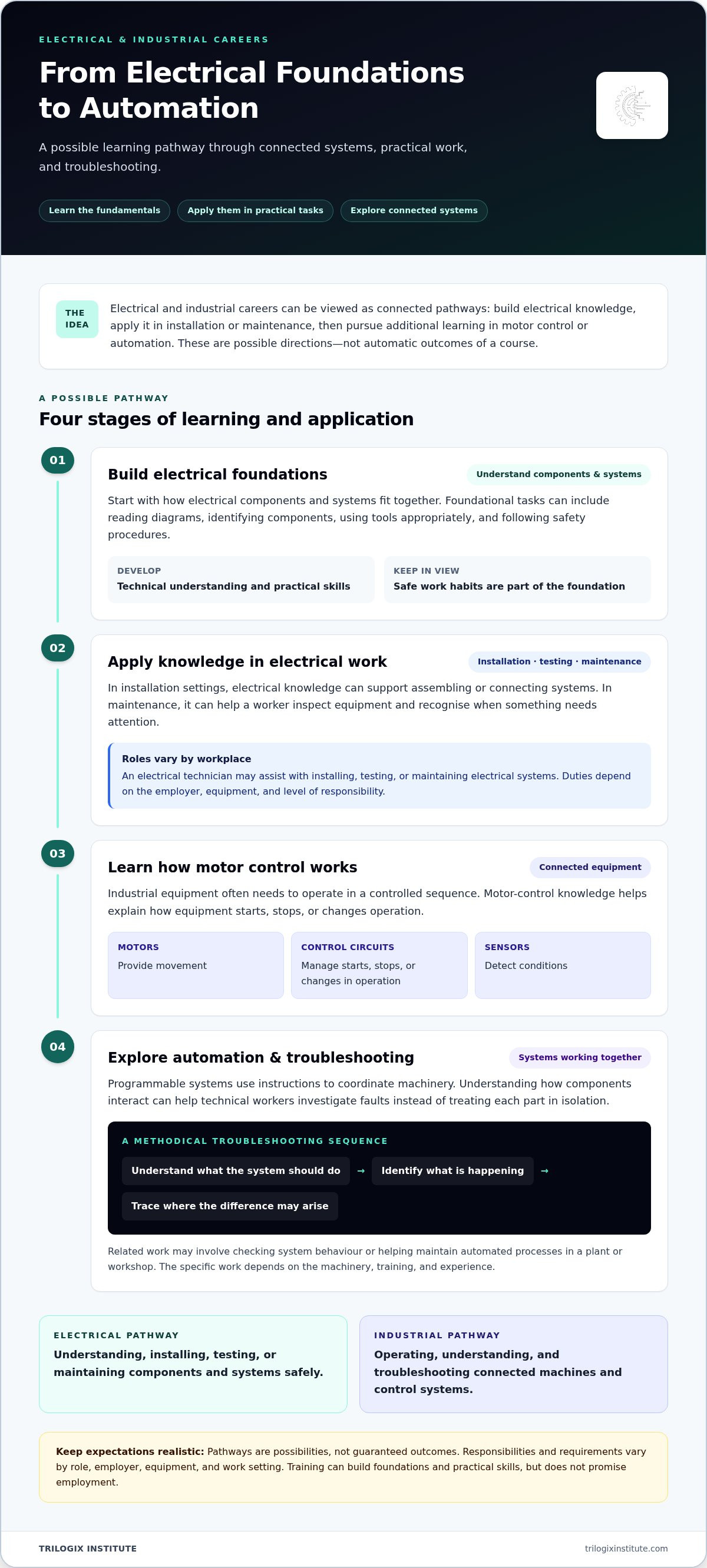
Electrical and industrial careers are easier to compare when you view them as connected pathways. A worker may build a foundation in electrical principles, apply it in installation or maintenance, and then pursue additional learning in motor controls or automation. These are possible directions, not automatic outcomes of completing a course. Each role has its own responsibilities and workplace expectations.
Electrical engineering and electrical technician pathways
Electrical work starts with understanding how components and systems fit together. Foundational tasks can include reading diagrams, identifying components, using tools appropriately, and following safety procedures. In installation settings, this knowledge can support assembling or connecting systems; in maintenance, it can help a worker inspect equipment and recognise when something needs attention.
With further experience and role-specific preparation, people may explore electrical technician or maintenance work in different environments. Duties depend on the employer, equipment, and level of responsibility. Trilogix Institute's Foundation Electrical Engineering training provides a focused route for developing foundational electrical knowledge and practical skills.
Pathway summary: Electrical roles centre on understanding, installing, testing, or maintaining components and systems safely.
Industrial motor control and automation pathways
Industrial settings add another layer: equipment often needs to operate in a controlled sequence. Motors provide movement; control circuits manage how equipment starts, stops, or changes operation. Sensors detect conditions, while programmable systems use instructions to coordinate machinery. Understanding how these parts interact helps technical workers investigate faults instead of treating each component in isolation.
Related roles may involve supporting motor-control equipment, checking system behaviour, or helping maintain automated processes in a plant or workshop. Troubleshooting calls for methodical observation: understand what the system should do, identify what is happening, and trace where the difference may arise. The specific work depends on the machinery and the worker’s training and experience. Explore the Industrial Automation Specialization Course: The 2026 Professional Buying Guide for more context on this area.
Pathway summary: Industrial motor control and automation focus on operating, understanding, and troubleshooting connected machines and control systems.
Electrical knowledge can provide useful context for learning controls, but progression takes practice and further role-specific development. Instructor-led training with equipment helps learners apply concepts in a guided setting. Trilogix Institute offers the TITP Beginner Essential Industrial Motor Control course and Industrial Automation Specialization. Explore electrical and industrial training courses to compare focused practical learning options.
How to compare skilled-trade careers before choosing a direction
Job titles can hide important differences. Compare roles by what you would do each day, where you would work, which practical skills you would use, and how you might learn them. This makes career paths for skilled trades easier to assess against your strengths, preferences, and circumstances.
Which practical skills and working conditions suit you?
Start with the kind of problem you enjoy solving. Do you prefer tracing a fault, working precisely from a drawing, coordinating equipment, or preparing food to a consistent standard? Consider whether you like varied tasks or a repeatable workflow, working independently or as part of a team, and handling tools or technical equipment.
Then picture the setting. Electrical work may involve installation or maintenance tasks; automation roles can centre on equipment and control systems; drafting supports design work through technical drawings; culinary work involves food preparation in a kitchen. Physical demands, noise, temperature, time pressure, and time spent standing or at a workstation differ by role and employer. Evaluate these conditions role by role rather than assuming all trade work is site-based or equally physical.
| Pathway | Typical practical focus | Possible work setting |
|---|---|---|
| Electrical | Reading diagrams, identifying components, supporting installation or maintenance | Sites, workshops, or facilities |
| Automation | Understanding control systems and investigating equipment behaviour | Plants or industrial workshops |
| Drafting | Preparing or revising technical drawings with design software | Office or project environment |
| Culinary | Preparing ingredients and dishes with attention to timing and consistency | Professional kitchen |
Use the table as a first comparison, not a complete job description. For a construction-sector perspective on workforce development, the Associated General Contractors of America shares construction workforce development information. Its US context should not be treated as a guide to UAE requirements.
What qualifications or credentials might a role require?
Entry requirements vary across occupations, employers, and jurisdictions. A course can help build knowledge and practical skills, but completing it does not automatically confer a licence, regulated credential, or employer-specific qualification. Before committing to a route, review current job descriptions and verify applicable UAE requirements with the relevant authority. Distinguish general skills from any credential required for a particular role.
How to prepare for a skilled-trade career: a practical action plan
Turn an interest into a plan you can act on. The aim is not to commit to a job title immediately, but to identify a direction, understand the work, and build relevant skills step by step.
- Assess your preferences. Note the tasks you enjoy, the equipment or materials that interest you, and the working conditions you’re comfortable with. Include tasks you would rather avoid.
- Choose one or two role families. Narrow your options to areas such as electrical work, industrial automation, drafting, or culinary work. Compare day-to-day duties, not just job titles.
- Research real job descriptions. Look for recurring tasks, tools, technical knowledge, teamwork expectations, and any stated experience or credentials. Separate common capabilities from requirements specific to an employer or role.
- Map your current skills. Match what you already know to the practical capabilities described. Identify one or two gaps to work on, such as interpreting technical diagrams, understanding control circuits, or using relevant design software.
- Set a focused learning goal. Choose a specific, measurable step that fits your starting point, such as guided practice in a defined technical topic or documenting a project. Review your progress and adjust the plan as you learn more.
Turn a career interest into a focused learning plan
Keep the plan manageable. For each role family, list the tasks that attract you and the ones that raise questions. Connect your skill gaps to practical learning activities. For example, someone exploring electrical or industrial work could focus on understanding components, diagrams, or motor-control concepts. A clear goal helps you choose training for a reason instead of collecting courses without a defined direction.
Build practical evidence of what you can do
Record projects, supervised exercises, tools used, and problems solved. Describe the task, the steps you took, and what you learned. These notes can help you explain your progress to an instructor or discuss relevant experience with an employer. Keep the evidence accurate and within the scope of your practice. A portfolio or course certificate can demonstrate learning, but it does not replace any licence, regulated credential, or employer-specific requirement that a role may have.
Practical, instructor-led learning with equipment gives you a guided setting to apply technical concepts and practise tasks. Trilogix Institute offers focused training in electrical engineering, industrial motor control, and industrial automation. Explore relevant technical training courses and consider how they fit your learning plan.
Build trade-ready skills through focused, hands-on training
Once you’ve identified the tasks and capabilities that interest you, choose learning that lets you practise them. Instructor-led, equipment-based training connects technical concepts to practical exercises: learners can work through a task, observe how components respond, and build understanding with guidance. For people comparing career paths for skilled trades, that practical connection can help clarify which skills to develop next.
What hands-on technical training can help you practise
Electrical engineering provides a foundation for understanding components, diagrams, and how electrical systems work. Guided practice helps you apply those concepts to equipment and structured exercises, rather than leaving them as theory alone.
From there, focused learning in motor control and automation can extend your technical understanding. Motor-control practice can introduce how circuits govern a motor’s operation, while automation learning can build familiarity with how equipment and control systems work together. These are relevant areas to explore if your target roles involve industrial equipment, but training alone does not qualify you for every job or establish that you meet a particular employer’s requirements.
For another perspective on education choices, see Vocational Training vs. University Degree: Choosing Your Path in 2026. Consider how each learning route fits your goals, preferred way of learning, and the practical capabilities you want to build.
Choose a learning environment that supports practical progress
Instructor guidance can help you work through unfamiliar concepts and understand the purpose behind each exercise. Access to equipment gives you a setting to apply those concepts, while structured activities help you build skills in a deliberate sequence. The value lies in connecting what you learn to the tasks you’re preparing to perform.
Before choosing a course, compare its learning objectives with the role tasks you identified earlier. Ask yourself: will the content help me understand electrical fundamentals, practise motor-control concepts, or develop familiarity with automation? A focused match makes it easier to see what the training is designed to teach and what you may still need to learn through further study or workplace experience.
Training can support preparation, but it cannot guarantee employment. Hiring decisions depend on factors beyond course completion, and some roles may have separate experience, credential, or employer requirements. Treat training as one practical step in a broader plan, not a promise of a job outcome.
Compare course content with the skills you want to develop and the tasks you want to practise.
Choose a practical next step
The right direction starts with the work itself. Compare roles by their daily tasks, setting, and practical skill requirements, then use real job descriptions to identify capabilities worth developing. Career paths for skilled trades can also build over time: electrical foundations may support further learning in areas such as motor control and automation, though each role has its own requirements.
Focused training is one way to turn an interest into guided practice. Instructor-led electrical engineering learning can help you apply technical concepts, while industrial motor control and automation offer further areas to explore. Training supports preparation, but it cannot guarantee employment or replace credentials a particular role may require.
Choose a learning goal that fits your starting point and compare course content with the tasks you want to practise. Explore Trilogix Institute’s focused, hands-on technical training in electrical engineering, industrial motor control, and automation.
Frequently Asked Questions
What are the best career paths for skilled trades?
There’s no single best option. Compare career paths for skilled trades by the work involved: electrical roles may focus on systems and components, industrial maintenance on equipment, automation on control systems, construction on building tasks, and culinary work on food preparation. Consider which tasks interest you, the settings where you’d prefer to work, and the skills you want to develop. The right fit depends on your strengths, preferences, and the requirements of the specific role.
Can you start a skilled-trade career without a university degree?
Yes, some trade routes focus on practical training and role-specific credentials rather than a university degree. However, entry requirements differ by occupation, employer, and jurisdiction, including within the UAE. Check current requirements for the role and location you’re considering, and distinguish course completion from any separate licence or credential that may apply. Training can help you build relevant skills, but completing a course alone does not guarantee employment.
Which skilled trades are best for beginners?
No trade is best for every beginner. Start by comparing foundational electrical work, maintenance, automation, construction, culinary work, and other practical pathways according to their tasks, working conditions, and entry requirements. Review job descriptions to see what each role expects, then choose one skill area to explore first. A focused start, such as learning electrical fundamentals, can help you test your interest before committing to a broader plan.
How do I choose the right skilled trade for me?
Compare everyday tasks, work settings, practical strengths, physical demands, and learning requirements. Review several job descriptions and note which responsibilities recur, such as equipment checks, technical drawing, troubleshooting, or food preparation. Instructors can help you understand the skills involved. Then set a small learning goal, such as practising one foundational concept, before making a longer-term career plan.
Does vocational training guarantee a job in a skilled trade?
No, vocational training cannot guarantee a job. Practical instruction may help you develop skills relevant to a trade, but employment also depends on role requirements, your experience, employer needs, and wider market conditions. Treat a course as preparation, not a placement promise. Before enrolling, compare its learning objectives with the capabilities in relevant job descriptions and identify any additional experience or credentials the specific role may require.
What skills are important for skilled-trade jobs?
Important skills include trade-specific technical ability, safety awareness, careful problem-solving, communication, and reliability. The balance varies by occupation. Electrical and automation roles may involve diagnostic thinking and understanding how components interact, while culinary work calls for different practical skills, such as accurate preparation and coordination. Look at job descriptions for examples of tasks and tools, then use them to identify capabilities to practise for your chosen direction.
Is hands-on training useful for a skilled-trade career?
Yes, supervised hands-on practice can help you apply concepts, use equipment, and become familiar with practical tasks. Its value depends on how closely the exercises match skills relevant to your target role. Trilogix Institute offers instructor-led training in electrical engineering, industrial motor control, and automation for guided practice in technical topics. Practical training supports preparation, but it does not replace any credential a role may require or guarantee employment.


