

A course can promise practical skills yet offer little opportunity to practise. The value of hands-on skills training programs depends on more than the word “practical”: look for relevant tasks, instructor guidance, useful feedback, and skills you can demonstrate. These details help you decide whether a program fits your goals, rather than relying on a course title alone.
This guide explains how to assess practical instruction, compare course content with the abilities you want to build, and choose a focused next step. It also shows how instructor-led, equipment-based learning can connect technical concepts with applied work. Trilogix Institute offers vocational training in electrical engineering, industrial automation, AutoCAD, motor control, and culinary arts. Each path serves a different learning goal. Match the subject and level to what you want to learn, and remember that training can support job readiness but cannot guarantee a job.
Key Takeaways
- Assess hands-on skills training programs by the practice they include, the guidance learners receive, and the skills they can demonstrate.
- Compare learning objectives, practice tasks, equipment or materials, instructor support, and assessment.
- Look beyond course length: time spent in training doesn’t show how much meaningful practice it provides.
- Align your subject choice with your goals, whether you’re exploring electrical engineering, automation, motor control, AutoCAD, or culinary arts.
- Choose a focused next step by defining the skill you want to build and matching it to your current experience.
What Makes Hands-On Skills Training Programs Different?
Hands-on training combines instruction with opportunities to practise relevant tasks, tools, or techniques and apply feedback. Learners engage with the process rather than only hearing how a task should be done. This active participation distinguishes hands-on skills training programs from courses focused mainly on reading, presentations, or discussion of concepts.
Applied learning and theory work together: concepts explain why a technique or process matters, while practice gives learners a chance to use that knowledge. Vocational education includes learning designed to prepare people for specific occupations and fields. In a practical program, instruction connects to relevant activity, so information becomes a starting point for developing capability.
What counts as practical learning in a training program?
Look for activities that match the skills being taught. Depending on the subject, learners might use tools or equipment, complete a task, produce a piece of work, or work through a troubleshooting scenario. An instructor can demonstrate the steps first, then guide learners as they practise. Activities should relate directly to the program’s objectives, not just appear in the course description as a general promise of “practical learning.”
To assess a course description, ask yourself: what will I actually do? “Learn about technical processes” names a topic. “Practise applying a process” describes active learning. Specific descriptions make it easier to distinguish exposure to information from opportunities to develop a skill.
Who benefits from instructor-led skills training?
Structured instruction can suit both people new to a field and working professionals, though their needs may differ. A beginner may want a clear introduction to a vocational subject; someone with experience may want to strengthen or update a particular capability. Compare your background with the course level and learning objectives so you choose a suitable starting point.
Instructor-led learning adds guidance to practice. An instructor can demonstrate a method, clarify a concept, and help learners approach a task. Trilogix Institute provides vocational training in electrical engineering, industrial automation, AutoCAD, motor control, and culinary arts, with different subject areas for different skill goals.
- Active participation: Learners perform tasks rather than only observe or read.
- Relevant practice: Activities connect directly to the skills the program aims to develop.
- Guided instruction: Demonstrations and direction help learners approach practical work with clarity.
How Hands-On Skills Training Turns Concepts into Practice
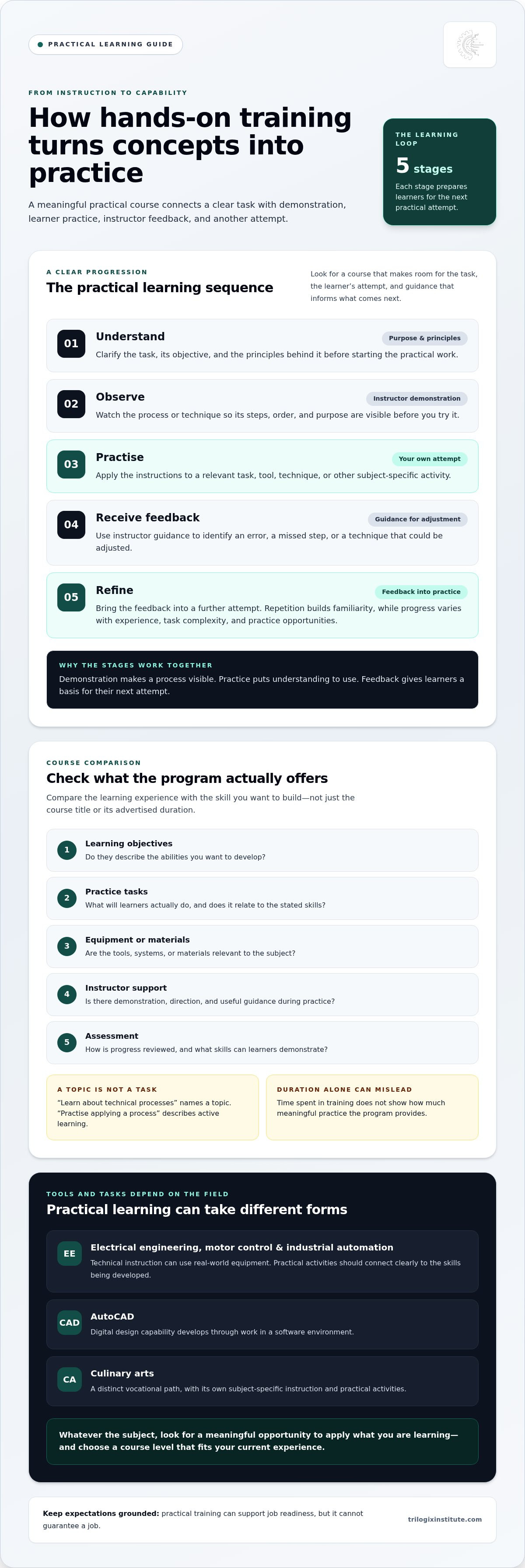
Practical learning works best as a sequence, not a one-off activity. Learners understand the task and its purpose, observe an instructor demonstrate the process, then practise and use feedback to improve. This progression gives concepts a practical context and makes each stage easier to follow.
- Understand: Clarify the task, its objective, and the principles behind it.
- Observe: Watch a demonstration of the process or technique.
- Practise: Apply the instructions to a relevant task or tool.
- Receive feedback: Identify errors or adjustments with instructor guidance.
- Refine: Use that feedback in a further attempt.
Why demonstrations, practice, and feedback work together
A demonstration makes a process visible before learners try it themselves. It can clarify the order of steps, the purpose of a technique, and details that may be difficult to grasp from a written explanation alone. Practice puts that understanding to use. Instructor feedback can highlight a missed step or a technique to adjust, giving learners a clear basis for their next attempt.
Guided practice connects an explained task to a demonstration, a learner’s own attempt, and instructor feedback, so learners can identify adjustments and apply them in later practice. Repetition builds familiarity, but progress varies with prior experience, task complexity, and opportunities to practise. A sound program supports development without implying that everyone reaches the same level at the same pace.
What equipment-based learning can look like
For technical instruction, relevant equipment or realistic task materials give learners a way to engage with tools and systems related to their subject. Trilogix Institute’s training includes electrical engineering, motor control, and industrial automation, with instructor-led technical courses using real-world equipment. Practical activities should connect clearly to the skills the program aims to develop.
Not every practical skill involves physical equipment. AutoCAD develops digital design capability through work in a software environment, while culinary arts is a separate vocational path with its own subject-specific instruction. The relevant tools and tasks differ by field, but learners still need a meaningful opportunity to apply what they’re learning.
Explore Trilogix Institute’s instructor-led vocational courses to compare its subject areas. Strong hands-on skills training programs connect instruction, practice, and feedback to a defined skill goal.
How to Compare Hands-On Skills Training Programs
Course titles and advertised duration don’t show how much meaningful practice a program includes. Compare what learners will work on, how instruction is delivered, and how progress is reviewed. Use these criteria to judge whether a course’s stated outcomes match the skills you want to practise.
Learning objectives: Do they describe specific capabilities, or rely on broad promises such as “career readiness”?
Practice tasks: What will learners actually do, and does the activity connect to your intended skill area?
Instructor guidance: Does the course include demonstration, direction, or feedback during practice?
Equipment or materials: Are the tools, systems, software, or other materials relevant to the subject?
Assessment: How will learners review or demonstrate their progress?
Compare the answers across programs instead of judging by one feature. A longer course isn’t automatically more practical: its schedule doesn’t show how much time is devoted to applied tasks or how useful the guidance is. A short course may have focused objectives, but its title alone won’t tell you whether the practice fits your goals. Look for clear descriptions of learner activities and how each activity supports the course outcomes.
Which signs indicate a genuinely practical program?
Useful indicators include specific learner activities, instructor guidance, and opportunities to apply concepts. Check whether the practice materials fit the subject and your intended skill area. For instance, someone aiming to develop digital design capability should look for design practice, while someone interested in technical systems should look for activities related to those systems. A general promise of practical skills is less informative than a clear account of what learners practise.
How to assess certificates, outcomes, and career claims
Read credentials and outcomes precisely. A certificate of completion records participation or completion according to a program’s terms; it isn’t automatically a professional licence or an academic degree. Don’t assume accreditation or external recognition without reliable information about the specific credential.
Training can help develop skills, but it can’t guarantee employment. Hiring outcomes may depend on a person’s skills, experience, qualifications, and individual circumstances, as well as employer requirements. Assess a program on the instruction and practice it provides, and treat job guarantees cautiously. Strong hands-on skills training programs connect their stated outcomes to the practical capabilities you want to build.
Which Practical Training Path Fits Your Skill Goals?
The right path depends on what you want to learn to do, not just which subject sounds interesting. Foundation electrical engineering, control systems, digital drafting, and culinary training develop different kinds of practical knowledge. Compare the subject focus with your current experience and the tasks you want to become more confident tackling.
Technical training paths: electrical, automation, and motor control
Foundation Electrical Engineering suits learners seeking a grounding in electrical concepts and practical capability. It can provide a starting point for people exploring the field or building their understanding before more focused technical learning.
Industrial automation is a distinct path for learners interested in automated systems and technical processes. Trilogix Institute’s Industrial Automation Specialization focuses on this subject. Motor control narrows the focus to control-related learning; the Beginner Essential Industrial Motor Control course offers a beginner-level entry point. Consider whether your goal is foundational knowledge, automation systems, or an introduction to motor control. For more on electrical engineering as a learning path, read our electrical engineering career readiness guide.
Design and culinary paths: AutoCAD and professional kitchen skills
Advanced AutoCAD 2D & 3D suits learners who want to develop digital design and drafting skills. Its tools and outputs differ from equipment-based engineering instruction: the focus is working in a design environment and building capability with 2D and 3D drafting. If technical drawings are closer to your goal than electrical or control systems, this may be a better fit.
Professional Culinary Arts offers a separate vocational path for learners drawn to culinary practice rather than technical engineering or digital design. The subject has its own tools, techniques, and learning objectives. Choose it based on your interest in developing culinary capability, not simply because you want a hands-on course.
Use this quick match to narrow your options:
- Build foundational electrical knowledge: consider foundation electrical engineering.
- Explore automated systems: consider industrial automation.
- Focus on control systems: consider motor control.
- Develop digital drafting capability: consider AutoCAD.
- Learn in a culinary field: consider professional culinary arts.
Hands-on skills training programs are most useful when their subject and level align with a clear learning goal. Review Trilogix Institute’s vocational course options to find a practical path that fits the skills you want to develop.
Take the Next Step Toward Practical Skills Training
Choosing a program gets easier when you turn a broad ambition into a defined learning goal. Identify the capability you want to build, consider your starting experience, and compare the course subject, stated outcomes, and practical learning with that goal. Then choose a path that fits what you want to practise now.
A practical checklist before selecting a program
Use this sequence to focus your comparison:
- Name the skill goal: Write down a task or capability you want to perform more confidently.
- Identify your starting level: Consider related experience and whether the course is designed for beginners or a more advanced learner.
- Compare the practice: Look for activities, tools, equipment, or software relevant to your goal, along with instructor guidance.
- Select a path: Choose the subject whose outcomes and learning approach best align with your next step.
This approach keeps the decision grounded in learning fit rather than broad promises about career outcomes. Training can help you develop practical capability, but employment depends on more than course participation. Treat a program as a focused step in your development, not a guarantee of a particular job.
Explore instructor-led training at Trilogix Institute
Trilogix Institute offers instructor-led vocational learning across electrical engineering, industrial automation, AutoCAD, motor control, and culinary arts. These areas support different goals, from building a foundation in electrical engineering to exploring automation, developing digital drafting skills, or pursuing culinary training. Choose the option that matches your intended skill and current experience.
Review the Trilogix course overview to compare subject areas and identify a relevant next step. Consider course content alongside your own goals when deciding which learning path fits.
Keep the decision practical: define what you want to learn, match it to an appropriate path, and choose training that supports that aim through instructor-led, subject-specific learning. A clear goal makes it easier to move forward one focused skill at a time.
Choose a Practical Path That Moves You Forward
The most useful training choice starts with a clear skill goal. Look beyond course titles and compare what you’ll practise, the guidance you’ll receive, and how the program’s outcomes align with your experience. That’s how you can judge whether hands-on skills training programs support the capabilities you want to develop.
Trilogix Institute provides instructor-led technical and vocational training across electrical engineering, industrial automation, AutoCAD, motor control, and culinary arts. Each area offers a distinct learning direction, so focus on the subject that best fits your next step. Training can build practical capability, but it doesn’t guarantee employment.
Ready to explore your options? Explore Trilogix Institute training programs and choose a focused path for your goals. With a clear objective and purposeful practice, you can take your next learning step with confidence.
Frequently Asked Questions
What are hands-on skills training programs?
Hands-on skills training programs combine instruction with opportunities to practise tasks, techniques, or tools relevant to a subject. Instead of only reading or listening, learners apply concepts through guided activity and can use instructor feedback to refine their approach. Practical learning varies across fields: it may involve technical equipment, digital design work, or vocational subject instruction. The key is that practice supports the skills the program aims to develop.
Are hands-on training programs better than online courses?
Neither format is automatically better; the right choice depends on your learning goal and the kind of practice required. Online courses can suit theory or digital tasks, while equipment-based technical skills may call for access to relevant tools and instructor guidance. Compare what you will actually practise, how feedback is provided, and whether the format fits your subject. A course’s delivery label alone doesn’t establish its practical value.
How do I know if a training program includes enough practical experience?
Look for specific descriptions of learner activities, not only broad claims about career readiness. Check which tasks or tools learners will use, how instructors guide practice, and how activities relate to the stated outcomes. Consider whether those skills match your goal. Course length alone doesn’t show how much time is devoted to practice or whether that practice is relevant.
Can hands-on vocational training help me change careers?
Vocational training can help you build or strengthen practical skills for a career change, especially when the subject aligns with the field you want to enter. Start by identifying relevant capabilities, then compare the program’s learning objectives and practice with your current experience. Training is one part of a transition; hiring decisions can also depend on experience, qualifications, employer requirements, and individual circumstances. It can support preparation, but can’t promise a role.
Do skills training programs guarantee a job after completion?
No. Completing a training program can help you develop subject-specific knowledge and practical capability, but it doesn’t guarantee employment. Hiring outcomes depend on factors such as your skills, experience, qualifications, and the requirements of individual employers. Evaluate a program based on its instruction, practice opportunities, and relevance to your learning goals. Be cautious about interpreting career preparation claims as a promise of a job or placement.
What should I look for in an instructor-led technical training program?
Look for clear learning objectives, relevant practice, instructor demonstration or guidance, and opportunities to apply concepts. The course subject and materials should match the capability you want to build and your starting level. Read stated outcomes carefully, and distinguish practical skill development from claims about credentials or employment. A focused program makes it easier to understand what you’re learning and how the instruction relates to your goal.
Which hands-on training programs cover electrical engineering or industrial automation?
Trilogix Institute offers instructor-led training in both areas. Foundation Electrical Engineering suits learners seeking foundational electrical knowledge, while the Industrial Automation Specialization focuses on automation as a distinct technical subject. Beginner Essential Industrial Motor Control offers another related path for those interested in controls. Compare each subject with your experience and goal, then review the course information to choose a relevant next step.


