

What if the best upskilling course isn’t the one with the broadest syllabus, but the one that helps you solve a real task at work? Choosing among upskilling courses for engineers can feel difficult when technical priorities compete and course descriptions don’t explain how learning translates into practice.
That concern is well founded. New knowledge matters most when it addresses a specific skills gap and gives you a way to apply and demonstrate what you’ve learned. A theory-focused course may explain a concept, but practical development also requires opportunities to work through relevant tasks.
This guide will help you identify an engineering skills gap, compare training formats and plan how to apply new skills in your role. You’ll learn how to connect learning goals to day-to-day work, assess whether a course includes practical development and keep evidence of your progress. For engineers focused on electrical systems, industrial automation, motor control or AutoCAD, instructor-led, equipment-based training can provide a practical way to develop job-relevant skills.
Key Takeaways
- Use changes in equipment, software or work processes to pinpoint a capability gap that matters to your role.
- Compare upskilling courses for engineers by feedback, practice opportunities, flexibility and the learning goal they support.
- Turn a broad learning aim into a task-based goal connected to an actual workplace responsibility.
- Use a five-step checklist to assess subject fit, learning methods and how you’ll apply new skills.
- Explore how instructor-led, equipment-based training in electrical engineering, AutoCAD, automation or motor control can support applied skill development.
Why engineers pursue upskilling courses as technical work changes
Engineering roles evolve as equipment, software and work processes change. A new control system, revised maintenance workflow or different design tool can alter what a task requires, even when an engineer’s job title stays the same. This can reveal a focused skills gap: you may understand the underlying principles but need practice with a specific tool or a changed task.
Engineering upskilling is structured development of technical capabilities relevant to an engineer’s current or emerging work. It targets a defined need rather than requiring a complete career change or another degree. The concept of upskilling reflects how technological change can make it valuable to refresh or develop knowledge. Technical learning builds a capability, but it shouldn’t be treated as a promise of promotion or a guaranteed job outcome.
The right subject depends on the work in front of you. An engineer responsible for electrical systems may want to strengthen their understanding of electrical principles or motor control. Someone working with automated processes may need to develop familiarity with industrial automation. In technical design, the gap might involve creating or interpreting drawings in AutoCAD. These are different learning needs, so the most useful upskilling courses for engineers match real responsibilities rather than simply covering a popular subject.
Start by describing the task you want to perform more effectively. This gives you a concrete basis for assessing course relevance and defining progress. Trilogix Institute’s technical course areas include electrical engineering, industrial automation, motor control and AutoCAD, connecting these subjects with applied vocational training. Explore the technical training course areas and match them to the capability you want to build.
Which changes can create an engineering skills gap?
A skills gap can emerge when a workplace introduces new systems, updates procedures or assigns responsibilities that involve unfamiliar technical work. For example, an electrical engineer may encounter equipment that requires knowledge they haven’t used in their current role. An automation task may call for understanding how control components work together, while a design workflow may require producing or revising technical drawings with software. The priority depends on your actual duties.
How can engineers identify what to learn next?
Compare the tasks you handle confidently with those you need, or expect, to take on. Note recurring technical challenges, unfamiliar tools and upcoming responsibilities. Then write one observable objective before searching for a course, such as “interpret a technical drawing” or “explain the steps in a motor-control task.” A clear objective helps you judge whether a course’s stated learning aims fit the work you need to do.
How practical engineering training turns concepts into usable skills
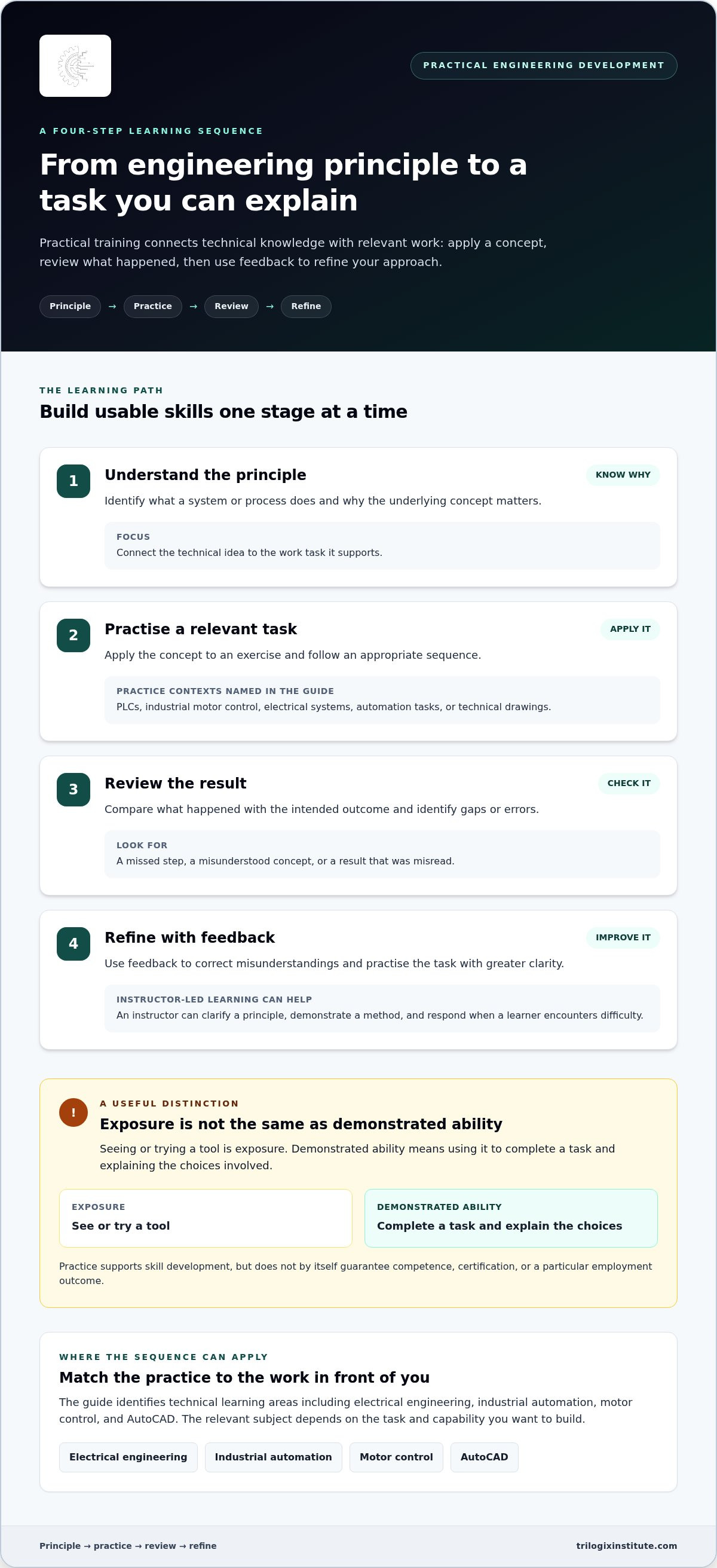
Practical engineering training helps participants apply technical concepts to relevant tasks. Instead of stopping at an explanation or demonstration, learners work through a task, examine the result and use feedback to refine their approach. This connects technical knowledge with the decisions and actions a task requires.
A useful learning sequence moves from principle to performance:
- Understand the principle. Identify what a system or process does and why the underlying concept matters.
- Practise a task. Apply that concept to a relevant exercise and follow an appropriate sequence.
- Review the result. Compare what happened with the intended outcome and identify gaps or errors.
- Refine the approach. Use feedback to correct misunderstandings and practise the task with greater clarity.
Exposure means seeing or trying a tool; demonstrated ability means using it to complete a task and explaining the choices involved. That distinction matters when comparing upskilling courses for engineers: a course can introduce a concept, while guided practice gives learners a chance to work through its application. Practice supports development, but it doesn’t by itself guarantee competence, certification or a particular employment outcome. The National Science Foundation’s discussion of engineering workforce development also considers education and workforce needs as part of the broader effort to develop engineering capability.
What makes instructor-led learning useful for technical subjects?
An instructor can clarify how a technical principle relates to a task, demonstrate a method and respond when a learner encounters difficulty. Feedback during practice can help identify whether an error comes from misunderstanding a concept, missing a step or misreading a result. Trilogix Institute’s technical programs use instructor-led learning, with applied skills development in electrical engineering, AutoCAD, industrial automation and motor control.
Why does equipment-based practice matter?
Hands-on exercises let learners engage with relevant tools or systems rather than relying only on verbal explanations. PLCs and industrial motor control, for example, provide technical contexts for exploring how components and control logic relate to a task. The goal isn’t simply to handle equipment. Learners should also be able to describe the task, explain its sequence and give a reason for key decisions. That makes their process easier to review and improve.
When assessing a learning format, look for a clear connection between the concept taught, the task practised and the feedback provided. Those elements help you judge what you’re learning and how it relates to your work. Explore practical training in these technical areas through Trilogix Institute’s technical courses.
Compare engineering upskilling courses by learning format and skill area
The right learning format depends on what you need to do after studying. An engineer developing a hands-on technical procedure may need guided practice and feedback. Someone reviewing concepts or looking up reference material may value flexible access. A university-degree program serves a broader, longer-term educational goal. Compare these routes against the capability you want to develop rather than treating one as best for everyone.
| Learning format | Feedback | Practice opportunities | Flexibility | May suit |
|---|---|---|---|---|
| Instructor-led practical course | Questions and guidance can be addressed during instruction and practice. | Guided tasks may involve relevant tools, systems or technical exercises. | Learning follows a scheduled structure. | Developing an applied skill or practising a technical task with guidance. |
| Self-paced online study | Feedback may be limited or delayed, depending on the learning material. | Practice may rely on simulations, exercises or independent work. | Learners can often study at their own pace and revisit material. | Reviewing concepts or accessing reference material around other commitments. |
| University-degree program | Feedback is provided through the program’s teaching and assessment structure. | Practice and project work depend on the program and subject. | Usually follows a longer, structured study pathway. | Broader academic study and a sustained educational goal. |
Which course format fits a hands-on technical goal?
If your goal involves performing a procedure or working with a system, consider whether you need to practise the task, receive feedback and review your approach. Equipment-based learning can suit applied technical subjects. Online study can offer convenient access to explanations and reference material, but the format should match the skill: if your objective is task performance, look for opportunities to practise, not just recall concepts.
How do engineering course subjects differ in application?
Electrical engineering can build understanding of relevant electrical concepts and technical work. AutoCAD focuses on design and drafting capabilities, such as creating or interpreting technical drawings. Industrial automation addresses automated systems and processes, while motor control focuses on the operation and control of motors. These areas can overlap in workplaces, but they represent distinct learning goals. Trilogix Institute provides instructor-led, equipment-based technical training across these subject areas.
Make your comparison specific: name the task you want to carry out, then look for a course format and subject that support it. A drawing-related objective points toward design and drafting, while a goal involving motor operation points toward motor control. Trilogix Institute’s technical course areas include electrical engineering, AutoCAD, industrial automation and motor control. Comparing upskilling courses for engineers this way keeps the decision focused on practical fit, without assuming every learning need calls for the same format or level of study.
Choose an upskilling course with a practical five-step checklist
A course decision becomes clearer when you connect it to a task, not just a broad ambition. Use this checklist to assess whether the subject, learning method and intended application align with the capability you want to develop.
- Define the skills gap. Identify a technical task that currently takes extra support, causes recurring difficulty or falls outside your experience. Name the specific knowledge or ability that would help you handle it.
- Set a task-based goal. Describe what you want to be able to do after training. For example, aim to interpret a particular type of technical drawing or explain the steps involved in a motor-control task.
- Compare subject fit. Read the stated learning objectives and map each relevant objective to a real work task. Electrical engineering, AutoCAD, industrial automation and motor control address different learning needs, so choose the subject that matches your goal.
- Assess the learning method. Consider how instruction, practice and feedback relate to the subject. If you need to develop an applied skill, look for a clear link between concepts and opportunities to practise, rather than relying on topic titles alone.
- Plan application. Decide where you’ll use or demonstrate the learning, what evidence you can keep and how you’ll review your progress. A simple plan helps you move from course activity to workplace capability.
How can engineers assess course relevance before enrolling?
Check whether the course objectives describe capabilities tied to a technical task or responsibility you want to develop. Look for a sensible progression from concepts to practice, and consider whether the stated starting level fits your experience. If the objectives are broad, translate them into a practical question: “Which task should I be better prepared to perform?” This helps distinguish relevant development from interesting but unrelated content.
For subject comparison, Trilogix Institute’s technical courses and training areas include electrical engineering, AutoCAD, industrial automation and motor control. Match a course area to your defined objective, then consider how instructor-led, equipment-based learning relates to the skill you want to practise.
How can learners make new skills visible at work?
Keep a brief record of exercises completed, tools or systems used, decisions made and problems addressed. Describe those tasks accurately in a portfolio, performance review or professional discussion, including what you practised and what you can now explain or demonstrate. Be precise: completed learning activities show development, but shouldn’t be presented as a formal credential unless one has actually been awarded.
Use your five-step checklist to compare upskilling courses for engineers against the work you need to do. Explore the technical courses and training areas and connect a defined skills goal with relevant applied training.
Build an engineering upskilling pathway with Trilogix Institute
Once you’ve defined the capability you want to build, choose a training area that aligns with it. Trilogix Institute’s specialised vocational programs connect technical subjects with instructor-led, equipment-based learning. This gives learners a structured setting to develop practical skills, ask questions and work through relevant exercises. Training supports development, but it doesn’t guarantee a job, promotion or a particular career outcome.
Match the training area to the capability you want to build
Start with the task or knowledge area, then compare it with a relevant course focus. Look for a clear fit between your learning objective and the subject, rather than choosing a broad course based only on your job title.
- Foundation Electrical Engineering: Consider this area if you want to strengthen foundational electrical knowledge relevant to your technical responsibilities. For additional context on electrical learning and career readiness, read the electrical engineering career-readiness guide.
- Advanced AutoCAD 2D & 3D: This subject area suits objectives centred on technical drafting and design tools, such as developing your ability to create or work with technical drawings.
- Industrial Automation Specialization: Explore this focus if your learning goal relates to automated industrial systems. The industrial automation specialization guide offers further context for readers considering this technical area.
- Beginner Essential Industrial Motor Control: This area is relevant if you want to develop knowledge related to industrial motor-control tasks. Keep the objective specific, such as understanding a process or building familiarity with its technical principles.
These areas address different interests. Electrical engineering supports foundational technical learning, AutoCAD focuses on design and drafting tools, automation concerns automated systems, and motor control has its own distinct focus. Matching the course area to your task makes your search more deliberate.
Take the next step with a clear learning objective
Before choosing a pathway, write a short objective that states what you want to learn and why it matters to your work. For example: “I want to strengthen my electrical engineering knowledge so I can better understand the technical tasks in my role.” Then compare course topics with that objective. Look for a connection between the subject, instruction and practical learning approach, rather than relying on a course title alone.
Use this process to assess upskilling courses for engineers for relevance and application. A focused learning goal gives you a practical basis for reviewing options and identifying what you want to practise. Explore practical engineering training at Trilogix Institute to take the next step toward a technical learning pathway aligned with your objective.
Turn your next learning goal into action
Your next step doesn’t need to be a complete career plan. Choose one technical capability that would make a real task clearer or more manageable, then decide how you’ll apply what you learn. A focused objective gives you a way to measure progress through what you can explain, demonstrate or document.
As you evaluate upskilling courses for engineers, consider whether the learning approach supports the capability you want to build. Trilogix Institute’s instructor-led technical programs use equipment-based practical learning across electrical engineering, AutoCAD, industrial automation and motor control. This provides a structured route to develop applied skills, without making career outcomes the only measure of learning.
Set a clear objective and choose a relevant technical area. Explore practical engineering training at Trilogix Institute and identify a learning pathway aligned with your goals. Each capability you build can help you approach your work with greater clarity and confidence.
Frequently Asked Questions
Can experienced engineers benefit from an upskilling course?
Yes. Experienced engineers can benefit when learning addresses a genuine change in responsibilities, technology or work processes. Their existing experience can help them connect unfamiliar concepts to systems and procedures they already understand. For example, an engineer taking on a revised technical review may need to learn a new way to interpret project information. Define the gap first, then select training that fits it. Course participation alone doesn’t guarantee promotion, a new role or another specific outcome.
How can engineers identify emerging skills they may need?
Review upcoming responsibilities, recurring technical challenges and the tools or systems your work is expected to involve. A project handover or new assignment may reveal a capability you’ll need to contribute effectively. Set a specific learning objective, such as being able to complete a defined analysis, and connect it to your role. A skill’s popularity by itself isn’t a reason to enrol; tie it to a plausible task or development goal.
Are short technical courses enough to build an engineering skill?
A focused course can introduce or develop a defined skill, especially when its topics and exercises align with your objective. For instance, you might use a course to establish a structured approach to a technical activity, then apply that approach in suitable work or further practice. The course is one part of development. Deeper proficiency can take continued application and experience, so don’t assume attendance alone proves mastery, awards certification or establishes job readiness.
How should engineers demonstrate skills gained through training?
Describe the task you completed, the tools or concepts you applied and your own contribution. Keep accurate notes or suitable work samples that show your process, while removing confidential project or employer information. In a review or professional discussion, distinguish what you practised in training from what you’ve applied independently at work. Evidence of learning can support a clear account of development, but it isn’t a formal qualification unless an applicable credential was awarded.
Do upskilling courses replace an engineering degree?
No. Vocational courses and degrees generally serve different learning purposes. A focused technical course can develop a particular applied capability, while a degree provides a broader academic pathway. Neither is an automatic substitute for the other. Consider the education or experience expected for your intended role, then compare those expectations with your learning objective. Trilogix Institute’s vocational programs provide technical training, not university degrees, and suit learners seeking focused development in a subject area.
How often should engineers refresh their technical skills?
There’s no single refresh interval for every engineering discipline or role. Review your skills when responsibilities shift, equipment or software changes, or work practices introduce unfamiliar tasks. Recurring difficulties can also signal that a particular capability needs attention. Rather than enrolling on a fixed timetable, periodically compare your current responsibilities with your development goals. Prioritise the gap that clearly connects to your work, and choose learning with a defined purpose.


