

What if the strongest case for training isn’t what it could do for your career, but how it could support your team’s work? If you’re wondering how to ask your boss to pay for training, it’s reasonable to feel unsure about company policy, available funding, or whether your manager will see the value. A clear, work-focused request gives them something practical to assess.
Start with a specific capability gap. Explain how addressing it could support a work outcome, team priority, or recurring task. Then show that you’ve considered the full commitment, including course costs, time away from regular duties, and scheduling. You don’t need to assume a particular budget or policy. Prepare a concise proposal and thoughtful questions instead.
This guide will help you prepare a business-focused request, anticipate your manager’s concerns, and explore funding and scheduling options. You’ll also learn how to close the conversation with a clear decision or follow-up plan, so you know what to do next whether the answer is yes, no, or not yet.
Key Takeaways
- Choose training by matching its learning outcomes and format to a skill your role requires.
- Build your case around a workplace need, then explain where you could apply the learning without promising results outside your control.
- To learn how to ask your boss to pay for training, prepare a specific request and raise it in a focused conversation or email.
- Be ready to discuss scheduling, how you’ll assess the learning, and how training fits your responsibilities.
- After your manager responds, clarify the decision, any agreed arrangements, and the next follow-up step.
Why asking your boss to pay for training can benefit both sides
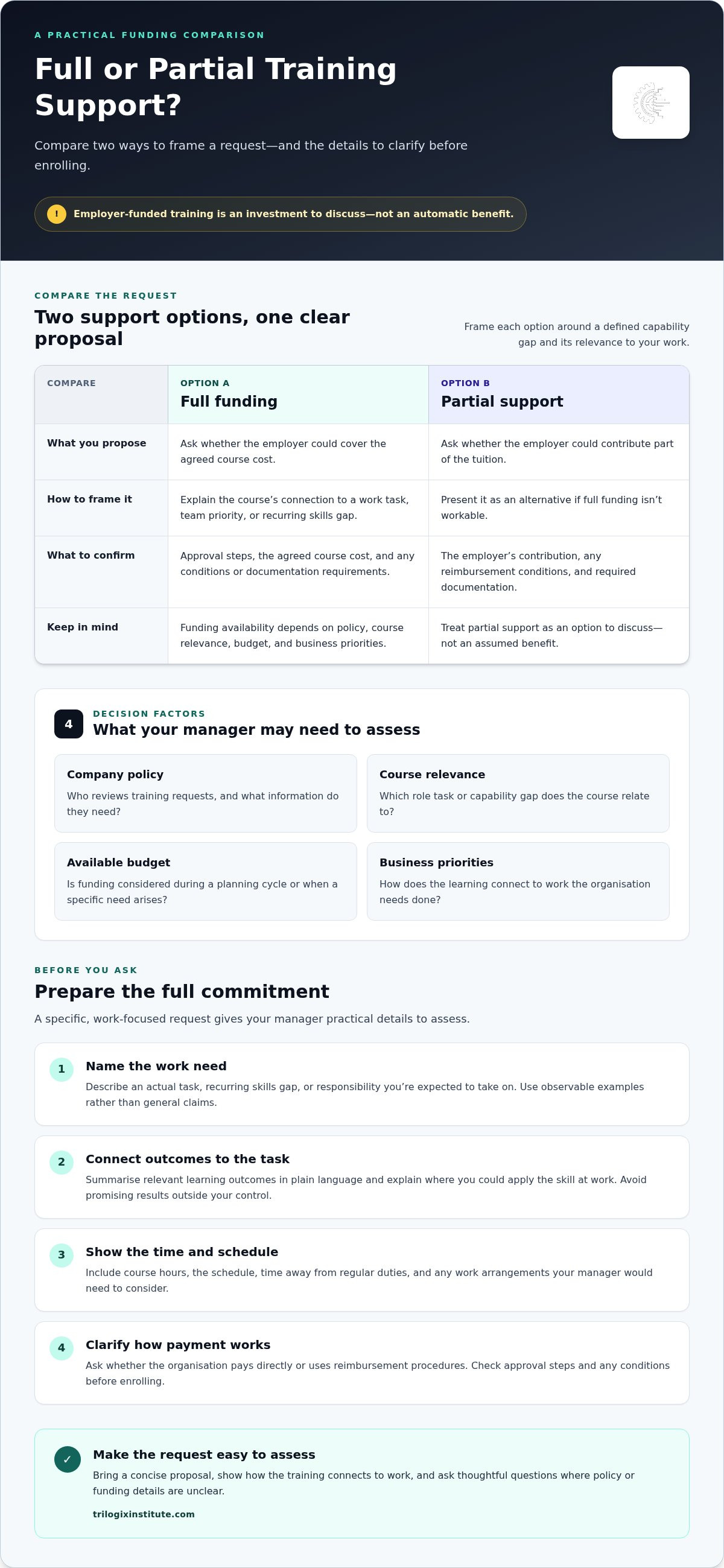
Employer-funded training is learning an organisation agrees to support because it develops a capability relevant to an employee’s work. It’s an investment to discuss, not an automatic benefit. The decision may depend on company policy, the course’s relevance to the role, available budget, and business priorities. A clear request gives your manager the context to assess whether the training fits.
The value should be mutual. You develop knowledge or practical skills to use in your role, while the organisation builds capability in an area connected to its work. For example, if technical drawings are part of your responsibilities, AutoCAD training may help you develop a skill relevant to those tasks. Trilogix Institute’s instructor-led technical courses include Advanced AutoCAD 2D & 3D and Industrial Automation Specialization, options to consider when they match a defined capability gap.
Professional development can take different forms, including structured learning that builds knowledge and supports growth at work. The broader idea is outlined in Professional Development. In a funding conversation, connect that idea to a specific workplace need. A business case links training to work the organisation needs done; a personal request focuses mainly on what the employee hopes to gain.
When does job-related training make a strong request?
Your request is easier to assess when you can connect the learning to an actual task, a recurring skills gap, or a responsibility you’re expected to take on. Use observable examples rather than general claims. Perhaps a process regularly slows while you complete a task, errors lead to repeat work, or new equipment will become part of your responsibilities. Describe what you’ve observed, then explain what capability the training could help you build.
Distinguish between immediate role requirements and longer-term career interests. A course that supports a current task has a clear workplace application. Training for a future career move may still matter to you, but its connection to the organisation’s current needs could be less direct. Being candid about that difference helps your manager understand what you’re asking them to support.
What should you find out before raising the subject?
Do some groundwork before deciding what support to request. Review employee handbooks, learning policies, or manager guidance where available. Look for details on who approves training, when funding is considered, and how payment or reimbursement works. If the guidance is unclear, prepare a specific question for your manager instead of relying on an assumption.
Company support can take different forms. Identify what you need to clarify:
- Approval: Who reviews the request, and what information do they need?
- Budget timing: Is funding considered during a planning cycle or when a specific need arises?
- Payment process: Does the organisation pay directly or use reimbursement procedures?
- Work arrangements: How could course time fit alongside your responsibilities?
Don’t assume a development budget or funding entitlement exists. This preparation helps you shape a realistic proposal and select training that aligns with both the work and your manager’s decision criteria.
How to choose training that fits your role and your employer’s needs
A course title alone won’t show your manager why it’s a good fit. Compare the learning outcomes with a specific task or capability you need to strengthen. Ask yourself: What should I be able to do after the training, and where would I use that skill at work? The closer the connection, the easier it is to explain why the course is relevant to your role and worth considering for employer support.
For example, an employee who needs to interpret technical drawings could look for training that develops applicable AutoCAD skills. Someone expected to work with industrial systems could compare course outcomes with the responsibilities involved. Trilogix Institute offers instructor-led, equipment-based technical training for practical skill development. Explore its programs to identify an option that matches the capability you want to build.
Which course details should you prepare?
Summarise relevant subjects and skills in plain language, using the course outline rather than promotional claims. Note the schedule, time commitment, assessment method, and practical components. Then connect those details to your duties: name the work task the learning relates to and explain how practice could help you prepare for it. Keep the link specific, and don’t claim the course will guarantee a particular result.
As you compare options, consider whether the format gives you a useful way to practise. Instructor-led, equipment-based learning may suit a skill that involves technical equipment or applying procedures. Check how the course hours overlap with your working hours and identify any schedule adjustment your manager would need to consider.
Which funding arrangement should you propose?
Match your request to the employer’s policy and the scale of the commitment. You could propose full or partial tuition support, with an alternative in case full funding isn’t workable. These are options to discuss, not benefits to assume. Clarify any reimbursement conditions, approval steps, or documentation requirements before enrolling.
A concise comparison helps your manager see where there may be room to negotiate:
| Support option | What to propose | What to clarify |
|---|---|---|
| Full funding | Employer covers the agreed course cost. | Approval, payment process, and any conditions. |
| Partial funding | Employer and employee share the cost. | How the contribution is divided and handled. |
| Non-financial support | Request approved study time or a workable schedule. | Which hours can be accommodated and how duties will be covered. |
When deciding how to ask your boss to pay for training, prepare a preferred option and a reasonable alternative. That shows you’ve considered both the learning value and practical constraints. Be ready to explain the course’s relevance, time commitment, and the support you’re seeking, while leaving policy and final approval to your employer.
How to build a business case your manager can assess
Start with the work problem, not the course. Identify a specific task, quality concern, or capability requirement, then name the skill the training is intended to build. For example, if preparing technical drawings requires repeated corrections, your case could focus on developing a particular drafting capability and applying it to relevant assignments. Stick to what you’ve observed rather than assuming the course will fix the issue.
Connect each training outcome to a workplace task where you can practise the skill. This gives your manager a clear line from the current need to the proposed learning and its application, without promising savings, speed, or quality improvements you can’t control.
How can you explain the return on training?
Use evidence already available, such as how long a task typically takes, where quality issues arise, or which capabilities an upcoming responsibility requires. Set a realistic indicator to review after you’ve had a chance to apply the learning. For example, you might assess whether you can complete a defined task independently or meet an existing quality check. Don’t invent savings, promise a promotion, or attribute every later improvement to one course.
How do you make the proposal easy to evaluate?
Prepare a one-page summary covering the work need, relevant course, schedule, support requested, and intended application. Mark details as confirmed, estimated, or still being finalised so your manager can distinguish facts from assumptions. Add a short coverage plan that identifies deadlines or routine responsibilities falling during training time, along with a proposal for managing them with your manager’s input.
Keep the summary focused. Your manager should be able to see the request, assess its relevance, and identify what needs a decision without searching through a long course description. Include only details that help evaluate the proposal:
- Need: The task or capability gap, supported by an observable example.
- Learning: The specific skill or knowledge you expect to develop.
- Application: A work task where you could use that skill.
- Review: A practical indicator you and your manager could revisit after application.
- Coverage: How you’ll coordinate duties around the training schedule.
Offer a simple plan for applying what you learn. After training, you could demonstrate a relevant skill on a suitable work task, share a concise summary with colleagues, or discuss your learning at a team meeting. Agree on an approach that fits the work and your manager’s expectations. Don’t assume every skill can be applied immediately.
For how to ask your boss to pay for training, this preparation turns a general request into a proposal your manager can assess. It shows the intended workplace application, the evidence behind the need, and how you’ll follow through, while leaving room to discuss feasibility and refine the plan together.
How to Ask for Training: Conversation and Email Steps
Choose a time when your manager can give the request focused attention. A scheduled one-to-one or a brief meeting request is usually more constructive than raising it during a busy handover or in reaction to a problem. In your meeting invitation, say that you’d like to discuss training related to a work need. This gives your manager context without asking them to decide before seeing the details.
What should you say in the meeting?
Open with the capability gap or work goal, then explain how the course fits and what support you’re requesting. Keep your opening direct: “I’d like to discuss training that could help me build the skills needed for [task].” Briefly cover the relevant learning outcomes, schedule, requested funding or study time, and how you could apply the skill. Then pause. Invite questions and listen for concerns about policy, timing, cost, or team coverage before responding.
Prepare concise answers rather than a rehearsed sales pitch. If asked about cost, state the course cost in AED and whether you’re seeking full or partial support. For schedule questions, explain the time commitment and how you’d coordinate responsibilities. For learning outcomes, name the practical skills you expect to develop and a suitable work task where you could use them. Be clear about what you know and what is still being finalised.
How should you write a training funding request email?
Use a clear subject line and keep your first message focused on requesting a conversation. Preview the work-related need, identify the training, and state the support you hope to discuss. Include the schedule and expected workplace application if known, then offer to share course information. The goal is to help your manager understand the reason for the meeting, not to fit every detail into one email.
Subject: Meeting request: training for [work need]
Hi [Manager’s name],
Could we schedule a short discussion about training related to [specific task, skills gap, or upcoming responsibility]? I’m considering [course name] to develop [relevant skill], which I could apply to [work task or responsibility].
The course is scheduled for [dates or schedule]. I’d like to discuss [specific request, such as full or partial funding, or approved study time], as well as how to manage my responsibilities during the training. I can bring the course details and a brief summary of the expected learning outcomes.
Would [proposed meeting time] work for you?
Best,
[Your name]
Adjust the wording to suit your workplace and the support you’re seeking. If you’re still working out how to ask your boss to pay for training, keep the request specific, professional, and open to discussion. To connect a technical capability gap with practical, instructor-led learning, explore Trilogix Institute’s technical training.
What to Do After Your Manager Responds
Your manager’s answer is the start of agreeing on what happens next. If the request is approved, confirm the details in writing before enrolling or paying. If the answer is no or not yet, stay professional and ask what influenced the decision. A clear follow-up keeps the conversation constructive and helps you understand whether a revised proposal could still address the work need.
How should you respond to yes, no, or not yet?
If approved, summarise the agreed funding amount in AED, payment or reimbursement process, training schedule, required documentation, and who will handle each next step. If the decision is delayed, ask what information would help and agree on a date to revisit it. If the answer is no, thank your manager and ask whether the main concern is timing, budget, course fit, or another factor.
Use the reason to decide what to do next rather than immediately offering a cheaper option. If timing is the issue, ask whether a later intake could work. If the budget is constrained, you could discuss partial support or approved study time, subject to company policy. If the course doesn’t closely match the role, refine the proposal or consider another format only if it still builds the capability the work requires.
How can you turn training into workplace value?
Before training begins, agree on a practical opportunity to use what you learn. That might mean applying a newly developed technical skill to an appropriate task, demonstrating a method to your manager, or sharing useful insights with colleagues. Choose an application that fits your responsibilities and available work. Don’t promise an outcome that depends on factors beyond your control.
Instructor-led learning can be relevant when a skill needs practical application. For instance, training in electrical engineering, AutoCAD, motor control, or industrial automation may help an employee develop capabilities related to technical work. Explore these training areas to see which may align with a defined workplace need.
After completing the training, follow up with your manager as agreed. Briefly describe what you learned, where you applied it, and whether further practice or support would help. If your request was declined, close the loop by confirming the reason and asking when it would be appropriate to revisit the need. That gives you a clearer basis for your next step.
Use your manager’s response to make a practical plan, whether that means proceeding, adjusting the timing, or strengthening the case. Explore training options that can support relevant skill development.
Turn Your Training Request Into a Next Step
A training conversation can be the beginning of a more deliberate approach to building capability at work. Choose one skill you want to apply, identify a suitable opportunity to practise it, and agree with your manager on how you’ll review progress. This keeps development connected to real responsibilities rather than leaving new learning unused.
If you’re still considering how to ask your boss to pay for training, look for a program whose practical content matches a capability you can explain. Trilogix Institute’s instructor-led vocational programs include technical and practical skill development, with options such as Foundation Electrical Engineering, Advanced AutoCAD 2D & 3D, and Industrial Automation Specialization. These programs can help you identify learning to discuss in relation to your work.
Explore Trilogix Institute’s practical training options and choose a course that aligns with a skill you want to build. Then prepare a focused request connecting that learning to a workplace need.
Frequently Asked Questions
How do I ask my boss to pay for training?
Make a direct request that connects a course to a current responsibility or upcoming work requirement. For example: “I’d like to discuss training in [skill] because I’m taking on [task]. Could we review whether the company can support it?” If you’re working out how to ask your boss to pay for training, prepare the course details and know what support you’re requesting before the conversation. Be ready to discuss alternatives if full funding isn’t possible.
Should I ask my employer to pay for all or part of a course?
Ask for the level of support that best fits your company’s policy and the training’s relevance to your work. You could request full funding if the course directly supports a role requirement, or propose shared payment if it also serves a broader development goal. Before paying any portion yourself, clarify in writing how contributions, reimbursement, and approval conditions would work. Don’t enrol based on an assumption that costs will be covered.
What should I include in an email asking for training funding?
Include a clear subject, the work need, course name, relevant learning outcomes, schedule, and the support you’re requesting. Explain where you expect to apply the learning, then ask for a meeting to discuss the proposal. If helpful, attach a course outline or schedule so your manager can review the details beforehand. Label estimated information clearly, and don’t present unconfirmed costs or dates as final.
What if my boss says there is no budget for training?
Ask whether the constraint applies only to the current budget period or to this course generally. If timing is the issue, agree when to revisit the request. If funding isn’t available, ask whether approved study time or a later intake could be considered. A shorter option may be worth discussing only if it builds the capability the work needs. Don’t commit to personal spending until you understand your employer’s position and any terms.
How do I show that training will benefit my employer?
Describe a work task where you can use what you learn, then suggest a way your manager can observe that application. For instance, after training in a relevant technical skill, you might complete a suitable task using the new method and review the result with your supervisor. Choose a measure within your control, such as demonstrating a defined technique, rather than promising productivity gains or savings you can’t guarantee.
Is my employer required to pay for job-related training?
Don’t assume every job-related course must be employer-funded. Whether payment is required can depend on the circumstances, applicable UAE requirements, your employment terms, and company policy. If training is mandatory for your role, ask your manager or HR to explain how the employer handles its cost and attendance. For a decision with legal implications, consult an appropriate UAE authority or qualified legal adviser rather than relying on a general answer.
When is the best time to ask my boss to fund a course?
Raise the request before enrolment and early enough for your manager to consider the schedule, workload, and approval process. A useful moment may be when responsibilities are changing, a new project is being planned, or a skills requirement has become clear. Avoid waiting until registration is urgent. If your organisation has a planning or budget cycle, align your request with it where possible.


