

What if the nearest PLC course isn’t the best fit for the skills you need? Searching for a plc training center near me can turn up plenty of listings, but they rarely show what you’ll practise, how much guidance you’ll receive, or whether the course matches your experience. Those details matter when you want training that connects technical concepts to industrial automation work.
Compare your options by practical learning, instructor support, course fit, and clear learning outcomes. Instructor-led training gives you the chance to learn with guidance, while self-study relies more on your ability to organise your own progress and practice. Trilogix Institute’s Industrial Automation Specialization connects PLC-related interests with a broader automation skill set through instructor-led vocational training and equipment-based practical learning. This guide covers the key questions to consider before enrolling, from assessing your starting point to comparing course structure and support.
Key Takeaways
- Look beyond proximity when searching for a plc training center near me; focus on whether instruction and course structure fit your learning needs.
- Compare programs by instructor guidance, practical learning, feedback, course outcomes, learner fit, and logistics.
- Use your current skills and target tasks to identify a suitable starting point, from fundamentals to deeper application.
- Consider how structured instruction can help you progress from control concepts toward interpreting practical automation tasks.
- Explore how Trilogix Institute’s Industrial Automation Specialization connects PLC-related learning with a broader industrial automation skill set.
What a PLC Training Center Near Me Should Help You Learn
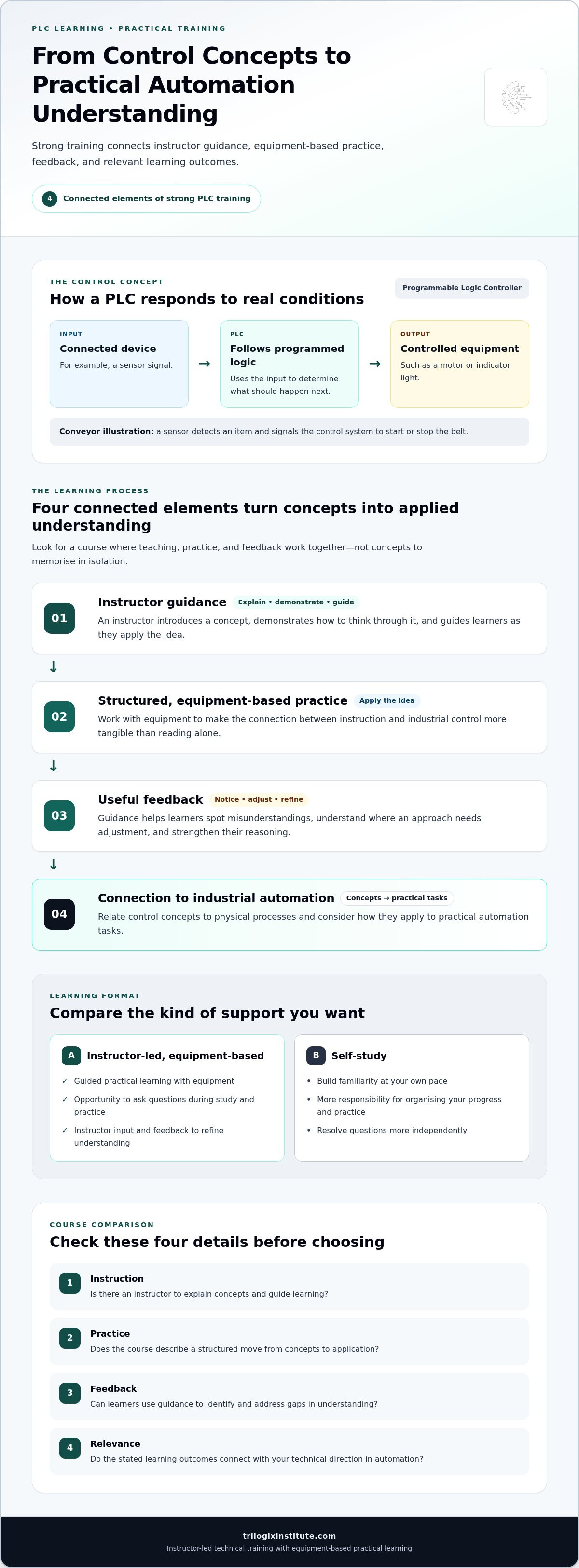
PLC training introduces industrial control concepts and how they are applied in automated processes. A programmable logic controller receives information from connected devices, follows programmed instructions, and controls outputs such as motors or indicator lights. In plain language, PLC training helps you understand how industrial equipment uses programmed logic to respond to real conditions.
Searching for a plc training center near me is about finding relevant instruction, not simply choosing the closest listing. Look for learning that connects control logic with electrical systems and the wider industrial automation environment. Instructor-led, equipment-based training provides guided practical learning and a chance to ask questions as you study. Self-study can help build familiarity at your own pace, but you take on more responsibility for organising practice and resolving questions independently. Consider which approach best matches your goals and how you learn.
What does PLC stand for, and what does it control?
PLC stands for Programmable Logic Controller (PLC), an industrial computer used to control automated processes. It reads inputs, such as a sensor signal, and uses programmed logic to determine what should happen next. Illustration: on a simple conveyor, a sensor could detect an item and signal the control system to start or stop the belt. PLCs are used in different systems, so applications and course topics can vary.
Who benefits from practical PLC training?
Beginners can use structured instruction to build foundational understanding, even without prior PLC experience. Technicians may connect new learning to equipment and control tasks they already encounter, while career changers can develop technical knowledge relevant to industrial automation. Electrical engineering or motor-control experience provides useful context: familiarity with circuits, motors, and control principles makes it easier to relate PLC logic to the equipment it directs. If you are new to those topics, choose a learning path that starts at an appropriate level.
Trilogix Institute delivers instructor-led technical training with equipment-based practical learning. Its Industrial Automation Specialization is relevant to learners exploring PLC-related skills within the broader automation field. As you compare course structures and learner support, focus on the stated outcomes and practical learning approach to find instruction that moves beyond definitions toward useful understanding.
What Strong PLC Training Includes: Practice, Instruction, and Feedback
Strong PLC training gives learners more than concepts to memorise. Look for four connected elements: instructor guidance, structured practice, useful feedback, and a clear relationship to industrial automation. Together, they help you move from understanding control logic to considering how it applies to practical tasks.
Supervised practice matters because it lets learners apply control concepts, spot misunderstandings, and strengthen their reasoning with guidance before working more independently. Practice without feedback can leave you unsure why an approach worked or where it needs adjustment. Instructor input helps make each learning step more deliberate.
How instructor-led, equipment-based learning supports progress
An instructor can introduce a concept, demonstrate how to think through it, and guide learners as they apply the idea. Working with equipment makes the connection between instruction and industrial control more tangible than reading alone. Learners can observe how a control concept relates to a physical process, ask questions during practice, and use feedback to refine their understanding. When comparing courses, look for a clear description of how instruction and practical learning work together.
How to assess course relevance without assuming a syllabus
Start with your technical goal. Compare it with the course’s stated outcomes: do they explain what you should understand or be able to apply, rather than relying only on broad phrases? A useful progression moves from foundational ideas toward applied learning, helping you build knowledge instead of facing disconnected topics. The International Society of Automation’s training options offer another reference point for how automation education can be structured.
As you compare a plc training center near me, consider whether the learning outcomes connect to the automation knowledge you want to develop. Trilogix Institute’s technical vocational training is instructor-led and includes equipment-based practical learning. Its Industrial Automation Specialization connects PLC-related interests with the wider field. Explore the technical training course catalogue and compare the course information with your learning goals.
- Instruction: Is there an instructor to explain concepts and guide learning?
- Practice: Does the course describe a structured move from concepts to application?
- Feedback: Can learners use guidance to identify and address gaps in understanding?
- Relevance: Do the stated outcomes connect with your technical direction in automation?
How to Compare PLC Training Centers: A Practical Decision Framework
A directory listing can help you discover options, but it can’t show whether a course suits your goals. Compare specific course details, such as stated outcomes and learning format, rather than relying on broad claims like “industry-ready” without supporting information. Useful signs of practical PLC training include clear outcomes, guided application, relevant feedback, and a course structure suited to the learner.
| Criterion | What useful evidence looks like | Why it matters |
|---|---|---|
| Instruction | A clear description of instructor guidance and how concepts are introduced. | Beginners benefit from explanation and direction; experienced learners may value focused support as they develop further. |
| Practical learning | Information explaining whether learning includes equipment-based application or other structured practice. | Practice helps connect concepts with the kinds of tasks found in industrial automation. |
| Course outcomes | Specific statements of what learners should understand or be able to apply. | Outcomes make it easier to judge relevance to your technical goals. |
| Learner fit | An indication of the intended starting level or foundational knowledge. | A suitable entry point supports steady progress without assuming too much or too little. |
| Logistics | Published information about schedule, access, format, and expected study commitment. | Practical details help you assess whether learning can fit alongside work and other responsibilities. |
Which training criteria matter most to your goals?
Prioritise the criteria that match your starting point. If you’re new to PLCs, look for clearly described fundamentals and supported learning. If you’re a working technician, focus on outcomes that extend your technical understanding and include applied learning. In either case, course fit is more useful than an unverified promise, ranking, or label. Look for details you can assess, not claims that sound impressive but explain little.
How can you compare training formats fairly?
Instructor-led, equipment-based learning offers structured guidance and practical application. Self-paced study can offer flexibility, but learners generally need to organise their own progress and practice. Neither format is automatically right for everyone. Consider how much instructor support you prefer, how you learn best, and whether your goals call for guided practical work. Then weigh schedule, access, and study commitments alongside the course content.
Use this framework to assess a plc training center near me against your priorities, rather than choosing on proximity alone. Trilogix Institute provides instructor-led technical training with equipment-based practical learning. Explore practical technical training and consider how structured learning may support your next step.
Is PLC Training Right for Your Experience and Career Goals?
PLC training can suit learners at different stages, from people exploring industrial automation to technicians building on existing electrical knowledge. Extensive experience isn’t essential for every learner. The key is to identify your starting point and choose instruction that develops skills progressively. Electrical or motor-control experience can provide useful context, but it isn’t the same as a formal prerequisite.
Can beginners start learning PLC concepts?
Yes. Clear instruction can introduce technical ideas step by step, helping beginners build understanding before progressing to applied learning. Be honest about what you already know: perhaps you’re familiar with basic electrical concepts, or perhaps automation is entirely new. This self-assessment helps you identify a suitable foundation and compare course outcomes with your current knowledge.
Use this four-step check to assess fit:
- Current skills: Note your experience with electrical systems, control concepts, or automation, including areas you’re still learning.
- Target tasks: Identify the technical understanding you want to develop, such as interpreting control logic or connecting it to industrial processes.
- Preferred learning format: Decide whether instructor guidance and structured practical learning suit you better than independent study.
- Study commitment: Consider how much time and attention you can consistently devote to training alongside your other responsibilities.
How does PLC learning connect to industrial automation careers?
PLC knowledge is one part of a wider industrial automation skill set. It connects with electrical control, motors, equipment, and the logic used to coordinate automated processes. Beginners may focus first on fundamentals; experienced learners may look for deeper application that builds on their technical background. Training can support skill development, but course completion doesn’t guarantee employment or a particular career outcome.
Trilogix Institute’s Industrial Automation Specialization relates PLC-focused interests to the broader automation field through instructor-led vocational training and equipment-based practical learning. Consider how this area of study aligns with your goals, then use your self-assessment to review course information and choose a considered next step.
Ready to build relevant technical knowledge? Explore industrial automation course information and identify a learning path that fits your experience and goals.
Explore PLC-Focused Learning Through Trilogix Institute
Choosing a plc training center near me is ultimately about finding instruction that fits your starting point and helps you build relevant technical understanding. Trilogix Institute delivers instructor-led vocational training in industrial automation and electrical engineering, with practical learning using real-world equipment. This approach combines explanation with applied learning, giving students a structured way to engage with technical concepts.
What makes the training approach practical?
Instructor guidance can help learners work through concepts in sequence, while equipment-based learning connects technical study with physical systems. Rather than relying only on written explanations, learners can engage with practical technical training in a guided environment. Compare the stated learning outcomes and course information to understand how the instruction supports your goals.
For learners interested in PLC-related study, the Industrial Automation Specialization connects to the broader automation field. PLC knowledge sits alongside other technical areas involved in industrial control, making the wider context useful when considering your learning direction. Explore the Industrial Automation Specialization and related course information to assess how the available details align with your goals.
What should your next step be?
Return to the criteria that matter most: course fit, practical instruction, clear learning outcomes, and a format that suits your preferred way of learning. Compare what you want to develop with the course information, and consider how the study commitment fits your responsibilities. Beginners may value a clear foundation; learners with technical experience may want to build on what they already know.
A considered decision doesn’t depend on grand promises. It comes from understanding what a course is designed to teach and how its learning approach supports your next step. Review the relevant details, then choose a path that matches your experience and interests.
Take Your Next Step in Industrial Automation
Choosing a plc training center near me is about more than finding a nearby listing. Prioritise clear learning outcomes, instructor guidance, and practical technical learning that fits your current experience and goals. A well-matched course can help you build understanding step by step, whether you’re new to automation or developing existing skills.
Trilogix Institute offers instructor-led vocational training in technical disciplines, with equipment-based practical learning in technical courses. Its Industrial Automation Specialization provides a relevant path to explore PLC-related learning within the wider automation field. Review the course information and consider how the learning approach aligns with your needs before deciding on your next step.
Explore Trilogix Institute courses and take a practical step toward developing your industrial automation knowledge.
Frequently Asked Questions
What is a PLC training center?
A PLC training center teaches learners how programmable logic controllers support industrial automation and control processes. Strong technical training pairs clear instruction with opportunities to apply concepts, rather than focusing on terminology alone. If you’re searching for a plc training center near me, compare the stated learning outcomes with your goals. Look for structured instruction, guided application, and feedback that helps you build understanding. Course formats and specific topics can vary.
Can a beginner take PLC training?
Yes, beginners can start learning PLC concepts when instruction introduces fundamentals clearly and builds toward applied understanding. Previous electrical or automation experience may provide helpful context, but it isn’t necessarily a formal requirement. Review the course’s stated entry expectations and learning outcomes to understand its fit. An instructor-led format gives new learners opportunities to ask questions and develop confidence as technical concepts become more complex.
What should I look for in a PLC training course?
Compare the teaching format, instructor support, practical learning, stated outcomes, and fit with your experience. A useful course description explains what learners will study and how they’ll apply it. Look beyond broad labels and focus on details relevant to your goals. Treat equipment, software, certificates, or assessments as course facts only when they are explicitly stated. This makes it easier to compare the learning itself rather than relying on general claims.
Is hands-on PLC training better than online learning?
The right format depends on your goals and how you prefer to learn. Instructor-led, equipment-based practice lets learners apply concepts with guidance, while self-study can offer flexibility for reviewing information. If practical technical experience is a priority, consider how much supported application the course includes. Compare the learning approach and stated outcomes instead of assuming one format works best for everyone. Your current skills and need for instructor support can help guide the choice.
How long does PLC training take?
PLC training duration depends on the program structure, topics, and learning schedule, so there isn’t one timeline for every course. Review the specific course information for its schedule and expected study commitment, and account for time to practise and review. Don’t choose by duration alone. Consider whether the course provides a clear learning pathway and enough structure to support your goals. The most suitable timeline is one that works with your responsibilities and learning needs.
Does PLC training guarantee a job or certification?
No. Completing PLC training doesn’t automatically guarantee employment, promotion, or a particular certification. Training can help you develop relevant technical knowledge, but career outcomes also depend on experience, role requirements, and other qualifications. Read stated course outcomes carefully, and distinguish course completion from an externally recognised credential. Choose training for the skills and learning support it provides, not for an unsupported promise of a specific job or career result.


