

A certificate course in cooking with the most impressive title may not be the one that best prepares you for a professional kitchen. Programs with similar names can differ in hands-on practice, assessment, and what the certificate documents.
If you’re comparing options in the UAE, look for practical skills and a learning format that fits your experience, schedule, and goals. Focus on what you’ll practise, how your work will be assessed, and who issues the certificate. Trilogix Institute’s Professional Culinary Arts training is instructor-led and equipment-based, making it a useful example of practical vocational learning.
This guide explains how to compare cooking programs by practical training, assessment, course fit, and credential details. You’ll find criteria for evaluating foundational skills, checking what a certificate represents, and matching training to your next step, whether you’re building basic competence or developing existing experience. The aim is to help you choose based on what you’ll learn and demonstrate, not the course title alone.
Key Takeaways
- Look beyond the title of a certificate course in cooking to understand what it teaches and how learning is assessed or documented.
- Match the program’s level and learning format to your experience, schedule, and intended next step.
- Compare certificates, diplomas, and short courses by their learning scope and practical requirements, not the label alone.
- Before enrolling, review the issuer, exact credential wording, assessment, curriculum, and completion requirements.
- Use instructor-led, equipment-based training, such as Trilogix Institute’s Professional Culinary Arts vocational training, as a practical point of comparison.
What Does a Certificate Course in Cooking Actually Teach?
A certificate course in cooking provides structured instruction in culinary knowledge or skills and may include an assessment, a completion document, or both. Requirements depend on the program. The title alone doesn’t tell you what learners practise, how their work is assessed, or whether the credential is relevant to a particular next step.
Culinary arts covers food preparation, cooking techniques, and the professional practices involved in producing meals. The overview of Culinary arts provides useful context, but a course should spell out which skills it teaches. In practical instruction, learners can apply a method to a kitchen task: prepare ingredients, follow the steps, monitor the result, and use equipment appropriately.
In brief: a course certificate documents an outcome defined by its issuer. It isn’t automatically equivalent to a diploma or degree. Compare what you’ll do and demonstrate, not just the credential label.
Which cooking skills should a beginner expect to develop?
Read the curriculum to see whether it covers foundational preparation, safe work habits, ingredient handling, and basic cooking methods. These are useful comparison points, not a standard syllabus for every course. For example, a program might include knife handling, preparing ingredients before cooking, or practising a basic method consistently. Look for specific skills and practice activities rather than a broad promise to “learn cooking.”
Supervised practice lets learners repeat tasks, receive guidance, and adjust their technique as they work. Repetition can support consistency, while safe habits help learners work carefully with ingredients, tools, and kitchen equipment. Trilogix Institute’s Professional Culinary Arts training is instructor-led and equipment-based, giving learners a practical vocational learning format. Review the course information to understand its specific skills and curriculum.
What does a certificate say about course completion?
Certificate titles and issuing bodies vary, so the word “certificate” doesn’t explain the outcome by itself. A document may confirm attendance, record completion of course requirements, or show that a learner passed an assessment. These outcomes are different. An assessed credential can provide evidence of demonstrated achievement; attendance alone doesn’t show that particular skills were tested.
Before enrolling, review the exact credential wording and identify who issues it. Check the completion requirements too: they might involve attendance, submitted work, a practical demonstration, a written test, or another stated condition. If recognition matters for your next step, establish what the credential represents and whether it is relevant to that purpose. These details offer a clearer basis for comparison than the title alone.
How to Compare Certificate Courses in Cooking Before Enrolling
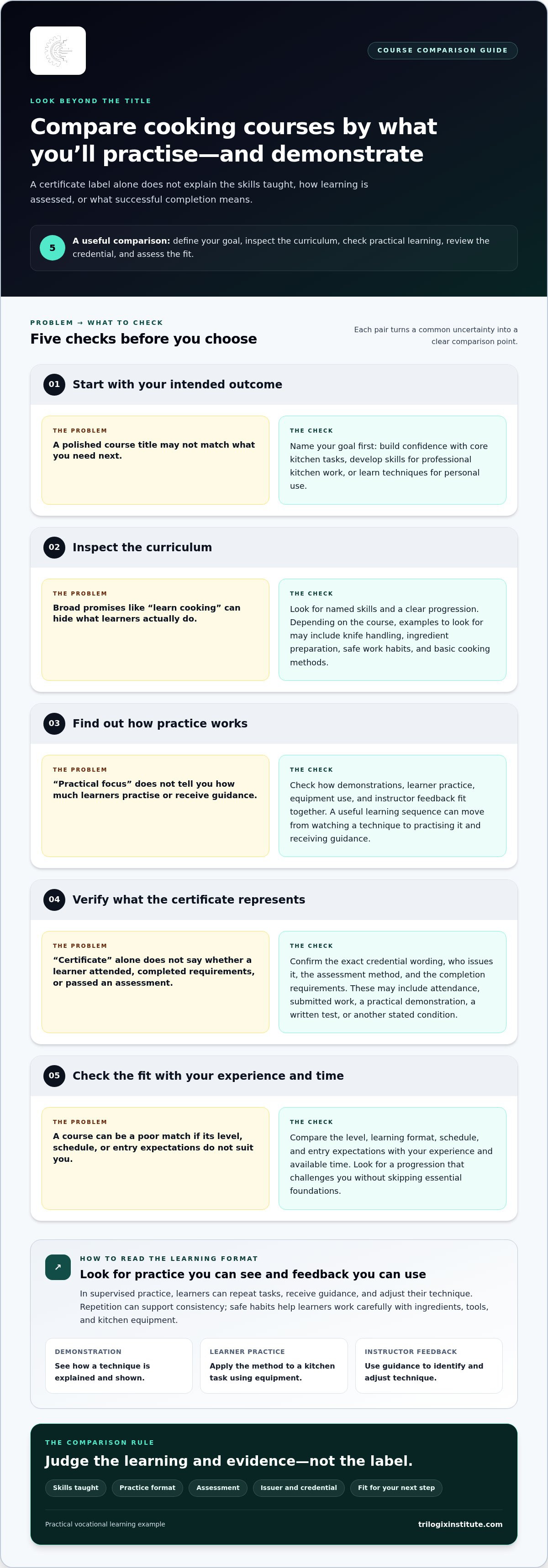
Compare what you’ll learn, practise, and demonstrate, then decide whether the format suits your experience and goal. A useful comparison starts with the outcome you want, not a polished course title. Course outcomes matter more than promotional labels because they show what learners can do by the end of the training.
- Define your goal. A beginner may want confidence with core kitchen tasks; a career changer may prioritise structured practice for professional kitchen work; a hobby learner may want techniques for personal use. Set a specific outcome before comparing programs.
- Inspect the curriculum. Look for named skills and a clear progression from foundational techniques to more complex tasks. Content varies, so don’t assume every program follows the same syllabus.
- Assess practical learning. Find out how learning is divided between demonstrations, learner practice, equipment use, and instructor feedback. These details say more about hands-on training than phrases such as “practical focus.”
- Review the credential. Check the exact certificate wording, issuer, assessment requirements, and what successful completion means. Consider whether those details support your intended next step.
- Compare the fit. Weigh the course level, learning format, schedule, and entry expectations against your experience and available time. A suitable program should challenge you without skipping essential foundations.
Match course level and curriculum to your goal
Start with your current ability. Beginners often benefit from building a foundation before moving on to more demanding tasks. Career changers may look for skills that apply to organised kitchen work, while hobby learners may prioritise particular interests and flexibility. Whatever your goal, check that lessons build progressively rather than presenting disconnected topics. A professional culinary arts training guide can help you consider how vocational training may support a professional learning objective.
Assess practical training and feedback
Review how instruction moves from explanation to application. A useful sequence might include watching a demonstration, practising the technique, and receiving guidance on the result. Instructor-led practice helps learners identify and adjust their technique as they work. Appropriate kitchen equipment also matters: learners need the chance to use tools and appliances related to the tasks being taught. Theory and self-paced formats may suit some learning needs, but they don’t necessarily provide the same supervised practice. Trilogix Institute’s Professional Culinary Arts training uses an instructor-led, equipment-based approach. Explore the culinary arts course information to learn about the training.
Certificate, Diploma, or Short Course: Which Cooking Program Fits?
These labels can help you narrow your options, but they don’t have a universal meaning across training providers. Compare the stated learning outcomes, practical requirements, and credential details before choosing a format. A certificate course in cooking may offer focused or introductory learning, while a diploma may cover a broader subject area. A short course may concentrate on a specific skill or interest.
| Program type | Possible purpose and scope | Practical intensity | Credential questions |
|---|---|---|---|
| Certificate | Focused skills development or structured introductory learning | Varies by course; review the practice and assessment requirements | What does the certificate document, and who issues it? |
| Diploma | May cover a broader range of culinary topics | Depends on the curriculum and delivery format | What are the completion requirements, and is any progression route defined? |
| Short course | May focus on a narrower skill, technique, or learner interest | May involve targeted practice, but scope differs by provider | Is completion documented, and is performance assessed? |
The table is a comparison framework, not a fixed definition of each qualification. A course title doesn’t establish professional recognition or guarantee employment. Progression and credit recognition aren’t automatic: they depend on the specific program and the institution receiving an application for further study.
When might a certificate course be the right fit?
A certificate may suit a beginner seeking structured foundations or a learner aiming to develop a defined set of skills. Start with your experience, available study time, and intended next step. Then examine the curriculum and assessment: does the content cover the skills you want, and does the course explain how learning is evaluated? The title alone can’t answer either question.
When should you compare a diploma or short course?
Consider a broader program if you want more extensive subject coverage, or a short course if you’re targeting a narrower interest or technique. Neither format is automatically more suitable; the right choice depends on the depth and application you need. Compare the stated duration, entry expectations, practical components, and completion conditions. If you hope to continue into another program, check whether the receiving institution recognises prior study or grants credit. Treat that as a specific arrangement, not an assumed benefit of the credential name.
What to Verify About a Cooking Certificate and Its Career Relevance
A certificate is more useful when you understand what it represents and how its learning outcomes relate to your next step. Before enrolling in a certificate course in cooking, review the course information for these details:
- Issuer identity: Identify the organisation that awards or issues the credential. Don’t assume the course provider and credential issuer are the same.
- Credential wording: Note the exact title and whether it documents attendance, course completion, or assessed achievement.
- Assessment: Look for how learning is evaluated, such as practical tasks, written work, or stated completion criteria.
- Curriculum: Compare the skills and knowledge taught with the requirements of the roles or further study you’re considering.
- Completion requirements: Check any stated attendance, assessment, or other conditions for receiving the credential.
How can you assess whether a certificate is relevant?
Identify who issues the credential and what successful completion demonstrates. Then compare its learning outcomes with a realistic next step. If you’re considering entry-level kitchen work, for example, assess whether the course develops relevant practical skills and work habits. If you plan to continue studying, check whether the receiving institution recognises the credential or grants credit. Recognition depends on the specific credential and context, so don’t infer it from the title alone.
Employer expectations differ by role and workplace. A certificate may document training, but it doesn’t automatically mean every employer will regard it as a professional qualification. Compare the course outcomes with the requirements of the roles you’re targeting, and consider recognition in the specific context where it matters.
What career outcomes can culinary training support?
Training can help you build a foundation for further learning or prepare to pursue kitchen experience, but it can’t guarantee employment or promotion. Course completion records a learning outcome; it does not guarantee a job or establish professional recognition for every role.
Think about readiness in practical terms: can you apply techniques consistently, follow instructions, maintain safe and organised work habits, and contribute within a team? These abilities develop through instruction and repeated practice, then continue to grow in real work settings. Use the course’s documented outcomes to decide what you’re prepared to pursue next, rather than treating the certificate as a career result in itself.
For program information, explore Trilogix Institute’s culinary course information and compare the training details with your learning goals.
Explore Professional Culinary Arts Training at Trilogix Institute
After comparing course level, practical learning, assessment, and credential details, consider which teaching environment will support your progress. Trilogix Institute provides Professional Culinary Arts vocational training through instructor-led, equipment-based learning. This format is designed for practical instruction rather than self-paced online study.
Training format matters because culinary skills develop through application as well as explanation. Instructor guidance and access to equipment let learners engage with practical tasks in a structured setting. For a broader look at how to compare program features and learning needs, read the culinary arts training overview.
Who may benefit from professional culinary arts training?
Learners seeking structured vocational instruction and practical skill development may benefit from a guided, equipment-based format. The right fit depends on your starting experience, the skills you want to develop, and how much instructor support you prefer. A beginner may prioritise clear guidance while building foundations; someone with prior experience may want a structured way to refine existing skills. Compare your goals with the course information rather than assuming one program suits every learner.
Trilogix Institute’s Professional Culinary Arts training is vocational education. Evaluate it against your preferred learning format and intended next step, and review the course information for details relevant to your decision. Choose training that aligns with your needs without assuming a particular credential or career outcome from a program name.
How to take the next step with confidence
Before choosing a certificate course in cooking, bring your comparison criteria together: define your learning goal, decide how much practice and guidance you want, and review assessment, credential wording, and possible progression arrangements. These details help you make a decision based on the training itself.
For visual context, browse the culinary training gallery. Explore the culinary courses and course information to find a suitable next step for your learning goals.
Choose Training That Moves You Forward
The right certificate course in cooking is one that fits your goals and clearly explains what you’ll practise, how your learning will be assessed, and what the credential represents. Compare certificates, diplomas, and short courses by their actual outcomes, not their labels. Then consider how the curriculum and learning format match your experience and intended next step.
Practical instruction matters when you want to develop skills you can apply in a kitchen. Trilogix Institute offers Professional Culinary Arts vocational training through an instructor-led, equipment-based approach. Review the program details and weigh them against your priorities before deciding.
Explore Professional Culinary Arts training at Trilogix Institute and take the next step toward your learning goals.
Frequently Asked Questions
What is a certificate course in cooking?
A certificate course in cooking is structured learning in culinary knowledge or skills, with a completion document, assessment, or both, depending on the program. The certificate may record attendance, completion of course requirements, or demonstrated achievement, so check its exact wording. Course content also varies. Review the curriculum, teaching format, and assessment details to understand what you’ll learn and what the credential represents.
Is a cooking certificate enough to work as a chef?
A cooking certificate alone doesn’t guarantee that you can work as a chef. Employers may consider practical ability, prior experience, teamwork, and the requirements of a particular role, as well as training credentials. A course can help you develop relevant skills and prepare for a next step, such as pursuing entry-level kitchen experience. Compare the course outcomes with the roles you’re considering, and don’t assume the certificate title guarantees employment or professional recognition.
Can I take a cooking certificate course with no experience?
Some cooking certificate courses are designed for beginners, but entry requirements differ by program. Look for information about the expected starting level and whether instruction begins with foundational techniques before progressing to more complex tasks. If you’re new to cooking, a guided format with opportunities to practise and receive feedback can help you build skills steadily. Choose a course whose level and pace match your experience and learning goals.
What skills should a certificate course in cooking teach?
Review the curriculum for skills that match your goals. Useful comparison points may include ingredient preparation and handling, safe kitchen habits, basic cooking methods, and consistent execution of tasks. These are examples, not a standard syllabus for every course. For practical learning, check whether learners practise techniques, use relevant kitchen equipment, and receive guidance on their work. Skills and assessment methods depend on the program, so read its course details carefully.
How do I know whether a cooking certificate is recognized?
Identify the credential’s issuer and read the exact title and completion requirements. Then establish what “recognized” means for your purpose, such as acceptance by a particular employer, industry body, or further-study institution. Recognition can depend on the context, so don’t infer it from a course name or assume one organisation’s acceptance applies everywhere. Review documented information from the relevant organisation before relying on the credential for a career or study decision.
What is the difference between a cooking certificate and a culinary diploma?
A certificate may focus on a defined set of skills or structured introductory learning, while a diploma may cover a broader subject area. However, these labels don’t have a universal meaning across providers. Compare each program’s curriculum, duration, practical requirements, assessment, and completion outcome rather than assuming one is automatically more advanced. If you plan to progress to further study, check whether the receiving institution recognises the credential or grants credit.
Are hands-on cooking classes better than online courses?
Hands-on classes may be a better fit if you need supervised practice with cooking techniques, kitchen equipment, and instructor feedback. Online learning can support theory or offer flexibility, but a self-paced format may not provide equivalent guided practice. The best option depends on what you want to learn and how you learn effectively. Compare the practical components, feedback opportunities, and course outcomes with your goals before choosing a format.


