

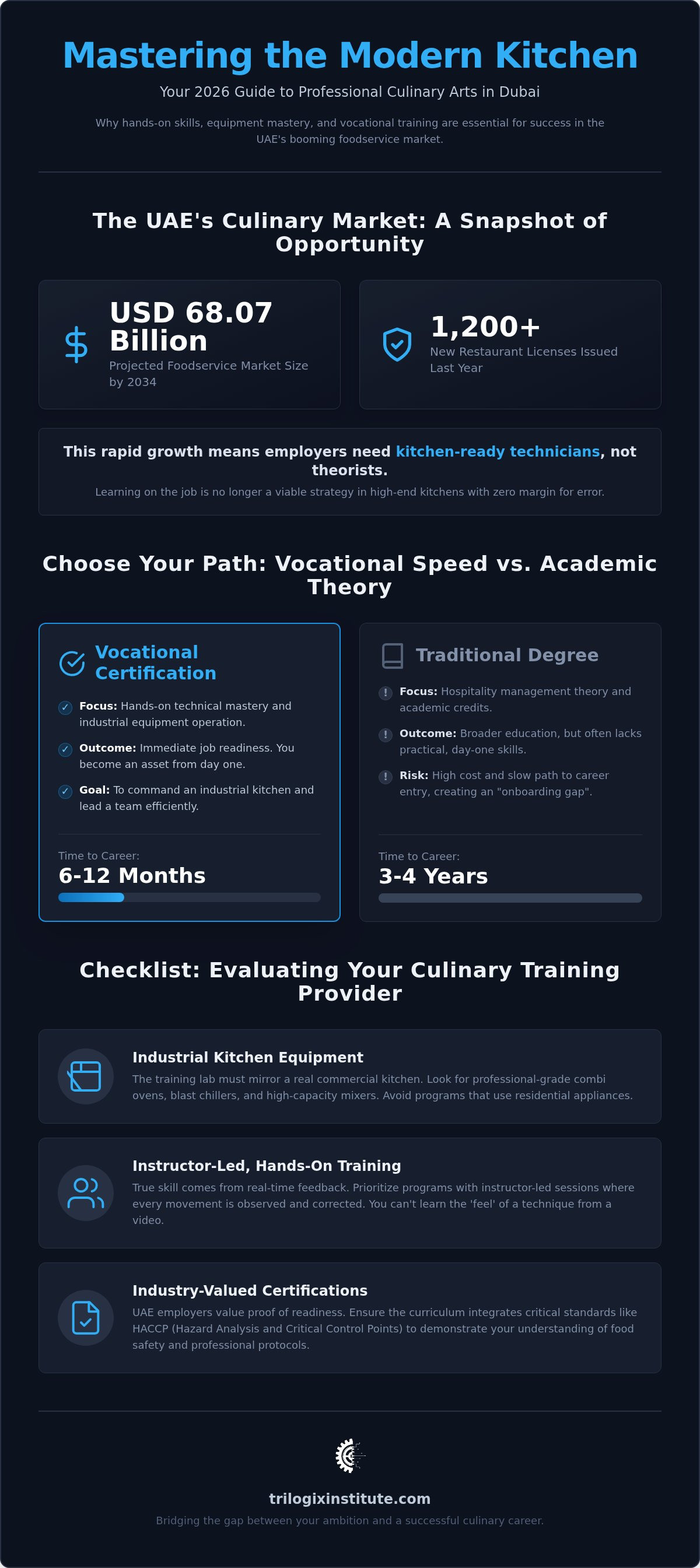
A university degree might look impressive on a wall, but it won't help you master a rational oven during a Saturday night rush. In a market where 1,200 new restaurant licenses were issued last year, UAE employers aren't looking for theorists. They need technicians who can command an industrial kitchen from day one. You likely already know that traditional academic paths are often too slow and far too expensive for your career goals. This is why professional culinary arts training Dubai must focus on hands-on execution rather than just classroom lectures.
This 2026 guide helps you cut through the noise to find a program that prioritizes instructor-led technical skills and industrial equipment mastery. We'll examine the specific certifications that carry weight with UAE hospitality groups, ensuring your investment leads to immediate job readiness. By focusing on vocational excellence rather than just academic credits, you can fast-track your entry into the professional kitchen and secure your place in a foodservice market projected to reach USD 68.07 billion by 2034. It's time to bridge the gap between your ambition and a successful culinary career.
Key Takeaways
- Understand why the 2026 UAE hospitality market prioritizes technical mastery and equipment-based skills over traditional academic theory.
- Learn to identify high-quality programs by evaluating their access to industrial kitchen equipment and the presence of instructor-led training.
- Compare the practical advantages of 6-12 month vocational pathways against 4-year degrees to minimize opportunity costs and accelerate your career.
- Discover the specific criteria for selecting professional culinary arts training Dubai that emphasizes hands-on kitchen hours over classroom lectures.
- Identify the core certifications and technical standards that UAE employers actually value when hiring for professional kitchen roles.
Navigating Professional Culinary Arts Training in Dubai (2026)
The hospitality sector isn't just about food; it's about precision. To understand what are culinary arts in a professional setting, we must look beyond the home kitchen. In the UAE, professional culinary arts training Dubai has evolved into a high-stakes technical field. By 2026, the industry has moved away from generalist knowledge. Employers now demand specialized certifications that prove a candidate can handle complex industrial workflows. This is no longer about simple cooking. It's about technical mastery and operational efficiency.
This shift is part of a broader push for Technical and Vocational Education and Training (TVET). Unlike hobbyist classes, which focus on recipes, professional training focuses on systems. It's the difference between following a guide and managing a line. Professional career training prepares you for the physical and mental rigors of a commercial environment. It bridges the gap between passion and professional standards, ensuring you're ready for the pace of a modern kitchen.
The Demand for Certified Culinary Professionals in the UAE
The UAE foodservice market is expanding rapidly. It's projected to grow to USD 68.07 billion by 2034. With nearly 1,200 new restaurant licenses issued in Dubai in 2024 alone, the competition for talent is fierce. Learning on the job is no longer a viable strategy for high-end kitchens. These establishments operate with zero margin for error. They require staff who already understand food safety, knife skills, and equipment calibration. Industry-standard certifications are the only way to prove this readiness to hiring managers. They provide the career mobility needed to move from a Commis role into leadership positions.
Vocational vs. Academic: Choosing Your Path
You have two main routes: technical diplomas or multi-year university degrees. A degree often takes three to four years and focuses heavily on hospitality management theory. In contrast, vocational programs like the TTI Dubai Professional Culinary Arts track prioritize practical mastery. These intensive courses usually last 6 to 12 months. They're designed for individuals who want to enter the workforce quickly without the financial burden of a traditional degree. If your goal is to master industrial equipment and lead a kitchen team, instructor-led professional culinary arts training Dubai offers the most direct path. Aligning your training with the immediate needs of the 2026 market ensures you aren't just educated, but employable.
Evaluating Culinary Schools: Equipment and Instructor-Led Standards
Selecting the right institution for professional culinary arts training Dubai requires a critical assessment of the physical environment. A professional kitchen is a high-pressure ecosystem of specialized machinery. If a training lab looks more like a residential kitchen than a commercial production center, it isn't preparing you for the industry's reality. Mastery of industrial-grade tools is what separates a technician from a hobbyist. In 2026, UAE employers expect new hires to arrive with a functional understanding of commercial workflows. They don't have the luxury of teaching you the basics of equipment safety during a busy shift.
Self-paced online modules might offer convenience, but they can't teach the tactile skills of heat management or knife control. You can't learn the "feel" of a perfectly emulsified sauce through a screen. True vocational readiness comes from instructor-led sessions where every movement is corrected in real-time. This direct feedback loop is the only way to ensure your technique aligns with global standards.
The Importance of Hands-On Kitchen Labs
Industrial labs must feature professional-grade combi ovens, high-capacity mixers, and stainless steel prep stations. Learning on this equipment reduces the "onboarding gap" for your future employer. When you walk into a hotel kitchen already knowing how to operate a blast chiller or a commercial sous-vide circulator, you become an immediate asset. These labs also serve as the primary training ground for safety and sanitation. You'll learn to maintain Hazard Analysis and Critical Control Points (HACCP) standards as a reflex rather than a memorized list. Key benefits of equipment-based labs include:
- Reduced On-Site Training: Employers save time and resources when staff are already familiar with industrial hardware.
- Operational Safety: Hands-on experience with high-voltage and high-temperature equipment prevents workplace accidents.
- Technical Consistency: Learning to use precision tools ensures repeatable results in high-volume environments.
Instructor Expertise: Learning from Industry Insiders
An academic lecturer can explain the chemistry of baking, but a professional chef instructor teaches you how to survive a 200-cover dinner service. Direct feedback in a lab setting is the fastest way to acquire skills. A mentor can spot a minor technical flaw in your technique before it becomes a bad habit. This level of oversight builds professional discipline. It's about punctuality, station organization, and the mental stamina required for the industry. For those serious about technical proficiency, exploring the TTI Dubai Professional Culinary Arts program reveals a curriculum built on these exact industry-led standards. You aren't just earning a certificate; you're gaining the steady confidence of a trained professional.
Vocational Certification vs. Culinary Degree: A Practical Comparison
Choosing between a multi-year degree and a vocational diploma isn't just about the title on your resume. It's about the speed of your career progression. Traditional university programs often include general education modules that don't directly improve your performance on the line. In contrast, professional culinary arts training Dubai focuses exclusively on the technical skills required by high-volume kitchens. For many, the choice depends on whether they want to manage a hotel chain in a decade or lead a kitchen team by next year. Employers in the UAE increasingly value specialized diplomas because they indicate a candidate who is ready to work without extensive retraining.
Time-to-Market: The Advantage of Technical Training
Vocational pathways bridge the skills gap in a fraction of the time. While a Bachelor's degree takes three to four years, a technical diploma usually requires only 6 to 12 months. This allows you to enter the workforce as a qualified Commis Chef significantly faster. You aren't just saving time; you're gaining years of seniority. In a market where nearly 1,200 new restaurant licenses were issued in 2024, being first to the kitchen door is a distinct advantage. You can then use stackable certifications to specialize in areas like pastry or industrial kitchen management as your career evolves. This modular approach ensures your education keeps pace with your professional needs.
The ROI of Professional Culinary Diplomas
The financial implications of your choice are substantial. A three-year program at the Dubai College of Tourism (DCT) costs AED 105,000 for the 2026 academic year. Meanwhile, other international pathways in the city can reach approximately AED 127,944. Vocational training offers a lower entry cost and eliminates the massive opportunity cost of lost wages during four years of study. If an entry-level Commis Chef earns up to AED 4,500 per month, a degree student loses over AED 160,000 in potential earnings while studying. UAE hospitality groups frequently prefer "equipment-ready" graduates because they require less supervision. By choosing a pragmatic route like the TTI Dubai Professional Culinary Arts program, you avoid the debt trap of academic degrees and start earning sooner. You're investing in a tool for employment, not just a piece of paper. It's a results-oriented decision that aligns with the fast-moving 2026 hospitality market.
Key Criteria for Selecting Your Culinary Training Provider
Selecting a training provider is a strategic investment in your professional future. It requires looking beyond marketing brochures to evaluate the actual kitchen-to-classroom ratio. A program that prioritizes library hours over line experience won't serve you in a high-pressure hospitality environment. You need a provider that mirrors the intensity of a commercial production center. Effective professional culinary arts training Dubai should offer a curriculum where at least 80 percent of your time is spent behind a stove or at a prep station. This ensures that technical movements become muscle memory before you ever step into a professional role.
You must also assess the program's alignment with the 2026 market. The UAE's dining scene is increasingly sophisticated, blending global influences with strict operational standards. A provider that focuses only on niche artisanal trends without mastering core industrial workflows leaves you ill-equipped for high-volume roles. Precision is mandatory. Your choice should be based on the provider's ability to bridge the gap between your current skill level and the exacting demands of the region's leading executive chefs.
Accreditation and UAE Industry Recognition
Credentials are your first filter. In Dubai, the Knowledge and Human Development Authority (KHDA) is the primary regulatory body for private education. You should verify that your chosen institute holds relevant local approvals and aligns with international bodies like City & Guilds or Worldchefs. These endorsements ensure your certification carries weight when applying to major hospitality groups. National brands look for training that adheres to global vocational standards. To see how specialized technical tracks can accelerate your career, Learn more about our courses and how they meet these rigorous industry benchmarks.
Curriculum Focus: Essential Technical Skills
A robust curriculum must focus on the skills that translate directly to industrial kitchen roles. Mastery of seafood and meat preparation to international standards is non-negotiable in the UAE's luxury dining sector. You should also look for programs that cover the fundamentals of professional baking and pastry for the generalist chef. These "stackable" skills make you a more versatile asset. Beyond the food itself, look for integrated certifications in kitchen management and food safety. Understanding HACCP protocols and waste management is just as critical as your knife skills. If you're ready to secure a technical edge in the workforce, explore the professional pathways at Trilogix Institute to start your journey.
Launch Your Career with TTI Dubai Professional Culinary Arts
The transition from student to professional chef requires more than just a passing grade; it requires a complete immersion in the technical standards of the UAE market. The TTI Dubai Professional Culinary Arts program is designed to deliver this exact result. By stripping away non-essential academic modules, we provide a streamlined, high-impact curriculum that prioritizes your time and your career goals. This is professional culinary arts training Dubai that views the kitchen as a technical environment where equipment mastery is the primary currency. Precision is mandatory. Our results-oriented approach ensures that every hour spent in our labs translates directly to workplace readiness.
Our methodology is rooted in the belief that instructor-led training is the only way to build professional discipline. You won't find self-paced online modules here. Instead, you'll find seasoned chefs who provide real-time feedback as you navigate industrial workflows. This approach prepares you for the high-pressure dining environments of 2026, where efficiency and consistency are the only metrics that matter. We don't just teach recipes. We build the technical foundation required to lead a kitchen team in a market that demands excellence at every level.
The Trilogix Practical Advantage
The core of our program is the equipment-based curriculum. Every session involves direct interaction with industrial-grade tools, from commercial combi ovens to precision thermal circulators. This hands-on focus bridges the gap between ambition and professional employment. You aren't just learning how to cook; you're learning how to manage a professional station under pressure. This technical readiness is what makes our graduates stand out to hospitality groups across the UAE. To understand our mission and our commitment to vocational excellence, you can learn more About Trilogix Institute and our focus on pragmatic education.
Enrolling in the TTI Dubai Program
Taking the first step toward a culinary career should be a logical, informed process. We encourage prospective students to visit our labs and witness the training environment firsthand. Seeing the equipment and the instructor-led sessions in action provides a clear picture of the professional journey ahead. Once you apply, our team will guide you through the preparation needed for your first week in the kitchen. We focus on readiness from day one, ensuring you have the mental and technical stamina to succeed. If you're ready to bypass traditional degrees and secure your place in the UAE's thriving hospitality sector, Get in touch today to speak with a professional career advisor.
Master the Technical Standards of the 2026 Kitchen
The UAE hospitality sector is moving toward a future defined by precision and technical excellence. Success in this competitive landscape requires more than just a passion for food; it requires the ability to command industrial equipment and manage commercial workflows with confidence. By choosing professional culinary arts training Dubai that prioritizes hands-on mastery over academic theory, you position yourself as an immediate asset to any kitchen team. Vocational pathways offer a pragmatic, high-impact alternative to four-year university degrees. They allow you to enter the workforce sooner and with the specific skills employers demand.
Trilogix Institute provides the instructor-led, equipment-based environment necessary to bridge the gap between your ambition and a professional career. Our curriculum focuses on vocational readiness, ensuring you're prepared for the real-world pressure of the modern hospitality market. It's time to trade the classroom for the kitchen line. Begin Your Professional Culinary Journey with TTI Dubai and secure your future in the world's most dynamic dining destination. Your career in the kitchen starts with technical mastery today.
Frequently Asked Questions
Is a professional culinary certificate enough to get a job in Dubai?
Yes, especially in the 2026 market where employers prioritize technical competence over academic history. Many entry-level roles like Commis Chef require practical skills and a solid understanding of food safety. A recognized certificate proves you've mastered industrial line operations and can contribute immediately. It's often the most efficient way to enter the hospitality industry without the multi-year commitment of a traditional degree.
What is the difference between a culinary diploma and a culinary degree?
The primary difference lies in the curriculum focus and duration. A culinary degree typically lasts three to four years and includes general education and management theory. A vocational diploma, such as professional culinary arts training Dubai, focuses almost exclusively on technical kitchen skills and industrial equipment. Diplomas are designed for rapid workforce entry while degrees prepare you for long-term corporate management roles.
Can I take professional culinary arts training while working another job?
Many vocational institutes offer flexible scheduling to accommodate working professionals. This includes evening or weekend sessions designed for those looking to pivot careers without losing their current income. Since these programs are intensive and equipment-based, they require physical attendance in the lab. It's a pragmatic way to build stackable certifications while maintaining your professional responsibilities in other sectors during the week.
What equipment will I learn to use in the TTI Dubai culinary lab?
You'll gain hands-on experience with industrial-grade hardware used in high-volume kitchens. This includes commercial combi ovens, blast chillers, high-capacity mixers, and precision sous-vide equipment. Mastery of these tools is a core part of the TTI Dubai Professional Culinary Arts program. Learning on professional equipment ensures that you don't face a steep learning curve when you start your first role in a hotel or restaurant.
How long does professional culinary arts training typically take?
Professional training programs generally range from 6 to 12 months. This accelerated timeline is possible because the curriculum removes non-essential academic subjects to focus on technical mastery. In contrast, university pathways can take up to four years. The shorter duration of a vocational program allows you to begin earning a salary and gaining industry seniority much sooner than traditional academic routes, maximizing your early career growth.
Do I need prior kitchen experience to enrol in a professional program?
Prior experience is not usually a requirement for foundation-level professional programs. Most vocational courses are designed to take you from a beginner level to a technically proficient Commis Chef. Instructors provide the foundational knowledge of knife skills, food safety, and station organization. What's more important than experience is a steady commitment to learning and the physical stamina required for a high-pressure commercial kitchen environment.
Is instructor-led training better than online culinary courses?
Instructor-led training is significantly more effective for acquiring tactile skills. You can't learn the precise texture of a dough or the correct heat management of a pan through a screen. Direct feedback in a lab setting allows for immediate correction of technical errors. This real-time mentorship is essential for professional culinary arts training Dubai, as it ensures you meet the rigorous standards expected by UAE hospitality employers.
What certifications will I receive after completing the TTI Dubai course?
Upon successful completion, you receive the TTI Dubai Professional Culinary Arts certification. This credential confirms your technical proficiency in industrial kitchen operations and food safety standards. While you should always verify the current KHDA status of any program, our focus remains on providing a vocational qualification that UAE employers recognize for its emphasis on practical, equipment-based readiness and instructor-led mastery in a commercial environment.


