

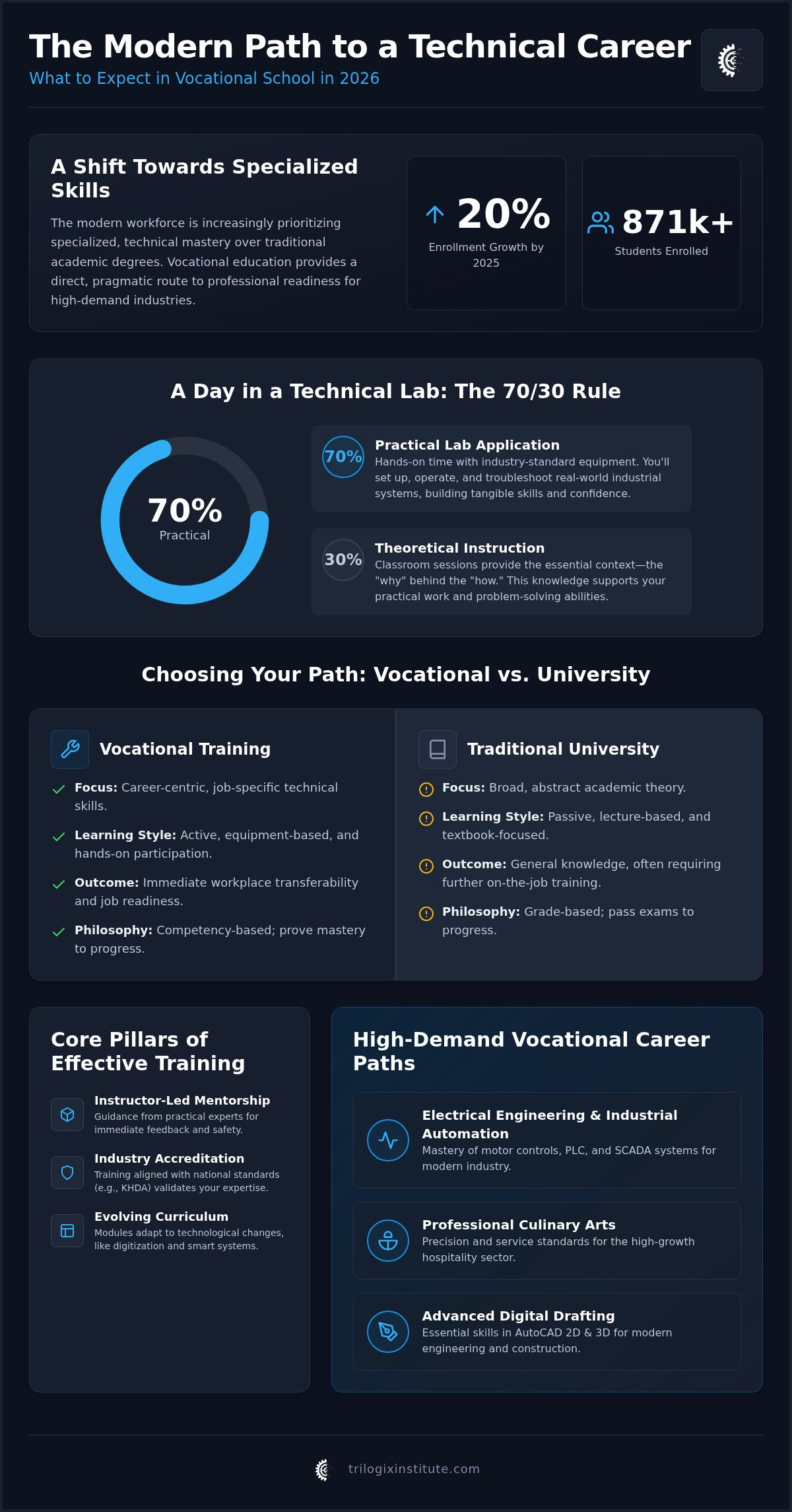
Enrollment at vocational-focused institutions grew by nearly 20% by spring 2025, reaching over 871,000 students. This surge proves that the modern workforce is shifting away from traditional degrees toward specialized, technical mastery. If you're considering this path, you likely want to know what to expect in vocational school beyond the marketing brochures. You aren't looking for another four years of abstract lectures. You're looking for a direct, pragmatic route to professional readiness.
You're right to be skeptical of programs that prioritize textbooks over tools. It's frustrating to spend time on theory that doesn't translate to the job site, especially when high-demand industries require immediate technical proficiency. This guide bridges that gap by detailing the day-to-day reality of equipment-based training and how it prepares you for a career in 2026. We'll walk through the typical daily schedule, the process of mastering industrial tools, and the clear roadmap toward earning industry-recognized certifications. By the end, you'll have the confidence to move from ambition to employment with a clear-eyed understanding of the training process.
Key Takeaways
- Learn why modern vocational education prioritizes industry-specific technical skills over abstract academic theory to ensure immediate workplace transferability.
- Discover what to expect in vocational school regarding your daily schedule, which typically balances a 70% practical lab focus with 30% theoretical instruction.
- Compare the career-centric approach of technical training against traditional university degrees to determine the fastest route to your professional goals.
- Understand how aligning your training with national accreditation and KHDA standards validates your expertise for the high-demand job market.
- Explore how instructor-led, equipment-based programs bridge the gap between your career ambition and professional employment.
What is Vocational School? Defining the Practical Education Path
Vocational education is a specialized educational path designed to equip students with job-specific technical skills. Unlike traditional academic routes that prioritize broad theoretical knowledge, the curriculum here is dictated by current industry requirements and global standards. This approach ensures that every hour spent in the classroom contributes directly to your professional portfolio. Vocational education is the direct bridge between classroom learning and industrial application.
When considering what to expect in vocational school, you must understand that the focus shifts from abstract grades to tangible competency. Competency-based learning requires you to demonstrate mastery of specific tasks before moving forward. You aren't just passing a test; you're proving you can operate a system, repair a component, or manage a professional process under real-world conditions.
The curriculum isn't static. It evolves as technology changes. In 2026, this means integrating digitization and smart systems into every module to stay ahead of the curve. Employers no longer look for generalists who need months of retraining. They seek specialists who can troubleshoot specific industrial systems on day one. This alignment with national standards ensures that your training remains relevant and valuable in a fast-moving global market.
The Core Philosophy: Skills Over Theory
In technical fields, understanding the "why" provides context, but mastering the "how" provides a career. This philosophy moves you away from passive listening and into active, equipment-based participation. This hands-on immersion is exactly what to expect in vocational school if you choose a program committed to practical excellence. Using industry-standard tools during your training eliminates the anxiety of being unprepared for real-world equipment and builds steady confidence.
Common Industries for Vocational Training
- Electrical Engineering and Industrial Automation: Sectors requiring experts in motor controls and PLC systems.
- Professional Culinary Arts: High-growth hospitality roles focused on precision and service standards.
- Advanced Digital Drafting: Essential mastery of AutoCAD 2D & 3D for modern construction.
You can explore these career paths in detail through our specialized vocational courses, which are designed to meet 2026 industry benchmarks.
The Daily Experience: What Happens in a Technical Lab?
When researching what is a vocational school, the most significant differentiator you'll find is the environment. You won't spend your days in a standard classroom. Instead, a technical lab serves as your primary workspace. You should expect a high ratio of lab time to classroom lectures, typically 70% practical application and 30% theory. This balance ensures that your time is spent on the skills that matter most to employers in 2026.
Knowing what to expect in vocational school helps you prepare for the rigorous pace of a professional shift. Your daily routine involves setting up, operating, and troubleshooting real-world industrial systems. You won't just learn how to turn a machine on; you'll learn why it stops working and how to fix it safely. You'll work through complex scenarios where systems fail, requiring you to apply logic and technical knowledge to restore function. This environment also encourages collaboration. You'll often work with peers on multi-stage projects, mimicking the communication and teamwork required in any modern industrial plant or engineering firm.
Equipment-Based Learning in Action
Technical mastery is impossible without access to the specific hardware used in modern industry. In our labs, you'll work directly with Essential Industrial Motor Control systems to master power distribution, motor protection, and control logic. You'll also engage in hands-on sessions with PLC and SCADA systems, which are the backbone of industrial automation today. Using industry-standard hardware ensures that you don't face a learning gap when you step onto a job site. You've already mastered the exact tools that global companies use to manage their infrastructure.
The Role of the Instructor-Led Mentor
While online learning has its place, technical trades demand the presence of a Practical Expert. Instructor-led training significantly outperforms self-paced modules because it offers immediate, real-time feedback. Your instructor acts as an authoritative guide, sharing tribal knowledge and industry-specific tips that aren't documented in standard manuals. They provide critical safety corrections when you're handling high-voltage equipment or complex machinery, ensuring you build safe habits from the very first hour. This direct guidance bridges the gap between basic understanding and professional mastery.
You can explore our technical lab facilities to see the professional environment where this training takes place.
Vocational Training vs. University Degrees: Making the Choice
Deciding between a four-year university degree and a vocational certificate requires a clear-eyed look at your professional goals. University programs typically focus on broad academic theory and research methodologies. While this provides a wide knowledge base, it often delays your entry into the workforce by several years. In contrast, vocational schools prioritize specific career readiness. When you evaluate what to expect in vocational school, the primary advantage is a significantly faster time-to-market. You gain the exact skills required for a role and enter the industry while your peers are still in lecture halls.
This efficiency creates a superior return on investment (ROI) for many students. By choosing short-term technical courses, you reduce the total cost of education and start earning a professional salary much sooner. We're currently seeing a "Blue-Collar Gold" trend across national markets. There's a high demand for certified technicians who can handle complex industrial systems. Employers are shifting toward skills-based hiring, valuing documented competency over traditional academic titles. This makes technical training a strategic choice for those who want to bridge the gap between ambition and employment quickly.
Curriculum Depth vs. Practical Breadth
Vocational training strips away the "fluff" found in general education requirements. Every module is designed to have a high impact on your daily job performance. Understanding what to expect in vocational school means recognizing that these programs prioritize practical breadth over abstract theory. For instance, the TTI Dubai Foundation Electrical Engineering program is a dedicated career starter. It focuses on the technical standards and safety protocols required in the UAE rather than general physics. While a degree might be necessary for research roles, a certification is often more valuable for site-based engineering and technical management. It proves you have the mastery to handle real-world equipment from day one.
Flexibility for Working Professionals
Managing a career change is a logistical challenge that vocational education solves through modular learning. You don't have to put your life on hold for four years. Instead, you can navigate your transition through intensive, short-term modules that fit into a professional schedule. This modular nature allows for continuous professional development, where you can stack industry-recognized certifications as you progress in your career. It's a pragmatic approach to staying relevant in a fast-moving economy. Explore our range of technical courses to see how our equipment-based training aligns with your career roadmap.
Aligning Your Skills with National Industry Standards
Technical excellence is not just about individual skill. It is about having those skills validated by the authorities that govern the regional workforce. In the UAE, this validation comes through national accreditation and KHDA standards. These benchmarks ensure that your training meets the rigorous quality requirements of the modern economy. When you consider what to expect in vocational school, you must look for programs that align directly with these industry standards. This alignment guarantees that your certification is recognized by major engineering firms and industrial plants, giving you a competitive edge during the hiring process.
Vocational schools update their curricula frequently to match shifting job market demands. In 2026, this means integrating smart technology and digitization into traditional trades. Understanding what to expect in vocational school involves recognizing the value of "stackable" certifications. By combining a foundation in industrial automation with advanced digital drafting, you create a versatile professional profile. This modular approach allows you to specialize in high-growth areas without committing to years of unrelated study. It also ensures you are prepared for the safety and compliance standards required in the regional engineering sector.
Mastering Industry-Standard Software
Modern industrial roles require more than just manual dexterity. They require digital mastery. Transitioning from basic drafting to TTI Dubai Advanced AutoCAD 2D & 3D is essential for anyone entering the construction or engineering fields. You will learn to create digital twins and utilize 3D modeling, which are now standard practices in industrial engineering. While self-taught skills might help you navigate a program, professional certification proves to employers that you can handle complex projects under industry-standard constraints. It validates your ability to produce precise, compliant technical drawings that meet global benchmarks.
Soft Skills in a Technical World
Technical expertise is most effective when paired with professional soft skills. Learning teamwork and communication is a core part of the experience, often achieved through group lab projects. You will practice problem-solving under pressure, such as troubleshooting motor control faults in a TITP Beginner Essential Industrial Motor Control lab. This environment builds the work ethic and professionalism required in an industrial or culinary setting. You aren't just learning a trade; you're learning how to function as a reliable, expert partner in a high-stakes workplace.
To ensure your training meets these rigorous professional requirements, view our industry-aligned programs and start your journey toward technical mastery.
Launching Your Technical Career with Trilogix Institute
Trilogix Institute operates as a pragmatic partner in your career journey. We provide a no-nonsense path to technical mastery, stripping away academic filler to focus on high-impact skill acquisition. Our campuses in the UAE and Philippines utilize specialized labs where you engage with real-world machinery under the guidance of expert instructors. Understanding what to expect in vocational school at Trilogix means preparing for an immersive, equipment-first experience. You won't just read about industrial systems; you'll operate, troubleshoot, and master them.
Our methodology is built on the belief that education should be a functional tool for professional advancement. We don't offer purely online self-paced courses because technical trades require hands-on validation. Every hour spent in our facility is designed to bridge the gap between your ambition and a high-demand career. This results-oriented approach ensures that our graduates are ready to contribute to their respective industries from their very first day on the job.
Our Specialized Technical Programs
Our curriculum is modular and outcome-oriented. We design every program for immediate workplace transferability, ensuring our graduates meet global standards and regional requirements.
- TTI Dubai Foundation Electrical Engineering: This program builds the essential technical foundation for a power-filled career. It focuses on the safety protocols and technical standards required to excel in the regional energy sector.
- Industrial Automation Specialization: Master the complex systems that drive modern production. You'll gain hands-on experience with PLC and SCADA hardware, preparing you to manage the digital backbone of 2026 factories.
- TTI Dubai Professional Culinary Arts: Precision and passion meet in our industrial kitchens. We train you to handle high-pressure service environments while maintaining the highest standards of culinary excellence.
Next Steps: From Ambition to Employment
Choosing the right program depends on your long-term career goals and the specific industry you wish to enter. Whether you're a newcomer or a working professional seeking a career change, our modular certificates provide the flexibility you need to upskill without pausing your life. When you know what to expect in vocational school, the transition from the lab to the job site becomes a logical progression rather than a leap of faith. We focus on steady confidence and technical readiness.
For a deeper dive into specific engineering paths, read our Electrical Engineering Courses in Dubai: A 2026 Career Readiness Guide. This resource details the specific technical requirements for the UAE market.
Your path to becoming a certified technician or professional chef starts with a clear roadmap. We invite you to contact our admissions team for a consultation. Our practical experts will help you align your current skills with the demands of the 2026 job market.
Master Your Technical Future
Choosing a vocational path is a strategic investment in your professional readiness. By prioritizing equipment-based training over abstract theory, you bridge the gap between classroom learning and industrial application. You now have a clear understanding of what to expect in vocational school: a high-impact environment where the majority of your time is spent in specialized labs. This approach ensures you master the exact tools used by global industry leaders, from PLC systems to advanced digital drafting software.
Our expert faculty provides instructor-led guidance, ensuring you gain the tribal knowledge and safety skills required for high-stakes environments. With industry-centric certifications that meet national standards, you can move toward employment with steady confidence. Trilogix Institute acts as your partner in this journey, offering the specific keys to meet the demands of the 2026 job market. Ready to build practical skills? Explore Trilogix Institute courses now. Your ambition deserves a clear, no-nonsense path to success, and we're here to help you turn that potential into professional mastery.
Frequently Asked Questions
Is vocational school harder than a regular university?
Vocational school isn't necessarily harder, but it demands a different type of rigor focused on physical competency and technical precision. While university students focus on theoretical research and abstract concepts, vocational students must demonstrate mastery of industrial systems under real-world conditions. You'll find that the challenge lies in the 70/30 practical-to-theory split, where your success is measured by your ability to troubleshoot equipment rather than writing academic essays.
Can I get a good job with just a vocational certificate in the UAE?
Yes, the UAE job market increasingly prioritizes skills-based hiring over traditional degrees for technical roles. Employers in engineering, automation, and hospitality seek candidates with industry-recognized certifications that validate their ability to handle specialized equipment. By aligning your training with national standards, you position yourself as a ready-to-work professional. This pragmatic approach allows you to enter high-demand sectors like industrial automation or electrical engineering without the multi-year time commitment of a degree.
What is the age limit for enrolling in vocational training programs?
There is no strict age limit for enrolling in our vocational programs. We welcome high school graduates looking for a career starter as well as seasoned professionals navigating a career change. The curriculum is designed for anyone with the ambition to master a technical trade. Because our modules are focused on utility and professional advancement, we see a diverse range of students who all share the goal of achieving technical mastery.
How much hands-on time will I actually get with the equipment?
You should expect a high ratio of practical immersion, typically involving 70% hands-on lab time and 30% classroom theory. This ensures that you spend the majority of your training hours operating and troubleshooting the exact hardware found in modern plants and factories. Understanding what to expect in vocational school means preparing for a schedule where you're actively working with motor controls, PLCs, or professional culinary tools rather than just sitting at a desk.
Are Trilogix Institute courses accredited by the KHDA?
Trilogix Institute ensures that its programs align with regional requirements, including KHDA standards in the UAE. This accreditation validates the quality of our instructor-led training and ensures your certification is recognized by local employers. Maintaining these standards is a core part of our commitment to professional excellence. You should always verify the current status of specific courses to ensure they meet your long-term career roadmap and specific industry benchmarks.
Do I need prior engineering experience to start a foundation course?
No prior engineering experience is required to begin a foundation course like the TTI Dubai Foundation Electrical Engineering. These programs are designed to build your technical knowledge from the ground up. We start with the basic principles of power and safety before moving into more complex industrial motor control systems. This structured progression allows students from any background to achieve professional competency through methodical, instructor-led practice in our specialized labs.
What happens if I miss a practical lab session?
Attendance in practical lab sessions is critical because competency-based learning requires you to physically demonstrate your skills. If you miss a session, you miss vital hands-on experience with the equipment that cannot be replicated through independent study. We encourage all students to maintain a consistent schedule to ensure they don't fall behind in their technical mastery. Missing lab time can delay your certification, as every hour is designed for immediate workplace transferability.
Can vocational school help me transition from a non-technical field?
Vocational school is an ideal bridge for those transitioning from non-technical fields into specialized trades. The modular nature of our certificates allows you to gain specific, high-impact skills without wasting time on irrelevant theory. When considering what to expect in vocational school during a career shift, focus on how equipment-based training quickly replaces anxiety with confidence. Our Practical Experts guide you through the transition, ensuring your new skills are directly transferable to the 2026 job market.


