

A university degree might look impressive on a wall, but it often fails to provide the technical precision required in today's fast-moving industrial landscape. In 2026, the most valuable asset you can possess is not a broad theoretical background, but the mastery of a specific, specialized toolset. You're likely concerned about investing time into a program only to find it lacks the practical depth needed for the actual workplace. It's frustrating to choose between similar-sounding fields when you just want a direct path to a specialized role.
This comprehensive Trilogix Institute courses comparison is designed to remove that uncertainty. We've structured this guide to help you evaluate every technical and culinary program we offer, from TTI Dubai Foundation Electrical Engineering to TITP Industrial Automation Specialization. You'll gain a clear understanding of how each curriculum translates into real-world application. We'll examine the specific equipment, skill standards, and career outcomes of our instructor-led training to ensure you select the exact certification that aligns with your professional goals. By the end of this guide, you'll have the confidence to choose a path that turns your ambition into a functional, high-impact career.
Key Takeaways
- Identify the specific technical toolsets required for 2026 career success rather than relying on broad academic degrees.
- Distinguish between digital design mastery in AutoCAD and the physical implementation skills required in electrical engineering.
- Evaluate the progression from foundational motor control to complex industrial automation to find your place in modern manufacturing.
- Utilize this Trilogix Institute courses comparison to determine whether your career goals align with professional culinary arts or industrial engineering.
- Discover how hands-on, instructor-led training with specialized equipment bridges the gap between ambition and professional readiness.
Navigating Vocational Training: Why Choice Matters in 2026
The global economy is shifting. Employers in 2026 value specialized expertise over generalized theory. This evolution makes a thorough Trilogix Institute courses comparison essential for anyone looking to bridge the gap between their current skills and a high-demand role. Whether you're in the UAE or the Philippines, the focus remains the same: practical readiness. Trilogix operates as TTI in Dubai and TITP in the Philippines, providing a localized approach to vocational education that meets specific regional industrial standards. We've organized our offerings into three core pillars: Engineering, Design, and Culinary Arts. Each is designed to strip away academic "fluff" and focus on the technical mastery required for professional advancement.
Vocational Certificates vs. University Degrees
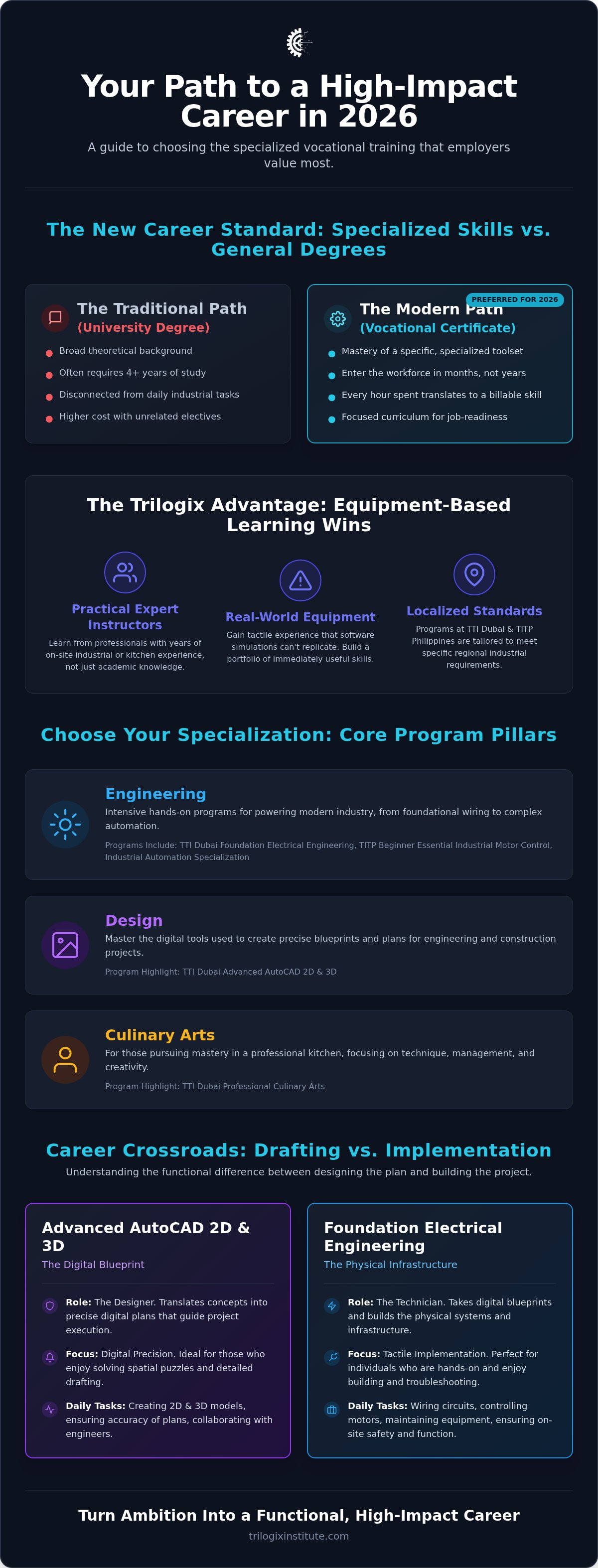
A university degree often requires four years of academic research, much of which is disconnected from the daily tasks of a technician or designer. Vocational training prioritizes hands-on mastery. You can enter the workforce in months rather than years. This speed-to-market is a critical advantage in a fast-paced economy. Equipment-based training offers a superior cost-benefit ratio because every hour spent in the lab directly translates to a billable skill. You aren't paying for unrelated electives; you're paying for the technical proficiency that secures your future. Our programs are concentrated, allowing you to focus entirely on the specialized tools of your chosen trade.
The Trilogix Philosophy: Instructor-Led Excellence
We believe learning must be guided by a "Practical Expert." These are instructors who have spent years on industrial sites or in professional kitchens. They don't just teach from a manual; they share the nuances of the trade. While many institutions push purely online, self-paced modules, Trilogix remains committed to instructor-led sessions with real-world equipment. Software simulations have their place, but they can't replicate the tactile experience of wiring a motor or managing a high-pressure kitchen environment. This approach allows you to build a portfolio of skills that employers recognize as immediately useful. You can view our full range of programs on our courses page to see which environment fits your goals.
Our curriculum is categorized to streamline your decision-making process:
- Engineering: Intensive programs like TTI Dubai Foundation Electrical Engineering and TITP Beginner Essential Industrial Motor Control.
- Design: Advanced technical training in TTI Dubai Advanced AutoCad 2D & 3D for precision drafting.
- Culinary Arts: The TTI Dubai Professional Culinary Arts program for those pursuing mastery in the kitchen.
Choosing the right path requires understanding the specific demands of each field. A Trilogix Institute courses comparison helps you identify which program matches your aptitude and the current market needs. Whether you're interested in the precision of AutoCAD or the complexity of industrial automation, the goal is the same: alignment with professional standards.
Drafting vs. Implementation: Advanced AutoCAD vs. Foundation Electrical Engineering
Many students struggle to decide whether they belong in the drafting office or on the plant floor. This Trilogix Institute courses comparison clarifies that choice by highlighting the functional differences between design and execution. While both paths are essential to Technical Engineering Trades, they require distinct aptitudes and daily tasks. The designer drafts; the technician builds. It's a simple distinction that dictates your entire workday and long-term career trajectory.
The AutoCAD specialist translates concepts into precise digital blueprints that serve as the master plan for any project. In contrast, the electrical technician takes those blueprints and builds the physical infrastructure. A detailed Trilogix Institute courses comparison reveals that while AutoCAD is digital, electrical engineering is tactile. In large-scale industrial projects, these roles are two sides of the same coin. One cannot function without the other's accuracy and technical insight.
Choosing the TTI Dubai Advanced AutoCAD 2D & 3D Path
Precision is the priority in this program. It's designed for individuals who enjoy solving spatial puzzles and working with high-performance software. This isn't just about drawing basic lines; it's about digital modeling for construction, architecture, and industrial design. You'll progress from 2D fundamentals to complex 3D environments, learning how to create documentation that meets global industrial standards. This path is your gateway to the design side of the industry, where your work informs every stage of the building process. You'll master the tools needed to visualize and refine structures before a single wire is even placed.
Choosing the TTI Dubai Foundation Electrical Engineering Path
If you prefer physical problem-solving and working with your hands, this program focuses on installation, wiring, and system logic. You'll spend your time in instructor-led labs working directly with power systems and circuit design. It's about understanding how electricity flows and ensuring safety and efficiency in a real-world environment. Software simulations don't teach you how a circuit reacts to a real-world load or how to troubleshoot a physical fault. You can Learn more about Electrical Engineering in Dubai to see how this foundation sets you up for advanced technician roles.
These disciplines overlap when a design must be adjusted for physical constraints on-site. An AutoCAD drafter needs to understand electrical logic to create feasible plans, and a technician must be able to read a complex 3D schematic to complete an installation. Understanding both gives you a significant competitive edge in the job market. You can explore our full vocational training options to see which side of the project lifecycle excites you most.
Powering Industry: Beginner Motor Control vs. Automation Specialization
Industrial automation is the engine of modern production. Without it, factories stop. This Trilogix Institute courses comparison focuses on the distinction between foundational hardware management and the high-level logic required for smart manufacturing. Understanding the progression from manual motor circuits to integrated automated lines is vital for anyone aiming to become an indispensable technician. You must decide if your current goal is to master the physical components or the digital systems that govern them.
The transition from a basic technician to a systems specialist involves a shift in perspective. You move from looking at a single machine to observing an entire ecosystem of connected devices. While motor control deals with the "muscles" of the industry, automation provides the "brain." Both are critical, but they require different troubleshooting mindsets and toolsets.
TITP Beginner Essential Industrial Motor Control
This course serves as the foundational entry point for industrial electrical systems. You can't program a system if you don't understand the physical components it controls. Students master the selection and wiring of contactors, relays, and motor protection devices. It's about hardware mastery. You learn to build the physical control circuits that keep industrial motors running safely. This is the essential first step for technicians who need to understand why a motor isn't turning before they ever look at a line of code. It provides the tactile experience that purely online courses simply can't replicate.
Industrial Automation Specialization Course
Once you understand basic motor logic, the specialization track introduces high-level complexity. This program integrates sensors, actuators, and advanced control logic to create seamless, autonomous workflows. It's designed for those with an existing technical foundation who want to move into roles within smart factories or automated logistics hubs. You transition from simple on/off troubleshooting to managing entire system architectures. It's a shift from being a repair technician to becoming a systems specialist. Career outcomes in this field often involve overseeing the sophisticated tech that defines 2026 manufacturing standards.
The core difference lies in the day-to-day application of your skills. Motor control is about physical troubleshooting and hardware reliability. Automation is about programming and system integration. While a motor control expert ensures a single machine runs safely, an automation specialist ensures ten machines communicate effectively. This Trilogix Institute courses comparison shows that while the paths are different, they are sequential. One provides the physical grounding; the other provides the digital intelligence. You can explore the specific modules for each track on our technical courses page to determine your current readiness level.
The Career Crossroads: Culinary Arts vs. Technical Engineering Trades
Choosing between a career in a professional kitchen and a role in industrial engineering is a significant decision. This Trilogix Institute courses comparison highlights that while the environments differ, the underlying requirement for mastery remains constant. A kitchen is a high-pressure, sensory-driven environment where timing is everything. An industrial site is a structured, safety-critical space where technical accuracy prevents system failure. Both demand a specific temperament and a commitment to global standards. You aren't just choosing a job; you're choosing the daily atmosphere in which you'll solve problems.
The growth prospects for both sectors remain strong in 2026. Dubai's hospitality sector continues to require skilled professionals who can manage international culinary standards. Simultaneously, the industrial sector's shift toward smart manufacturing creates a constant demand for technicians who understand complex circuitry. Both paths offer long-term stability for those who possess specialized certifications rather than general knowledge. The choice depends on where you want to apply your focus.
TTI Dubai Professional Culinary Arts: A Path to the Kitchen
The TTI Dubai Professional Culinary Arts program is designed for individuals who thrive in fast-moving, creative environments. You won't find theoretical lectures here. Instead, you'll engage in hands-on training within professional kitchen settings. The curriculum covers everything from fundamental knife skills to the complexities of advanced plating and flavor profiles. You'll learn to manage the heat of a service line while maintaining strict hygiene and safety protocols. You can Explore our Culinary Arts gallery to see our students in action and the professional-grade equipment you'll be using to master your craft.
How to Decide: Personality and Goal Assessment
To make the right choice, you must evaluate your personality and long-term goals. Ask yourself a few critical questions. Do you prefer a career where you create tangible, sensory products daily? Or do you find satisfaction in maintaining the complex systems that power our world? A chef's day is defined by service peaks and immediate feedback from guests. A technician's day involves methodical troubleshooting and system optimization. Both roles require precision, timing, and a deep respect for safety standards. Whether you're calibrating a sensor or temping a steak, the margin for error is slim.
If you're still unsure which environment suits you best, it helps to look at the work-life rhythm. Technical trades often follow a more predictable industrial schedule. Culinary roles often involve evening and weekend shifts that align with the hospitality industry's peak hours. If you're ready to commit to a specific path, you can contact our career advisors to discuss which program fits your profile and 2026 career objectives.
The Trilogix Advantage: Why Equipment-Based Learning Wins
Self-paced online modules often fail because they treat technical trades as purely theoretical subjects. You can't learn the physical resistance of a wire or the precise temperature of a sauté pan through a computer screen. True mastery requires physical interaction with industrial-grade tools. This Trilogix Institute courses comparison has detailed the technical requirements of our programs, but the unifying factor is our commitment to equipment-based learning. Building muscle memory is the only way to ensure you're ready for the pressures of an active industrial site or a professional kitchen.
In our instructor-led labs, mistakes aren't just allowed; they're essential. It's better to trip a circuit breaker or miscalculate a 3D model in a controlled environment than on a high-stakes project. Our "Practical Experts" guide you through these errors, teaching you the troubleshooting logic that separates a novice from a professional. This hands-on approach ensures that when you step into a new role, you aren't just carrying a certificate. You're carrying the confidence that comes from having already done the work on real equipment.
Bridging the Skill Gap Between Ambition and Employment
The gap between wanting a career and actually being ready for one is bridged by aligning your training with current global industrial standards. Our programs strip away the academic fluff to focus on the exact skills employers are looking for right now. Beyond the curriculum, the instructor-led environment provides a unique opportunity for networking with industry insiders. You learn the nuances of the trade that aren't found in textbooks. If you're ready to move from ambition to a functional career, you can contact our admissions team to discuss your specific goals.
Your Enrollment Checklist
Starting your 2026 career journey requires a logical approach to your education. Use this Trilogix Institute courses comparison to narrow down your options based on your aptitude and the market demands we've discussed. Once you've identified your path, the following steps will help you prepare for your first session:
- Select Your Track: Choose between Engineering, Design, or Culinary Arts based on your "Day in the Life" preference.
- Verify Dates: Check the calendar for upcoming intakes at our Dubai (TTI) or Philippines (TITP) campuses.
- Review Requirements: Ensure you meet the foundational needs for advanced tracks like Industrial Automation.
- Secure Your Spot: Complete the registration process to gain access to our specialized labs.
Your success in the technical or culinary trades depends on the quality of your foundational training. By choosing a path that prioritizes real-world equipment and expert guidance, you're investing in a future defined by mastery and professional reliability. You can view all available course dates to find the next enrollment window that fits your schedule.
Secure Your Place in the 2026 Industrial Landscape
Success in the modern workforce requires more than just interest; it demands specialized mastery. This Trilogix Institute courses comparison has outlined the critical differences between technical engineering trades and professional culinary arts. Whether you're mastering AutoCAD in Dubai or motor control in the Philippines, the focus remains on immediate professional application. You've seen why instructor-led training with industry-grade equipment is the only way to build reliable muscle memory. It's the most pragmatic path to bridging the gap between your current skills and a high-impact career.
Our specialized campuses in the UAE and Philippines are designed to bridge the distance between ambition and employment through pragmatic, results-oriented curricula. It's time to transition from a learner to an industry expert. Don't let your professional goals stall in the gap between theory and the actual workplace. Compare our full list of courses and enroll today to begin your journey toward technical excellence. Your future as a specialized professional starts with the right choice today. We're ready to help you master the tools of your trade.
Frequently Asked Questions
What is the main difference between TTI Dubai and TITP Philippines courses?
The primary difference between TTI Dubai and TITP Philippines is their geographic focus and regional branding. TTI operates in the UAE, while TITP serves the Philippines. Despite these different names, both campuses deliver the same high standards of instructor-led training using real-world equipment. This ensures that a Trilogix Institute courses comparison reveals consistent quality across all locations, regardless of which campus you choose for your technical or culinary certification.
Can I take Trilogix Institute courses purely online if I am working?
No, Trilogix Institute doesn't offer purely online self-paced courses because technical mastery requires physical interaction with equipment. We believe that software simulations can't replace the experience of wiring a physical panel or managing a professional kitchen. All programs are instructor-led and campus-based to ensure you develop the necessary muscle memory. This approach guarantees that you're prepared for the tactile demands of your chosen industry upon completion.
Which course is better for beginners: Motor Control or Electrical Engineering?
TTI Dubai Foundation Electrical Engineering is typically better for absolute beginners as it provides the essential logic of power systems. While TITP Beginner Essential Industrial Motor Control is also an entry-level track, it focuses specifically on motor circuits and protection devices. Starting with electrical engineering gives you a broader base of knowledge. You can then specialize in more complex fields like industrial automation once you've mastered these fundamental electrical concepts.
Does the Advanced AutoCAD course include 3D modeling for industrial use?
Yes, the TTI Dubai Advanced AutoCAD 2D & 3D course includes comprehensive training in 3D modeling for industrial use. You'll progress from basic 2D drafting to creating complex three-dimensional environments that reflect modern construction and design standards. This shift is vital for 2026 roles where spatial visualization is a required skill. Mastering these 3D tools allows you to produce documentation that meets the rigorous demands of global architecture and engineering firms.
Are the culinary arts programs at Trilogix instructor-led or demonstration-based?
The TTI Dubai Professional Culinary Arts program is fully instructor-led and emphasizes active participation over simple demonstration. You won't just watch a chef cook; you'll be at your own station practicing techniques from knife skills to advanced plating. This hands-on methodology ensures you master the timing and precision needed in a high-pressure kitchen. Our instructors act as mentors, providing immediate feedback as you work through each module of the curriculum.
What kind of equipment will I use in the Industrial Automation course?
Students in the Industrial Automation Specialization work with a variety of real-world hardware, including sensors, actuators, and integrated control systems. You'll move beyond theory to program and troubleshoot the actual components used in smart factories today. Using industry-grade equipment is a core part of our Trilogix Institute courses comparison, as it ensures your skills are directly transferable to the workplace. This practical exposure is what makes our graduates ready for immediate employment.
How long do most vocational courses at Trilogix Institute take to complete?
Most vocational courses at Trilogix Institute are designed for efficiency, typically taking a few months to complete rather than years. We focus on intensive, high-impact training that strips away academic fluff to get you into the workforce faster. The exact duration depends on the complexity of the program, but every track is structured to respect your time. This accelerated pace allows you to gain specialized certifications and start your 2026 career journey sooner.
Is there a prerequisite for the Industrial Automation Specialization?
Yes, the Industrial Automation Specialization requires a technical foundation in electrical systems or motor control. It's an advanced track designed for those who already understand basic circuit logic and hardware components. If you're new to the field, we recommend starting with the Foundation Electrical Engineering or Beginner Motor Control courses first. These foundational programs provide the necessary knowledge to handle the complex programming and system integration covered in the automation specialization.


