

What if the only thing standing between your current career and a professional kitchen isn't your age, but the specific equipment you're practicing on? Many adults hesitate to pursue their culinary ambitions because they fear they've waited too long or don't have years to spend on abstract theory. Choosing a culinary arts certification for adults shouldn't feel like a compromise between your schedule and your goals. You've likely noticed that traditional academic schedules rarely align with the realities of adult life, leaving you searching for a more direct, pragmatic route to the chef’s coat.
This 2026 guide outlines a clear path to the kitchen, focusing on instructor-led programs that prioritize technical mastery of industrial equipment. We'll show you how to bypass the academic fluff and choose a certification that emphasizes repetition and vocational skill. You'll learn what to look for in a curriculum to ensure you're prepared for a technical role in hospitality. We'll also examine why equipment-based training is the most efficient way to gain the confidence needed for a high-pressure culinary environment. It's time to trade theory for the practical mastery that modern employers actually value.
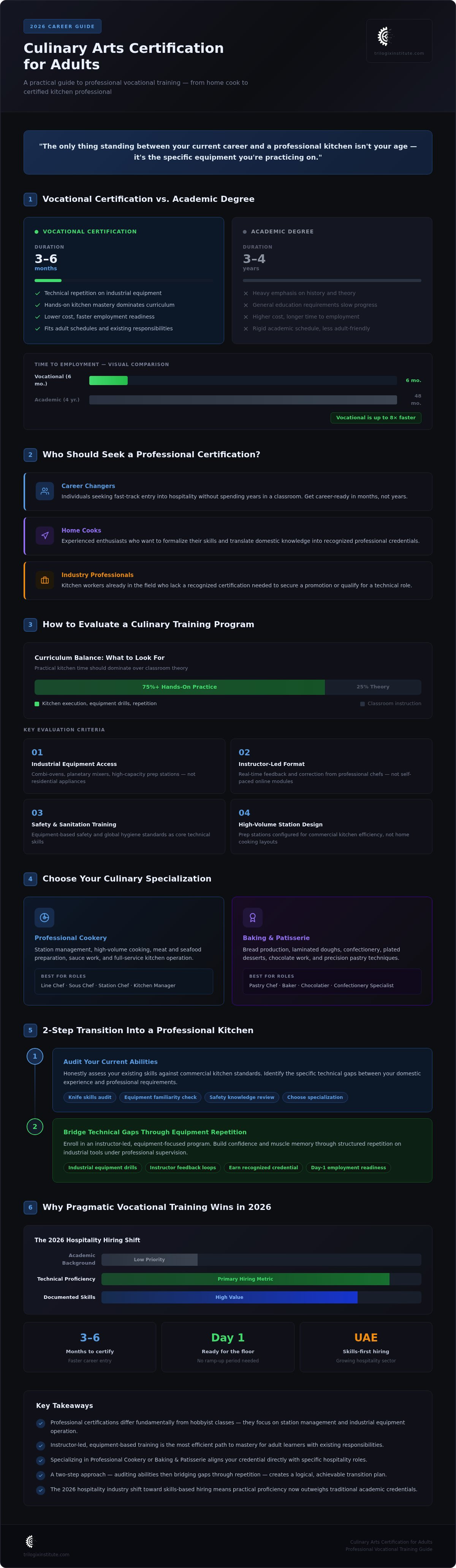
Key Takeaways
- Distinguish between hobbyist cooking classes and professional vocational paths that focus on career-ready technical skills.
- Identify why an instructor-led culinary arts certification for adults is the most efficient way to achieve mastery of industrial kitchen equipment.
- Explore how choosing a specialization in Professional Cookery or Baking and Patisserie aligns your training with specific hospitality roles.
- Follow a logical two-step transition plan that audits your current abilities and bridges technical gaps through equipment-based repetition.
- Understand the 2026 industry shift toward skills-based hiring that prioritizes practical proficiency over traditional academic theory.
Understanding Culinary Arts Certification for Adults
A professional culinary arts certification for adults is a technical credential that signals immediate readiness for a commercial kitchen. It differs fundamentally from hobbyist cooking classes. While a weekend workshop might teach you how to prepare a specific dish, a professional certification teaches you how to manage a station, operate industrial equipment, and maintain global safety standards. For adult learners, this distinction is vital. You aren't just learning to cook; you're gaining the specific skills required to function within a high-pressure hospitality environment.
The demand for these certifications is rising as the national hospitality sector shifts toward skills-based hiring. Employers increasingly value documented technical proficiency over general academic backgrounds. Choosing a vocational path allows you to bypass the abstract theory often found in traditional education. Instead, you focus on the practical mastery of tools and techniques. This results in a shorter duration of study and lower overall costs, making it a highly pragmatic choice for those managing existing personal or professional responsibilities.
Vocational Certification vs. Academic Degrees
The primary difference between vocational training and an academic degree is the economy of time. A traditional degree often requires a three to four year commitment. In contrast, a vocational culinary arts certification for adults typically ranges from three to six months. This compressed timeline doesn't sacrifice quality; it removes the "fluff" of general education requirements to prioritize technical repetition. While a university might spend months on the history of gastronomy, programs like the TTI Dubai Professional Culinary Arts focus on the immediate application of skills. In the UAE hospitality market, this technical proficiency is the primary metric for recruitment. Employers need staff who can operate industrial equipment safely and efficiently from their first day on the job.
Who Should Seek a Professional Certification?
Professional training is designed for several distinct groups of adult learners. Each group benefits from the structured, equipment-based approach of vocational education:
- Career Changers: Individuals looking for a fast-track entry into the hospitality industry without spending years in a classroom.
- Home Cooks: Experienced enthusiasts who want to formalize their skills and translate domestic knowledge into professional credentials.
- Industry Professionals: Workers already in the kitchen who lack a recognized certification and need one to secure a promotion or a technical role.
Formalizing your skills through an instructor-led program provides the confidence needed to transition into a professional kitchen. It bridges the gap between ambition and employment by providing a clear, recognized path to success. You can explore these pathways further at our courses page.
How to Evaluate a Culinary Training Program
Selecting a culinary arts certification for adults requires a critical look at the learning environment. You aren't just paying for information; you're paying for access to a professional ecosystem. While online modules offer convenience, they can't replicate the sensory feedback of a working kitchen. You can't learn heat management, texture recognition, or knife speed through a screen. Practical kitchen time should dominate the curriculum, ideally maintaining a significant majority of hours in favor of hands-on execution over classroom theory.
A pragmatic program focuses on the "how" rather than just the "why." When you evaluate an institute, look for a curriculum that treats the kitchen as a laboratory for technical mastery. This means the program should be built around repetitive practice on industrial tools. It's this direct engagement that bridges the gap between being a home cook and becoming a professional ready for a technical role in hospitality.
The Role of Industrial Equipment in Training
Professional readiness depends on your comfort with commercial-grade machinery. Home appliances don't behave like industrial combi-ovens or high-capacity planetary mixers. If a program relies on residential equipment, it isn't preparing you for the realities of a commercial kitchen. Mastery of equipment-based safety and sanitation is a core technical skill that employers look for. When you audit a facility, ensure the prep stations are designed for high-volume efficiency. Programs like the TTI Dubai Professional Culinary Arts prioritize this equipment-based repetition to ensure students are ready for the floor from day one.
Instructor-Led Mastery: Why Mentorship Matters
Real-time feedback is the fastest way to correct technical errors. An instructor-led model ensures that a seasoned expert is watching your technique, correcting your posture, and refining your palate. This mentorship goes beyond recipes. It covers professional kitchen etiquette, efficiency short-cuts, and the mental stamina required for service. This direct observation builds a portfolio of skills that are verified by industry insiders, providing a level of credibility that self-paced courses simply can't match.
Use this checklist when visiting a vocational institute to ensure the lab meets professional standards:
- Equipment Variety: Are there specialized stations for hot kitchen, butchery, and pastry?
- Student-to-Station Ratio: Will you have your own workspace or are you sharing one with multiple others?
- Sanitation Standards: Does the lab mirror the rigorous health and safety requirements of a licensed restaurant?
- Instructional Access: Is the instructor physically present in the lab during all practical sessions?
Choosing Your Culinary Specialization
Selecting a specific track within a culinary arts certification for adults is a strategic career decision. It determines your daily environment, from the high-velocity heat of a line to the climate-controlled precision of a pastry lab. In 2026, the national hospitality market favors specialists who can demonstrate deep technical mastery in one area rather than generalists with superficial knowledge. Adults often find that specializing early allows them to leverage their existing maturity and focus on a targeted professional outcome.
Specialization is about efficiency. You don't have years to explore every corner of a kitchen; you need to master the specific tools and techniques that lead to employment. Aligning your choice with market demands ensures that your training translates directly into a technical role.
Professional Cookery: The Foundation
This path focuses on the "hot kitchen" and the execution of savory dishes. You'll master knife work, stocks, sauces, and complex protein preparation. The TTI Dubai Professional Culinary Arts curriculum emphasizes high-volume production, teaching you how to maintain consistency under pressure. It's about building the stamina and technical speed required for a line cook or station chef role. You'll learn to manage multiple orders simultaneously while utilizing commercial ranges, grills, and specialized prep equipment.
Baking and Patisserie: Precision and Artistry
For adults who prefer the science of ratios over the intuition of seasoning, this is the ideal route. It requires mastering industrial pastry equipment like deck ovens, provers, and high-capacity mixers. Success here depends on precision and scaling. You aren't just making a single cake; you're managing professional-grade batches where a one-gram error ruins the entire production. This specialization is highly valued in commercial bakeries, hotels, and specialized pastry shops that demand extreme consistency.
Beyond technical execution, some pathways lead toward kitchen management. This involves moving from doing the work to supervising it. It includes inventory control, labor management, and food cost analysis. This is a natural progression for adults with previous leadership experience in other industries who want to apply those skills to hospitality. You can view our available specialization modules on our courses page to see which path aligns with your career goals.
Steps to Transition into a Professional Kitchen
Transitioning into a commercial kitchen as an adult is a deliberate professional pivot. It requires more than passion; it demands a structured plan to replace domestic habits with industrial standards. You aren't starting from scratch. Instead, you're layering technical proficiency over your existing professional maturity. This transition is most successful when you follow a methodical sequence of skill acquisition and industry engagement.
- Step 1: Audit your current skills and identify technical gaps. Be honest about your comfort level with industrial machinery and high-volume prep.
- Step 2: Enroll in an equipment-based vocational program. Earning a culinary arts certification for adults provides the technical foundation needed to bypass entry-level hurdles.
- Step 3: Build a technical portfolio. Document your mastery of specific techniques through instructor-led assessments and practical lab work.
- Step 4: Network within the national hospitality industry. Attend technical workshops and leverage your institute's reputation to meet decision-makers.
- Step 5: Apply for roles that value certified technical proficiency. Focus on positions where your previous career experience and new certifications make you a high-value asset.
Building Your Professional Portfolio
A professional portfolio is your proof of mastery. It shouldn't just be a list of recipes; it must document your progress through rigorous, instructor-led assessments. Highlight your proficiency in specific techniques, such as precision knife work or managing complex production schedules. Including a recognized credential like the TTI Dubai Professional Culinary Arts signals to employers that you've been trained to meet global standards. You can view our gallery of student work to see the level of technical execution expected in a professional environment. This documentation acts as a visual resume, proving you can handle the demands of a commercial station.
Networking for Adults in Hospitality
Adult learners have a unique advantage: previous professional experience. Whether you come from project management, logistics, or retail, those soft skills are highly valuable in a kitchen environment. Use technical workshops and industry events to connect with head chefs and kitchen managers. When you pitch yourself, focus on your reliability, your ability to handle pressure, and your certified technical skills. Leverage the reputation of your training institute to open doors. Many employers prioritize candidates from vocational programs because they know the training was focused on immediate readiness rather than abstract theory. To begin your professional journey, connect with our career mentors to align your training with your specific employment goals.
Why Pragmatic Vocational Training Wins in 2026
The landscape of hospitality recruitment has moved decisively toward documented technical proficiency. In 2026, a culinary arts certification for adults serves as a more powerful signal of professional readiness than a general academic degree. Employers no longer have the luxury of training new hires on basic equipment for months. They require staff who can step into a technical role and perform immediately. This shift rewards the pragmatic learner who chooses intensity and repetition over long-term theoretical study. By focusing on vocational mastery, you position yourself as a high-value asset in a fast-moving industry.
Trilogix Institute bridges the gap between ambition and employment by focusing exclusively on industry alignment. Our philosophy centers on the belief that mastery comes from direct engagement with real-world industrial equipment. We've eliminated the academic fluff that often delays career entry. Instead, we provide an environment that mirrors the high-pressure reality of a commercial kitchen. This results-oriented approach ensures that every hour you spend in our labs serves a functional purpose for your future career.
The Trilogix Advantage for Adult Learners
Our vocational model is built on instructor-led, practical application. You don't just watch a demonstration; you execute the technique until it becomes second nature. Every session is designed to align with current professional standards, ensuring your skills are directly transferable to a workplace. This approach respects your time and your need for a clear return on your educational investment. We act as a knowledgeable guide, providing the specific keys to meet the demands of the global job market. You can explore our full list of courses to see how our modular training fits your specific career timeline.
Taking the First Step Toward Your New Career
Preparing for a technical role begins with a single, focused action. We invite prospective students to see our facilities firsthand rather than relying on brochures. Scheduling a tour of our technical labs allows you to observe the equipment-based training in action. You'll see the TTI Dubai Professional Culinary Arts program being delivered by industry insiders who understand what modern kitchens actually require. This transparency is part of our commitment to being a steady, reliable partner in your career journey.
The enrollment process is straightforward and designed for busy adults managing existing responsibilities. We focus on your potential for technical mastery and your readiness to work. To begin your journey, contact our admissions team to discuss your goals and secure your place in the next intake. Your transition to a professional kitchen is a vital tool for personal advancement, and we provide the no-nonsense path to get you there.
Securing Your Future in the Professional Kitchen
Transitioning into the hospitality sector requires a deliberate shift from domestic curiosity to technical execution. You've seen how a culinary arts certification for adults provides a direct, vocational route that respects your timeline and professional goals. By prioritizing equipment-based labs over abstract theory, you gain the practical mastery required for immediate employment. This focus on an industry-aligned curriculum ensures your skills meet the rigorous standards of 2026 commercial kitchens. You aren't just learning to cook; you're preparing to lead in a high-pressure environment.
Success in this field is built on repetition and precision under the guidance of seasoned mentors. Our instructor-led training provides the real-time feedback necessary to refine your technique and build a credible portfolio. Don't allow the perceived barriers of age or academic tradition to stall your progress. Your previous career experience is an asset that, when paired with technical proficiency, sets you apart in a competitive market. It's time to take the next step toward your professional ambitions. Start your culinary career with TTI Dubai Professional Culinary Arts and gain the tools needed for lasting success.
Frequently Asked Questions
Is it too late to start a culinary career at 30 or 40?
It's never too late to start. Many head chefs value the maturity and discipline that older career changers bring to the kitchen. While physical stamina is required, your previous professional experience in organization and teamwork gives you a distinct advantage. A culinary arts certification for adults focuses on bridging the technical gap quickly, allowing you to enter the industry with the same proficiency as younger peers.
How long does it take to get a culinary arts certification for adults?
Most vocational programs take three to six months to complete. This compressed timeline is designed for adult learners who need to transition into the workforce without the four-year commitment of a traditional degree. Programs like the TTI Dubai Professional Culinary Arts prioritize intensive, hands-on repetition in equipment-based labs. This ensures you gain the necessary technical skills in a timeframe that respects your professional goals.
Do I need a university degree to become a professional chef?
You don't need a university degree to succeed as a chef. The hospitality industry in 2026 increasingly prioritizes skills-based hiring over academic credentials. Employers look for documented mastery of kitchen operations and industrial equipment. A vocational certification provides a more direct and cost-effective path to the kitchen floor. It focuses on practical application, which is the primary metric used for recruitment in commercial hospitality environments.
What is the difference between a cooking class and a professional certification?
A cooking class is typically a hobbyist experience focused on specific recipes. A professional culinary arts certification for adults is a comprehensive technical program designed for career readiness. It involves instructor-led training on industrial equipment, food safety protocols, and station management. While a class teaches you how to follow a recipe, a certification teaches you how to function within a professional, high-volume commercial kitchen.
Can I work while completing my culinary training?
Many adult learners successfully balance work with their training. Vocational institutes often design schedules that accommodate the realities of adult life, offering morning or evening sessions. Since these programs are intensive and shorter in duration, they're easier to manage alongside other responsibilities than a multi-year degree. You should check the specific lab hours to ensure you can commit to the required hands-on practice sessions.
What kind of equipment will I learn to use in a professional course?
You'll learn to operate commercial-grade machinery that isn't found in home kitchens. This includes industrial combi-ovens, high-capacity planetary mixers, commercial ranges, and specialized prep stations. Mastery of these tools is essential because they behave differently than residential appliances. Learning equipment-based safety and maintenance ensures you can step into a professional kitchen and operate the floor with confidence and efficiency from your first day.
Are vocational culinary certifications recognized by international hotels?
International hotels widely recognize vocational certifications that align with global industry standards. These establishments prioritize candidates who have been trained in a professional lab environment using real-world industrial equipment. A certification from a reputable institute signals that you've undergone rigorous technical assessment. This documented proficiency makes you a reliable candidate for technical roles in hospitality groups that value practical skill over abstract theory.
What is the cost of a professional culinary certification in the UAE?
The cost varies depending on the specialization and the duration of the curriculum. While we don't quote specific prices, vocational paths are generally more affordable than multi-year university programs. You should research current industry averages for professional training in the UAE to understand the typical investment required. For specific details regarding our current intakes and enrollment fees, we recommend contacting our admissions team directly for a consultation.


