
What turns a motor-control diagram into a safe, working system on the floor? It takes more than memorising symbols. Effective industrial motor control training connects circuit logic with supervised, hands-on troubleshooting, a practical focus for anyone researching industrial motor control training across the United Arab Emirates.
If contactors, overloads, push buttons and wiring diagrams seem difficult to piece together, that’s a common starting point. Course descriptions can also blur motor control with broader automation topics, making it hard to tell what you’ll practise and which fundamentals to learn first.
This guide explains how common motor-control circuits operate and how their components work together to start, stop and protect motors. You’ll find practical exercises that develop safer troubleshooting habits, criteria for choosing structured, equipment-based instruction, and a learning path suited to your current knowledge. Trilogix Institute provides instructor-led vocational training in electrical engineering and industrial automation, including Beginner Essential Industrial Motor Control training. The focus is practical skill development, not a promise of employment.
Key Takeaways
- See how motors, contactors, control devices, overload protection and wiring work together in a basic start-stop circuit.
- Learn why reading a diagram is only one part of practical skill-building, and how supervised circuit tracing supports safer fault-finding.
- Use a step-by-step learning path to build familiarity with electrical basics, circuit symbols and control components before practical exercises.
- Track progress by explaining component roles and circuit sequences, then practise careful observation, systematic fault isolation and clear technical communication.
- Understand how instructor-led, equipment-based technical learning connects electrical principles with practical application and workplace readiness.
What Industrial Motor Control Training Covers, and Why It Matters
Industrial motor control is the coordinated use of electrical commands and components to start, stop and protect motor-driven equipment. The motor provides movement, while the control system determines when it runs and how it responds to commands or faults. For learners exploring industrial motor control training Dubai, understanding that relationship makes circuit diagrams easier to interpret.
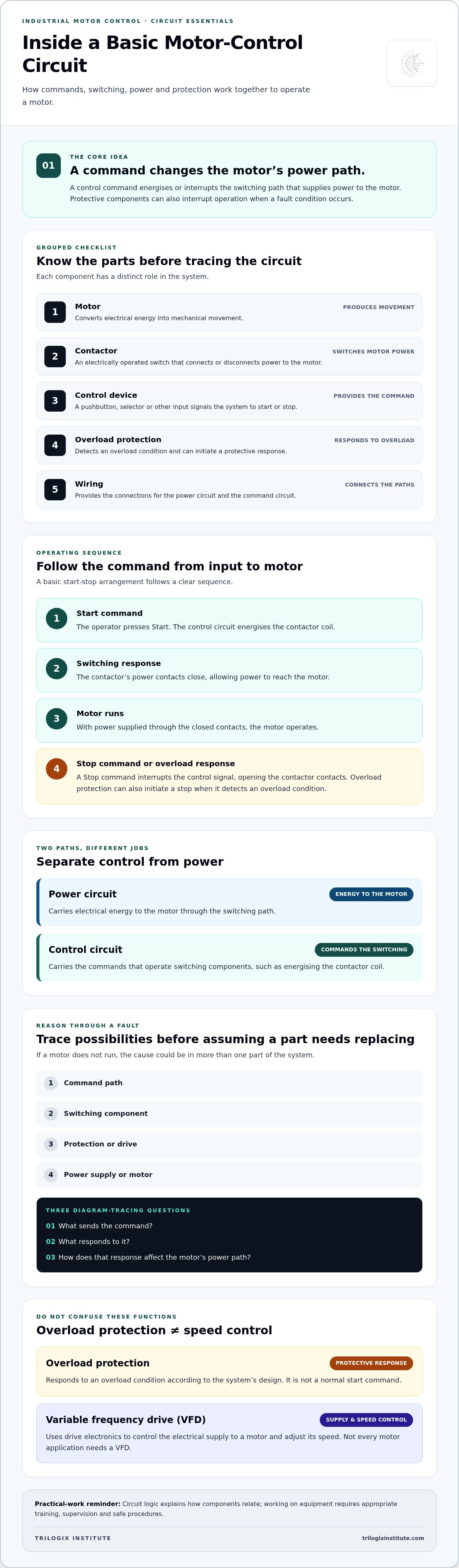
A useful first distinction is between the power circuit and the control circuit. The power circuit carries electrical energy to the motor. The control circuit carries the commands that operate switching components. In a basic start-stop arrangement, pressing Start can energise a contactor coil, closing its power contacts so the motor receives power. Pressing Stop interrupts the control command and opens the contactor. Overload protection can also initiate a stop when it detects an overload condition. The specific circuit depends on the application and equipment.
A Motor controller can coordinate functions such as starting, stopping, speed control and protection. Training helps learners understand how these functions fit together instead of treating every component as an isolated item.
What does an industrial motor-control system do?
It translates an operator’s command into a controlled response from a motor. A start command initiates operation through the control circuit, while a stop command interrupts the operating sequence. Protective components can also interrupt operation when a fault condition occurs. The principle is simple, but circuit designs differ according to the machine, control method and operating requirements.
Why distinguish control from power?
The distinction helps you reason through a problem before assuming a component needs replacing. If a motor doesn’t run, the cause could be in the command path, a switching component, protection, the power supply or the motor itself. Separating these possibilities supports systematic observation and troubleshooting. Practical work should always take place with appropriate supervision and safety procedures.
Who can benefit from learning motor control?
Aspiring technicians can use motor-control fundamentals to build familiarity with electrical systems. Learners with electrical foundations can extend their knowledge from individual components to complete operating sequences. Maintenance and automation roles draw on related skills, including reading diagrams, recognising control devices and explaining what a circuit is doing. Instructor-led, equipment-based learning connects electrical principles with practical exercises, but it doesn’t guarantee a particular job or career outcome.
How Motor-Control Circuits Work: Components, Commands, and Protection
A motor-control circuit combines components so a machine can respond to commands and operate as intended. The motor produces movement, the contactor switches its power, a control device provides the command, protective devices respond to certain fault conditions, and wiring connects everything into a defined circuit.
- Motor: Converts electrical energy into mechanical movement.
- Contactor: An electrically operated switch that connects or disconnects power to the motor.
- Control device: A pushbutton, selector or other input that signals the system to start or stop.
- Overload protection: Detects an overload condition and can initiate a protective response.
- Wiring: Provides the paths that connect the power and command circuits.
A control command changes motor operation by energising or interrupting the switching path that supplies power to the motor.
How do contactors and control devices work together?
In a basic circuit sequence, an operator presses a start control and the control circuit energises the contactor coil. The contactor’s power contacts then close, allowing the motor to run. A stop command interrupts the control signal, causing the contacts to open and the motor to stop. This explains circuit logic, not how to work on equipment. Practical electrical work requires appropriate training and safe procedures.
Following this sequence makes a wiring diagram easier to interpret. Ask three questions as you trace it: what sends the command, what responds to it, and how does that response affect the motor’s power path?
What roles do overload protection and VFDs play?
Overload protection is not a normal start command. It serves a protective purpose by responding to an overload condition according to the system’s design. A variable frequency drive (VFD), by contrast, uses drive electronics to control the electrical supply to a motor and adjust its speed. Not every motor application needs a VFD, and drive or protection devices must suit the equipment and operating requirements.
This distinction is useful during fault-finding. A motor that won’t run could involve a command, switching, protection or drive issue. Industrial motor control training Dubai can help learners build a logical understanding of these relationships before supervised practice. Trilogix Institute provides instructor-led, equipment-based technical learning in this area. Explore the technical course information to take a practical next step.
Which Practical Skills Make Industrial Motor-Control Training Useful?
Motor-control knowledge becomes more useful when you can connect a diagram to circuit behaviour. Reading a schematic develops symbol recognition and understanding of circuit logic. Tracing a supervised training-board circuit adds practical reasoning: you follow how components relate, identify where a command travels and explain the response you expect. When comparing industrial motor control training Dubai options, look for instruction that develops both diagram-reading and practical reasoning.
| Learning task | Skill developed |
|---|---|
| Identify components by their function | Recognise the role of each device in the circuit |
| Read a motor-control diagram | Follow symbols and understand the intended logic |
| Trace a supervised circuit | Connect the diagram with component relationships |
| Reason through a simulated fault | Build a systematic approach to fault-finding |
What should learners practise on training equipment?
With instructor guidance, practise identifying components and tracing the control logic shown in a circuit diagram. A simulated fault can prompt you to describe what you observe, consider which part of the circuit could explain it, and communicate your reasoning before taking any action. The aim is a disciplined diagnostic process, not guesswork. Workshop activity should follow instructor direction and applicable safety procedures.
Practical learning can also reveal gaps in your understanding. You may recognise a symbol on paper but need more practice explaining its relationship to another component. A supervised exercise helps make that connection clearer and reinforces the importance of following procedures rather than experimenting on live equipment.
How is motor control different from broader automation training?
Motor control is one focused area within industrial automation. It concentrates on how electrical commands and circuit components govern a motor’s operation. Broader automation learning may also cover PLCs, which process control logic; HMIs, which provide operator interfaces; and SCADA systems, which support supervisory monitoring and control. These topics can connect in larger systems, but they address different layers of operation.
This distinction helps you choose a sensible next step: strengthen circuit-level understanding or explore how motor-control concepts fit into wider automated systems. Trilogix Institute provides instructor-led vocational learning in electrical engineering and industrial automation, including practical technical study. For broader context, read the industrial automation specialization guide.
How Beginners Can Prepare for Motor-Control Learning
You don’t need to arrive knowing every component or circuit symbol. Start by identifying what you already understand, then build your knowledge in a deliberate sequence. The aim is to strengthen the fundamentals that help you get the most from guided motor-control learning.
What electrical basics should beginners understand first?
Use this four-step path to prepare:
- Review electrical basics: Understand voltage as electrical potential difference and current as the flow of electric charge. Revisit continuity as a way to describe an unbroken electrical path.
- Practise reading diagrams: Get familiar with basic circuit symbols and how lines show connections. Focus on following a circuit, not memorising every symbol at once.
- Recognise control components: Learn to distinguish common control devices and switching components by their general purpose.
- Move to supervised practice: Apply your understanding through instructor-led demonstrations and practice activities guided by the curriculum.
Check your starting point honestly. Can you explain the difference between voltage and current in simple terms? Can you follow a basic diagram and identify its symbols? If not, write down unfamiliar terms and review them before moving on to control logic. Learners bring different educational and work backgrounds, so preparation is a personal baseline, not a pass-or-fail test.
How can learners build confidence safely?
Build confidence through understanding and guided practice, not by experimenting on industrial equipment. Instructor-led demonstrations let you observe how a circuit is intended to behave. Where appropriate, practice on de-energised training setups can help connect diagrams with components without treating a live circuit as a learning exercise. Industrial machinery has its own operating conditions and hazards, so follow instructor direction and the safety procedures for every exercise.
Ask focused questions during instruction: What does this symbol represent? What sequence should follow a command? What observations could help distinguish one possible fault from another? Questions like these develop diagnostic reasoning and clear technical communication.
To strengthen your electrical foundation before studying motor-control concepts, explore Trilogix Institute’s electrical engineering course information.
Turning Motor-Control Knowledge into Practical Technical Readiness
Progress in motor control means more than remembering component names. It means explaining how the parts relate, what a command is intended to do and how to approach an unexpected result. These milestones can help you identify what you understand and what still needs practice.
How can learners recognize progress in motor control?
Use a gradual checklist. First, name common components and describe their general functions. Next, interpret a basic diagram by following its symbols and connections. Then explain the circuit’s purpose and expected operating sequence in your own words instead of relying on memorised labels.
Progress also shows in the quality of your reasoning. Given a training example, can you describe what you observe, identify possible areas to investigate and explain why? A structured approach might involve following the circuit logic and distinguishing a command issue from a protection response. These are indicators of developing understanding, not proof that someone is ready to work independently on industrial equipment.
Which habits transfer to technical work?
Motor-control learning can reinforce habits useful across technical settings:
- Observe carefully: Describe what the diagram or supervised exercise shows before drawing conclusions.
- Isolate methodically: Consider the circuit in logical stages instead of guessing at a cause.
- Communicate clearly: Explain the observed condition, your reasoning and any remaining uncertainty using precise language.
These habits support skill development, but completing training doesn’t guarantee employment, workplace competence or certification. Progress depends on continued learning, practice and the requirements of the role or credential you may pursue.
What is a sensible next step?
Once the fundamentals are clearer, choose further study according to your goals. You might deepen your electrical foundations or explore related automation topics. If certification is part of your plans, read the separate motor-control certification guide to understand the decision factors. Certification is distinct from learning circuit fundamentals.
For practical, instructor-led vocational learning in electrical engineering and industrial automation, explore Trilogix Institute’s technical training.
Build Confidence Through Practical Motor-Control Learning
Motor-control understanding grows when you connect component functions with circuit diagrams and explain how a command affects a motor. Guided exercises can help develop careful observation, structured fault-finding and clear technical communication.
For anyone considering industrial motor control training Dubai, look beyond theory alone. Instructor-led vocational programs and practical, equipment-based learning connect electrical principles with hands-on technical study. Training supports skill development, but it doesn’t guarantee employment or certification.
Trilogix Institute provides instructor-led vocational training in electrical engineering and industrial automation, including Beginner Essential Industrial Motor Control training. Explore the options and take your next learning step through Trilogix technical training.
Frequently Asked Questions
What is industrial motor control training?
Industrial motor control training teaches how electrical control components direct and protect motor operation. Learners study circuit diagrams, control devices, contactors, overload protection and troubleshooting concepts. A strong foundation connects each component’s role to the operating sequence rather than treating equipment names as separate facts. Trilogix Institute provides instructor-led Beginner Essential Industrial Motor Control training, connecting technical learning with practical study.
Is industrial motor control training suitable for beginners?
Beginners can start by learning electrical fundamentals before moving on to control circuits. Reviewing basic terms such as voltage and current, along with common circuit symbols, can make new concepts easier to follow. Practical work should be instructor-led, with safety expectations explained before learners use training equipment.
What do you learn in a motor-control course?
A motor-control course can cover circuit concepts, motor components, switching devices, protective functions, diagram interpretation and structured fault-finding. Some curricula also introduce variable-frequency drives or connect motor control with broader automation topics. Trilogix Institute’s technical training uses instructor-led, equipment-based learning across electrical engineering and industrial automation.
Can motor-control training help me work in industrial maintenance?
Motor-control knowledge can support technical learning relevant to maintenance and electrical work because it helps explain how motors are commanded and protected. Supervised practice can build foundational skills in component recognition, diagram reading and systematic reasoning. Training alone doesn’t guarantee employment, a specific job title or authorization to work on equipment. Role expectations depend on the employer, equipment, experience and applicable workplace safety procedures.
How is motor control different from PLC training?
Motor control focuses on the electrical circuits and functions used to operate motors. PLC training focuses on programming and configuring a programmable logic controller to manage equipment or processes. The subjects may connect in automated systems, but they’re not interchangeable. Motor-control fundamentals can help you understand equipment behaviour, while PLC study adds controller logic. Which to pursue next depends on your technical goals and the system knowledge you want to develop.
Do I need electrical experience before learning motor control?
Familiarity with electrical terms, basic circuit diagrams and safety concepts can make new material easier to follow. Before choosing a learning path, consider whether you can explain voltage and current or trace a simple diagram. If those ideas feel unfamiliar, reviewing them can provide a useful foundation for understanding control logic.
Is hands-on practice important in industrial motor-control training?
Yes. Practical activities help learners connect circuit diagrams and component functions with observable system behaviour. Under instructor guidance, exercises can develop component identification, circuit tracing and structured fault-finding. Training practice is not a substitute for authorization or safety procedures on industrial machinery. Don’t experiment on live equipment without appropriate instruction and supervision.


