
You cannot learn to troubleshoot a faulted three-phase motor by simply clicking through a digital slide deck. While many programs promise a career in automation, most leave students stranded in a world of abstract diagrams and theoretical math. It's frustrating to spend your hard-earned money on a course only to realize you still feel unprepared to face a live industrial control panel. You deserve a training path that replaces confusing technical jargon with practical, job-ready skills and steady confidence.
We understand that the transition from basic electrical theory to industrial mastery feels daunting when you lack access to professional equipment. This 2026 professional buying guide is designed to help you select a motor control certification for beginners that delivers genuine competence. You will learn how to identify high-quality training that prioritizes a hardware-first approach, focusing on hands-on wiring and diagnostic logic over passive observation. We'll break down the essential industry standards, the specific equipment you must master, and the certifications that turn your ambition into a concrete career advantage. By the end of this guide, you'll have a clear roadmap to gaining the troubleshooting expertise required to keep global industries running.
Key Takeaways
- Understand why motor control mastery is the foundational skill for high-demand careers in manufacturing, HVAC, and automation.
- Learn how to evaluate a motor control certification for beginners by prioritizing instructor-led, equipment-based training over purely theoretical courses.
- Identify the essential components of industrial circuitry, including contactors, timers, and magnetic starters, to build a strong troubleshooting foundation.
- Explore the career trajectory from junior technician to automation specialist across global industries like logistics and food and beverage.
- Discover why a hardware-first approach is the most efficient way to gain the confidence needed to handle live industrial control panels.
Why Motor Control Skills are the Bedrock of Industrial Careers
Industrial motor control is much more than just flipping a switch. It is a sophisticated system of hardware and circuitry designed to start, stop, and protect the motors that drive global productivity. Whether it's a conveyor belt in a logistics hub or a massive compressor in an HVAC system, these motors require precise management to avoid catastrophic failure. For anyone seeking a motor control certification for beginners, understanding this foundational role is the first step toward a high-stakes career in modern industry.
Modern manufacturing faces a critical shortage of technicians who can bridge the gap between physical electrical wiring and control logic. We see a massive shift toward "smart" motor controls and Integrated Power Centers, but these advanced systems still rely on the same fundamental principles of electromagnetic induction and circuit protection. You can't master automation without first mastering the contactors and relays that make it possible. A solid foundation ensures you don't just follow a manual; you understand the "why" behind every connection.
The Role of a Motor Control Technician
A motor control technician acts as the primary guardian of industrial uptime. Their daily responsibilities involve installing magnetic starters, configuring overload relays, and diagnosing complex circuit faults that could halt production. Because motor control systems dictate how and when machines move, they are effectively the "brain" of any industrial facility. Mastery here means you aren't just pulling wire; you're managing the heartbeat of the operation. Technicians frequently handle tasks such as:
- Schematic Interpretation: Reading industrial blueprints to understand sequence and logic.
- Fault Diagnosis: Identifying why a motor won't start or why it keeps tripping its protection.
- System Integration: Wiring control devices like timers and sensors into a cohesive circuit.
From General Electrician to Specialized Professional
Shifting from residential or commercial electrical work to industrial motor control represents a significant leap in professional status. While residential wiring focuses on power distribution and lighting, industrial motor logic requires a deep understanding of sequence, timing, and safety interlocking. Industrial motor control is the coordination of hardware and logic to manage mechanical motion. Specializing in this field makes you indispensable. Employers in 2026 aren't looking for someone who just knows the code; they want experts who can troubleshoot a dead motor under pressure. Earning a motor control certification for beginners provides the structured entry point needed to move from general labor to a specialized, high-value technician role.
Evaluating Motor Control Certifications: Theory vs. Hands-On Lab Work
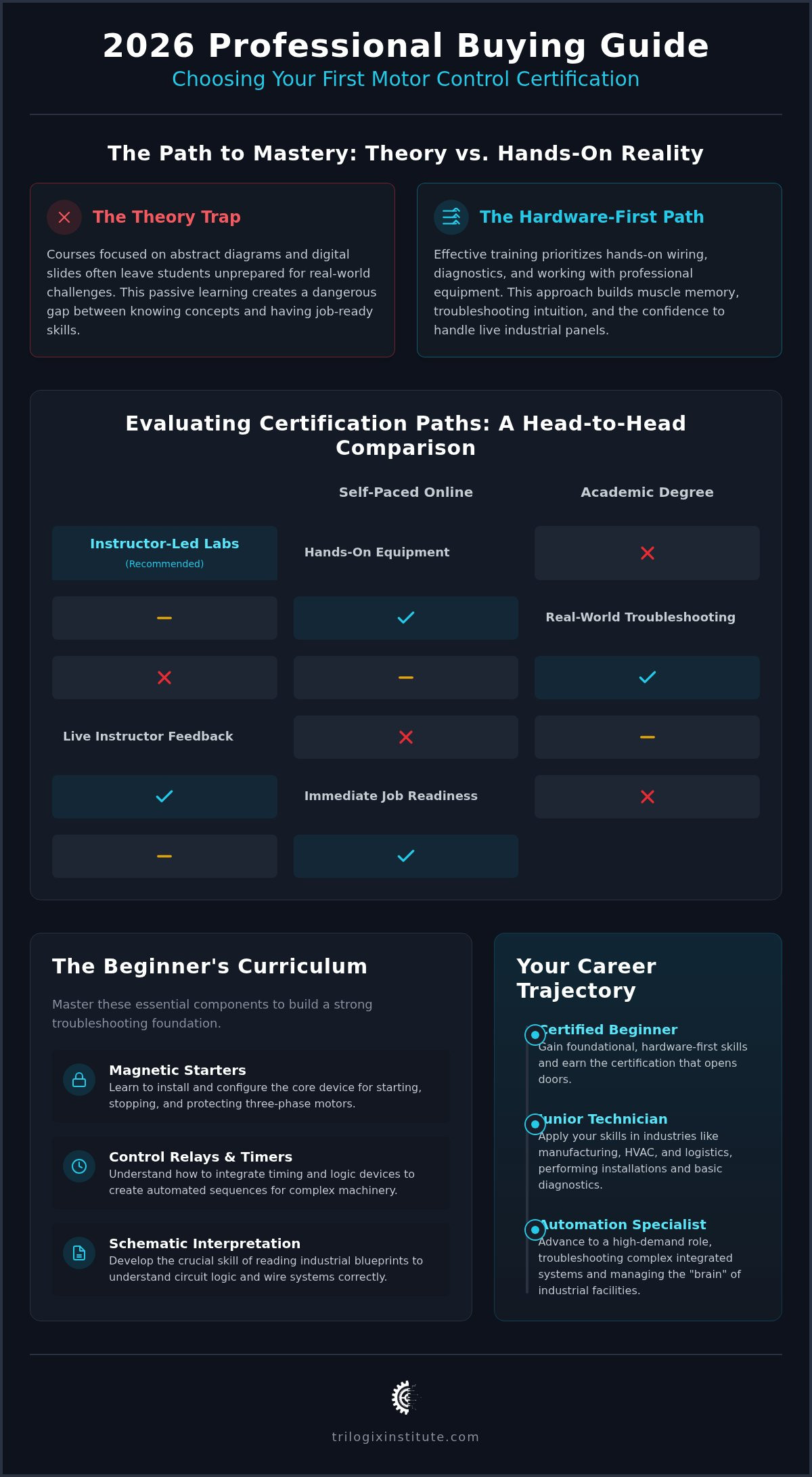
Choosing a path toward professional mastery requires a clear understanding of the training landscape. Beginners typically encounter three primary routes: self-paced online modules, academic university degrees, and vocational instructor-led training. While online courses offer convenience and university degrees provide theoretical depth, they often fail to prepare a technician for the physical reality of a factory floor. For a motor control certification for beginners to be effective, it must be built on a hardware-first philosophy where theory is immediately validated by hands-on application.
Theory is silent. Hardware is loud. In the industrial world, the difference between understanding a circuit diagram and successfully wiring a reversing starter is immense. Relying solely on "Theory-Only" learning creates a dangerous gap in competency. Without physical labs, a student cannot develop the muscle memory required for precise terminal connections or the diagnostic intuition needed to hear a struggling contactor. Choosing a vocational program that prioritizes equipment over slides ensures you aren't just memorizing definitions but building transferable skills.
The Limitations of Online Self-Paced Modules
A computer screen cannot replicate the tactile feedback of industrial components. You don't learn safety protocols by watching a video; you learn them through supervised repetition in a controlled environment. Online simulators often lack the "noise" of real-world variables, such as loose connections or oxidized contacts, which are the very things a technician must troubleshoot. Instructor-led environments provide real-time correction, preventing the development of bad habits that could lead to equipment damage or personal injury in the field.
What to Look for in a Certification Program
When evaluating potential institutes, look beyond the marketing brochures and inspect the lab facilities. A high-quality program should feel more like a workshop than a classroom. Use this checklist to ensure your investment leads to industrial mastery:
- Industrial-Grade Hardware: Does the lab use real contactors, relays, and timers from major manufacturers, or just plastic trainers?
- Veteran Instructors: Are the trainers industry veterans who have spent years in the field, or are they academic lecturers with limited practical experience?
- Lab-to-Lecture Ratio: Ensure the curriculum allocates at least 60% of its time to wiring and troubleshooting exercises.
- Physical Supervision: Verify that instructors are present to guide your wiring process and correct errors in real-time.
The goal is job-readiness. If a program cannot show you the specific equipment you will be working on, it's unlikely to provide the confidence you need to manage live industrial panels. High-impact training bridges the gap between ambition and employment by making the lab the center of the learning experience.
The Beginner’s Curriculum: Essential Components and Troubleshooting
A robust motor control certification for beginners must demystify industrial hardware before tackling complex logic. The curriculum begins with the four pillars of the control panel: contactors, overload relays, timers, and pilot devices. While a manual starter is essentially a heavy-duty switch, the transition to magnetic starters introduces the ability to manage high-power motors using low-voltage signals. This separation is the foundation of industrial safety and automation. Power circuitry handles the high-amperage load that drives the motor, while control logic dictates the precise timing and sequence of the operation.
Safety protocols are the non-negotiable prerequisite for every lab session. Before you touch a single terminal, you'll master Lockout/Tagout (LOTO) procedures to ensure a verified zero-energy state. Using Personal Protective Equipment (PPE) is not just a regulatory requirement; it's a professional standard that protects technicians from arc flash and accidental contact. High-quality vocational training at Trilogix Institute ensures these safety habits become second nature during your first week of training.
Mastering the Industrial Starter
The industrial starter is the heart of most motor circuits. You'll learn to differentiate between Full-Voltage Non-Reversing (FVNR) starters, which provide basic on/off control, and Reversing starters, which utilize interlocked contactors to safely change motor direction. Wiring a 3-wire control circuit is a critical milestone for any beginner. This configuration uses a "holding" or "seal-in" circuit to keep the motor running after the "Start" button is released. Thermal overload protection provides the final line of defense. By monitoring current levels, these devices disconnect the motor if it begins to overheat, preventing costly equipment damage and downtime.
Troubleshooting: The Technician’s Primary Value
Technicians aren't just paid to install equipment; they are paid to restore uptime. You'll develop a methodical approach to fault-finding that eliminates the "parts-swapping" guesswork common among untrained workers. Mastering the multimeter is essential for verifying voltage and continuity within live circuits. Effective troubleshooting relies on isolating the control circuit from the power circuit to identify the point of failure. This logical separation allows you to test pushbuttons, coils, and sensors without engaging the high-voltage motor load. Mastering this diagnostic flow is what separates a certified professional from a hobbyist, providing the confidence needed to handle complex industrial failures under pressure.
Career Trajectory: From Certified Beginner to Industrial Technician
Your career begins at the control panel, but it doesn't end there. Earning a motor control certification for beginners is the first step in a structured progression toward high-level automation roles. The path typically starts as a Junior Technician, where you focus on physical wiring and maintenance. As your diagnostic speed increases, you move into the role of an Automation Specialist, integrating PLC logic with motor circuits. Eventually, many professionals transition into Control Systems Engineering, where they design the very systems they once repaired. This journey is fueled by a global demand for technical expertise in logistics, food and beverage processing, and the rapidly expanding renewable energy sector.
Before moving into design, you must understand the physical constraints of the hardware. This is why practical certification serves as a critical prerequisite for our Advanced AutoCAD 2D & 3D course. Understanding how a contactor actually fits in a rail ensures your digital schematics are grounded in real-world feasibility. In the era of Industry 4.0, the most successful technicians are those who commit to continuous learning, bridging the gap between traditional electrical work and data-driven automation.
The ROI of Vocational Certification
Vocational training offers a pragmatic alternative to the traditional academic route. While a four-year degree involves significant time and debt, a targeted vocational course focuses exclusively on "Ready-to-Work" skills. This approach slashes your time-to-market, allowing you to enter the workforce in weeks rather than years. Hiring managers in industrial sectors prioritize candidates who can demonstrate immediate competency on a live circuit. By choosing an instructor-led, equipment-based program, you ensure your investment translates directly into earning potential from day one.
Building Your Technical Portfolio
A certification is a credential, but your portfolio is the proof. We encourage students to document their lab projects, from wiring complex reversing starters to successfully configuring timed sequence circuits. Showcasing these successful builds to employers demonstrates a level of practical mastery that a standard resume cannot convey. This foundational expertise is the perfect springboard for our Industrial Automation Specialization, where you'll advance from hardwired logic to programmable controllers. Your portfolio serves as a living record of your transition from ambition to industrial mastery.
Don't wait for a degree to start your career. Take the first step toward industrial mastery by exploring our available vocational programs today.
Mastering Mastery with Beginner Essential Industrial Motor Control
The search for a motor control certification for beginners ends where the physical application begins. Our TITP Beginner Essential Industrial Motor Control program is the definitive entry point for those ready to move beyond digital simulations and textbooks. We've built a curriculum that aligns with the global industrial standards of 2026, ensuring every student masters the precise coordination of hardware and logic required in modern facilities. By focusing on instructor-led sessions, we bridge the gap between your career ambition and actual employment. You won't find purely online, self-paced modules here; you'll find a partner in your professional journey.
Our institute acts as an authoritative industry insider, providing the specific keys to meet current market demands. We understand that your goal is not just a certificate, but the ability to perform on a live factory floor. This program is a vital tool for your professional advancement, offering a clear-eyed, no-nonsense path to success in the vocational field.
Why Trilogix Institute is the Practical Choice
We don't believe in learning from a distance. Our labs feature actual industrial starters, timers, and pilot devices from leading manufacturers. You'll work with the same equipment used in global logistics and manufacturing hubs. Small class sizes are a core part of our philosophy. This structure ensures you receive personalized guidance from veterans who've spent decades in the field. Every module is designed for immediate workplace application. The circuit you wire in the lab today is the same one you'll troubleshoot in a factory tomorrow. It's about building steady confidence through repetition and expert correction. We prioritize your ability to work safely and efficiently under pressure.
Next Steps to Your Certification
Starting your journey is straightforward. You can contact our admissions team to view upcoming course schedules and enrollment details. On your first day in the lab, expect to dive straight into the hardware. You won't just be sitting in a lecture; you'll be identifying components and practicing the LOTO procedures discussed earlier. We provide a logical and methodical progression that respects your time and your need for actionable information. Join the growing community of professionals who chose hands-on vocational training over purely theoretical education. This is your path to becoming a practical expert in a fast-moving industry. Your transition from electrical theory to industrial mastery starts with a single step into our equipment labs.
Bridge the Gap to Industrial Mastery
Industrial mastery isn't found in a textbook; it's built through the tactile experience of wiring and troubleshooting live hardware. Choosing a motor control certification for beginners that prioritizes instructor-led labs over digital slides is the most direct path to professional readiness. These foundational skills serve as the heartbeat of modern manufacturing. Specializing in control logic accelerates your career trajectory into high-demand automation roles across logistics and renewable energy.
Trilogix Institute provides the equipment-based training you need to transition from ambition to employment. By working with industry-standard components under the guidance of veteran experts, you develop the diagnostic intuition required to keep global industries running. Don't let your career stall in the realm of abstract theory. Take the definitive step toward your future as a specialized technician today.
Enroll in the Beginner Essential Industrial Motor Control Course and gain the vocational focus needed for immediate career entry. We look forward to seeing you in the lab and supporting your journey toward industrial excellence.
Frequently Asked Questions
What is the best motor control certification for someone with zero experience?
The TITP Beginner Essential Industrial Motor Control is the premier choice for those starting from scratch. It prioritizes hardware-first learning, ensuring you spend more time wiring actual panels than reading slides. This specific motor control certification for beginners bridges the gap between basic electrical knowledge and industrial mastery. By focusing on real-world components like magnetic starters and overload relays, you gain the practical confidence needed for immediate employment in manufacturing or logistics.
Do I need a university degree to become a motor control technician?
A university degree is not a requirement for becoming a successful motor control technician. Most industrial employers prioritize vocational certifications that demonstrate hands-on competency and troubleshooting logic. While academic degrees offer broad theoretical context, specialized training focuses on the specific equipment and safety protocols used on the factory floor. This pragmatic approach allows you to enter the workforce faster and with the exact skills needed to manage complex industrial control systems.
How long does it typically take to complete a beginner motor control course?
Completion times vary depending on the depth of the curriculum, but most high-impact vocational courses are designed for efficiency. Unlike multi-year academic programs, these specialized certifications focus on intensive, equipment-based learning to get you job-ready in a matter of weeks. This accelerated timeline respects your need for a quick return on investment while ensuring you spend sufficient hours in the lab mastering the wiring and diagnostic skills essential for industrial technicians.
Will I get to work with real industrial motors during the training?
You will work directly with industrial-grade hardware, including three-phase motors, magnetic contactors, and control relays. At Trilogix Institute, we believe that you cannot master industrial systems through a computer screen alone. Our labs are equipped with actual components from leading manufacturers, allowing you to practice wiring, testing, and fault diagnosis in a controlled, professional environment. This tactile experience is vital for developing the muscle memory required for safe field service.
What is the difference between a motor control course and a PLC course?
Motor control focuses on the physical, hardwired logic of contactors, relays, and timers to manage mechanical motion. In contrast, a PLC (Programmable Logic Controller) course teaches the software-based automation that supervises these hardwired circuits. Motor control is the essential foundation for PLC training. You must understand how the physical hardware operates and fails before you can effectively program the digital logic that controls it in a modern industrial setting.
Are these certifications recognized by industrial employers nationally?
Industrial employers globally recognize and value certifications that emphasize practical, equipment-based mastery. These credentials signal that a technician is prepared to handle live panels and follow strict safety protocols like Lockout/Tagout. By earning a motor control certification for beginners, you demonstrate to hiring managers that you possess the "Ready-to-Work" skills necessary for roles in food and beverage processing, logistics, and renewable energy sectors where uptime is the primary metric of success.
What safety equipment do I need to start my motor control training?
Safety is the highest priority, so you'll need standard Personal Protective Equipment (PPE) to begin your lab work. This typically includes clear safety glasses, sturdy work boots, and appropriate clothing to protect against arc flash or mechanical hazards. While specific tools like multimeters and insulated screwdrivers are often provided in the lab, learning to use them alongside Lockout/Tagout (LOTO) kits is a mandatory part of your training to ensure a zero-energy state during wiring.
How does motor control certification impact my salary as an electrician?
Specializing in motor control significantly increases your earning potential by moving you from general residential wiring into high-value industrial troubleshooting. Specialized technicians are paid a premium because they can reduce downtime in facilities where every hour of stopped production costs thousands of dollars. This certification transforms you from a generalist into a "Practical Expert" capable of managing the complex control logic that keeps modern industrial plants running at peak efficiency.


