
Standing in front of a live industrial motor for the first time shouldn't feel like a gamble with your safety or the facility's equipment. While many students master the theory of electromagnetism, the transition to a physical hands-on motor control lab is where true professional competence begins. You've likely felt the anxiety of staring at a complex schematic, wondering if your classroom knowledge will actually hold up on a high-voltage job site in the UAE.
We agree that the gap between academic theory and industrial reality is the biggest barrier to a successful technical career. That's why we focus on pragmatic, equipment-based training that replaces fear with steady confidence. This article reveals how our lab environment bridges that gap, providing you with the practical understanding of safety protocols and wiring mastery required today. You'll get an inside look at the latest 2026 NEC standards, such as Design BE and CE motor designations, and see how instructor-led practice prepares you for high-demand roles. We'll preview the path to recognized certification and the specific skills that lead to competitive salaries in specialized industrial automation fields across the region.
Key Takeaways
- Learn to translate complex electrical schematics into functioning physical systems by bridging the gap between theory and application.
- Identify and master the core components of motor protection, including magnetic contactors, overload relays, and pilot devices.
- Develop critical troubleshooting skills in a hands-on motor control lab where you can safely practice intentional fault-finding exercises.
- Master the interpretation of industrial ladder logic to ensure accurate component selection and mounting for various load requirements.
- Understand why instructor-led, equipment-based training provides a superior path to professional industrial career readiness compared to online modules.
What is a Hands-On Motor Control Lab and Why Does It Matter?
A hands-on motor control lab is a specialized, instructor-led environment designed to replicate the exact conditions of a modern industrial facility. It's not just a classroom; it's a bridge between abstract electrical theory and the physical demands of a professional job site. While textbooks explain the principles of electromagnetism, the lab teaches you how to manage that power using real-world hardware. In 2026, as industrial automation becomes more complex, companies in the UAE require technicians who possess deep hardware mastery, not just a passing familiarity with software interfaces.
Think of the lab as a flight simulator for the electrical industry. Pilots don't learn to handle engine failures while flying a commercial jet; they practice in a zero-risk, simulated environment until their responses are automatic. This lab provides the same vital safety net. You can practice high-stakes tasks, such as wiring a complex motor controller or configuring a variable frequency drive, without the risk of equipment damage or personal injury. It's the only way to turn dangerous trial-and-error into professional expertise.
The Shift from Theory to Application
Understanding a schematic diagram is a vital skill, but it's only half the battle. Reading a line on a page doesn't prepare you for the physical resistance of a thick conductor or the specific torque required for terminal blocks. At Trilogix Institute, we focus on the sensory experience of electrical work. You need to hear the distinct snap of a magnetic contactor, see the status indicators respond to your logic, and feel the vibration of a correctly balanced motor. This feedback builds the muscle memory necessary for safety protocols. When an emergency stop must be triggered, your hand should move before your mind even finishes processing the fault.
Who Benefits from Equipment-Based Training?
Pragmatic training in a hands-on motor control lab is essential for several professional paths:
- Early-Career Electricians: Those transitioning from residential work to the industrial sector need to master high-voltage equipment safely.
- Maintenance Staff: Professionals already in the field must upgrade their skills to handle 2026 efficiency standards, such as the new Design BE and CE motor types.
- Career Changers: Individuals moving into technical roles benefit from a clear, no-nonsense path that prioritizes job-ready skills over academic fluff.
By focusing on real equipment, we ensure that every hour spent in training translates directly to value on the job site. This approach respects your time and your career goals by providing the specific keys to meet current global market demands.
Core Components of a Professional Motor Control Environment
A high-quality hands-on motor control lab must mirror the complexity of a modern UAE industrial plant. It's not enough to see a relay on a shelf. You must understand how it interacts with the entire system. A professional environment is built on a foundation of specific hardware that turns a simple motor into a controlled, protected, and efficient machine. Every component serves a distinct purpose, from the primary power delivery to the subtle logic signals that govern operation.
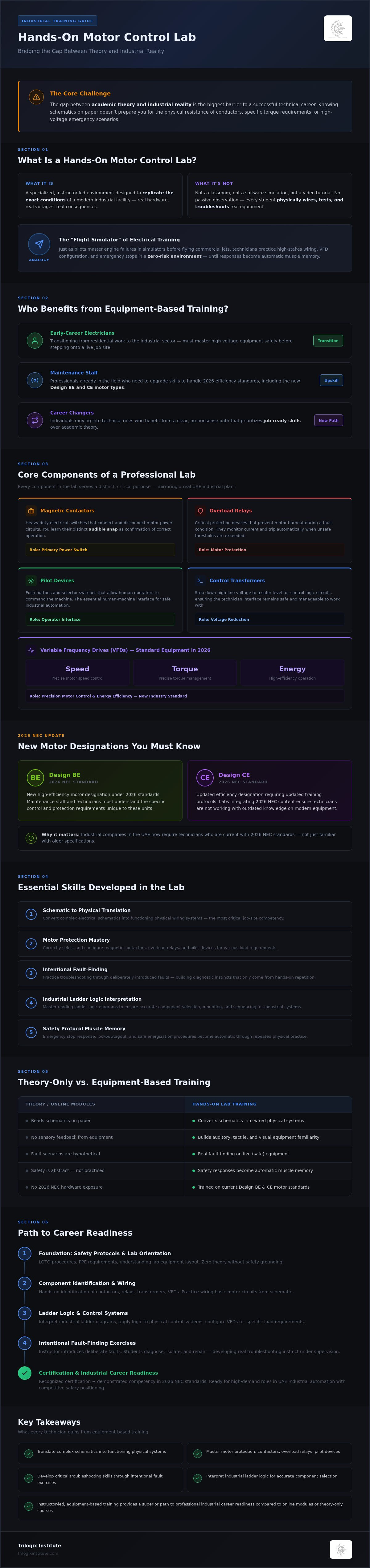
Magnetic contactors act as the heavy-duty switches, while overload relays provide the critical protection that prevents motor burnout during a fault. These work in tandem with pilot devices, including the push buttons and selector switches that allow a human operator to command the machine. Without these interfaces, industrial automation would be impossible to manage safely. Much like the curriculum found in a comprehensive Industrial Motor Control Systems course, our lab emphasizes the integration of these parts into a cohesive, functioning unit.
Control transformers are essential for stepping down high-line voltage to a safer level for the control logic. This ensures that the interface where the technician works remains manageable. For modern applications, Variable Frequency Drives (VFDs) are now standard equipment. Mastering these allows for precise control over motor speed and torque, which is vital for energy efficiency in systems using the latest high-efficiency motor standards. If you're ready to master these components, explore our advanced motor control courses to start your practical training.
Understanding the Control Circuit vs. Power Circuit
The power circuit is the high-voltage "heavy lifter" delivering current to the motor. The control circuit is the "logic layer." It uses lower voltage to trigger the contactors. Training involves learning to keep these separate but perfectly synchronized. Professional wiring standards require neatness and precise labeling. This ensures that any future technician can navigate the panel safely. You'll learn to manage both layers simultaneously, ensuring that the high-power delivery never compromises the sensitive control signals.
Modern Additions to the 2026 Lab
Industry 4.0 has changed the technical landscape. A modern hands-on motor control lab now incorporates Programmable Logic Controllers (PLCs) to automate the logic layer. We include digital monitoring tools and smart sensors that provide the data needed for predictive maintenance. This is a key requirement for technical roles in the UAE today. Safety isn't just a concept; it's a practice. We integrate modern lockout-tagout (LOTO) training directly into the assembly process to ensure compliance with international safety standards.
Bridging the Gap: Why Theory Alone Fails in Industrial Electrical Systems
A perfect circuit diagram on paper rarely accounts for the physical realities of a crowded industrial panel. This is the "Paper vs. Panel" problem. In a hands-on motor control lab, students quickly learn that theory assumes ideal conditions. In the real world, wires have resistance, terminals can be loose, and space is always limited. Understanding these physical constraints is what separates a student from a professional. If you can't translate a line on a page into a secure connection in a panel, the theory remains useless.
Troubleshooting is perhaps the most significant gap. You can't learn to diagnose a failed magnetic contactor by looking at a PDF. It requires physical interaction with the hardware. Fault-finding is an art form that demands logical deduction and practical experience. Without it, a minor equipment failure can lead to hours of costly downtime for a UAE manufacturing facility. Practical training ensures you don't just know how a system should work; you know how to fix it when it doesn't.
The Value of Intentional Failure
Our lab sessions use "fault insertion" to push your diagnostic skills to the limit. Instructors might introduce a subtle break in a control wire or a high-resistance connection. You'll learn to use a multimeter in high-pressure scenarios, just as you would on a live job site. This creates a vital psychological shift. You move from "I think I know how this works" to "I have done this before." It builds the steady confidence needed to handle high-voltage industrial equipment without hesitation. This experience is the core of our TITP Beginner Essential Industrial Motor Control program.
Theory vs. Practice Comparison
Classroom learning focuses on mathematical formulas and "ideal" states. It's necessary, but incomplete. The hands-on motor control lab focuses on real conditions, including voltage drops and mechanical wear. Employers in the UAE prioritize candidates who have documented equipment time over those with only theoretical knowledge. They want to know you can wire a panel safely and efficiently from day one. Practical mastery reduces the "on-boarding" time for new hires, making you a much more attractive candidate for technical roles.
Having an "Authoritative Industry Insider" as a mentor is irreplaceable. A textbook won't tell you if your wire stripping is too deep or if your safety labeling is unclear. Instructor feedback corrects these subtle errors before they become dangerous habits. This guidance ensures your transition to the workplace is seamless and professional, aligning your skills with global industrial standards.
Essential Skills Developed in an Equipment-Based Training Lab
A hands-on motor control lab transforms theoretical knowledge into a precise, professional skillset. Mastery in this field isn't about memorizing facts; it's about the ability to execute complex technical tasks with steady confidence. When you step into a professional environment, you're expected to perform a series of critical steps that ensure the safety and efficiency of industrial operations. These skills are the foundation of a successful career in the UAE's growing industrial sector.
The progression of mastery follows a logical, methodical path. You move from the abstract "why" to the practical "how" through five essential stages:
- Step 1: Interpreting Ladder Logic: You'll learn to translate industrial schematics into a physical wiring plan.
- Step 2: Component Selection: This involves choosing the right hardware, such as contactors for the new high-efficiency Design BE or CE motors, based on specific load requirements.
- Step 3: Precise Wiring: You'll practice termination using professional tools, ensuring every connection is secure and meets international standards.
- Step 4: Testing and Commissioning: Before power-up, you'll perform systematic checks to verify the system’s integrity.
- Step 5: Documentation: Every build requires accurate records for future maintenance and regulatory compliance.
Reading the "Language" of Industry
Global engineering firms use a specific set of symbols and notations to communicate complex ideas. In our hands-on motor control lab, you'll master this "language." Understanding these notations allows you to work anywhere in the world, from local UAE facilities to international manufacturing plants. You'll learn to look at a sequence of operations and immediately visualize the physical layout of the panel. For a detailed look at how we teach these concepts, explore our specific curriculum details.
Troubleshooting and Diagnostic Logic
Developing a diagnostic methodology is what separates a technician from an expert. Faults don't always announce themselves; they require a step-by-step approach to identify. You'll learn the importance of isolation and safety testing before any power is applied. By using diagnostic tools like clamp meters and insulation testers, you'll be able to pinpoint issues without the risk of damaging expensive equipment. This logical approach reduces downtime and increases your value to any employer. If you're ready to build these high-demand skills, contact our admissions team to learn about upcoming intake dates.
The Trilogix Advantage: Practical Motor Control Training for Career Readiness
Trilogix Institute operates on a simple, firm belief: you can't learn to master high-voltage industrial systems through a computer screen. While online modules offer convenience, they lack the physical feedback and expert oversight required for professional safety. Our hands-on motor control lab is designed to be the final step before you enter a live industrial environment. We view education not as an academic exercise, but as a functional tool for your professional advancement. Every hour spent in our facility is an investment in your ability to perform on a UAE job site from day one.
Our curriculum is structured to take you from a foundational understanding to advanced mastery. Most students begin with the TITP Beginner Essential Industrial Motor Control program. This course establishes the ground rules for safety and basic wiring. From there, you can progress into our Industrial Automation Specialization. This methodical path ensures you aren't just learning isolated tasks; you're building a comprehensive technical identity that aligns with the current demands of the global job market.
Our Equipment-Based Methodology
We prioritize small class sizes because individual attention is the only way to ensure technical precision. In our hands-on motor control lab, you won't be standing in the back of a crowded room watching a demonstration. You'll have direct access to real-world industrial panels and motor stations. This significant "hands-on" time allows you to make mistakes and correct them under the guidance of an industry insider. You can learn more about our training philosophy and how we bridge the gap between ambition and employment.
Your Path to Certification
The ultimate goal of your training is a successful career transition. Our labs are specifically designed to prepare you for a Motor Control Certification. This isn't just a piece of paper; it's a recognized signal to employers in the UAE that you possess verified, practical skills. Whether you're aiming for a role as a maintenance technician or a controls engineer, the transition from the lab to the workplace is seamless. You'll enter the industry with the confidence that comes from having already solved the problems you'll face on the job. Ready to start? Contact us to visit our lab and see the equipment for yourself.
Master the Future of Industrial Automation
Mastering industrial motor systems is about more than reading schematics; it's about the confidence to act when a machine fails. You've seen how our hands-on motor control lab replaces classroom theory with physical mastery. By interacting with real industrial equipment under the guidance of expert mentors, you develop the diagnostic logic that employers in the UAE value most. We don't just teach you how a circuit should work. We prepare you for the reality of the job site.
Our instructor-led programs focus on the career-ready vocational skills you need to excel in technical roles. Whether you're mastering magnetic contactors or programming a VFD, you're building a professional foundation that lasts. Trilogix Institute provides accredited training programs designed to bridge the gap between ambition and a high-paying industrial career.
It's time to stop guessing and start doing. Take the first step toward becoming a certified technical expert today. Explore Our Industrial Motor Control Courses and prepare for the next stage of your professional journey. Your career in automation starts with the right equipment and the right guide.
Frequently Asked Questions
Is a hands-on motor control lab better than an online course?
Yes, because industrial electrical work requires physical mastery that online simulations cannot replicate. In a hands-on motor control lab, you interact with live voltage and high-torque machinery, which builds the muscle memory necessary for safety. Online courses offer theoretical knowledge, but they don't prepare you for the physical resistance of conductors or the sensory feedback of a functioning panel. Pragmatic, equipment-based training is the industry standard for career readiness.
What equipment will I use in a typical motor control lab session?
You'll work with professional-grade industrial components found in modern UAE facilities. This includes magnetic contactors, overload relays, and control transformers. You'll also master user interfaces like push buttons and selector switches. Advanced sessions incorporate Variable Frequency Drives (VFDs) and Programmable Logic Controllers (PLCs). Using real equipment ensures that your skills are directly transferable to a workplace, replacing academic abstractions with tangible hardware experience that employers demand in the current market.
Do I need prior electrical experience to join a beginner motor control class?
No, you don't need extensive prior experience to begin your journey. Our TITP Beginner Essential Industrial Motor Control course is specifically designed to introduce newcomers to the field. We start with fundamental safety protocols and basic circuit logic before moving to complex wiring. This structured approach ensures that even career changers can build a solid foundation in a hands-on motor control lab without feeling overwhelmed by technical jargon or complex engineering concepts.
How long does it take to become proficient in industrial motor control?
Proficiency depends on the intensity of the program, but fundamental job-readiness is typically achieved within a few weeks of consistent, equipment-based practice. While theory can be read quickly, mastering the language of industrial panels takes repetitive, instructor-led sessions. Our modular curriculum allows you to progress from basic motor starting to advanced automation logic at a pace that ensures every skill is verified and solidified through physical practice before you move to the next level.
Are the skills learned in the lab transferable to different industries?
Yes, the technical skills you acquire are highly transferable across multiple sectors in the UAE. Industrial motor control is the backbone of manufacturing, water treatment, HVAC systems, and the oil and gas industry. Because we use global standards and international hardware, your ability to troubleshoot and maintain these systems remains relevant regardless of the specific facility. This versatility makes you a resilient candidate in a shifting job market where technical adaptability is a key asset.
What safety precautions are taken during a hands-on lab?
Safety is our primary focus and is integrated into every exercise. You'll learn strict lockout-tagout (LOTO) procedures to ensure equipment is de-energized before work begins. We enforce the use of proper Personal Protective Equipment (PPE) and maintain a low student-to-instructor ratio for constant supervision. These protocols aren't just lab rules; they're the professional standards required by UAE regulations to prevent workplace accidents and ensure operational integrity in high-voltage environments.
Will I receive a certificate after completing the motor control training?
Yes, you'll receive a recognized certificate upon the successful completion of your training. This document serves as a verified record of your equipment time and technical competence. Employers in the UAE look for these credentials to ensure that a candidate has moved beyond theory and can handle physical industrial systems safely. It's a vital tool for your professional portfolio when applying for specialized technical roles in the automation and electrical engineering sectors.
How does motor control training help with PLC and automation careers?
Motor control is the physical foundation that PLC logic commands. You can't effectively program an automated system if you don't understand the hardware it controls. By mastering the relays, contactors, and sensors first, you gain a deeper understanding of how software signals translate into mechanical action. This hardware-first approach is essential for anyone aiming to become a controls engineer or an industrial automation specialist in modern manufacturing facilities across the region.


