
The gap between a standard electrician and a high-paid industrial specialist isn't defined by years of service; it's defined by the ability to master complex circuitry and automation. You likely understand the frustration of feeling stuck in general electrical work while watching the industry shift toward sophisticated, automated systems. It's common to feel intimidated by dense industrial schematics or worry that a digital-only education won't prepare you for the realities of a physical factory floor.
This 2026 career guide explains how a comprehensive motor control technician course bridges that gap by focusing on practical, equipment-based troubleshooting. You'll discover the specific skills required to align with the latest NEC 2026 standards and NEMA "Premium 4" efficiency ratings. We will outline the essential training requirements, from PLC integration to VFD maintenance, and show you how to identify programs that prioritize hands-on mastery over theoretical lectures. By the end of this article, you'll have a clear roadmap to transition from a generalist to an authoritative industry insider in the rapidly growing automation sector.
Key Takeaways
- Understand why motor control systems serve as the critical "brain" of modern industrial automation and high-output manufacturing.
- Identify the specific technical competencies, such as interpreting ladder logic and wiring relays, that you'll master in a specialized motor control technician course.
- Learn why physical lab experience with real-world equipment is the only way to bridge the gap between engineering theory and professional troubleshooting.
- Follow a structured roadmap to transition from foundational electrical knowledge to becoming a qualified industrial technician.
- Discover how instructor-led programs focus on field-proven skills that align with the latest 2026 industry standards and efficiency ratings.
Defining the Motor Control Technician Course and Its Industry Importance
A motor control technician course is a specialized vocational program. It focuses on the installation, maintenance, and troubleshooting of industrial motor systems. While general electrical training covers the basics of circuits, this specialized path dives into the logic and hardware that drive global production lines. It's the difference between knowing how to wire a light switch and knowing how to synchronize a multi-motor assembly line.
In modern manufacturing, motors serve as the muscle, but the motor controller acts as the brain. This system dictates precisely how machinery starts, stops, and accelerates. The industry has shifted rapidly from simple manual starters to complex, automated Variable Frequency Drives (VFDs). Mastering these systems requires more than a general understanding of voltage; it demands a deep dive into automation logic and digital communication protocols.
Choosing a specialized motor control technician course offers a distinct advantage over a traditional engineering degree. While degrees focus heavily on theoretical physics and advanced mathematics, vocational training prioritizes immediate application. You don't just learn how a motor works in theory. You learn how to wire it, configure it, and fix it when it fails. This pragmatic approach prepares you for the high-stakes environment of a factory floor where downtime equals lost revenue. It bridges the gap between ambition and employment by teaching you to read real-world schematics that engineers often only see on a computer screen.
Who Should Enroll in a Motor Control Program?
This training is designed for professionals who value practical expertise over academic abstraction. It's ideal for those who want to work with their hands while using their minds to solve complex puzzles. The program typically serves three primary groups:
- Entry-level electricians: Professionals looking to exit residential work for more stable, higher-paying industrial roles.
- Maintenance personnel: Staff who need to upgrade their troubleshooting skills to handle modern, VFD-driven machinery.
- Career changers: Individuals seeking a pragmatic, instructor-led path to technical employment without spending years in a university.
The Growing Demand for Industrial Automation Technicians
Industry 4.0 has transformed the global job market. Specialized technicians now command significantly higher salaries than general electrical workers because they manage the systems that ensure energy efficiency. With NEMA's 2026 shift to "Premium 4" efficiency standards, companies need experts who can optimize motor performance to reduce operational costs. This isn't just about repair; it's about industrial sustainability.
The demand isn't limited to one niche. Several critical sectors rely on these specialized skills:
- Food and Beverage: Managing automated bottling and packaging lines.
- Water Treatment: Maintaining high-capacity pumps and filtration systems.
- Logistics: Servicing the massive conveyor systems found in global distribution centers.
For those ready to specialize, exploring the available technical programs is the first step toward a recession-proof career in the automation sector.
Core Technical Skills Taught in a Motor Control Course
Mastery in this field begins with the ability to decipher the "language" of industrial machinery. A motor control technician course isn't just about turning a wrench; it's about understanding the logic that governs high-output production environments. You won't just learn to connect wires. You'll learn to architect systems that are both efficient and resilient.
Interpreting industrial schematics and ladder logic diagrams is a primary technical competency. These documents act as the blueprints for automation. A technician must identify inputs, outputs, and logical interlocks before touching a single tool. Beyond the paperwork, you'll gain practical experience wiring and configuring physical control components. This includes the hands-on installation of relays, contactors, and timers. You'll learn to wire these into cohesive control panels that respond to specific environmental triggers without failure.
Integrating sensor logic systems allows you to automate industrial processes based on real-time feedback. You'll learn to configure limit switches, proximity sensors, and photo-eyes that tell the motor exactly when to activate or halt. High-voltage environments also demand rigorous safety testing. The technical competencies gained in a motor control technician course include hazard mitigation and insulation resistance testing. These skills ensure every system you touch meets 2026 safety benchmarks and operational standards.
Mastering Control and Power Systems
A professional must distinguish between control circuits and power circuits. Control circuits handle the logic, often at lower voltages, while power circuits execute the heavy lifting. Mastering panel wiring requires organization; a messy panel is a diagnostic nightmare. You'll practice wiring techniques that ensure clarity and reliability. Diagnostics also differ between systems. AC systems often involve frequency and phase issues, while DC systems require monitoring brush wear and voltage regulation. If you're ready to master these technical competencies, reviewing a professional industrial training curriculum is the most efficient way to start.
Introduction to Advanced Automation Components
Modern motor control doesn't exist in a vacuum. It integrates with Programmable Logic Controllers (PLCs) to handle complex, multi-step sequences. You'll also explore Automatic Transfer Switch (ATS) panels, which are vital for maintaining power in critical industrial facilities. Programming Variable Frequency Drives (VFDs) is another cornerstone of modern training. A VFD functions to reduce mechanical stress on motors by providing a controlled ramp-up during the start-up sequence. This prevents the sudden torque spikes that often lead to premature mechanical failure in industrial gearboxes and couplings.
Theory vs. Real-World Equipment: Why Hands-On Labs Matter
Theory provides the foundation, but industrial environments demand execution. A motor control technician course that relies solely on textbooks or slides leaves students unprepared for the visceral reality of a live factory floor. In a high-stakes setting, knowing the math behind a circuit isn't enough. You must be able to hear a failing bearing or identify the scent of an overheating contactor. Practical expertise is the only currency that matters when a production line stops and every minute of downtime costs thousands.
Trilogix Institute views education as a vital, functional tool for professional advancement. This is why we prioritize equipment-based technical training over purely digital modules. While online courses explain how components should work, they cannot simulate the physical resistance of a wire or the specific "click" of a properly seated relay. Bridging the gap between ambition and employment requires a training environment that mirrors the workplace.
The Dangers of Learning Troubleshooting via Simulation
Virtual labs offer convenience, but they lack the tactile feedback essential for professional mastery. You can't feel the tension of a terminal screw or the vibration of a motor in a digital environment. Real-world component failures look different than software errors. Seeing a burnt-out relay in a controlled lab environment teaches you more about hazard mitigation than any simulation could. It's about developing the "technician's eye." This involves recognizing physical anomalies that software models simply ignore. For a deeper look at this environment, explore the details Inside the Hands-On Motor Control Lab at Trilogix Training Institute.
Equipment-Based Training: A Faster Path to Competency
Working with industrial-grade hardware builds professional muscle memory. This is where instructor-led training becomes indispensable. A practical expert can watch your wiring technique in real-time, correcting errors before they become dangerous habits. This immediate feedback loop accelerates competency. Our approach focuses on what actually works in the field. It turns ambitious learners into industry-ready technicians by using the same contactors and VFDs found in modern factories. This hands-on immersion is the defining feature of the TITP Beginner Essential Industrial Motor Control program. It ensures that your first day on the job isn't your first time touching professional equipment. You step onto the site with steady confidence, ready to solve problems rather than just identifying them.
Career Path: From Beginner to Certified Industrial Technician
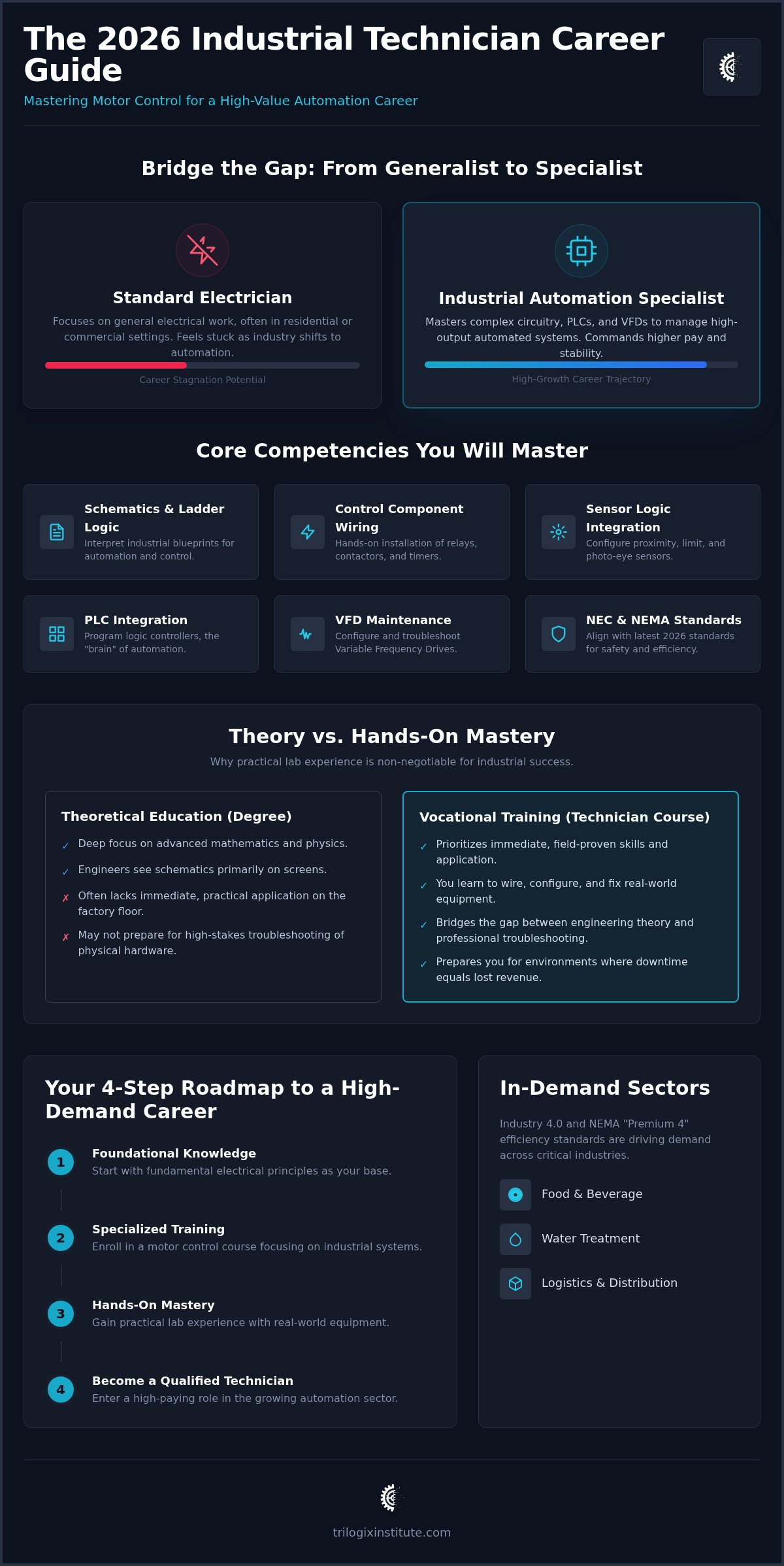
The journey from an aspiring learner to a professional industrial technician follows a logical, methodical progression. It begins with mastering foundational electrical principles. You must understand the relationship between voltage, current, and resistance before attempting to control industrial loads. Once this groundwork is established, the next phase involves enrolling in a specialized motor control technician course. This is where you move from general theory to the specific hardware that drives modern automation, such as the TITP Beginner Essential Industrial Motor Control program.
Practical mastery happens in the lab. You'll spend hours working through real-world troubleshooting scenarios, from diagnosing open coils to fixing phase imbalances. This leads directly to obtaining an industry-specific certification. In 2026, employers look for verified technical expertise that proves you can handle high-stakes environments. Finally, the path leads to continuous specialization. You don't stop at motor controls; you expand into PLC programming and broader industrial automation to remain competitive in a fast-moving market.
Certifications That Matter in 2026
Vocational certificates serve as a vital signal of readiness to national employers. In a market flooded with digital badges, instructor-led certifications carry significantly more weight. They prove you've performed under pressure with physical equipment rather than just clicking through a slide deck. These credentials demonstrate that your learning is directly transferable to a workplace. For a detailed breakdown of which credentials offer the best return on investment, see our Motor Control Certification: 2026 Professional Buying Guide.
Advancing Your Career After the Course
Completing your initial motor control technician course is just the start. Many technicians eventually transition from field repair to systems design or automation specialist roles. This shift requires a deeper understanding of how control panels are architected from the ground up. Mastery of design software is a key differentiator here. Learning tools like the Advanced AutoCAD 2D & 3D Course allows you to design the complex schematics used in large-scale industrial projects. This combination of field experience and design skill makes you an invaluable asset to any engineering team.
Bridge the gap between ambition and employment by contacting an admissions advisor today to discuss your personalized career roadmap.
Launching Your Career with Trilogix Institute
Trilogix Institute operates on a single core principle: education must be a functional tool for professional advancement. We don't focus on abstract theories that have no place in a modern factory. Instead, our motor control technician course is built around the pragmatic realities of the industrial sector. Every lesson is designed to prepare you for the specific demands of 2026 manufacturing environments. We act as a partner in your career journey, offering a clear-eyed path to success.
The TITP Beginner Essential Industrial Motor Control program serves as our flagship offering for those entering this field. It isn't a self-paced video series or a purely theoretical exercise. It's an instructor-led, equipment-heavy curriculum that puts industrial-grade hardware in your hands from day one. You'll work with the same contactors, relays, and VFDs used by global leaders in automation. This immersion ensures that your transition from student to technician is seamless and efficient.
Our reach extends across established campuses in the UAE and the Philippines. This geographic footprint allows us to train students to global standards, ensuring your skills are transferable across international borders. Whether you're training at TTI Dubai or TITP Philippines, you're receiving the same high-caliber, results-oriented instruction that defines our brand. We bridge the gap between ambition and employment by providing the specific keys needed to meet current global market demands.
Why Trilogix is the Choice for Practical Experts
We act as a knowledgeable guide that understands the current landscape of the global job market. Our "Feature-to-Benefit" teaching style means every technical skill you learn is immediately tied to its workplace application. For example, mastering VFD programming leads directly to reduced mechanical downtime for your employer. This approach turns you into a "Practical Expert" who is ready to contribute to a team immediately upon completion. You can learn more about our mission and our commitment to vocational excellence on our About Trilogix Institute page.
Take the Next Step Toward Technical Mastery
Preparation is the key to success in the fast-moving automation sector. We are currently accepting registrations for our upcoming 2026 motor control workshops. These sessions are designed for serious professionals who value instructor-led mastery over digital shortcuts. Our advisors are available to help you build a personalized career roadmap that aligns with your professional goals and the needs of the industry. Don't wait for the industry to move past you. Contact Trilogix Institute Today to secure your place in our next cohort and start your journey toward becoming a certified industrial technician.
Master Your Future in Industrial Automation
The industrial landscape of 2026 demands more than just basic electrical knowledge. It requires a deep understanding of the automated systems that drive modern production. Completing a specialized motor control technician course bridges the gap between being a generalist and becoming an authoritative industry insider. You've seen how instructor-led training with physical hardware builds the muscle memory necessary for high-stakes troubleshooting. This hands-on approach ensures you can identify and resolve faults before they lead to costly equipment downtime.
Trilogix Institute has maintained a specialized vocational focus since 2019. We provide a pragmatic, career-ready curriculum designed to make you industry-ready from day one. Our equipment-based training labs ensure that you don't just learn theory; you master execution. This is your chance to move beyond general maintenance and enter a high-demand, specialized field with steady confidence. We're ready to help you navigate this transition and secure your place in the future of manufacturing. Your journey from ambition to employment starts with the right practical foundation.
Start Your Journey to Becoming a Certified Motor Control Technician
Frequently Asked Questions
What are the prerequisites for a motor control technician course?
A motor control technician course requires a basic understanding of electrical principles. You should be familiar with voltage, current, and resistance. This foundation ensures you can safely navigate the complex logic and power circuits taught in the program. While some advanced programs require prior field experience, entry-level courses at Trilogix Institute are designed to bridge the gap for those with a standard electrical background.
How long does it take to complete a beginner motor control certification?
The duration depends on the specific curriculum depth. Specialized vocational programs are designed for efficiency, often ranging from intensive one-week workshops to modular certifications spanning several weeks. For example, some technical mechatronics training including motor control takes approximately six days of instructor-led sessions. This brisk pace respects your need for clear, actionable information and focuses on building the professional muscle memory required for technical employment.
Is a motor control course better than a university engineering degree for getting a job?
A vocational course is a more pragmatic tool for those seeking immediate employment. While a university degree provides broad theoretical knowledge, it often lacks the specific, equipment-based troubleshooting skills employers demand. Our curriculum focuses on what actually works in the field. This pragmatic expert approach makes you industry-ready faster than a four-year academic program, positioning you as a knowledgeable guide in the global job market.
Can I learn industrial motor control online without physical equipment?
You cannot fully master industrial motor control without physical equipment. Troubleshooting requires tactile feedback and the ability to diagnose physical component failures that software simulations simply cannot replicate. Trilogix Institute does not offer purely online self-paced courses because we believe hands-on mastery in a motor control technician course is essential. Real-world expertise is built by wiring physical contactors and configuring VFDs in an instructor-led lab.
What is the difference between an electrician and a motor control technician?
A motor control technician specializes in the logic and automation that drive industrial machinery. While an electrician handles general power distribution and wiring, a technician focuses on interpreting ladder logic, configuring VFDs, and integrating sensors. This specialized focus on the "brain" of manufacturing allows technicians to command higher salaries. They are responsible for the complex sequences and energy efficiency protocols that keep modern production lines running.
What kind of equipment will I use during a hands-on motor control lab?
You will work with industrial-grade hardware found in modern factories. This includes contactors, relays, timers, and Variable Frequency Drives (VFDs) for speed control. You'll also use Programmable Logic Controllers (PLCs) and various sensors to automate sequences. Working with this physical equipment builds the professional muscle memory needed to resolve faults under pressure. It ensures your training is directly transferable to a high-stakes, real-world industrial workplace.
Are the certifications from Trilogix Institute recognized nationally?
Yes, certifications from Trilogix Institute are recognized nationally across the UAE and the Philippines. Since our founding in 2019, we have focused on aligning our curriculum with global standards. These instructor-led credentials carry significant weight because they prove you've mastered physical troubleshooting on real equipment. Employers value these certificates as evidence of readiness, as they demonstrate a level of practical expertise that digital-only badges cannot match.
What is the typical salary for a certified motor control technician in 2026?
Certified technicians consistently command higher salaries than general electrical workers. In 2026, the demand for experts who can optimize motor performance and manage automation systems continues to outpace the supply of qualified labor. While exact figures vary based on industry and experience, specializing in motor control and PLC integration moves you into a higher-tier pay bracket. This career path offers a recession-proof future in the rapidly expanding industrial automation sector.


