
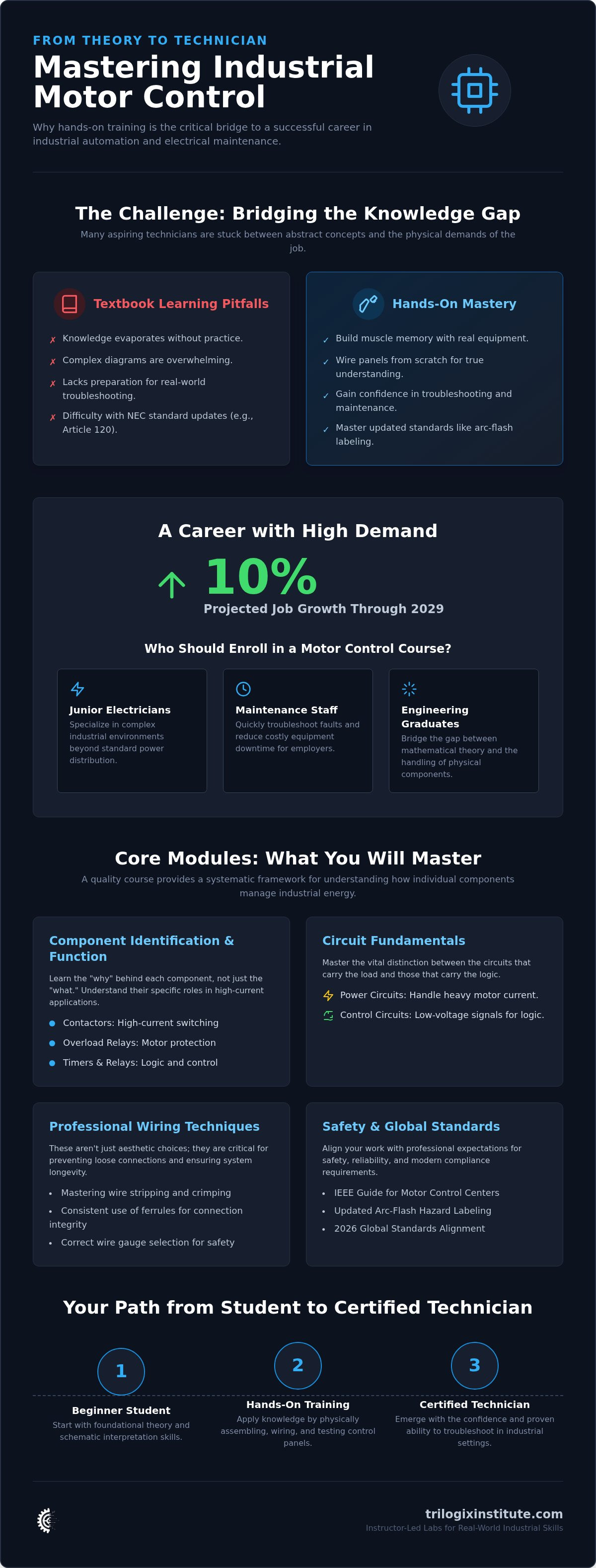
The most dangerous place for an aspiring technician isn't inside a live enclosure; it's stuck behind a textbook where theory never meets a physical wire. While you might understand the symbols on a page, that academic knowledge often evaporates the moment you begin a motor control panel wiring course that lacks hands-on equipment. If you've felt the frustration of staring at complex diagrams or felt overwhelmed by the 2026 NEC reorganization of load calculations into Article 120, you aren't alone. Most beginners struggle to bridge the gap between classroom concepts and the practical demands of a modern industrial facility.
Moving past this uncertainty is the first step toward a career in a field with 10% projected job growth through 2029. This guide reveals how to transition from theoretical learning to true industrial mastery. You'll discover how instructor-led training with real-world hardware allows you to wire panels from scratch, navigate updated arc-flash hazard labeling requirements, and gain the troubleshooting confidence required for professional advancement. We will break down the essential standards for 2026 and show you exactly how to identify a program that prepares you for the reality of the plant floor.
Key Takeaways
- Bridge the gap between engineering theory and physical assembly by mastering the installation of contactors, relays, and starters.
- Develop the ability to interpret complex industrial schematics and accurately identify key components within a control system.
- Prioritize equipment-based training over theoretical manuals to build the muscle memory necessary for professional troubleshooting.
- Discover how a certified motor control panel wiring course acts as a strategic bridge to employment in the expanding industrial automation sector.
- Learn why the TITP Beginner Essential Industrial Motor Control program utilizes instructor-led labs to ensure your skills align with 2026 global standards.
What is a Motor Control Panel Wiring Course?
A motor control panel wiring course is a focused, hands-on training program. It centers on the physical assembly and electrical connection of industrial control systems. While some providers prioritize design software or purely theoretical modules, this course focuses on the tactile skills needed on the plant floor. It's the point where electrical engineering theory meets the reality of industrial hardware. You don't just learn where a wire goes on a screen; you learn how to strip, crimp, and route it through a crowded enclosure while maintaining professional standards.
The curriculum bridges the gap between engineering concepts and the practical installation of contactors, relays, and starters. Beginners learn to interpret complex schematics and translate them into organized, safe, and functional control cabinets. This skill is critical when working with a Motor Control Center (MCC), where precision and organization are mandatory for safety and future maintenance. The ultimate goal of a motor control panel wiring course is ensuring industrial motors operate reliably under diverse load conditions, preventing equipment failure and ensuring personnel safety.
Who Should Enroll in Beginner Motor Control Classes?
Building a career in automation requires a specific set of vocational skills. Junior electricians often find these classes essential for specializing in industrial environments where control logic is more complex than standard power distribution. Maintenance staff also benefit significantly. Understanding the underlying logic of a panel allows them to troubleshoot faults with greater speed, reducing downtime for their employers. Even engineering graduates find value here. Many possess the mathematical background but lack the experience of handling physical components. This training provides the missing link for their professional development.
The Role of the Control Panel in Industrial Automation
The control panel serves as the central brain of a motor system. It manages the flow of power and logic to ensure machinery performs exactly as intended. Beyond simple operation, these panels provide critical protection. They safeguard expensive equipment from overloads, phase failures, and short circuits. Without a properly wired panel, heavy machinery is at constant risk of damage. By completing a motor control panel wiring course, you'll learn to enable both manual and automatic control modes. This ensures that heavy machinery remains safe, efficient, and responsive to the demands of a modern production line.
Core Modules: What Every Beginner Motor Control Class Should Cover
A high-quality motor control panel wiring course must move beyond a simple list of parts. It should provide a systematic framework for understanding how individual components collaborate to manage industrial energy. For a beginner, the first priority is the precise identification and application of hardware like contactors, overload relays, and timers. Understanding the "why" behind each component is what separates a technician from a hobbyist. For instance, you don't just learn that a contactor is a switch; you learn why it's the specific choice for handling high-current motor loads that would otherwise destroy a standard manual switch.
Mastery of these systems requires an alignment with global safety and design standards. Integrating the IEEE Guide for Motor Control Centers into your study ensures that your wiring practices meet professional expectations for safety and reliability. Beyond component theory, a foundational course must emphasize professional finishes. This includes mastering wire stripping, crimping, and the consistent use of ferrules. These aren't just aesthetic choices; they are critical for preventing loose connections and ensuring the longevity of the control cabinet in high-vibration industrial environments.
Understanding Components and Their Functions
One of the most vital distinctions you'll learn is the difference between power circuits and control circuits. The power circuit carries the heavy current required to turn the motor, while the control circuit handles the logic that tells the motor when to start or stop. You'll explore how relays act as the essential bridge between these two worlds, allowing low-voltage signals to safely switch high-voltage systems. Additionally, selecting the correct wire gauge is a mandatory skill. Using a wire that's too thin for the industrial load leads to heat buildup and potential fire hazards, which is why precision in component sizing is a core module in our technical training programs.
Circuit Logic and Troubleshooting Basics
Once you understand the hardware, you must learn the "language" of the panel through circuit logic. Beginners start with foundational "Start-Stop" stations and progress to interlocking circuits, which prevent two conflicting actions—like forward and reverse—from occurring simultaneously. Troubleshooting is the final piece of the puzzle. You'll learn to use a multimeter to verify continuity and voltage, allowing you to pinpoint faults quickly. By identifying common wiring errors during the initial assembly, such as reversed polarity or poor grounding, you develop the muscle memory needed to produce industrial-grade work on your first attempt.
Evaluating Training Quality: Theory-Heavy vs. Equipment-Based Learning
Selecting the right motor control panel wiring course requires a critical look at how the material is delivered. Many programs rely heavily on digital simulations or static manuals. While these resources provide a conceptual foundation, they cannot replicate the physical resistance of a 14-gauge wire or the specific torque required to secure a terminal block. True mastery is built through repetition and the development of muscle memory. In a professional industrial setting, your hands must know the path of the wire as clearly as your mind knows the schematic. This tactile familiarity is what separates a novice from a professional technician.
A pragmatic approach to education prioritizes bench time over screen time. When you physically run wires, you encounter the real-world constraints of enclosure space and component layout. This experience prepares you for the high-pressure environment of an active production line. Evaluating a facility means looking for modern, industry-standard equipment that matches what you'll find in the field today. Instructor-led training adds a final, vital layer of value. Having an expert provide immediate feedback when a circuit fails to fire saves hours of frustration. It prevents the formation of unsafe habits and ensures you understand the logic behind every connection.
The Pitfalls of Online-Only Electrical Courses
Purely online, self-paced courses often fail to provide the safety supervision necessary for working with live industrial components. Without a physical lab, you lose the ability to practice hands-on fault-finding. This gap in training significantly reduces your credibility with employers. Most industrial managers prioritize "bench time" and documented practical experience over digital certificates. They need to know you can safely navigate a cabinet without causing an arc-flash or damaging expensive hardware. Theoretical knowledge is a start, but it isn't enough to secure a specialized role.
What to Look for in a Hands-On Motor Control Lab
An effective lab environment must feature components from global leaders like Schneider or ABB. This ensures your skills are transferable to any international facility. Look for institutes that provide individual workstations. Shared, crowded benches often lead to passive learning. In those settings, one student does the work while others simply watch. To understand the standard of excellence required, you can look Inside the Hands-On Motor Control Lab at Trilogix Training Institute. High-quality training centers focus on individual skill acquisition, ensuring every student leaves with the confidence to wire a panel independently.
Career Pathing: From Beginner Student to Certified Control Technician
The transition from an aspiring learner to a professional technician requires a methodical approach to skill acquisition. This journey begins with a foundational motor control panel wiring course, where you move beyond circuit diagrams into the physical assembly of industrial hardware. Mastering the fundamentals is Step 1. You must understand how to translate a schematic into a functional, safe enclosure before you can manage the complexities of a modern production line. Step 2 involves securing a certification that proves your ability to handle industrial electrical controls training. This credential serves as a signal to employers that you possess the practical readiness required for high-stakes environments.
Once you have established your core competency, Step 3 focuses on advanced specializations. Pursuing further training in PLC programming and Industrial Automation allows you to manage the digital logic that drives physical motor systems. Finally, Step 4 is the transition into specialized roles. Whether you aim to be a Control Panel Wireman or a Maintenance Technician, your path is defined by your ability to bridge the gap between design and execution. Professional certifications validate your readiness to meet global standards, ensuring you are prepared for the rigors of the field from day one.
Bridging the Skill Gap in the Job Market
Modern industrial companies prioritize candidates with equipment-based certifications over those with purely theoretical backgrounds. There is a specific, high demand for technicians who can both interpret a design and physically wire the panel. This dual capability reduces the need for multiple specialists and streamlines the manufacturing process. If you want to understand the specific requirements for these roles, read our What is a Motor Control Technician Course? A 2026 Career Guide. Employers in 2026 look for "bench time" as a primary indicator of a candidate's potential value.
Salary and Role Expectations for New Technicians
Entry-level roles are abundant in sectors like manufacturing, oil and gas, and construction. According to 2026 industry data, the projected job growth for electricians and control technicians is 10% through 2029, with over 716,000 openings expected. While the average annual salary for an electrician is approximately $55,190, specialized control technicians often command higher rates due to their technical expertise. Success in these roles requires a commitment to continuing education in AutoCAD and PLC systems to stay ahead of automation trends. To begin your journey toward a high-demand technical career, explore our professional motor control programs today.
Advancing Your Skills with Trilogix Institute’s Hands-On Programs
Trilogix Institute bridges the gap between ambition and employment through specialized vocational training. Our primary offering for those entering the field is the TITP Beginner Essential Industrial Motor Control program. Unlike generic seminars, this motor control panel wiring course focuses on the specific hardware you'll encounter in 2026 industrial environments. You don't just observe; you build. This instructor-led approach ensures that you don't just learn about systems; you master the physical skills required to install and maintain them safely.
To achieve full-cycle expertise, we recommend combining your physical wiring skills with our Advanced AutoCAD 2D & 3D course. This pairing allows you to design precise schematics and then execute the physical installation yourself. It's the difference between being a laborer and being a comprehensive technical expert. We provide these programs across our campuses in the UAE and the Philippines, ensuring regional access to global standards. Our training is designed to be a vital, functional tool for your personal and professional advancement.
The Trilogix Practical Expert Philosophy
Our commitment is to equipment-based technical training. We eliminate theoretical fluff in favor of results-oriented labs. Your instructors aren't just academics; they are industry insiders who have worked on real industrial floors and managed complex automation projects. They bring a grounded, serious perspective to every lesson, helping you understand the real-world application of every wire you run. You can view our current schedules and program details on the Trilogix Courses page to find a session that fits your career timeline.
Next Steps: Secure Your Place in the Next Workshop
Taking the next step in your career journey requires decisive action. We encourage prospective students to contact our admissions team to schedule a campus tour. Seeing our motor control labs firsthand often provides the clarity needed to commit to your professional advancement. Early registration is essential because our workshops are equipment-limited to ensure every student has their own dedicated workstation and individual attention from the instructor. For more details on selecting the right path for your goals, consult our Motor Control Certification: 2026 Professional Buying Guide. Don't wait for opportunity; build the skills to create it.
Master the Future of Industrial Systems
Transitioning from electrical theory to practical mastery is the most strategic move you can make for your technical career. As we have explored, a professional motor control panel wiring course does more than teach diagrams; it builds the tactile confidence required to handle live industrial hardware. By focusing on equipment-based learning rather than theoretical manuals, you prepare yourself for the immediate demands of the 2026 manufacturing and automation sectors.
Trilogix Institute provides the instructor-led training and real-world equipment you need to succeed. Our hands-on labs at TTI Dubai and TITP Philippines offer industry-recognized certifications that validate your readiness for professional standards. It's time to stop reading about circuits and start wiring them. View Our Upcoming Beginner Motor Control Classes to find a workshop that fits your schedule. Your path to industrial mastery is ready; it's up to you to take the first step.
Frequently Asked Questions
Are these beginner motor control classes suitable for someone with no electrical background?
Yes, our beginner motor control classes are designed to be accessible. While having a basic understanding of electricity is beneficial, we structure the curriculum to build your skills from the ground up. If you're starting with zero experience, we recommend beginning with the TTI Dubai Foundation Electrical Engineering course. This ensures you have the prerequisite knowledge of voltage, current, and safety before you begin handling complex industrial control components in our advanced labs.
How long does a typical motor control panel wiring course take to complete?
A typical motor control panel wiring course is designed as an intensive, instructor-led program to maximize your bench time. For example, our mechatronics training that includes motor control modules often spans six days of focused, hands-on learning. This compressed schedule allows you to immerse yourself in the hardware without the distractions of a long, drawn-out academic semester. It's a pragmatic approach that prioritizes immediate skill acquisition and readiness for the industrial workforce.
Will I receive a professional certification upon completion of the course?
You will receive a professional certificate upon the successful completion of your training. These industry-recognized credentials validate your ability to handle industrial electrical controls and prove your competency to potential employers. In a competitive job market, having a certificate that confirms your hands-on experience with real-world equipment is a significant advantage. It demonstrates that you've met specific professional standards and are ready to contribute to a technical team immediately.
Do I need to bring my own tools to the industrial motor control workshop?
You don't need to bring your own tools to our workshops. Trilogix Institute provides all the necessary industrial equipment, including multimeters, wire strippers, crimpers, and professional-grade control components. Our labs are fully equipped with hardware from global brands like Schneider and ABB. This ensures you're learning on the exact same tools and components you'll encounter on the job. We focus on providing a complete, high-quality environment so you can focus entirely on your training.
What is the difference between a motor control course and a PLC course?
The primary difference lies in the method of control. A motor control panel wiring course focuses on the physical wiring of hardware logic using contactors, relays, and timers to manage power. A PLC course focuses on the digital "brain" that sends signals to those components via software programming. Mastery of motor control hardware is often a prerequisite for PLC training. You must understand how the physical hardware operates before you can effectively program its automated logic.
Can I take this course online, or is it strictly on-campus?
This training is strictly on-campus and instructor-led. Trilogix Institute doesn't offer purely online self-paced courses for motor control because physical "bench time" is essential for safety and skill mastery. You can't develop the necessary muscle memory or troubleshooting intuition through a computer screen. By training in person at our UAE or Philippines campuses, you get immediate feedback from experts and safe exposure to live industrial equipment that digital simulations simply cannot replicate.
What are the prerequisites for the TITP Beginner Essential Industrial Motor Control program?
The primary prerequisite for the TITP Beginner Essential Industrial Motor Control program is a basic understanding of electrical theory. Candidates should be familiar with fundamental concepts like Ohm’s Law and basic circuit safety. If you lack this background, we suggest completing our Foundation Electrical Engineering module first. This ensures every student in the motor control workshop can progress swiftly through the practical wiring exercises without struggling with the underlying physics of industrial electricity.
How does this training help with employment in the UAE or Philippines?
This training directly aligns your skills with the high demands of the industrial sectors in the UAE and the Philippines. Employers in these regions prioritize technicians who possess documented, hands-on experience with real hardware. By earning an industry-recognized certification, you prove your readiness for roles in manufacturing, oil and gas, and construction. Our pragmatic, equipment-based approach bridges the gap between ambition and employment, making you a high-value candidate for specialized technical teams across both countries.


