
In 2026, possessing a technical certificate is no longer enough to secure a high-paying role in the Philippine manufacturing sector. You've likely felt the frustration of sitting through hours of theory only to feel paralyzed when standing in front of a live motor control panel. It's a common concern that traditional education often fails to keep pace with rapid shifts in industrial automation. We understand that you don't just want a piece of paper; you want the practical skill to keep a production line running.
This guide will show you how to select the right industrial motor control training Philippines has to offer to ensure you gain hands-on mastery. You'll learn how to identify programs that prioritize real-world equipment over textbooks, helping you secure industry-recognized certifications that employers actually value. We will explore the latest TESDA competency standards issued in Circulars 071-2026 and 072-2026, compare equipment-based training models, and outline a clear path to becoming a confident automation specialist who can troubleshoot complex systems with ease.
Key Takeaways
- Understand the 2026 shift toward equipment-based mastery and why theoretical knowledge alone is no longer sufficient for high-level technical roles.
- Identify the core hardware components and Philippine Electrical Code standards required to build and maintain reliable motor control panels.
- Discover why instructor-led industrial motor control training Philippines is essential for bridging the kinesthetic gap and ensuring workplace safety.
- Follow a strategic 5-step roadmap to navigate the certification process and transition into a specialized role in industrial automation.
- Gain the confidence to troubleshoot complex systems by training with industry-grade equipment that mirrors real-world manufacturing environments.
The Demand for Industrial Motor Control Skills in the Philippines
Industrial motor control is the heartbeat of every production line. It's the critical technology that manages how electric motors start, stop, and protect themselves from damage. Understanding What is a Motor Controller? provides the foundation for anyone looking to enter the technical sector. Without these systems, manufacturing would be inefficient, prone to failure, and dangerous. In the modern factory, the technician who understands the logic behind the control panel is the one who keeps the entire operation alive.
In 2026, the Philippine industrial sector is reaching a turning point. New guidelines like TESDA Circulars 071-2026 and 072-2026 have raised the bar for competency. Companies no longer want staff who only understand theory; they need professionals who can handle high-voltage equipment safely and efficiently. Many technical graduates find that university degrees focus heavily on calculations while ignoring the physical tension of a wire or the "click" of a healthy magnetic contactor. This gap between theory and factory-floor reality makes choosing the right industrial motor control training Philippines a career-defining decision.
Key Industries Driving the Need for Technicians
Several sectors are currently actively seeking skilled motor control technicians. The food and beverage industry relies on automated lines for packaging and processing; any downtime there results in significant financial losses. Additionally, the rise of smart factories and the integration of IoT with motors has increased the demand for specialized industrial motor control training Philippines. Infrastructure projects also require specialists to manage the complex electrical controls in massive ventilation and pumping systems that keep our cities functional.
Career Path: From Apprentice to Automation Specialist
Your journey often begins with an entry-level role like a Maintenance Technician or Control Panel Wireman. By completing the TITP Beginner Essential Industrial Motor Control course, you gain the practical foundation needed to stand out from the crowd. As you master troubleshooting, your value to an employer grows. Technicians who can diagnose a fault in minutes rather than hours are the ones who see the fastest salary increases. Eventually, this expertise allows you to transition into high-level roles in industrial automation and PLC programming, where you design the systems that lead the industry forward.
Essential Components of a Professional Motor Control Curriculum
To succeed in the local technical sector, a student must master the Philippine Electrical Code (PEC). This isn't just about passing a board exam; it's about ensuring every installation meets national safety and performance standards. A high-quality industrial motor control training Philippines program will ground students in these regulations before they ever touch a screwdriver. Understanding circuit sizing, grounding, and overcurrent protection is the difference between a reliable system and a fire hazard.
Beyond the code, technicians must achieve total familiarity with the "big three" of manual control: magnetic contactors, thermal overload relays, and timers. These components form the backbone of motor protection and sequence control. Modern industrial motor control training Philippines must also prioritize Variable Frequency Drives (VFDs). As energy efficiency becomes a priority under the Philippine Development Plan and Industry 4.0, knowing how to program a VFD for soft starts and speed modulation is a non-negotiable skill for the modern technician.
Safety protocols must be woven into every lesson. Mastery of Lock-Out Tag-Out (LOTO) procedures and understanding arc flash protection are critical. In a high-voltage environment, a single error can be catastrophic. Students need to practice these life-saving habits until they become second nature. You don't just learn safety for the sake of compliance; you learn it so you can return home safely after every shift.
Mastering Wiring and Circuit Design
Reading an industrial ladder diagram is like reading a map; without it, you're lost. Professional training focuses on the practical wiring of start-stop stations and complex interlocking circuits. You shouldn't just follow a diagram; you should understand the logic behind every connection. In a controlled lab environment, instructors can introduce common wiring faults. This allows you to develop troubleshooting instincts without the pressure of a million-peso production line hanging in the balance.
Integration with Industrial Automation
Motor controls don't exist in a vacuum. They increasingly interface with Programmable Logic Controllers (PLCs) to handle complex logic and remote monitoring. You'll need to understand how sensors and feedback loops provide real-time data for motor protection. Manual control systems act as the reliable physical foundation upon which sophisticated automated logic is built to drive industrial efficiency. Mastering these connections is the key to career longevity. If you're ready to start building these skills, exploring the TITP Beginner Essential Industrial Motor Control curriculum is your next logical step.
Comparing Practical Training vs. Theoretical Online Courses
Digital learning platforms offer convenience, but they often leave technical students stranded in the "Kinesthetic Gap." You cannot learn the physical tension required for a secure terminal connection or the specific torque needed for a bolt through a glass screen. Theory doesn't move motors. In the field of industrial motor control training Philippines, hands-on experience serves as a critical safety barrier. Safety isn't a suggestion. Attempting to wire industrial-grade components at home without professional supervision invites extreme risks of electrical shock, arc flash, or permanent equipment damage.
The value of immediate feedback during a live workshop cannot be overstated. When an instructor watches you wire a circuit, they can correct a loose connection before you apply power. This real-time correction prevents the development of bad habits that could lead to workplace accidents later. From a cost-benefit perspective, short-term intensive training often outperforms long-term degree programs for those seeking immediate career placement. While a university degree provides broad theory over four years, a focused technical course builds specific, high-demand skills in a fraction of the time, allowing you to enter the workforce and start earning much sooner.
The Limitations of Virtual Simulations
Software simulations present "perfect" electrical conditions that rarely exist on a factory floor. In a real-world setting, components might have slight wear, environmental humidity affects conductivity, and physical space within a control panel is often cramped. Building muscle memory by handling actual magnetic contactors and thermal overload relays ensures you aren't overwhelmed when you step into a live industrial environment. You can see how this physical immersion works in practice by looking Inside the Hands-On Motor Control Lab at Trilogix Training Institute. Handling physical hardware exposes you to the tactile feedback that defines true professional expertise.
Instructor-Led Mentorship in the Philippines
Learning from PRC-licensed practitioners and industry veterans provides insights that pre-recorded videos simply cannot replicate. These mentors share "war stories" and troubleshooting shortcuts earned through decades of field service in Philippine manufacturing plants. A physical training center also offers a structured environment that eliminates the distractions of home-based learning. Beyond the curriculum, being in a lab allows you to network with peers and instructors. These professional connections often lead to direct job referrals and industry partnerships. This equipment-based immersion builds the steady confidence required to manage high-stakes industrial systems with precision and poise.
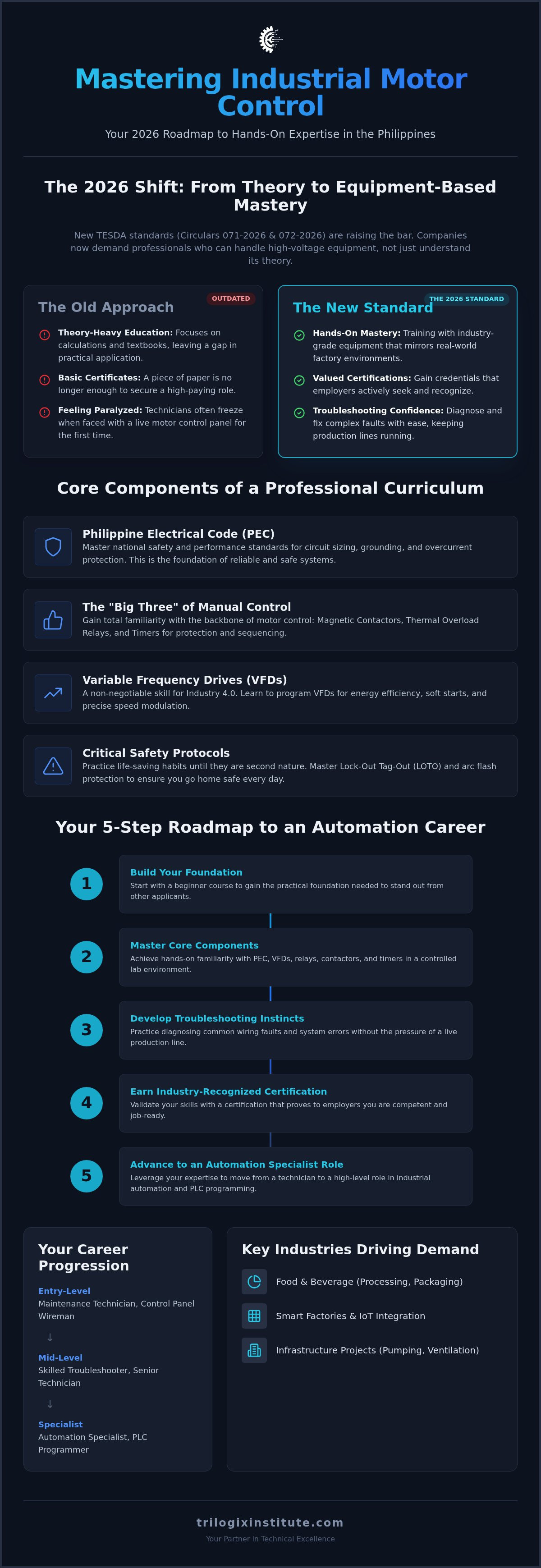
How to Master Industrial Motor Controls: A 5-Step Roadmap
Mastering industrial systems requires a structured approach that moves from conceptual understanding to physical execution. You can't skip the basics and expect to troubleshoot a multi-million peso production line. By following a clear, equipment-based path, you ensure that your industrial motor control training Philippines provides a return on your investment in both time and tuition.
- Step 1: Establish foundational electrical knowledge. You must internalize basic circuit theory and the Philippine Electrical Code (PEC). This foundation ensures you understand the "why" behind grounding and overcurrent protection before you handle live power.
- Step 2: Enroll in a specialized program. The TITP Beginner Essential Industrial Motor Control course is designed for this specific entry point. It focuses on the hardware you'll encounter on the job.
- Step 3: Log mandatory lab hours. Theoretical knowledge evaporates without physical repetition. Aim for at least 40 hours of wiring on real industrial motor trainers to build the muscle memory required for professional work.
- Step 4: Pursue specialized certifications. Once you've mastered manual controls, move toward an Industrial Automation Specialization. This step bridges the gap between traditional wiring and modern digital logic.
- Step 5: Apply skills in a practical setting. Seek out workshops or internships that offer exposure to live system maintenance. Nothing replaces the experience of diagnosing a fault in a real-world manufacturing environment.
Preparing for National Certification
In the Philippines, TESDA NCII and NCIII certifications serve as the industry standard for competency. These assessments don't just test what you know; they test what you can do under pressure. High-quality industrial motor control training Philippines aligns its curriculum with these national standards, ensuring you're ready for the assessment center. For a detailed breakdown of these requirements, consult our Motor Control Certification: 2026 Professional Buying Guide to choose the right path for your career goals.
Continuing Education and Specialization
The 2026 industrial landscape demands more than just basic start-stop logic. Modern technicians must eventually learn to integrate motor controls with PLC and SCADA systems for remote monitoring. Staying updated with IoT-enabled sensors and smart motor starters is essential for career longevity. The rapid evolution of technical standards means that a technician’s education never truly ends if they wish to remain competitive in the global market. If you're ready to begin this journey, contact Trilogix Institute today to secure your spot in our next instructor-led session.
Trilogix Institute: Your Partner in Technical Excellence
Technical ambition requires a clear path to professional execution. At Trilogix Institute (TITP), we recognize that the gap between a student and a technician isn't just knowledge; it's experience. Our approach to industrial motor control training Philippines is built on the reality of the 2026 job market. We don't just teach you how to read a diagram. We provide the environment where you can wire, test, and troubleshoot the systems that power modern industry. This pragmatic focus ensures you're ready to perform from your first day on the job.
The centerpiece of our foundational program is the TITP Beginner Essential Industrial Motor Control course. This instructor-led, 40-hour immersion is designed to strip away the fluff and focus on the high-impact skills employers demand. You'll work directly with industry-grade components, mastering the logic of magnetic contactors and the precision of timing relays. By the end of the session, you won't just understand the theory; you'll have the muscle memory to build reliable control panels from scratch.
Our Equipment-Based Learning Philosophy
We believe you can't master a trade by watching a video. Our lab is equipped with the same hardware you'll encounter in Philippine factories and international manufacturing plants. Students gain hands-on access to industrial motor trainers featuring components from brands like Siemens and Rockwell Automation. This exposure is critical. It allows you to feel the tension of a terminal block and hear the distinct snap of a functioning circuit breaker. For a deeper look at how this role functions in the real world, read our article on What is a Motor Control Technician Course? A 2026 Career Guide. Our goal is simple: to ensure you have the confidence to handle high-stakes equipment without hesitation.
Join the Trilogix Alumni Network
Our success is measured by the careers of our students. The TITP alumni network consists of thousands of technicians working in diverse sectors, from local food processing plants to global automation firms. These professionals are respected because they possess the practical readiness that theoretical programs lack. They understand the Philippine Electrical Code and the nuances of 2026 industrial technologies. If you're ready to transition from being a learner to being a leader in your field, Contact Trilogix Institute today to reserve your spot. You can also explore our full list of technical courses to see how we can support your long-term career growth in the automation sector.
Secure Your Future in Philippine Industrial Automation
The 2026 technical landscape demands technicians who can move beyond theory to deliver immediate operational value. We've explored how the right industrial motor control training Philippines provides the foundation for troubleshooting complex systems and mastering modern automation hardware. By prioritizing equipment-based immersion over virtual simulations, you build the muscle memory and safety habits that define a true professional.
Trilogix Institute stands as your partner in this journey, offering a no-nonsense path to technical success. Our industry-centric curriculum and instructor-led labs are designed to ensure you're ready for both national certification and the global job market. Don't let your career stall in the classroom when you could be mastering real-world panels.
Take the first step toward becoming a specialized automation expert today. Enroll in the TITP Beginner Essential Industrial Motor Control Course to gain the hands-on skills that local factories and international firms actively seek. Your path to professional mastery starts with the right equipment and the right mentorship.
Frequently Asked Questions
Is an engineering degree required for industrial motor control training in the Philippines?
No engineering degree is required to enroll in industrial motor control training Philippines. These programs are specifically designed for individuals seeking practical skill acquisition rather than university degrees. Whether you are a high school graduate, a career shifter, or a working technician, you can master motor control systems through instructor-led sessions. The curriculum focuses on the hardware and logic needed for immediate employment in the technical sector.
How long does a typical industrial motor control workshop last?
A typical workshop duration varies based on the depth of the curriculum. For instance, the TITP Beginner Essential Industrial Motor Control course is an intensive 5-day program totaling 40 hours of training. This brisk pace reflects the needs of the fast-moving industries we represent. While advanced specializations may take longer, these short-term programs are designed to provide a comprehensive immersion into panel wiring and system troubleshooting without the multi-year commitment of a degree.
What is the difference between TESDA NCII and NCIII for motor controls?
TESDA NCII in Electrical Installation and Maintenance focuses on the foundational skills of wiring and basic motor circuits. In contrast, NCIII represents a higher level of competency involving more complex industrial automation and troubleshooting. Professional training programs align their lab activities with these national standards. Achieving NCIII status demonstrates to employers that you possess the advanced technical mastery required to manage sophisticated industrial systems and complex motor control logic.
Can I learn industrial motor control online through virtual simulations?
You cannot achieve true mastery of industrial motor control training Philippines through virtual simulations alone. While software can illustrate logic, it fails to replicate the physical tension of wiring or the tactile feedback of industrial hardware. Trilogix Institute does not offer purely online self-paced courses because we believe in the necessity of equipment-based immersion. Real-world troubleshooting requires the muscle memory that only comes from handling physical magnetic contactors and thermal overload relays.
What specific equipment will I use during the Trilogix motor control course?
Students at Trilogix Institute work with industry-standard hardware that mirrors what is found in modern manufacturing plants. Our lab features real-world equipment including magnetic contactors, timers, thermal overload relays, and Variable Frequency Drives. We utilize components from leading brands like Siemens and Rockwell Automation. This hands-on access ensures that the skills you acquire are directly transferable to the workplace, eliminating the "kinesthetic gap" often found in purely academic environments.
Are there job placement guarantees after completing the training?
Trilogix Institute does not offer job placement guarantees. We focus on bridging the gap between ambition and employment by providing the specific keys to meet global job market demands. Our role is to act as a practical expert that prepares you with industry-recognized skills. While we don't promise a specific job, our graduates are highly valued by employers because they possess the hands-on competency and technical readiness required for high-stakes industrial roles.
How much does industrial motor control training cost in the Philippines in 2026?
The cost of industrial motor control training in the Philippines varies depending on the course depth and the quality of the lab equipment provided. While some short-term programs are available for a few thousand pesos, comprehensive instructor-led certifications that include extensive lab hours using industry-grade hardware represent a more significant investment. We recommend contacting training centers directly to receive current 2026 tuition rates and to verify the specific equipment available in their labs.
What safety certifications are included in the motor control curriculum?
Safety is a core component of every professional motor control curriculum. Training typically includes mastery of the Philippine Electrical Code standards to ensure every installation is compliant and safe. Additionally, students learn critical procedures like Lock-Out Tag-Out and arc flash protection. These are not separate certifications but are integrated into the practical training. This ensures that every technician we train views safety as a vital, functional tool for their professional advancement and personal well-being.


