

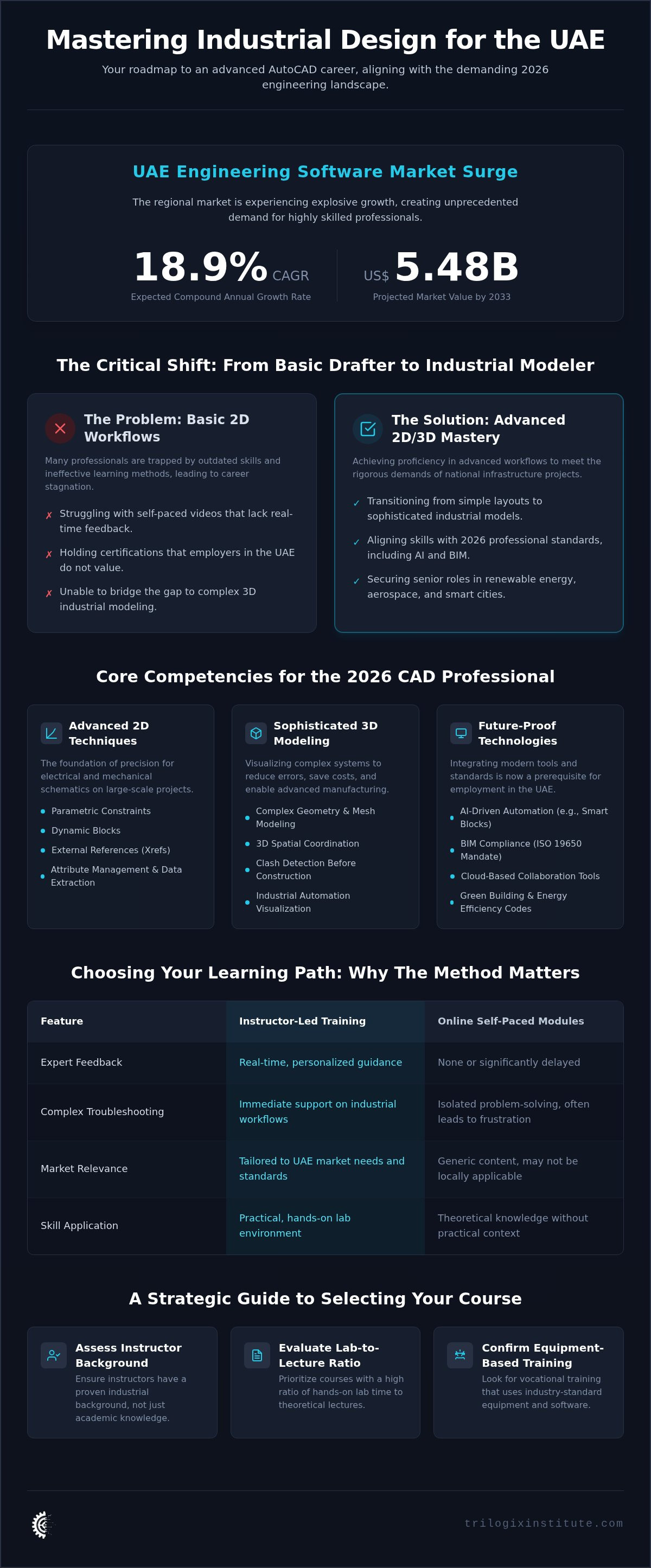
What if the only thing standing between your current salary and a senior industrial modeling role in the UAE is the lack of real-time expert feedback? Many professionals find themselves trapped in basic 2D workflows, struggling to bridge the gap to complex 3D modeling through self-paced videos that don't recognize the nuances of the local market. It's frustrating to invest time in certifications that employers simply don't value when the regional engineering software market is expanding at an expected compound annual growth rate of 18.9% through 2033. You need more than just a tutorial; you need a roadmap to mastery.
We understand that moving into high-level drafting requires a precise, hands-on approach. This guide will help you identify the right advanced AutoCAD 2D 3D course to ensure your skills align with 2026 professional standards, including the latest AI integrations and BIM requirements. You'll discover how to transition from simple layouts to sophisticated industrial models that meet the rigorous demands of national infrastructure projects. We'll break down the essential features of instructor-led training, evaluate the shift toward subscription-based licensing, and provide a clear framework for selecting a program that turns your ambition into a functional career tool.
Key Takeaways
- Identify the critical shift from basic drafting to advanced industrial modeling required for the 2026 UAE engineering landscape.
- Master the technical progression from complex 2D geometry to sophisticated 3D mesh modeling and professional attribute management.
- Evaluate why an instructor-led advanced AutoCAD 2D 3D course provides the real-time feedback necessary for troubleshooting complex industrial workflows.
- Apply a strategic buying guide to assess instructor industrial backgrounds and lab-to-lecture ratios before committing to a program.
- Bridge the gap between basic software knowledge and professional employment through equipment-based vocational training tailored to the UAE market.
The Role of Advanced AutoCAD in the 2026 UAE Engineering Landscape
The UAE engineering sector is undergoing a rapid transformation. With the regional engineering software market projected to reach US$ 5485.8 million by 2033, the demand for specialized technical skills has never been higher. Basic drafting is no longer enough to secure a competitive role in this environment. Modern projects require a deep understanding of industrial automation, electrical design, and complex systems integration. Enrolling in an advanced AutoCAD 2D 3D course is the most direct way to align with these 2026 professional standards. This software provides a comprehensive overview of AutoCAD capabilities that are essential for modern national infrastructure.
Key industries like renewable energy, aerospace, and smart city development are driving the current demand for specialized CAD technicians. These sectors don't just need generalists; they need experts who can navigate the shift toward integrated 3D modeling and BIM workflows. Throughout the UAE's engineering sector, for instance, BIM processes are now mandated in accordance with ISO 19650 standards for all project stages. This regulatory environment makes advanced proficiency a prerequisite for employment rather than an optional upgrade.
Why 2D Drafting Remains the Foundation
High-level 2D drafting serves as the backbone for technical schematics, especially in electrical engineering. Precision is mandatory. You can't afford errors in wiring diagrams or industrial motor control layouts. Advanced practitioners use standardized layers and dynamic blocks to ensure seamless collaboration on large-scale national projects. This isn't just about drawing lines; it's about creating a structured data environment. Speed and precision in professional documentation allow teams to meet tight deadlines without compromising the technical accuracy required by UAE regulators.
The Rise of 3D Modeling for Industrial Applications
The transition to 3D modeling is reshaping how professionals visualize complex industrial automation systems. By utilizing an advanced AutoCAD 2D 3D course, technicians learn to reduce errors through 3D spatial coordination. This process identifies physical clashes before construction or installation begins, saving significant costs. Mastering these workflows prepares you for advanced manufacturing roles where complex geometry and mesh modeling are the norm. It's a vital bridge between basic software knowledge and the high-stakes reality of industrial engineering.
Professional CAD mastery in 2026 involves:
- Adopting AI-driven automation for repetitive drafting tasks.
- Ensuring compliance with stricter green building and energy efficiency codes.
- Utilizing cloud-based collaboration tools like Autodesk Construction Cloud.
- Managing data residency requirements for regulated sectors like finance and healthcare.
Decoding the Advanced AutoCAD 2D 3D Course Curriculum
A professional advanced AutoCAD 2D 3D course moves far beyond basic drawing commands like line or circle. It focuses on the industrial workflow, guiding you through a logical progression from complex 2D geometry to sophisticated 3D mesh modeling. This structured path ensures you don't just learn the tools; you master the application of those tools within a high-stakes engineering environment. In 2026, this includes leveraging AI-driven features like Smart Blocks to automate repetitive tasks and improve overall project accuracy.
Large-scale engineering projects in the UAE require seamless coordination. Mastering External References (Xrefs) is a critical part of the curriculum. It allows multiple team members to work on different components of a single project simultaneously without data conflicts. When combined with advanced attribute management, you gain the ability to extract data for schedules and bill of materials automatically. This level of proficiency is what separates a general drafter from a professional CAD technician.
Advanced 2D Techniques for Technicians
Precision at the 2D level is non-negotiable for electrical and mechanical schematics. You'll master parametric constraints, which allow you to define relationships between objects so that changes to one part of a drawing automatically update the rest. Dynamic blocks improve workflow efficiency by allowing a single block to change shape, size, or configuration based on custom properties. For national-level projects, implementing advanced sheet set management ensures that massive sets of drawings remain organized, indexed, and ready for professional submission.
Professional 3D Modeling and Visualization
The transition to 3D is where industrial equipment truly comes to life. You'll learn to create solid, surface, and mesh models that represent complex motor controls or automation systems with physical accuracy. Navigating the 3D workspace with professional efficiency involves mastering coordinate systems and viewing tools to inspect every angle of a prototype. By applying realistic materials and lighting, you can produce technical presentations that communicate design intent clearly to stakeholders. This capability is vital for reducing errors during the manufacturing phase. If you're ready to advance your technical proficiency, exploring technical curriculum options can provide the structured path you need.
Core curriculum highlights include:
- Advanced layer management and industry-standard naming conventions.
- Creating and managing complex 3D assemblies for industrial gear.
- Integrating 2026.1 AI enhancements for faster drafting cycles.
- Rendering high-fidelity visualizations for client approvals.
Instructor-Led Training vs. Online Self-Paced Modules
Choosing an advanced AutoCAD 2D 3D course is a significant investment in your career. While self-paced online modules offer convenience, they often fail to deliver the technical depth required for high-stakes UAE industrial projects. Passive video watching leads to lower retention rates compared to hands-on vocational training. When you're troubleshooting a complex 3D assembly, a pre-recorded video can't answer your specific questions or identify why your mesh model is failing. Real-time interaction isn't just a luxury; it's the catalyst for professional growth.
Professional mastery requires a lab environment that mirrors the workplace. Training on high-end equipment ensures you're prepared for the hardware demands of 2026 software versions. This equipment-based approach bridges the gap between academic theory and practical skill acquisition. It transforms a student into a technician ready to handle national infrastructure demands.
The Benefit of Immediate Expert Feedback
Real-time interaction allows an instructor to identify bad drafting habits before they become professional liabilities. You'll learn industry shortcuts that aren't found in standard software manuals. These techniques save hours of work on complex schematics. An expert mentor provides personalized guidance on specific industrial engineering applications, such as motor control layouts or automated system designs. This feedback loop ensures your drafting meets the precision standards required by UAE engineering firms. You don't just learn the commands; you learn the professional workflow.
Networking and Professional Environment
Learning alongside other technical professionals in the UAE provides exposure to real-world industrial automation and electrical engineering contexts. You're not just studying in a vacuum. You're building a professional mindset through structured, disciplined learning. This environment encourages the exchange of ideas and troubleshooting strategies used in the field today. It fosters a sense of reliability and seriousness. You'll develop the focus needed to manage the complex data residency and sovereign cloud requirements often found in regulated UAE sectors like healthcare and finance.
There's a common misconception that a generic online certificate carries the same weight as vocational institute training. In the UAE job market, employers prioritize practical readiness. They look for candidates who have trained in structured environments where their work was critiqued by experts. This vocational rigor is what truly validates your expertise. It proves you can handle the pressure of live projects and deliver results that align with national standards.
How to Evaluate an Advanced AutoCAD Course: A Buying Guide
Selecting an advanced AutoCAD 2D 3D course requires more than just checking a syllabus. You need a framework to distinguish between generic design training and professional industrial education. The right program acts as a bridge to employment by focusing on the technical markers that UAE engineering firms prioritize. Use these five steps to ensure your investment delivers a high return in skill acquisition.
- Verify the instructor's background: Ensure they have documented experience in industrial engineering or automation, not just graphic design.
- Assess the lab-to-lecture ratio: Look for programs that dedicate at least 70% of the time to hands-on practice on professional workstations.
- Check for national alignment: The curriculum must reflect UAE technical standards, including current BIM mandates and international ISO protocols.
- Review the 3D focus: Confirm the course teaches modeling for industrial equipment, such as motor control centers, rather than basic architectural shapes.
- Confirm employer recognition: Ask if the certification is recognized by technical employers within the local engineering and manufacturing sectors.
Curriculum Relevance for 2026
Technology moves fast. An effective course must cover the specific AI-driven enhancements found in AutoCAD 2026.1, such as Smart Blocks and multi-user markup refinements. You should look for a syllabus that prioritizes practical industrial projects over theoretical exercises. It's also beneficial to see if the skills are transferable to other specialized paths, like electrical engineering courses in Dubai. This cross-disciplinary relevance ensures you're prepared for the multifaceted demands of the modern UAE job market. Mastery in 2026 is about staying ahead of software automation features that speed up the drafting cycle.
Lab Equipment and Learning Resources
3D rendering and complex mesh modeling require significant computing power. High-performance workstations equipped with dedicated GPUs and ample RAM are essential to prevent lag during technical presentations and spatial coordination exercises. You can't master professional workflows on consumer-grade laptops that crash during a render. Beyond the hardware, evaluate the quality of the reference materials. A professional institute provides access to real-world industrial motor control schematics and printed technical guides. These resources serve as a vital reference when you're troubleshooting complex systems in a professional setting. If you're ready to evaluate your options, you can connect with a career consultant to discuss your specific training needs.
Accelerate Your Career with the TTI Dubai Advanced AutoCad 2D & 3D Course
Trilogix Institute bridges the gap between ambition and professional employment. Our approach isn't about memorizing commands or sitting through endless lectures. It's about mastering the industrial workflow through equipment-based practice. The Trilogix Institute Advanced AutoCad 2D & 3D program focuses on practical skill acquisition that translates directly to the workplace. You spend your time in a lab environment on professional workstations, not just watching a screen. By simulating a real-world engineering environment, we ensure you're ready for the technical demands of the UAE industrial sector. You can view the Trilogix gallery to see our hands-on lab environment in action.
This advanced AutoCAD 2D 3D course is designed for those who need to deliver results immediately. We integrate this training with other technical specializations, such as industrial automation and electrical design. This synergy allows you to understand how a 3D model translates into a physical automated system. It's about comprehensive technical readiness. Our curriculum is built by industry insiders who understand what employers look for in 2026. You'll develop the focus needed to manage complex data and high-stakes projects with confidence.
Why Professionals Choose Trilogix Institute
Pragmatism is our core value. We strip away the academic fluff to focus on high-impact skills that drive career progression. This direct approach is why many professionals choose the vocational training vs university degree path. It's about speed to market and functional expertise. Our instructors act as career mentors, providing the specific keys to meet global standards. You won't just learn to draw; you'll learn to engineer professional-grade documentation that meets national regulatory codes. This focus on reliability and seriousness ensures our graduates are viewed as practical experts by industry leaders.
Next Steps for Enrollment
Ready to advance your technical proficiency? You should review our full course catalog to see how this program fits into your broader career plan. We offer several related technical modules that complement your CAD skills, including industrial motor control and automation specializations. Consulting with one of our advisors is the best way to tailor a path to your specific goals. They'll help you align your training with current UAE market demands and certification requirements. Secure your spot in our next instructor-led intake to start your transition from a basic drafter to an authoritative industry insider.
Secure Your Technical Future in the UAE Engineering Sector
The 2026 UAE engineering landscape requires more than just basic drafting skills. It demands a sophisticated understanding of complex 3D industrial modeling and integrated BIM workflows. You've learned that selecting an advanced AutoCAD 2D 3D course isn't just about software commands; it's about finding a program that offers real-time instructor feedback and hands-on equipment practice. This approach ensures your technical proficiency aligns with national standards and professional expectations.
Bridging the gap between ambition and employment starts with structured, vocational rigor. By prioritizing instructor-led technical training and equipment-based practical labs, you position yourself as a practical expert ready for immediate industrial application. Trilogix Institute provides the industry-aligned 2026 curriculum needed to master these high-stakes environments. Don't let your career plateau in basic workflows. Take the next step toward professional mastery today. Enroll in the Advanced AutoCAD 2D & 3D Course at Trilogix Institute and gain the specialized keys to meet the demands of the global job market. Your path to becoming an authoritative industry insider begins with the right training partner.
Frequently Asked Questions
Is an advanced AutoCAD 2D 3D course worth it in 2026?
Yes, an advanced AutoCAD 2D 3D course is essential for professionals aiming for senior roles in the UAE's growing US$ 5.4 billion engineering software market. Basic drafting is insufficient for 2026 standards, especially with Abu Dhabi mandating BIM processes via ISO 19650. Advanced proficiency allows you to manage complex industrial automation projects and stay competitive in a market that's expanding at an 18.9% annual rate.
What are the prerequisites for joining an advanced AutoCAD course?
You need a firm grasp of basic 2D drafting commands, including coordinate systems and layer management, before enrolling. Familiarity with general technical drawing standards is essential for success in higher-level modules. Most successful students have already completed foundational engineering or architectural training. This background ensures you can focus on mastering sophisticated 3D modeling and industrial workflows rather than learning basic interface navigation.
How long does it take to master 3D modeling in AutoCAD?
Mastering 3D modeling typically takes several months of consistent, hands-on practice in a professional lab. While you can learn basic commands in a few weeks, professional fluency in mesh modeling and rendering requires dedicated time. Our instructor-led approach accelerates this timeline by providing immediate troubleshooting for complex 3D assemblies. It's about building the muscle memory needed for high-stakes industrial engineering projects.
Can I get a professional AutoCAD certification without a university degree?
Yes, professional certifications from vocational institutes are highly valued by UAE technical employers who prioritize practical readiness. These certifications focus on career mastery and functional application rather than academic theory. Employers often look for your ability to deliver accurate industrial models over traditional degrees. This makes vocational training a direct path to employment in the engineering and manufacturing sectors across the country.
What is the difference between AutoCAD 2D and 3D modeling?
AutoCAD 2D focuses on flat technical schematics and wiring diagrams, while 3D modeling creates three-dimensional representations of industrial equipment. 3D modeling allows for spatial coordination and clash detection, which are critical for reducing errors in complex automation systems. An advanced AutoCAD 2D 3D course covers both disciplines to ensure you have the technical versatility required for modern national infrastructure projects.
How does advanced AutoCAD training help in electrical engineering?
It enables the creation of precise industrial motor control layouts and complex power distribution schematics for large-scale projects. Advanced practitioners use dynamic blocks and parametric constraints to automate updates across massive sheet sets. This precision is vital for meeting the UAE's strict energy efficiency and safety regulations. You'll learn to create documentation that's accurate, professional, and ready for regulatory submission.
Are instructor-led AutoCAD classes better than online tutorials?
Instructor-led classes are superior because they provide real-time feedback and equipment-based practice on professional workstations. Online tutorials lack the personalized guidance needed to troubleshoot complex 3D workflows or industrial schematics. Learning in a structured lab environment with technical peers fosters a professional mindset. It ensures your skills meet regional industrial standards and prepares you for the hardware demands of 2026 software versions.
What specific 3D skills are taught in the TTI Dubai Advanced AutoCad 2D & 3D course?
The program focuses on creating solid, surface, and mesh models for complex industrial automation systems. You'll master 3D workspace navigation, lighting, and realistic material application for technical presentations. The curriculum specifically targets the integration of 3D models into broader engineering workflows. This ensures you can produce high-fidelity visualizations and accurate prototypes that align with the latest 2026 software enhancements and industrial requirements.


