

In the 2026 UAE hospitality market, a prestigious degree often matters less than the ability to command a high-volume industrial kitchen on day one. You've likely felt the frustration of weighing expensive university programs against the fear that online courses won't actually provide the hands-on chef certification Dubai employers demand. It's a valid concern; many aspiring chefs worry they'll enter the industry with plenty of theory but no technical confidence or equipment mastery.
This guide explores how instructor-led training bridges the gap between amateur cooking and professional career success through equipment-based learning. You'll discover the specific pathways to obtaining a recognized UAE culinary diploma without the financial burden of a traditional four-year commitment. We will outline the essential technical skills needed to transition to a 'Chef de Partie' level, ensuring you're ready to operate professional kitchen equipment with precision and authority.
Key Takeaways
- Understand why 2026 UAE hospitality standards favor intensive vocational certificates over traditional academic degrees for rapid career entry.
- Learn the core components of a true hands-on chef certification Dubai, focusing on repetitive mastery of industrial kitchen equipment.
- Identify the essential technical skills, including advanced knife work and precision heat application, required to command a professional kitchen.
- Discover how adult learners can navigate successful career pivots by balancing intensive, instructor-led training with existing professional commitments.
- Explore the TTI Dubai Professional Culinary Arts curriculum designed for immediate readiness in high-volume, commercial kitchen environments.
The Evolution of Professional Culinary Training in the UAE (2026)
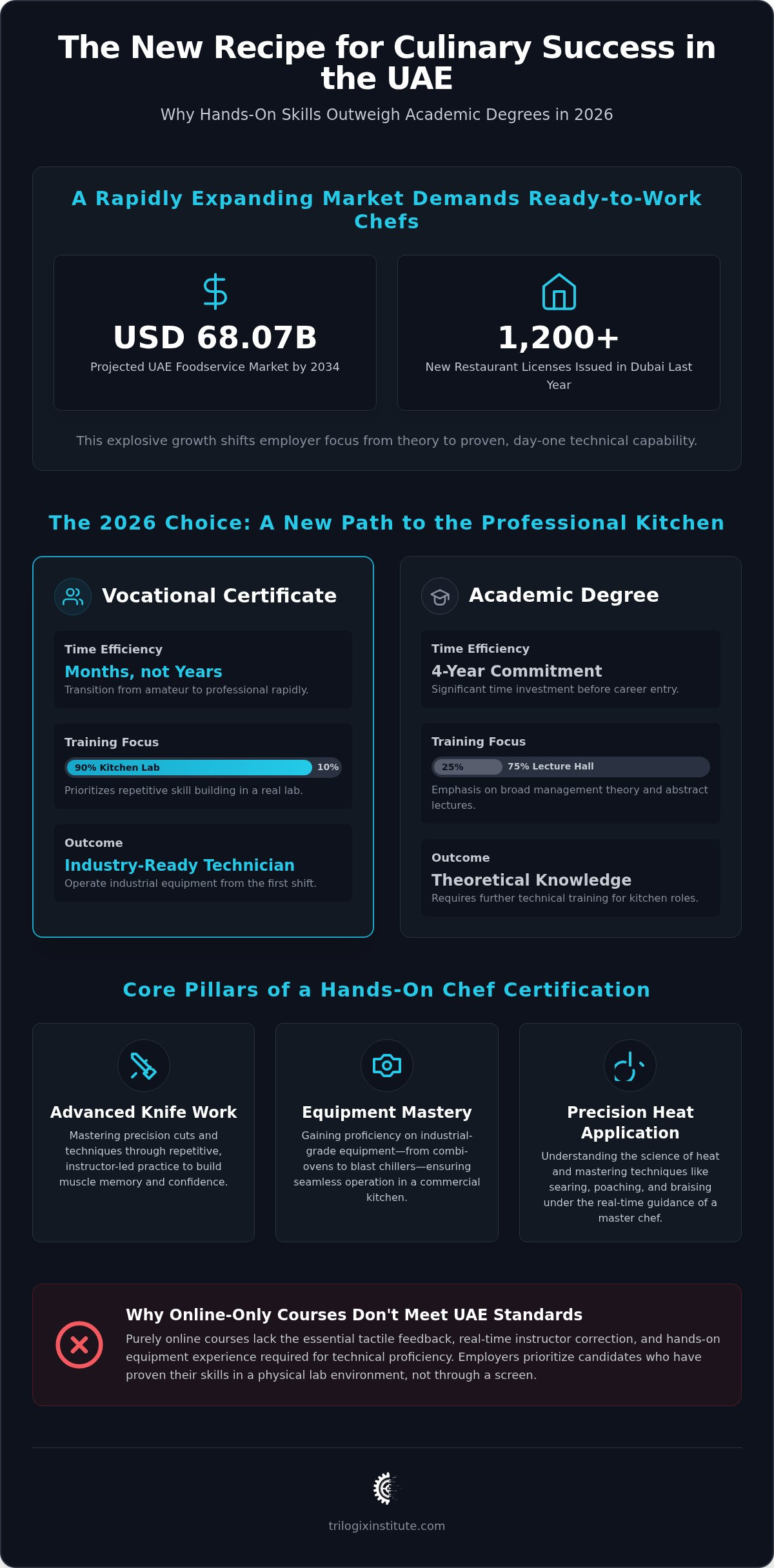
The UAE's culinary sector has undergone a fundamental transformation. By 2026, the industry focus has shifted from theoretical hospitality management to technical, laboratory-based mastery. This change is driven by a massive expansion in the foodservice market, which is projected to reach USD 68.07 billion by 2034. Employers no longer prioritize degrees that keep students in classrooms; they seek professionals who can operate industrial equipment from their first shift. The job market now demands a hands-on chef certification Dubai that proves a candidate can handle the pressures of a high-volume commercial kitchen.
This evolution reflects the Emirates' broader commitment to Technical and Vocational Education and Training (TVET). This educational model treats culinary arts as a technical trade rather than an academic pursuit. It prioritizes repetitive skill building over abstract lectures. In a landscape where 1,200 new restaurant licenses were issued in Dubai in the last year alone, the need for immediate industry readiness has never been higher. Modern kitchens require technicians who understand the science of heat and the precision of modern equipment.
Understanding the UAE Hospitality Landscape
The national hospitality sector is currently defined by a blend of global innovation and deep respect for heritage. While international standards dictate kitchen hierarchies, there is a growing emphasis on mastering traditional Emirati cuisine within professional frameworks. This requires a unique set of skills that combine heritage techniques with modern efficiency. For those entering the field, a professional culinary diploma is no longer just an advantage; it's a prerequisite for navigating the 1,731 training institutes currently regulated by the KHDA. Choosing a hands-on chef certification Dubai ensures that your training aligns with these rigorous national standards and employer expectations.
Vocational vs. Academic: The 2026 Choice
For adult learners and career changers, the choice between a four-year university degree and an intensive vocational certificate is often decided by the return on investment. A university program requires a significant time commitment and often focuses on broad management theory. In contrast, a six-month professional certification provides direct, equipment-based training that leads straight to the line. Consider these factors when choosing your path:
- Time Efficiency: Transition from amateur to professional in months rather than years.
- Technical Focus: Spend 90% of your time in a kitchen lab rather than a lecture hall.
- Cost-Effectiveness: Avoid the high tuition of academic degrees while gaining industry-recognized credentials.
If you're ready to evaluate specific programs, our Professional Culinary Arts Training in Dubai: The 2026 Buying Guide provides a detailed breakdown of what to look for in a provider. Pragmatic professionals choose pathways that offer the fastest route to technical mastery.
What Defines a True Hands-On Chef Certification in Dubai?
Authenticity in culinary education is measured by lab hours, not lecture slides. A true hands-on chef certification Dubai is an instructor-led, equipment-based program focusing on repetitive skill mastery. While many institutions use "hands-on" as a marketing buzzword, the reality in 2026 is that employers prioritize technicians who have executed full services rather than just watching a demonstration. Purely online culinary courses fail to meet UAE industry standards because they lack the tactile feedback necessary for technical proficiency. You simply can't learn the exact moment a protein reaches perfect doneness or how a sauce emulsifies through a screen.
The distinction lies in the lab environment. In a vocational setting, the focus shifts from "knowing" to "executing." This requires a dedicated space where students can fail, correct, and repeat until a technique becomes muscle memory. This rigorous approach ensures that when you step into a commercial kitchen, the transition is seamless. You aren't just a student; you're a prepared professional ready for the line.
The Role of Instructor-Led Labs
In a professional lab, the difference between watching and doing is the presence of a mentor. Master chefs provide immediate feedback loops that are non-negotiable for professional growth. They correct technique in real-time, from the specific angle of a knife blade to the subtle adjustment of a gas flame. This interaction builds the psychological resilience needed for the fast-paced hospitality sector. Institutions like the Dubai College of Tourism emphasize this vocational model, ensuring students are acclimated to the high-pressure environment of a commercial kitchen before they ever apply for a role.
Equipment-Based Learning Standards
Mastery involves more than just following a recipe. It requires total familiarity with industrial-grade tools. During your training, you must command industrial combi-ovens, high-capacity sous-vide machines, and commercial prep equipment. Understanding the safety protocols and preventative maintenance of these tools is a core skill for any serious professional. Equipment-based training is the bridge between theory and employment. If you're ready to master these tools in a professional setting, consider exploring our technical culinary programs to begin your career transition.
By focusing on these industrial standards, you ensure your skills are transferable to any major hotel or restaurant group in the Emirates. Practical expertise is the only currency that matters in a professional kitchen environment.
Core Skills Mastered Through Equipment-Based Training
Technical proficiency in a professional kitchen isn't about learning "tricks"; it's about mastering the industrial motor control of the culinary environment. A hands-on chef certification Dubai provides the repetition required to turn complex movements into instinctive actions. This training transforms an amateur into a kitchen technician capable of maintaining high standards under the pressure of a full service. You'll move beyond the basics to command the station with steady confidence.
Advanced knife mastery is the first pillar of this training. Precision in cuts like julienne or brunoise isn't merely for aesthetics; it's essential for even cooking and consistent texture in high-volume environments. Coupled with 'mise en place' efficiency, students learn to organize their stations to minimize wasted movement. This logistical discipline ensures that every ingredient is prepped and ready before the first order arrives, preventing the chaos often found in untrained kitchens.
Professional heat application follows. You'll master the specific thermal dynamics of industrial equipment, including:
- High-velocity sautéing: Maintaining texture and color through precise flame control.
- Precision roasting: Utilizing combi-ovens to ensure optimal yield and moisture retention.
- Controlled poaching: Mastering temperature stability for delicate proteins.
Safety is equally technical and pragmatic. Training includes rigorous adherence to HACCP and food safety standards specific to the UAE market. You'll learn to manage inventory and organize stations to meet Dubai Municipality's strict compliance requirements, ensuring your kitchen remains a safe and professional environment.
Technical Proficiency in International Cuisines
Modern certification requires standardizing recipes for high-volume service without sacrificing quality. You'll study the science of flavor balancing and plating aesthetics to meet the 2026 professional culinary diploma requirements. This involves understanding how different ingredients interact at a molecular level, ensuring that every dish served is technically perfect and visually compelling. Mastery here means being able to replicate high-end results consistently, regardless of the volume.
The Business of the Kitchen
A chef's value is often measured by their ability to manage the "bottom line." You'll learn the mechanics of food costings and wastage reduction, turning a kitchen from a cost center into a profitable operation. Understanding the communication and hierarchy within a 'Brigade de Cuisine' is also vital for professional advancement. Just as technical standards are foundational in other trades, as seen in the 5 Essential Practical Skills for Every Dubai Electrician, culinary success depends on disciplined adherence to professional protocols and industrial standards.
Navigating Vocational Pathways for Adult Learners in the Emirates
2026 has emerged as the definitive year for the career pivot in the UAE. As the national economy continues to diversify, many professionals are transitioning from corporate roles into the technical trades. The hospitality sector's projected growth makes this an opportune moment to secure a hands-on chef certification Dubai. For adult learners, this transition is not about starting from zero; it's about translating existing professional discipline into a kitchen environment. Success in this field requires a pragmatic approach to education that respects your time and previous experience.
A critical component of this pathway is the Recognition of Prior Learning (RPL). This framework allows the UAE's educational authorities to validate skills you may have acquired through informal experience or related industries. When combined with national accreditation from bodies like the KHDA, it ensures that your certification carries weight across the entire Emirates. Adult education in 2026 focuses on efficiency. You need a program that balances intensive, lab-based training with the realities of existing professional or personal commitments.
Career Change Strategies
Transitioning into a professional kitchen requires more than just technical skill; it requires a strategic mindset. You can leverage soft skills such as project management, team leadership, and crisis resolution in a high-pressure line environment. During your certification, focus on building a professional portfolio that documents your technical mastery of industrial equipment. This tangible proof of skill is often more persuasive than a list of completed modules. For a deeper dive into these strategies, read our Culinary Arts Certification for Adults: 2026 Guide.
Selecting the Right Institute
Not all training centers are created equal. When evaluating where to earn your hands-on chef certification Dubai, use a strict technical checklist. Prioritize institutes that offer a national network of peers and industry connections over small, neighborhood-specific schools. Your choice should be based on the quality of the laboratory facilities and the industrial relevance of the equipment. Consider the following when visiting a campus:
- Equipment Standards: Does the lab use the same industrial-grade tools found in five-star hotel kitchens?
- Instructor Credentials: Are the lead instructors active industry insiders with verified technical backgrounds?
- Accreditation: Is the institute fully permitted by the KHDA to offer professional vocational diplomas?
If you are ready to commit to a rigorous, results-oriented training path, you can explore our professional culinary arts programs to begin your technical journey today. Choosing an institute that functions as a career mentor rather than just a school is the most reliable way to bridge the gap between ambition and employment.
Advancing Your Career with TTI Professional Culinary Arts
Success in the 2026 UAE hospitality sector requires more than a basic understanding of recipes; it demands technical mastery of industrial environments. The TTI Dubai Professional Culinary Arts program is designed specifically to meet this need. Our curriculum strips away unnecessary academic theory to focus on the pragmatic, equipment-based training that employers actually value. By securing a hands-on chef certification Dubai through Trilogix, you position yourself as a ready-to-work professional capable of managing complex kitchen operations from day one.
Our philosophy is rooted in the "Practical Expert" model. We believe that culinary education should function as a bridge to employment, not just a classroom exercise. This means every hour spent in our labs is dedicated to building the technical stamina and precision required in high-volume commercial kitchens. We prepare you for technical roles that demand authority over industrial tools and a deep understanding of professional kitchen hierarchies. This grounded approach ensures that your learning is directly transferable to the workplace.
The TTI Advantage
Choosing TTI means opting for a high-impact, results-oriented educational experience. We provide access to professional-grade laboratories that mirror the real-world scenarios you'll face in the national hospitality industry. The advantages of our approach include:
- Industry-Led Instruction: Learn from seasoned professionals who possess a deep understanding of current UAE market demands and global standards.
- Equipment Mastery: Gain repetitive, hands-on experience with the specific industrial tools used in five-star establishments across the Emirates.
- Zero-Fluff Curriculum: Focus exclusively on the technical skills and power verbs of the trade that lead to immediate industry readiness.
Your Next Steps
Transitioning from an amateur enthusiast to a certified professional requires a clear, methodical plan. Your journey begins with identifying the right program for your specific career goals. You can review the full list of Trilogix Courses for 2026 to find the module that aligns with your ambitions. Seeing the environment firsthand is often the best way to understand our technical standards. We encourage you to visit our Gallery to see our professional labs in action and witness the level of equipment mastery our students achieve.
Ready to start your technical training? Don't leave your career progression to chance. You should Contact Trilogix today to discuss enrollment details, batch schedules, and how our equipment-based philosophy can accelerate your professional growth in the Emirates. Take the pragmatic step toward becoming a recognized kitchen professional in the UAE's thriving hospitality landscape.
Mastering the Industrial Kitchen: Your Path to Professional Certification
The UAE hospitality landscape in 2026 demands technical mastery over academic theory. We have explored how traditional degrees are giving way to intensive vocational paths that prioritize immediate industry readiness. A true hands-on chef certification Dubai focuses on repetitive skill mastery using industrial-grade equipment. This rigorous approach ensures you're prepared for the technical demands and fast-paced environment of a professional commercial kitchen. By choosing a path rooted in vocational excellence, you bridge the gap between ambition and a sustainable career.
TTI Dubai provides the instructor-led, equipment-based training required to excel in this competitive market. Our pragmatic, industry-centric curriculum aligns with national UAE vocational standards, ensuring your skills are recognized by top employers across the Emirates. Don't leave your professional development to chance. You can Enroll in TTI Dubai's Professional Culinary Arts Program Today to begin your transition from amateur enthusiast to a command-level kitchen professional. Your journey toward technical authority and career advancement starts with a single, decisive step.
Frequently Asked Questions
Is a hands-on chef certification in Dubai recognized internationally?
Yes, certifications from KHDA-permitted institutes that align with global bodies like WorldChefs or City & Guilds carry significant weight internationally. These programs validate technical skills against rigorous global standards. Employers in major hospitality hubs recognize the high level of vocational training provided in the Emirates. This recognition is essential for professionals who intend to build a career in diverse international kitchen environments.
Can I get a professional culinary diploma while working a full-time job?
Flexible scheduling allows many adult learners to balance intensive training with existing professional commitments. Vocational institutes often provide weekend or evening batches specifically designed for those executing a career pivot. These sessions focus on equipment-based mastery in a condensed format. It's a pragmatic way to gain a professional culinary diploma without the need to pause your current income or career progression.
What is the difference between a cooking class and a professional chef certification?
A cooking class is generally a recreational activity focused on specific recipes, while a professional certification is a comprehensive vocational program. Certifications involve repetitive mastery of industrial equipment, HACCP compliance, and kitchen management. Obtaining a hands-on chef certification Dubai ensures you possess the technical stamina and industry-ready skills required to command a station in a high-volume commercial kitchen environment.
How much does a vocational culinary school in the UAE typically cost in 2026?
Fees for vocational culinary programs in the UAE are typically determined by the certification level, the number of lab hours, and whether materials like uniforms or examination fees are included. While costs vary across the Emirates, serious students should view this as a pragmatic investment in technical mastery rather than a simple tuition fee. It is best to consult with the admissions department of your chosen institute for a verified fee structure tailored to your professional goals.
Do I need previous kitchen experience to enroll in a professional program?
Most foundational programs don't require prior kitchen experience to begin your training. They are structured to build your technical skills from the ground up through instructor-led labs. While experience isn't mandatory, a strong commitment to the culinary arts and a disciplined mindset are vital for success. The curriculum focuses on turning beginners into technically proficient professionals using industrial-grade kitchen equipment.
What equipment will I learn to use during the TTI Professional Culinary Arts course?
Students master a comprehensive range of industrial tools essential for modern commercial operations. This includes high-capacity combi-ovens, precision sous-vide machines, and commercial prep equipment. You will also learn the safety and maintenance protocols for these machines. This technical familiarity ensures you can step into any professional kitchen hierarchy with confidence and authority, ready to operate complex machinery from day one.
How long does it take to complete a professional chef certification in the UAE?
Program durations depend on the intensity of the curriculum and the specific certification level. Intensive vocational certifications are typically completed in three to six months. More advanced professional diplomas may require up to eight months of training. These timelines are significantly shorter than traditional academic degrees. They focus on rapid, high-impact skill acquisition to ensure you're ready for the job market quickly.
Is there a demand for certified chefs in the UAE national hospitality market?
Demand is exceptionally high as the national hospitality sector continues to expand its global footprint. With thousands of new establishments opening annually, the need for skilled labor is critical for maintaining service standards. Employers prioritize candidates with a hands-on chef certification Dubai because it proves technical readiness and equipment mastery. Certified chefs are vital for maintaining the high standards expected in the UAE's world-class tourism sector.


