

What if the secret to a successful career in a five-star kitchen isn't found in a recipe book, but in the mastery of commercial-grade hardware? Many aspiring chefs in the region feel stuck between their love for food and the daunting reality of professional industry standards. You might worry that self-paced online certificates won't carry weight with hiring managers, or perhaps you feel anxious about your lack of "real-world" kitchen experience. It is often confusing to decipher which accreditation levels actually matter to employers in the current market.
This guide explains how a structured diploma transforms your culinary passion into a technical asset. You'll discover how to obtain a culinary arts certification UAE hospitality leaders prioritize while building immediate proficiency with industrial equipment. We'll break down the 2026 career strategy, highlighting why instructor-led labs in the TTI Dubai Professional Culinary Arts program offer the most efficient path to bridging the gap between amateur skills and a high-growth career. By focusing on technical vocational skills and equipment-based training, you can transition from a home cook to a prepared professional ready for the demands of a commercial kitchen.
Key Takeaways
- Understand why the UAE's expanding hospitality market demands technical vocational credentials rather than just home-cooking experience.
- Identify the specific criteria for a culinary arts certification UAE employers respect, ensuring your training meets 2026 national standards.
- Learn why mastering commercial-grade kitchen equipment is more vital for your career progression than simply following recipes.
- Discover the advantages of instructor-led labs over self-paced online courses for gaining immediate technical proficiency in a professional kitchen.
- Explore how the TTI Dubai Professional Culinary Arts program uses an equipment-based approach to bridge the gap between ambition and employment.
The Value of a Professional Culinary Diploma in the UAE Hospitality Sector
A professional culinary diploma is far more than a collection of recipes. It's a vocational credential designed for technical kitchen mastery. Unlike casual cooking classes, this qualification focuses on the rigorous standards required to operate within a high-pressure, commercial environment. It transforms a personal interest in food into a structured, professional discipline. In the current market, this diploma acts as a technical validation of your skills, proving you possess the discipline and precision needed for a modern brigade.
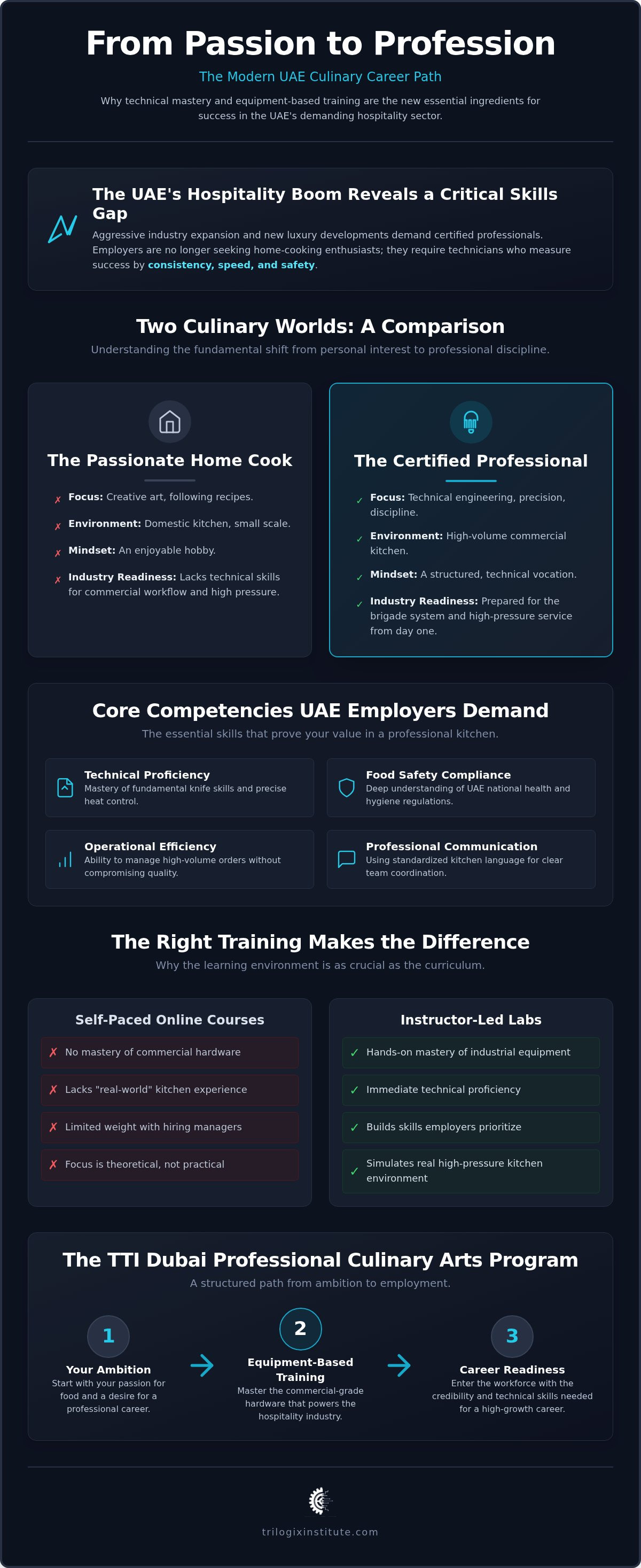
The UAE's hospitality market is undergoing a significant transformation. As we move through 2026, the volume of international visitors and the launch of new luxury developments have spiked the demand for qualified staff. Employers no longer seek self-taught enthusiasts for their kitchens. They require certified professionals who understand the mechanics of a commercial workflow. This shift has turned culinary arts from a creative hobby into a technical vocation, where success is measured by consistency, speed, and safety.
Meeting the Demand for Skilled Kitchen Professionals
The national food and beverage industry is expanding at an aggressive pace. This growth has exposed a critical skill gap. Many applicants possess a passion for food but lack the technical readiness required for immediate deployment. A culinary arts certification UAE employers recognize solves this problem by prioritizing practical competence over theoretical lectures. In entry-level roles, the ability to execute a task correctly under pressure is more valuable than a broad academic degree. Employers look for specific indicators of readiness, including:
- Technical proficiency: Mastery of knife skills and heat control.
- Food safety compliance: Deep understanding of national health regulations.
- Operational efficiency: Ability to manage high-volume orders without compromising quality.
Bridging the Gap Between Passion and Professionalism
Home cooking is an art; professional cooking is a technical engineering project. Transitioning from a domestic kitchen to a high-volume line requires a complete shift in mindset. You must learn to speak the standardized professional language used in global kitchens. This ensures clear communication during peak service hours. Without this foundation, even the most talented home cook will struggle to keep pace with a professional team.
True professional readiness depends on your mastery of commercial-grade hardware. This is why equipment-based learning is essential. You aren't just learning to cook; you're learning to operate the engines of the hospitality industry. The TTI Dubai Professional Culinary Arts program focuses on this technical foundation. It ensures you can handle the rigors of a professional workflow from your first day on the job. By treating the kitchen as a technical environment, you build the credibility needed for long-term career advancement.
Core Components of a Comprehensive Culinary Arts Certification
A comprehensive culinary arts certification UAE candidates seek is built on technical foundations, not just creative flair. It bridges the gap between understanding a recipe and executing it perfectly 100 times in a row. This level of consistency requires mastery of three core technical skills: knife work, heat control, and precision plating. Knife work ensures speed and safety. Heat control guarantees the correct texture and flavor profile every time. Precision plating turns a technical process into a professional product that meets industry standards.
Technical mastery also involves understanding commercial kitchen operations. You must learn how a professional workflow differs from a domestic one. This includes managing high-volume orders and coordinating with a larger team. Career preparation units, such as workplace communication, are also vital. They prepare you to function within the rigid hierarchy of a professional brigade, ensuring that information flows clearly even during the most intense service periods.
Mastering Technical Kitchen Skills and Operations
High-volume kitchens function through specialized stations. You might start in the garde manger section or work as a commis at the grill. Each station requires specific technical skills and a deep understanding of the equipment involved. Learning on commercial-grade equipment is non-negotiable. Industrial ovens, high-pressure ranges, and large-scale mixers behave differently than home appliances. In a lab setting, repetition is your best teacher. It builds the muscle memory required to maintain precision even when the tickets start piling up. Preparing for these rigors is exactly why the TTI Dubai Professional Culinary Arts program prioritizes hands-on lab time over traditional lectures.
Essential Theory: Food Safety, Sanitation, and Management
Technical skill is useless without a foundation in safety. Food safety and sanitation, specifically HACCP (Hazard Analysis and Critical Control Points), are the non-negotiable pillars of any professional certification. The UAE enforces strict national standards to ensure public health. A professional program doesn't just teach these as abstract concepts. It integrates them into every practical session. You also need to learn the management side of the industry. This includes food costing, inventory management, and restaurant operations. These skills are what allow a chef to move beyond the line and into senior leadership roles, making them indispensable to any hospitality business.
Practical vs. Theoretical Training: Why Equipment-Based Learning Wins
Watching a video of a chef deboning a chicken is fundamentally different from performing the task yourself in a high-pressure environment. Self-paced online modules often fail to prepare students for the sensory realities of a professional kitchen. A culinary arts certification UAE hospitality leaders respect requires more than just passing a digital quiz. It demands physical mastery of industrial tools. This is why instructor-led vocational training is superior to purely theoretical models. It focuses on the "how" of cooking, ensuring that you can execute complex techniques consistently when the tickets start flying.
The Trilogix approach prioritizes practical application. We view culinary training as a technical vocational skill, much like engineering or automation. You don't just learn the theory of heat transfer; you master the specific behavior of a commercial induction range. This equipment-based focus ensures that your skills are directly transferable to the workplace. You leave the program not just with knowledge, but with the readiness to perform from day one.
The Limitations of Classroom-Only Culinary Education
Theoretical knowledge often collapses under the weight of a busy dinner service. University graduates with limited lab time frequently struggle with the physical stamina and speed required in a commercial brigade. This creates a significant skill gap that employers find difficult to bridge. While understanding the science of emulsification is helpful, it doesn't help if you can't fix a broken sauce in thirty seconds. Equipment-based training is the bridge between theory and employment.
Benefits of Instructor-Led, Commercial-Grade Kitchen Training
A professional vocational lab is a controlled environment designed to simulate real-world stress. In these labs, instructors serve as more than just teachers; they act as mentors who provide immediate, actionable feedback. They can correct your posture, adjust your grip, or refine your workflow in real-time. This level of interaction is impossible in a self-paced setting. This hands-on intensity is a core part of the TTI Dubai Professional Culinary Arts program. It debunks the common vocational culinary school Dubai myths that suggest you can learn this trade through a screen. True proficiency is built through repetition on the same commercial-grade hardware you'll find in the industry's top establishments.
How to Select the Right Culinary Arts Program for Your Career
Selecting a culinary arts certification UAE employers will respect requires a methodical approach. You should treat this selection process like a business investment. If a program spends more time in a lecture hall than a lab, it's likely failing to prepare you for the physical demands of 2026 hospitality standards. Your goal is to find a bridge to employment, not just a certificate. This means prioritizing technical readiness over academic theory. Look for a curriculum that guarantees at least an 80/20 ratio of practical lab time to classroom lectures. Muscle memory is your most valuable asset in a high-volume environment, and it can't be built through a screen.
Check the instructor's background carefully. Real-world industry experience is non-negotiable. You need mentors who have managed the stress of a professional line and understand the current UAE market. Furthermore, audit the equipment before enrolling. A training facility must mirror a modern commercial kitchen to be effective. Finally, ensure the program is designed for your specific career stage. Adult learners often require a modular approach that respects their existing professional history and allows for efficient skill acquisition.
Evaluating Accreditation and International Standards
A valid UAE vocational certificate must align with national standards to ensure your skills are recognized by local hospitality groups. This alignment provides the professional credibility needed to secure roles in luxury hotels and high-end restaurants. International alignment is equally important if you plan to seek global roles later in your career. For those transitioning into food service from another industry, refer to the culinary arts certification for adults guide for specific tips on navigating these standards as a mature student.
Assessing Laboratory Facilities and Instructor Expertise
A training kitchen should be a high-performance environment. When evaluating a facility, use this "must-have" equipment checklist:
- Industrial Induction Ranges: For mastering precise temperature control.
- Combi-Ovens: To understand modern high-volume cooking technology.
- Blast Chillers: Essential for learning professional food safety and HACCP standards.
- Commercial Prep Stations: To practice efficient workflow management.
Instructor-led modules are superior because they allow for immediate correction of technical errors. You can't learn the subtle "feel" of a sauce or the correct pressure for a knife cut from a video. We suggest asking for a tour of the gallery to see these facilities in action before making your decision. Explore the TTI Dubai Professional Culinary Arts course details to see how our modular, equipment-based training fits your specific career goals.
Advancing Your Career with TTI Professional Culinary Arts
The TTI Dubai Professional Culinary Arts program is built for individuals who view the kitchen as a technical workspace. We understand that a culinary arts certification UAE employers value must be grounded in operational reality. This isn't about sitting in a lecture hall; it's about standing at a station. Our curriculum removes the academic "fluff" that often slows down career progress. Instead, we provide a pragmatic vocational solution that focuses on the mechanics of professional cooking. By treating the culinary arts with the same level of technical precision as industrial engineering, we ensure our graduates are ready for high-growth roles in the hospitality sector.
Our approach prioritizes the acquisition of skills that translate directly to the bottom line of a restaurant or hotel. We don't just teach you how to follow a recipe; we teach you how to engineer a consistent, high-quality product under pressure. This focus on practical skill acquisition is what sets our graduates apart in a competitive market. When you enter a professional kitchen with a TTI diploma, you arrive with the confidence that only comes from hours of equipment-based practice.
The Trilogix Approach: Pragmatic and Results-Oriented Training
At Trilogix Institute, we apply an engineering-level focus to our culinary training. We believe that mastery of commercial hardware is the foundation of a chef's success. Our courses are exclusively instructor-led, ensuring you receive direct mentorship from industry experts. This isn't self-paced learning where you're left to guess the correct technique. We provide equipment-based labs that simulate the exact environment of a professional kitchen. You don't just learn to cook; you learn to manage heat, timing, and workflow on the same industrial tools used by the region's leading hotels. This results-oriented training is designed to build the specific technical proficiency that the 2026 market demands.
Preparing for Immediate Entry into the Professional Kitchen
The transition from ambition to employment requires a clear strategy. Our program is designed to bridge this gap by focusing on immediate readiness. We prepare you for the rigors of a high-volume line, ensuring you can handle the stress of a peak service without hesitation. Whether you're a career changer or an aspiring professional, our focus remains on your workplace utility. We act as your partner in this journey, providing the keys to a sustainable and high-growth career path.
Don't leave your professional development to chance. If you're ready to master the technical side of the culinary arts, we're here to guide you. We encourage you to visit our contact page to schedule a consultation with our vocational experts. Explore our professional culinary diploma programs today and take the first step toward a recognized, equipment-based certification that works as hard as you do.
Mastering the Technical Future of UAE Hospitality
Success in the modern kitchen depends on technical readiness and equipment mastery. We've explored how a professional diploma bridges the gap between home cooking and industry standards by focusing on commercial-grade hardware. Obtaining a culinary arts certification UAE employers respect is the most direct way to establish your professional credibility. By prioritizing instructor-led practical labs over theoretical lectures, you build the muscle memory required for high-volume service. This approach ensures you aren't just learning recipes; you're learning to operate the engines of a commercial kitchen.
Trilogix Institute has been a vocational training specialist since 2019. We provide the specific tools and expertise needed to manage the 2026 job market with steady confidence. Our equipment-based vocational training ensures your skills are directly transferable to any professional environment. Don't settle for academic fluff when you can gain immediate technical proficiency under the guidance of industry experts who understand the rigors of the line.
Start your journey toward a professional culinary career with Trilogix Institute today. It's time to transform your passion into a high-growth career path. We're ready to help you master the skills that matter.
Frequently Asked Questions
Is a culinary arts certification for adults worth it for a career change in the UAE?
A culinary arts certification UAE employers recognize is highly valuable for adults making a career pivot. While mature students often possess strong communication and management skills, they usually lack the technical proficiency required in a commercial kitchen. This certification provides the equipment-based training needed to demonstrate immediate utility. It replaces years of entry-level struggle with a structured path to professional credibility and technical mastery.
What is the difference between a culinary degree and a professional culinary diploma?
A culinary degree typically follows a multi-year academic structure with a heavy emphasis on theory and general management. In contrast, a professional culinary diploma is a vocational credential designed for rapid technical readiness. It focuses on hands-on mastery of kitchen hardware and workflow. For those seeking immediate employment, the diploma offers a more efficient and pragmatic route into the national hospitality sector.
Can I get a chef job in the UAE with just a professional culinary diploma?
Most entry-level and intermediate chef roles prioritize technical skill and safety knowledge over academic degrees. Possession of a recognized culinary arts certification UAE standards support proves you can handle commercial equipment and maintain high-volume output. Hiring managers in the hospitality industry look for candidates who can contribute to a professional brigade immediately. A diploma establishes your technical readiness from your first shift.
How long does it take to complete a professional culinary arts training program?
Professional culinary arts training programs are designed for efficiency, typically ranging from a few weeks to several months. This modular structure allows students to gain specific technical skills without the long-term commitment of a university degree. The focus is on intensive skill acquisition through repetition in equipment-based labs. This brisk pace reflects the fast-moving nature of the industry and respects the student's need for a timely career transition.
What equipment will I learn to use in a professional culinary diploma course?
You will learn to operate a wide range of commercial-grade hardware found in modern kitchens. This includes industrial induction ranges, combi-steam ovens, blast chillers, and large-scale mixers. Mastery of these tools is essential because they behave differently than domestic appliances. The TTI Dubai Professional Culinary Arts program ensures you are familiar with the specific technology and safety protocols required to manage a high-performance professional kitchen.
Is instructor-led culinary training better than online cooking courses?
Instructor-led training is significantly more effective than online courses for technical vocational skills. You simply cannot master knife precision or heat control through a screen. Practical labs provide immediate feedback from industry experts who can correct your technique in real-time. This hands-on interaction builds the muscle memory and confidence required to perform under the high-pressure conditions of a professional service environment.
What are the entry requirements for a professional culinary diploma in the UAE?
Entry requirements for vocational diplomas are generally pragmatic and accessible. Most programs prioritize a candidate's commitment to the trade and their physical ability to work in a kitchen environment. Unlike academic degrees, you don't always need a specific GPA or previous hospitality experience to begin. The goal is to identify individuals with the drive to master technical skills and provide them with the professional tools for success.
How does a vocational culinary school prepare me for real-world kitchen pressure?
Vocational schools prepare you for pressure by simulating high-volume service scenarios in a controlled lab setting. You'll practice managing multiple orders and coordinating with different stations under strict time constraints. This repetition builds resilience and ensures your technical skills remain sharp even when the kitchen becomes intense. Learning from mentors who have managed real-world commercial brigades provides the psychological and technical preparation needed for industry success.


