

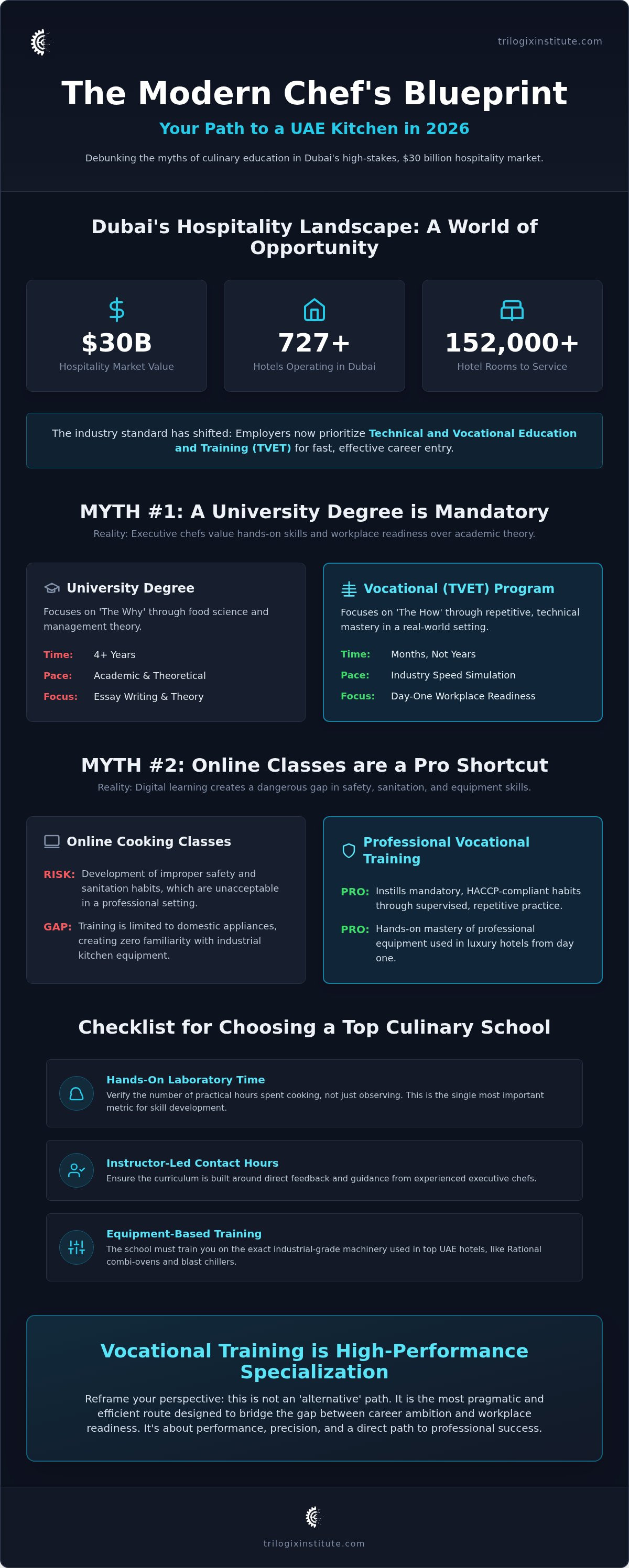
A university degree is no longer the golden ticket to a head chef position in the UAE's $30 billion hospitality market. While many believe that years of academic theory are required to lead a professional kitchen, the reality of 2026 tells a different story. If you're looking for a vocational culinary school Dubai offers pathways that prioritize technical mastery over textbook memorization. You likely feel the pressure to choose a program that actually matters to the 727 hotels currently operating across the emirate, yet the fear of wasting time on theoretical fluff remains a significant barrier.
It's true that the distinction between amateur cooking classes and rigorous professional training is often blurred, leaving many aspiring chefs uncertain about their next step. This article clarifies that confusion by debunking five persistent myths about culinary education. You'll discover why equipment-based training is the most efficient way to earn industry-recognized certifications and start your career in months rather than years. We are looking at the pragmatic shift toward vocational excellence that's defining the modern UAE kitchen and providing a clear, no-nonsense path to professional success.
Key Takeaways
- Understand why UAE hospitality leaders prioritize Technical and Vocational Education and Training (TVET) over traditional academic degrees for rapid career entry.
- Identify the safety and technical limitations of online cooking classes compared to training in a regulated, industrial-grade kitchen environment.
- Discover why choosing a vocational culinary school Dubai offers the most pragmatic path to mastering professional equipment and industry standards in 2026.
- Learn how to evaluate training programs based on concrete metrics like instructor-led contact hours and hands-on laboratory time.
- Reframe vocational training as a high-performance specialization designed to bridge the gap between career ambition and workplace readiness.
Myth 1: A University Degree is Mandatory for a Professional Culinary Career
The assumption that a four-year university degree is the only route to a prestigious kitchen is a relic of the past. In the high-pressure environment of 2026, academic theory rarely translates to the speed required on a busy Saturday night in a Dubai hotel. While an academic degree focuses on the 'why' through food science and management theory, a vocational program focuses on the 'how' through repetitive, technical mastery. Understanding what is a vocational school helps clarify this distinction; it's an institution designed specifically to provide the skills needed for a particular job. For those seeking a vocational culinary school Dubai offers a more direct, pragmatic path that prioritizes your ability to perform over your ability to write essays.
The Rise of TVET in the UAE Hospitality Sector
The UAE hospitality sector has undergone a massive shift toward competency-based hiring. National standards now lean heavily on Technical and Vocational Education and Training (TVET) to fill the gap in the labor market. With over 152,000 hotel rooms to service, employers don't have the luxury of waiting four years for a graduate to learn the basics of knife skills or HACCP compliance. Practical certifications are the new benchmark for 2026 industry requirements. You can explore how these standards impact your career choices in our Professional Culinary Arts Training in Dubai: The 2026 Buying Guide. Vocational programs deliver a time-to-market advantage that's impossible to ignore, moving you from the classroom to a professional kitchen in months.
Why Executive Chefs Value Skills Over Diplomas
Executive chefs operate in a 'trial by fire' environment where the primary currency is technical proficiency. They value candidates who can handle the physical and mental rigors of a commercial kitchen without needing their hands held. A vocational culinary school Dubai simulates this environment, training students on industrial-grade equipment from day one. This prepares you for the intense heat, the rapid pace, and the precise coordination required in a professional setting. Vocational readiness is the ability to operate at industry speed from day one.
Myth 2: Online Cooking Classes Provide Sufficient Professional Training
Digital platforms and video tutorials have made culinary knowledge more accessible than ever, but they've also created a dangerous illusion. Watching a high-definition video of a chef searing a scallop is not the same as managing a twelve-pan station during a dinner rush. Amateur learning happens in the safety of a home kitchen, often without the pressure of time, volume, or strict regulatory oversight. If you want to move beyond home-cook status and enter the 152,000-room hotel market in the UAE, you need the structured environment provided by a vocational culinary school Dubai.
One of the most significant risks of self-paced online learning is the development of improper safety and sanitation habits. In a home kitchen, a minor cross-contamination error might only lead to a personal inconvenience. In a professional setting governed by Dubai's 2026 unified national food safety system, such an error is a legal and ethical catastrophe. Vocational training instills mandatory HACCP-compliant habits through repetition and expert supervision. This ensures that food safety becomes second nature rather than an afterthought.
The Equipment Gap: Home Kitchen vs. Industrial Facility
You can't master high-volume output on a domestic four-burner stove. Professional kitchens rely on specialized, heavy-duty machinery that requires specific technical training to operate safely and efficiently. To bridge this gap, Trilogix utilizes equipment-led training that mirrors the setups found in luxury hotels. You can view our TTI Dubai campus facilities to see the industrial-grade environment where students train. Mastery of the following equipment is essential for 2026 industry readiness:
- Rational Combi-Ovens: Mastering steam, convection, and combination cooking for precision at scale.
- Industrial Blast Chillers: Understanding rapid cooling cycles to meet strict food safety standards.
- High-Volume Ranges and Grills: Learning to manage intense heat zones during peak service hours.
- Vacuum Sealers and Immersion Circulators: Applying sous-vide techniques for consistent texture and flavor.
The Necessity of Real-Time Instructor Feedback
Culinary mastery is a sensory experience. A screen cannot tell you if your reduction is too acidic, if your emulsion is about to break, or if your seasoning lacks balance. Real-time feedback from a physical mentor is critical for 'tasting and adjusting', which is the fundamental skill of any chef. This hands-on guidance is a core component of the value of vocational education, as it ensures technical errors are corrected the moment they occur.
Professional success also depends on your ability to function within the 'brigade system.' This kitchen hierarchy requires face-to-face communication, teamwork, and a deep understanding of non-verbal cues that simply cannot be replicated in a virtual environment. For those looking to transition into this fast-paced world, our Culinary Arts Certification for Adults: 2026 Guide provides a detailed roadmap for on-site learning. If you're ready to move past the screen, the TTI Dubai Professional Culinary Arts program offers the hands-on immersion required to truly master the craft.
Myth 3: Vocational Schools are Only for 'Alternative' Students
The outdated stigma that vocational education is reserved for those who struggle in traditional academic settings has no place in the 2026 economy. Today, a vocational culinary school Dubai is a destination for high-performance individuals who recognize that technical specialization is the fastest route to professional mastery. In a city where luxury hotels achieve average occupancy rates of 72-78%, the demand for precision-trained culinary technicians is at an all-time high. This isn't a secondary option; it's a deliberate choice for those who value practical results over theoretical prestige.
The earning potential for specialized roles reflects this value. In Dubai, an Executive Chef can earn up to AED 25,000 per month, while specialized pastry artists and kitchen technicians command premium salaries due to their rare technical expertise. We see a diverse demographic entering our labs, ranging from ambitious young professionals to established entrepreneurs looking to launch their own concepts in the UAE's $30 billion hospitality market. These individuals aren't looking for a general education; they're looking for the specific keys to a highly competitive industry.
Professional Career Changers in the Kitchen
By 2026, we've seen a surge in corporate professionals trading spreadsheets for chef's knives. These career changers aren't looking for a "student experience"; they're looking for a professional transition that respects their existing drive and ambition. Trilogix supports these adult learners through instructor-led, focused modules that eliminate unnecessary fluff and prioritize workplace readiness. Our approach is grounded in the same reliability and seriousness found in our engineering and automation tracks. You can learn more about our commitment to industry alignment and our professional background on the Trilogix About Page.
The Technical Complexity of Modern Gastronomy
Modern cooking has evolved into a discipline that mirrors industrial engineering. Just as our industrial automation programs require precise control and technical understanding, a modern kitchen relies on scientific principles like thermal dynamics and enzymatic reactions. Mastering a combi-oven or a blast chiller requires more than just a passing interest in food; it requires a technical mindset. Modern culinary excellence is the intersection of creative vision and technical precision. This technical complexity is why a vocational culinary school Dubai attracts students who are as comfortable with data and precision as they are with flavors and textures.
How to Evaluate a Vocational Culinary School in Dubai
Selecting the right training partner is a high-stakes decision that determines your career trajectory in the UAE’s competitive hospitality sector. With hundreds of options available, you must look beyond marketing brochures and focus on technical indicators. A high-quality vocational culinary school Dubai should function as a bridge to employment, not just a place to collect a certificate. Use the following five steps to evaluate any institution before committing your time and resources.
- Audit the technical hours: Verify the exact number of hours spent on professional equipment. If the curriculum is heavy on classroom theory and light on campus-based practical labs, it won't prepare you for industry speed.
- Demand instructor-led modules: Avoid programs that rely on self-paced video learning. You need a mentor who can provide real-time feedback on your technique, seasoning, and workflow.
- Verify industry-specific certifications: Ensure the school holds an Educational Services Permit from the Knowledge and Human Development Authority (KHDA). This is the baseline for legitimacy in Dubai.
- Assess the technology: A 5-star hotel kitchen in 2026 relies on advanced tech. If the school isn't using the same industrial ranges and blast chillers found in major hospitality groups, your training is already obsolete.
- Check for management balance: Technical skill is only half the battle. A professional chef must understand food safety standards (HACCP), inventory management, and food cost control.
The Checklist for Professional Equipment Access
Your search for a vocational culinary school should center on the phrase 'equipment-based.' When visiting a campus, ask specific questions about the kitchen labs. Are there dedicated stations for pastry and hot prep? Does every student have access to industrial-grade mixers and ovens? If you aren't training on real-world machinery, you aren't gaining professional skills. You can review our equipment-centric modules and technical pathways by exploring the Trilogix Courses page.
Accreditation and Certification Realities
Certificates that don't translate to workplace readiness are a waste of investment. In the UAE, KHDA accreditation is essential, but you should also look for programs that align with the national framework for Technical and Vocational Education and Training (TVET). Unrecognized certifications often fail to meet the rigorous standards of luxury hotel chains, leaving you underqualified for high-level roles despite your training. If you have questions about which credentials will help you reach your specific career goals, reach out to Trilogix Admissions for a direct consultation. Choosing the right path now ensures your skills are recognized by executive chefs across the country.
The Trilogix Way: Pragmatic Culinary Excellence
Trilogix Institute (TTI Dubai) rejects the notion that culinary arts should be taught as a loose, artistic hobby. Our TTI Dubai Professional Culinary Arts program is a technical curriculum designed for the high-demand 2026 market. We view the kitchen as a precision environment where technical mastery is the only path to success. By removing the academic fluff found in traditional degree programs, we provide a streamlined route for those who want to transition from ambition to employment. As a vocational culinary school Dubai, our focus remains entirely on workplace readiness and the mastery of industrial equipment.
Our instructors act as authoritative industry insiders who understand exactly what executive chefs in the UAE require. We don't just teach you how to follow a recipe; we teach you how to manage a station, control food costs, and maintain a HACCP-compliant environment under pressure. This grounded, results-oriented approach ensures that every student graduates with the steady confidence needed to lead in a professional setting. At Trilogix, we treat culinary arts with the same seriousness as our engineering and automation tracks, creating a unique synergy of technical precision and creative execution.
Instructor-Led Mastery: Beyond the Recipe
Mastering the 'how' and 'why' of culinary techniques is what separates a technician from a hobbyist. Trilogix focuses on the scientific principles behind food preparation, ensuring you understand the thermal dynamics of a combi-oven or the chemistry of a stable emulsion. This technical rigor is a hallmark of our institute. We believe that a professional kitchen is a technical hub, which is why our culinary students train in an environment that mirrors our other high-stakes disciplines. This cross-disciplinary focus on precision is evident across all our programs, including the TTI Dubai Foundation Electrical Engineering track, which shares our core philosophy of equipment-based excellence.
Your 2026 Career Start: Enrollment Steps
Starting your career in a professional kitchen doesn't require years of academic study. Our enrollment process is designed for the focused professional who is ready to begin their journey immediately. We act as a practical expert and partner in your career, offering a clear-eyed path to the industry. To join the 2026 intake, follow these steps:
- Submit your application through our digital portal for the TTI Dubai Professional Culinary Arts program.
- Attend a technical consultation to discuss your career goals and review our campus-based practical labs.
- Complete the enrollment paperwork to secure your station in our next instructor-led cohort.
If you are ready to move beyond theory and master the technical skills required by the UAE’s leading hotels, now is the time to act. Apply for the Professional Culinary Arts Program at TTI Dubai and take the first step toward a career defined by technical excellence and professional readiness.
Accelerate Your Culinary Career in 2026
The path to becoming a professional chef in the UAE is defined by technical competency rather than academic duration. By debunking the myths surrounding university degrees and online shortcuts, it's clear that industry readiness depends on physical immersion in a high-pressure environment. Choosing a vocational culinary school Dubai ensures you spend your time mastering the industrial equipment and safety protocols that luxury hotels demand in 2026. This technical mastery is the primary currency in a market that values skills over diplomas.
Trilogix Institute provides an industry-centric curriculum built on instructor-led, equipment-based training. We avoid degree-based fluff to deliver a pragmatic learning experience that respects your time and ambition. This approach bridges the gap between your career goals and the reality of a professional kitchen. If you're ready to master the technical precision required to lead in the hospitality sector, it's time to take the next step. Enroll in TTI Dubai Professional Culinary Arts today and start your journey toward professional excellence. Your future in the kitchen begins with technical mastery and a results-oriented mindset.
Frequently Asked Questions
Is a vocational culinary school better than a university degree for chefs?
For rapid career entry, a vocational program is often superior. While degrees focus on management theory over several years, a vocational culinary school Dubai focuses on technical mastery in months. Executive chefs in the UAE prioritize candidates who can handle high-volume service immediately. Vocational training provides the practical readiness that academic degrees often lack, making it the more pragmatic choice for aspiring kitchen professionals.
How long does it take to complete a professional culinary diploma in the UAE?
Most intensive vocational programs take between three to six months to complete. This is significantly faster than a traditional three-year degree. Programs are designed to be brisk and efficient, focusing strictly on the technical skills required by the industry. This reduced timeline allows you to enter the workforce sooner, gaining real-world experience while your peers are still studying theoretical concepts in a classroom setting.
Can I work in a 5-star hotel with a vocational culinary certificate?
Yes, luxury hotels in Dubai actively recruit graduates from recognized vocational programs. With over 152,000 hotel rooms in the market, there's a constant demand for skilled line chefs and technicians. Employers look for KHDA-accredited certifications that prove you can operate industrial equipment and follow strict food safety standards. Technical proficiency is often more valuable to a 5-star hotel than a general academic background without practical kitchen experience.
What is the difference between a cooking class and a vocational culinary school?
A cooking class is a recreational activity, whereas a vocational school is a career-focused institution. Vocational programs utilize industrial-grade equipment like combi-ovens and blast chillers that you won't find in a home kitchen. They also emphasize professional hierarchy, high-volume preparation, and mandatory HACCP compliance. While a class teaches you a recipe, a vocational culinary school Dubai prepares you to manage a professional station under intense service pressure.
Do I need prior experience to enroll in a professional chef training program?
No, most professional programs are designed to take you from beginner to industry-ready. Instructors start with foundational techniques like knife skills and safety protocols before moving to complex culinary science. The curriculum is structured to build technical mastery through repetition and expert feedback. Your drive to work in a fast-paced environment and your willingness to follow professional standards are more important than any previous kitchen experience.
Is culinary training in Dubai recognized internationally?
Many vocational schools in Dubai offer certifications that align with international standards like City & Guilds from the UK. Dubai's status as a global culinary hub means that training received here is highly regarded by international hospitality groups. The skills learned are directly transferable to professional kitchens worldwide. You should always verify that your chosen institution holds the necessary KHDA permits to ensure your credentials carry weight.
What equipment will I learn to use at a vocational culinary school?
You'll train on industrial machinery found in commercial kitchens. This includes high-volume Rational combi-ovens, industrial blast chillers, vacuum sealers for sous-vide, and heavy-duty planetary mixers. Learning to operate these technical tools safely is a core part of the curriculum. Mastery of this equipment ensures you can step into any 5-star hotel kitchen and operate at full capacity from your very first shift in the industry.
Are there culinary arts certifications specifically for adults changing careers?
Yes, vocational programs are ideal for career changers because they're intensive and results-oriented. These modules respect your professional drive and eliminate the fluff associated with traditional schooling. Adult learners often prefer instructor-led, campus-based labs because they provide a direct path to employment. Programs like the TTI Dubai Professional Culinary Arts are specifically designed to bridge the gap between your current career and a professional kitchen role.


