

If you think mastering AutoCAD is simply a matter of memorizing a few dozen keyboard shortcuts, you're likely working twice as hard as you need to. It's a common trap. Many technicians believe that speed comes from finger memory, yet they still find themselves stuck in the office after hours, fixing drawings that were rejected for failing to meet strict industrial standards. You've likely felt the pressure of transitioning from familiar 2D drafting to complex 3D modeling while trying to maintain your output. It's frustrating when your tools feel like a bottleneck rather than an advantage.
We understand that in the competitive UAE market, technical precision is your most valuable currency. This guide will show you why professional proficiency requires a deeper understanding of industrial integration and how specialized AutoCAD classes for professionals UAE can fast-track your career. We'll debunk five persistent myths that stall professional growth and provide a clear path toward faster project turnarounds and mastery of Advanced AutoCAD 2D & 3D for industrial applications. By the end, you'll know exactly how to align your skills with global standards.
Key Takeaways
- Understand why knowing software commands is not the same as professional drafting mastery and how inefficient workflows impact your project timelines.
- Learn why specialized AutoCAD classes for professionals UAE provide the instructor-led feedback and equipment-based training that self-paced online modules lack.
- Discover the technical requirements for transitioning from simple 2D shapes to data-rich 3D models specifically for industrial and engineering contexts.
- Explore how professional-grade drafting aligns with industrial automation and electrical engineering workflows to ensure compliance with UAE industry standards.
- Identify the critical criteria for selecting a vocational institute, focusing on hands-on practical skill acquisition over purely academic theory.
The "I Already Know the Basics" Trap in Professional Drafting
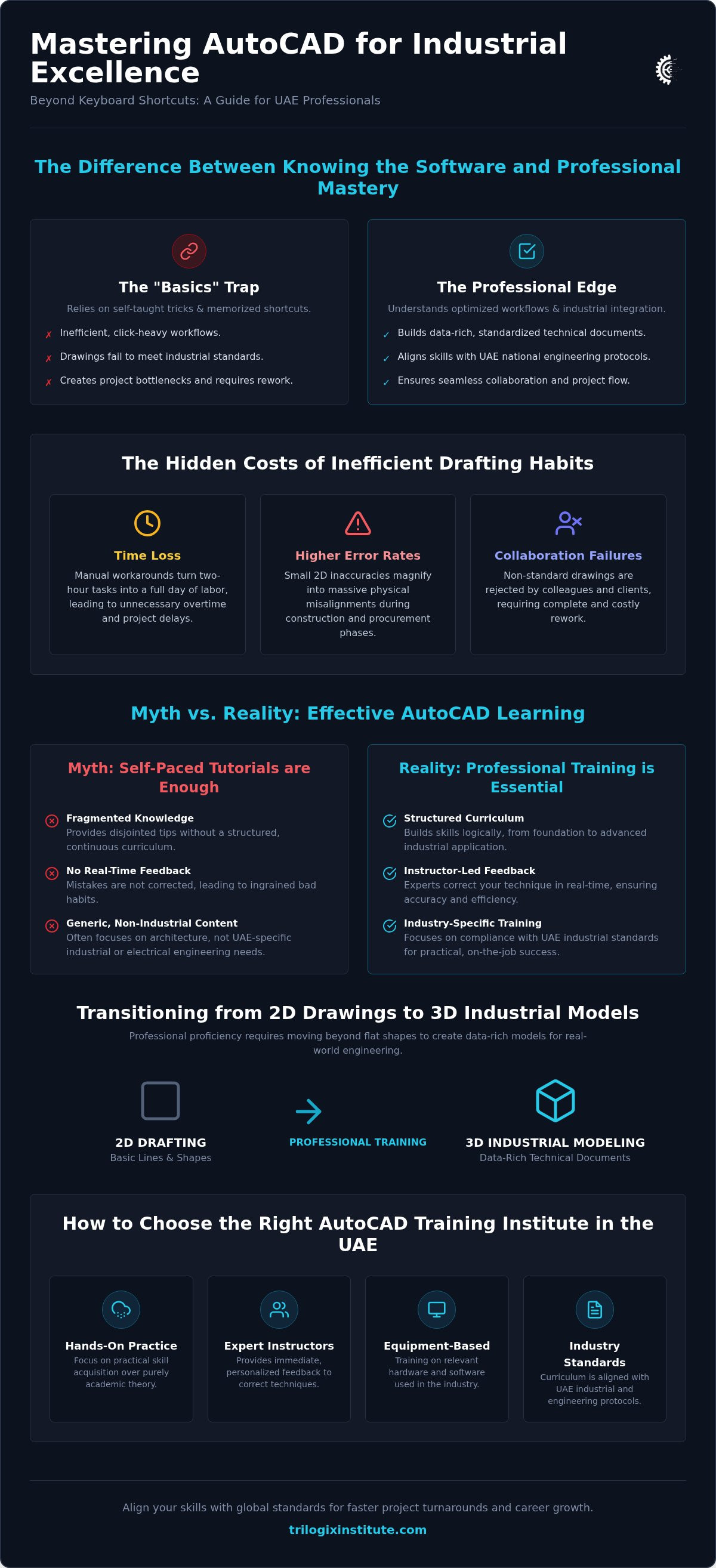
Many technicians mistake software familiarity for professional proficiency. Knowing how to use computer-aided design (CAD) software is only the first step in a much larger journey. True mastery isn't defined by your ability to draw a line or circle; it's defined by your ability to optimize workflows for high-stakes industrial environments. For those relying on self-taught methods, the transition to complex projects often reveals a "basics trap" where inefficient habits lead to project bottlenecks.
Professional drafting requires a shift in mindset. You aren't just creating a picture; you're building a data-rich technical document. Enrolling in specialized AutoCAD classes for professionals UAE allows you to "unlearn" the slow, click-heavy workarounds that accumulate during years of trial and error. These bad habits might work for small tasks, but they crumble under the weight of large-scale industrial requirements.
The High Cost of Inefficient Drafting Habits
Inefficiency carries a heavy price tag in the technical sector. When a drafter uses non-standard layering or fails to utilize dynamic blocks correctly, the entire project team suffers. Files become difficult to navigate, and the risk of corruption increases. These "shortcuts" often lead to file sizes that lag and crash during critical presentations. Consider these common hidden costs:
- Time Loss: Manual workarounds can turn a two-hour task into a full day of labor, leading to unnecessary overtime.
- Error Rates: Small inaccuracies in 2D drafting translate into massive physical misalignments during the procurement and construction phases.
- Collaboration Failures: Drawings that don't follow standardized protocols are often rejected by colleagues or clients, requiring complete rework.
Why National Standards Require Professional Training
The UAE industrial sector operates on strict engineering documentation standards. Precision isn't optional; it's a regulatory and safety requirement. Whether you're working on industrial automation or electrical design, your drawings must align with national protocols to ensure seamless integration. This is why many technicians choose to formalize their skills through our Advanced AutoCAD 2D & 3D program.
Professional training validates your technical credibility. It ensures that every line you draw serves a functional purpose within a broader industrial workflow. By mastering these standards through AutoCAD classes for professionals UAE, you move beyond the "basics" and position yourself as an essential asset in any engineering or technical department. Accuracy in the digital environment directly dictates success on the factory floor or the construction site.
Myth vs. Reality: Professional AutoCAD Training in the UAE
The internet is saturated with free tutorials, leading many to believe that formal education is an unnecessary expense. This is a risky assumption for those working in high-stakes environments. While a video can show you where a button is, it can't tell you why your specific project file is lagging or why your dimensions don't align with UAE industrial standards. Professional AutoCAD classes for professionals UAE bridge the gap between knowing the software and mastering the craft. Relying on fragmented information often results in knowledge gaps that only surface during a project crisis.
YouTube vs. Instructor-Led Training
Self-paced online modules often feel like trying to assemble a puzzle with missing pieces. You search for one specific command, watch a three-minute clip, and hope it applies to your current task. This approach lacks the continuity of a structured curriculum designed for the workplace. In contrast, instructor-led training provides immediate feedback. When you make a mistake in a complex 2D layout, an expert is there to correct your technique before it becomes a permanent bad habit. Our Advanced AutoCAD 2D & 3D course prioritizes this real-time interaction, ensuring your learning is both accurate and efficient.
Another common myth is that AutoCAD is purely a tool for architects and interior designers. In reality, the UAE's industrial sector relies heavily on these tools for electrical engineering and industrial automation. If you're designing motor control systems or complex piping networks, digital drafting is your primary language. It's the foundation for every physical installation in a modern plant.
The Professional Reality of 3D Modeling
Many technicians view 3D modeling as a luxury skill used only for client visualizations. This couldn't be further from the truth. In modern industrial engineering, 3D models are functional tools used for clash detection. They allow you to identify physical interference between electrical conduits and mechanical structures before a single piece of equipment is installed. This foresight saves companies massive amounts in rework costs and material waste.
Mastering both 2D and 3D drafting isn't just about adding a line to your resume. It's about becoming a practical expert who can navigate the entire lifecycle of a project. Technicians who possess these skills are often the first to be considered for lead roles in complex UAE infrastructure projects. They move beyond basic drafting into the role of a technical coordinator who ensures project success through digital precision.
Mastering Advanced AutoCAD 2D & 3D for Industrial Accuracy
Industrial drafting isn't about artistic flair; it's about technical reliability. In the UAE, where infrastructure projects move at breakneck speeds, precision is a non-negotiable requirement. Professionals must move beyond standard drawing to create data-rich models that reflect physical reality. This is where AutoCAD classes for professionals UAE provide the most value. They teach you to manage complex systems rather than just individual lines, ensuring your output survives the scrutiny of senior engineers and project auditors.
Mastery at this level means your drawings become the single source of truth for a project. Whether you're designing a factory floor or an electrical grid, the software should work for you, not against you. Professional training focuses on building this relationship between the technician and their tools, prioritizing workflows that eliminate repetitive manual tasks.
Precision in 2D Industrial Layouts
Managing a large-scale industrial site plan requires more than just a large monitor. It requires advanced organizational techniques. Using External References (Xrefs) allows multiple team members to work on separate sections of a plant simultaneously without creating version conflicts. Dynamic blocks enable you to swap out electrical components or motor specifications across hundreds of schematics in seconds. This level of automation ensures that your 2D accuracy remains high even as project deadlines tighten. Standardized layering protocols further ensure that your files remain readable across different engineering departments, preventing the "file corruption" issues common in self-taught workflows.
Transitioning to Professional 3D Modeling
The shift from 2D to 3D is a significant career milestone for any technician. It isn't just about adding a third axis. It's about creating a digital prototype that mirrors physical reality. For those specializing in industrial motor control, 3D drafting allows for precise spatial planning. You can see exactly how a control panel fits within a larger assembly before manufacturing begins. This reduces material waste and streamlines the installation process. Beyond technical benefits, 3D models serve as powerful communication tools. They allow you to present complex ideas to stakeholders who may not have a technical background, making project approvals much faster.
Speed often comes at the cost of accuracy for the untrained. However, for a professional, speed is a result of efficient systems. If you're ready to upgrade your technical capabilities, check out our Advanced AutoCAD 2D & 3D Course for a deep dive into these techniques. Mastering these tools ensures your work meets the rigid standards of the UAE industrial sector while significantly reducing your drafting time.
Integrating AutoCAD with Industrial Engineering Workflows
AutoCAD doesn't exist in a vacuum. For a technician in the UAE, it's the vital link between a theoretical electrical design and a functional industrial installation. Successful integration means your digital files must accurately reflect the physical hardware they represent. This is why AutoCAD classes for professionals UAE emphasize the relationship between drafting and real-world application. When your digital schematics align perfectly with your hardware requirements, project risks drop significantly.
Effective drafting acts as a universal language. It allows engineers, technicians, and project managers to stay aligned throughout the project lifecycle. Without this digital bridge, the gap between a conceptual design and a physical assembly becomes a breeding ground for expensive errors and delays.
Drafting for Electrical and Motor Control Systems
Precision in motor control circuit diagrams requires more than just drawing lines between components. It demands a deep understanding of industrial equipment. A professional drafter must account for wire gauges, terminal blocks, and spatial constraints within a control panel. Digital drafting acts as a safeguard. By simulating the layout in a digital environment, you prevent physical errors that lead to costly on-site modifications.
We believe that "equipment-based" understanding is the secret to high-quality drafting. If you don't understand how a motor starter or a PLC functions, your drawings will lack the technical depth required for industrial automation. This synergy ensures that every symbol on your screen represents a verified physical reality. It's the difference between a drawing that looks correct and one that is technically sound for construction.
The Technician as a Designer-Operator
The UAE industrial sector is increasingly looking for hybrid professionals. These are individuals who can both design a system in AutoCAD and troubleshoot it on the factory floor. This "Designer-Operator" role is highly valued because it closes the communication gap between the drafting office and the maintenance team. You aren't just a drafter; you're a technical coordinator who understands the entire workflow.
Possessing advanced CAD skills enhances your ability to perform maintenance and upgrades. When you can read, modify, and update your own technical drawings, you reduce system downtime. Use this checklist to integrate CAD into your daily engineering routine:
- Update as-built drawings immediately after any physical modifications.
- Use 3D models to plan cable tray routes before starting installation.
- Standardize electrical symbols to match international ISO or IEC standards.
To truly excel in this dual role, consider pairing your drafting expertise with hands-on electrical technician courses. Combining software mastery with physical hardware knowledge makes you an indispensable asset. If you're ready to bridge this gap, our Advanced AutoCAD 2D & 3D program provides the technical foundation you need to succeed in the UAE's industrial landscape.
Choosing the Right AutoCAD Training Institute in the UAE
Selecting the right training provider is a strategic decision that directly impacts your earning potential. In the UAE's technical market, price shouldn't be the primary metric for choosing AutoCAD classes for professionals UAE. High-quality vocational training pays for itself through increased efficiency and reduced errors on the job. You need a partner that understands the specific demands of your industry and bridges the gap between digital drafting and physical implementation.
Professional institutes focus on results, not just attendance. They view education as a functional tool for career advancement. When you evaluate potential providers, look for signs of a pragmatic, industry-centric approach. The goal is to acquire skills that are directly transferable to your current or future workplace, ensuring you can meet the rigid standards of the UAE industrial sector from day one.
What to Look for in a Vocational Training Provider
Start by evaluating the instructors. Are they career academics or industry practitioners who've managed real-world projects? A professional who's navigated the complexities of UAE industrial standards will offer insights that a textbook cannot provide. They understand the "why" behind the drafting protocols, helping you avoid common pitfalls in industrial automation and electrical design.
Prioritize institutes that offer equipment-based learning. While some centers focus on purely digital environments, the most effective training happens when you can see how your drafts translate into actual hardware configurations. You should also ensure the curriculum isn't just a generic module. Specialized programs like Advanced AutoCAD 2D & 3D are essential because they focus on the high-level techniques required for professional-grade drafting. If an institute only teaches basic commands, it isn't preparing you for the demands of a modern technical role.
Your Path to Professional Certification
Moving from a beginner to an advanced professional is a structured journey. It starts with mastering the fundamentals and progresses into the data-rich 3D modeling that prevents physical clashes in industrial installations. Certification acts as a formal validation of this expertise. In the competitive UAE job market, it serves as proof to employers that you've mastered the professional workflows required for project success.
Certification can be the catalyst for your next promotion or a successful transition into a more specialized engineering role. It demonstrates a commitment to global standards and technical excellence. Don't let your career plateau due to outdated or self-taught methods. If you're ready to fast-track your technical career with instructor-led, pragmatic training, Contact Trilogix Institute today for a consultation. We'll help you align your training with your specific professional goals and industrial requirements.
Future-Proof Your Technical Career in the UAE
Professional success in the UAE industrial sector depends on your ability to bridge the gap between digital design and physical reality. We've explored why basic software knowledge is often a liability in high-stakes projects and how specialized workflows define true mastery. By transitioning from simple 2D drafting to data-rich 3D modeling, you ensure your work meets rigid national standards while significantly reducing project turnaround times. It's about moving beyond the screen and into a leadership role on the factory floor or construction site.
Choosing the right AutoCAD classes for professionals UAE is the final step in this journey. You need a partner that offers instructor-led vocational excellence and a pragmatic, results-oriented curriculum tailored to industrial engineering. Don't settle for fragmented tutorials that leave you guessing during a project crisis. Instead, invest in training that provides immediate feedback and aligns with your specific career goals.
Master Advanced AutoCAD 2D & 3D with Trilogix Institute and gain the precision required to lead your next industrial project with confidence. Your path to becoming a practical expert starts today.
Frequently Asked Questions
Is an AutoCAD course worth it for an experienced professional?
Yes, formal AutoCAD classes for professionals UAE are essential for experienced technicians who want to eliminate slow, manual workarounds. While you might know the commands, professional training focuses on workflow integration and industrial protocols. This ensures your drawings meet the strict documentation standards required by UAE engineering firms. It's about moving from a software user to a technical coordinator who can manage complex project files without errors.
What is the difference between 2D and 3D AutoCAD training for engineers?
2D training focuses on creating precise technical schematics, floor plans, and electrical layouts. 3D training, such as our Advanced AutoCAD 2D & 3D course, teaches you to build digital prototypes for clash detection and spatial coordination. For engineers, 2D is the foundation for documentation, while 3D is a functional tool for preventing physical interference between mechanical and electrical systems during the installation phase.
How long does it take to master professional AutoCAD workflows?
Mastering professional workflows typically requires several weeks of intensive, instructor-led training followed by consistent project application. While basic command knowledge can be learned quickly, true proficiency involves mastering advanced features like dynamic blocks and Xrefs. A structured course provides the roadmap to reach this level efficiently. This approach prevents the years of trial and error often associated with self-taught methods in the industrial sector.
Do I need a high-end laptop to start an AutoCAD class in the UAE?
You don't need a high-end personal laptop to begin your training at an equipment-based institute. At Trilogix, we provide the necessary hardware and software for your learning sessions. However, for your professional drafting work, you'll eventually need a machine with a dedicated graphics card and sufficient RAM to handle complex 3D models. We recommend checking the latest Autodesk system requirements before making a significant hardware investment.
Can I learn AutoCAD online or is classroom training better for technicians?
Instructor-led classroom training is superior for technicians because it offers immediate error correction and hands-on context. Online courses often lack the real-time feedback necessary to master complex industrial drafting. In a physical classroom, you can see how digital designs relate to physical equipment. This immersive environment is particularly effective for those specializing in electrical engineering or industrial automation where precision is a safety requirement.
What are the career benefits of AutoCAD certification in the UAE industrial sector?
Certification serves as a formal validation of your technical skills in a competitive job market. It proves to employers that you've completed rigorous AutoCAD classes for professionals UAE and can produce drawings that comply with national standards. Beyond improving your resume, it demonstrates a commitment to technical accuracy. Certified professionals often find it easier to transition into senior drafting roles within large-scale industrial projects.
Does Trilogix Institute provide hands-on practice with real engineering equipment?
Yes, Trilogix Institute prioritizes equipment-based training to ensure practical skill acquisition. We believe that drafting shouldn't be taught in isolation from the hardware it represents. Our Advanced AutoCAD 2D & 3D curriculum is designed to help you understand how digital schematics translate into physical installations. This hands-on approach builds the confidence needed to handle real-world engineering challenges on the factory floor or construction site.
How does AutoCAD training help with industrial motor control design?
AutoCAD training is vital for motor control design because it allows you to map complex circuitry into a readable, standardized format. You'll learn to create precise panel layouts and wiring diagrams that account for spatial constraints. This digital planning prevents wiring errors and material waste during the assembly of motor control centers. It ensures that your designs are technically sound and ready for physical implementation by maintenance teams.


