

A university degree proves you can study, but it doesn't prove you can wire a control panel or troubleshoot a failing industrial motor under pressure. The UAE's industrial sector moves at a relentless pace, and the gap between academic theory and the reality of a high-voltage job site is often wider than graduates expect. You aren't alone if you feel unprepared to handle professional-grade equipment or if the transition from textbooks to transformers feels overwhelming.
Mastering specific practical electrical engineering skills is the only way to transform from a student into a high-demand professional. In 2026, industry standards require more than just knowing how to solve equations; you need the confidence to interface with complex machinery and the latest design software like ETAP 2026. This guide provides a clear checklist of the technical competencies you need to bridge the skill gap and thrive in a competitive industrial career. We'll explore the essential hands-on abilities, from industrial motor control to AI-driven CAD modeling, that define today's engineering excellence.
Key Takeaways
- Bridge the gap between academic theory and industrial reality by identifying the specific competencies UAE employers demand in the 2026 job market.
- Identify the five essential practical electrical engineering skills needed to confidently install, troubleshoot, and maintain complex physical systems.
- Learn why instructor-led lab environments are superior to online modules for mastering safety-critical tasks like motor control and high-voltage wiring.
- Gain a clear technical roadmap for progressing from foundational knowledge to specialized industrial certifications using professional-grade equipment.
Practical Electrical Engineering Skills vs. Theoretical Knowledge
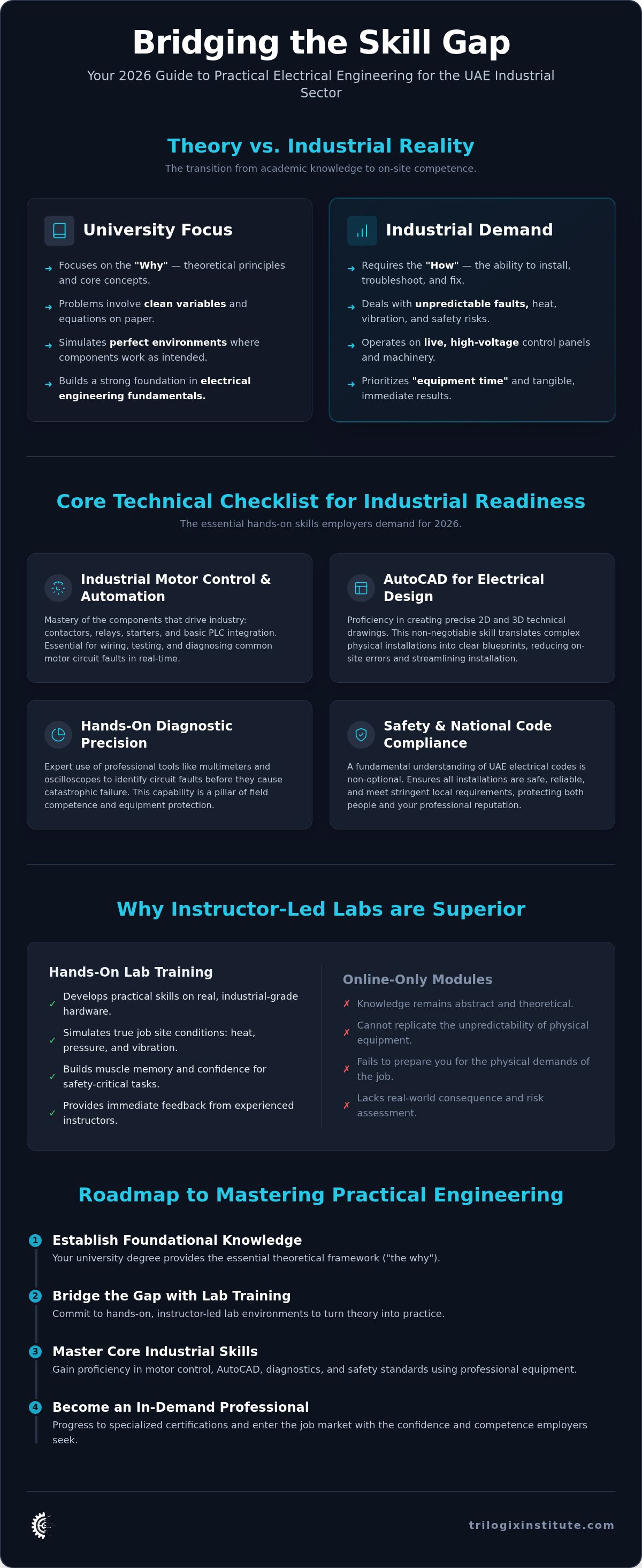
A university degree often focuses on the "why," but the industrial floor demands the "how." While understanding core electrical engineering concepts is vital, it doesn't automatically translate to field competence. In today's rapidly expanding industrial sector, the ability to install, troubleshoot, and maintain physical systems is what separates a technician from a true professional. Employers nationwide aren't just looking for someone who can calculate load; they need someone who can wire a distribution board without hesitation.
The economic value of hands-on proficiency has never been higher. As industries invest heavily in manufacturing and smart infrastructure, practical electrical engineering skills have become the primary currency for career advancement. Transitioning from a mindset of "how it works" to "how to fix it" requires a shift in focus. In a high-pressure industrial setting, machine downtime of even an hour can cost significant sums. Companies prioritize candidates who can step onto a job site and handle professional-grade equipment immediately.
The Limitations of Academic Theory
Textbooks are perfect environments where every component works as intended. They cannot simulate the unpredictability of faulty industrial wiring or the physical resistance of an oxidized contactor. Solving a circuit on paper involves clean variables; solving it on a live control panel involves heat, vibration, and safety risks. This is why technical interviews in 2026 prioritize "equipment time" over a high GPA. If you haven't held the tools or felt the weight of the components, your theoretical knowledge remains abstract and potentially dangerous in a live environment.
The 2026 Industrial Landscape
The current market demands a hybrid professional. You must bridge the gap between sophisticated automation and traditional electrical work. National infrastructure projects require technicians who understand both the digital logic and the physical power delivery. Practical engineering is the application of safety-standardized techniques to physical hardware. Developing practical electrical engineering skills ensures you aren't just a spectator of technology but an active operator. Whether it's managing power grids or maintaining factory assembly lines, the focus has shifted toward tangible results. Practicality isn't just a bonus; it's the baseline for employment in the modern economy.
The Core Technical Checklist for Industrial Readiness
Industrial readiness isn't about writing code in a vacuum. It's about ensuring high-voltage systems operate safely and efficiently. While many academic paths focus on software, the actual Electrical Engineer Skill Requirements for field work center on physical hardware and diagnostic precision. You must master the use of professional tools like multimeters and oscilloscopes to identify circuit faults before they lead to catastrophic equipment failure. This hands-on diagnostic capability is a pillar of practical electrical engineering skills.
Compliance with national safety standards is equally critical. In the UAE, industrial installations must adhere to specific electrical codes to ensure public safety and operational reliability. Understanding these regulations isn't optional. It's a fundamental part of your professional toolkit that protects both the equipment and your career reputation. Every wire you pull and every breaker you install must meet these stringent local requirements.
Industrial Motor Control and Automation
Motors are the workhorses of the industry. Mastery of motor control involves more than just knowing how a motor spins; it requires a deep understanding of contactors, relays, and starters. Wiring and testing these circuits in a controlled lab environment allows you to see how components interact in real-time. This experience is vital for moving from manual controls to basic PLC integration. Systematic diagnosis of common faults, such as coil failures or contact pitting, becomes second nature when you've practiced on real hardware. If you're ready to start, the TITP Beginner Essential Industrial Motor Control course provides the necessary equipment-based training.
AutoCAD for Electrical Design
Manual drafting is a relic of the past. In 2026, speed and precision in digital design are mandatory. Professional AutoCAD proficiency allows you to translate a complex physical installation into a precise 2D or 3D technical drawing. This isn't just about making drawings; it's about creating a blueprint that reduces onsite errors and streamlines the installation process. High-speed drafting and 3D modeling help you visualize cable routing and panel layouts before a single wire is cut. Gaining an TTI Dubai Advanced AutoCad 2D & 3D certification significantly improves your workflow, making you an asset to any engineering firm in the UAE. Developing these practical electrical engineering skills ensures you can communicate complex designs clearly to any technical team.
Why Hands-On Lab Training Beats Online Modules
Online videos might show you how a circuit works, but they can't simulate the arc flash risk of a 415V industrial panel. Developing practical electrical engineering skills requires a physical environment where safety is managed by experts. Home hobbyist kits and breadboards are excellent for low-voltage logic. However, they fail to prepare you for the scale of UAE's industrial infrastructure. Access to professional-grade equipment, such as industrial contactors and high-end oscilloscopes, is essential. These tools are often too expensive for individuals to purchase for home use. A dedicated lab provides the necessary exposure to the exact hardware used in Dubai’s manufacturing plants and utility stations.
The psychological benefit of physical repetition shouldn't be underestimated. Muscle memory is built when you repeatedly wire, test, and dismantle actual control circuits. In a high-pressure job site, you won't have time to re-watch a tutorial. You need to rely on the instincts developed through hands-on practice. Physical training ensures that your response to a system failure is automatic and safe, rather than hesitant and theoretical.
The Risk of Self-Taught Technical Skills
Relying on unverified online tutorials often leads to dangerous safety misconceptions. You might learn a "shortcut" that violates national safety standards, putting lives and expensive machinery at risk. In the UAE, professional career progression often requires proof of supervised practical hours. A controlled lab allows you to make mistakes, trip breakers, and blow fuses in a safe environment. It's better to learn from a wiring error in a training center than on a multi-million dirham client site. Real-world consequences for technical errors are severe; lab training mitigates this risk through controlled simulation.
The Instructor-Led Advantage
Mentors provide immediate, real-time troubleshooting that a pre-recorded video simply cannot offer. When a complex motor control circuit fails to start, an instructor guides you through the diagnostic process. They help you identify the "why" behind the failure, correcting inefficient habits before they become permanent. This interaction significantly accelerates the learning curve compared to self-paced videos. You aren't just a spectator; you're an operator. This immersion also offers networking opportunities with industry insiders who understand the local market's specific demands. Mastering practical electrical engineering skills under expert supervision ensures your habits align with both global and UAE industrial standards.
A Roadmap to Mastering Practical Engineering
Transitioning from a theory-heavy background to a career-ready status requires a structured progression. You can't jump straight into complex automation without a solid grounding in electrical physics and safety protocols. The first step involves mastering practical electrical engineering skills through foundational training. This includes understanding Ohm’s Law in a physical context and becoming proficient with basic safety tools. Once the foundation is stable, you should move toward specialized certifications. Focusing on high-demand areas like motor control provides a specific technical edge that generalists often lack.
The journey continues with design proficiency. Integrating AutoCAD into your repertoire allows you to visualize and document your work to professional standards. Finally, the roadmap leads to industrial automation. By progressing to PLCs and integrated systems, you position yourself at the top of the technical hierarchy. This sequence ensures you build confidence and competence at every level of the industrial pyramid. It's about building a stack of skills that makes you indispensable on any Dubai job site.
Starting with the Foundations
Every technician needs a personal toolkit they can trust. Mastery starts with owning and understanding your primary diagnostic gear. Beyond the hardware, you must develop the ability to read complex technical manuals and data sheets. These documents are the primary source of truth on any job site. Set realistic milestones for your first six months. Aim to master circuit wiring and basic fault-finding before attempting more complex installations. Learning to interpret a manufacturer's specifications for an industrial relay is just as important as knowing how to wire it. If you're starting from scratch, the TTI Dubai Foundation Electrical Engineering program is the ideal entry point.
Specializing for Career Growth
Choosing a specialization should align with national industrial trends. In the UAE, the growth of the manufacturing and energy sectors creates a massive demand for motor control experts. There is a powerful synergy between motor control skills and automation specialization. One manages the physical movement; the other manages the logic. Building a portfolio of practical projects and documented lab hours proves your readiness to potential employers. This tangible evidence of your practical electrical engineering skills carries more weight than a certificate alone. It shows you've spent the time necessary to handle real-world challenges with steady confidence. Professional growth in this field is a marathon, not a sprint. Consistently adding new hardware competencies to your resume ensures long-term job security in a fast-moving market.
Bridge the Gap with Trilogix Institute
Trilogix Institute stands as the essential bridge for graduates and professionals who find their theoretical knowledge insufficient for the UAE’s demanding job sites. Our programs aren't just lectures; they're immersive experiences designed to build practical electrical engineering skills through direct interaction with industrial hardware. The TTI Dubai Foundation Electrical Engineering program serves as the launchpad, establishing the core safety and technical competencies required in a professional setting. By moving beyond the abstract, we ensure our students possess the "doing" power that employers in Dubai and Abu Dhabi prioritize.
Our Industrial Motor Control lab is a cornerstone of this approach. Here, you don't just study circuit diagrams; you wire contactors and troubleshoot relays on the same equipment found in modern manufacturing plants. Similarly, our TTI Dubai Advanced AutoCad 2D & 3D courses focus on the practical application of design. You'll learn to create schematics that are ready for the field, not just the classroom. This instructor-led, vocational model is specifically tailored for 2026’s industrial requirements, where speed and precision are non-negotiable.
Equipment-Based Learning
Students at our national campuses gain experience with the exact hardware found on modern industrial sites. The Trilogix philosophy is simple: "Theory for context, equipment for mastery." We believe true competence only comes from physical repetition and expert correction. Our labs provide a safe yet realistic environment to test your limits and refine your technique. Trilogix provides the specific keys to meet global job market demands. This focus on tangible hardware ensures you're ready to handle high-voltage systems with steady confidence from day one. Key equipment you'll master includes:
- Professional-grade multimeters and oscilloscopes for precise diagnostics.
- Industrial contactors and relays for motor control mastery.
- High-performance workstations for advanced AutoCAD modeling.
Enrolling in Your Future
Choosing the right technical path depends on your specific career goals. Whether you're interested in the TITP Beginner Essential Industrial Motor Control course or an Industrial Automation Specialization, our team helps you align your training with market needs. You'll join a community of pragmatic, professional learners who view education as a functional tool for advancement. This network of peers and mentors provides ongoing support as you transition into high-demand roles. It's time to move beyond ambition and secure your place in the industry. Explore our Technical and Vocational Training Programs and start building your future today.
Advance Your Industrial Career Today
The 2026 industrial landscape in the UAE doesn't reward those who only understand the theory. It rewards professionals who can walk onto a site, read a complex schematic, and troubleshoot a motor control system with total precision. Mastering practical electrical engineering skills is the most direct path to bridging the gap between your current knowledge and a high-demand career. By prioritizing instructor-led, equipment-based training, you ensure your habits are safe and your technical competencies align with the latest global standards.
Trilogix Institute provides the specialized industrial automation labs and pragmatic, career-focused curriculum you need to succeed in this competitive market. Don't let your professional ambitions stall in a textbook. Take the next step toward mastery by gaining the hands-on experience that modern employers demand. Your transition from student to industry insider starts with the right tools and the right guidance. We're ready to help you turn your technical potential into industrial reality.
View our Practical Engineering Courses and Certifications
Your journey toward a resilient and rewarding engineering career begins with the first wire you connect. We look forward to seeing you in the lab.
Frequently Asked Questions
What are the most important practical skills for an electrical engineer?
Industrial motor control, professional-grade diagnostic testing, and advanced CAD drafting are the fundamental pillars of the modern electrical field. You must also master circuit troubleshooting and the meticulous application of national safety codes to physical hardware. These practical electrical engineering skills ensure you can maintain operational uptime in high-pressure industrial environments across the UAE. Developing these competencies allows you to transition from theoretical study to active, high-value industrial contributions immediately.
Can I learn practical electrical engineering skills online?
You cannot fully master high-voltage systems or physical hardware through a screen alone. While online modules effectively explain the theoretical "why," only instructor-led lab training provides the critical "how" through hands-on repetition. Physical labs allow you to correct dangerous habits under expert supervision and build the muscle memory that digital simulations simply cannot replicate. This real-world experience is what prepares you for the unpredictability of a live industrial job site in Dubai.
Do I need a university degree to work in industrial motor control?
Many entry-level roles in industrial motor control prioritize specialized vocational certifications over a traditional four-year university degree. Employers specifically look for documented lab hours and a proven ability to handle real-world contactors, relays, and starters. While a degree offers theoretical depth, pragmatic technical training provides a faster, more direct route to employment in the manufacturing sector. This approach focuses on the immediate technical skills required to keep industrial machinery running smoothly.
How long does it take to master AutoCAD for electrical design?
Most professionals achieve proficiency in 2D and 3D industrial schematics within three to six months of intensive, instructor-led training. Mastery depends on the frequency of application and the complexity of the projects you undertake in a lab setting. Structured courses accelerate this timeline by teaching industry-specific shortcuts and national standards. This ensures your drawings aren't just aesthetically correct but are also technically viable for physical installation on UAE job sites.
What is the difference between a technician and an electrical engineer?
Technicians typically focus on the hands-on installation, maintenance, and repair of physical electrical systems. Electrical engineers usually handle the broader design, project management, and complex system-wide integration. However, the most successful professionals in the UAE bridge this gap by possessing both high-level design knowledge and strong practical electrical engineering skills. This combination allows an engineer to design systems that are not just theoretically sound but also physically viable and easy to maintain.
Are vocational certifications recognized by national employers in 2026?
UAE employers increasingly value vocational certifications that prove immediate, documented job-readiness. In 2026, the rising demand for verified technical competencies has made specialized training a standard requirement for most industrial and manufacturing roles. These certifications serve as a professional guarantee that you can operate expensive, professional-grade equipment safely and efficiently from your first day on the job. They represent a commitment to both global standards and local safety regulations.
What equipment should I be familiar with before my first engineering job?
You should be thoroughly comfortable using digital multimeters, oscilloscopes, and insulation testers for precise diagnostic work. Familiarity with specific industrial components like Variable Frequency Drives (VFDs), contactors, and programmable logic controllers is also essential for modern roles. Knowing how to safely interface with distribution boards and high-voltage control panels will significantly set you apart during technical interviews. Mastery of these tools demonstrates your readiness to handle the physical demands of the industry.
How does industrial automation training help in career advancement?
Industrial automation training shifts your professional focus from simple manual systems to sophisticated, integrated logic and control. This specialized expertise allows you to manage smarter infrastructure and more efficient production lines, which are high-priority areas for the UAE's 2026 industrial strategy. Mastering these advanced systems often leads to senior supervisory roles and significantly higher salary brackets. It transforms you into a specialist capable of overseeing the future of national manufacturing and energy.


