

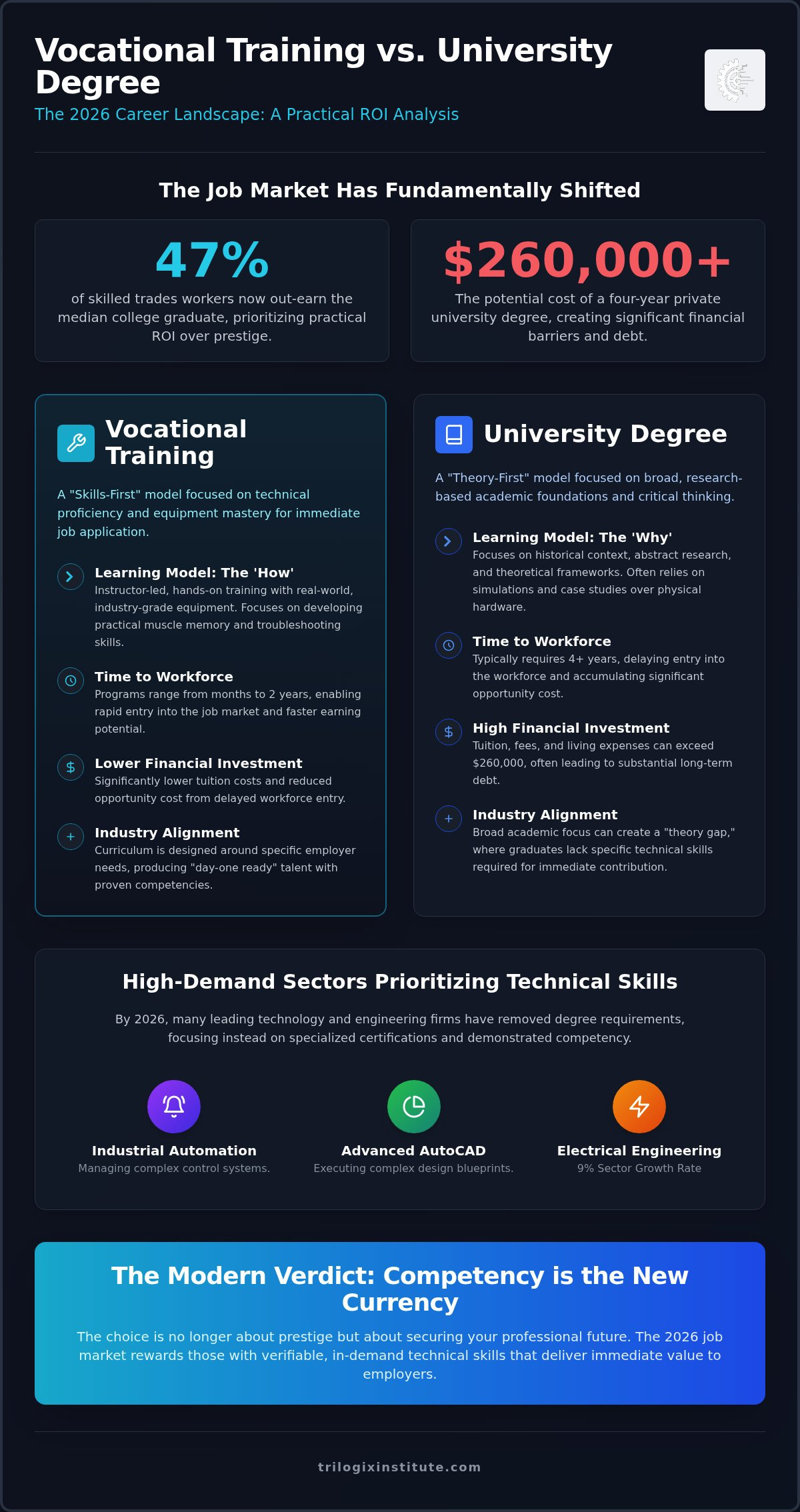
By 2026, the traditional assumption that a four-year degree is the only path to a high-paying career has been thoroughly dismantled. With 47% of skilled trades workers now out-earning the median college graduate, the choice between vocational training vs university degree is no longer about prestige; it's about practical ROI. In an era where a private university degree can exceed $260,000, the financial stakes of your education have never been higher.
You've likely felt the anxiety of watching tuition costs climb while wondering if four years of academic theory will actually translate into a paycheck. It's a valid concern. Many students fear wasting years in a classroom without gaining the hands-on experience required to operate specialized equipment or manage industrial systems. You want a career path that offers confidence through technical mastery, not just a certificate on the wall.
This article compares the practical benefits of equipment-based training against traditional academic theory to determine which route secures your professional future. We'll examine the latest salary projections, debt ratios, and the rising demand for "day-one ready" talent in a rapidly evolving job market. By the end, you'll have a clear framework for choosing a program that gets you into the workforce faster with the skills employers actually value.
Key Takeaways
- Understand the fundamental shift in the 2026 job market where industry-aligned technical mastery is prioritized over broad academic research.
- Learn why instructor-led training using real-world equipment offers more effective preparation for technical roles than purely theoretical or self-paced models.
- Evaluate the financial impact of vocational training vs university degree by analyzing tuition costs and the opportunity cost of delayed workforce entry.
- Identify high-growth sectors, such as Industrial Automation and Advanced AutoCAD, where specialized technical certifications are the primary requirement for employment.
- Use a pragmatic 5-point checklist to determine which educational path aligns with your specific career objectives and financial situation.
Vocational Training vs. University Degree: The 2026 Landscape
The educational market in 2026 has undergone a fundamental realignment. For decades, the university degree was viewed as the default requirement for professional success. Today, that hierarchy has flattened. The debate over vocational training vs university degree now centers on a simple question: does your education provide the specific competency required by the modern workplace?
University degrees remain focused on broad, research-based academic foundations. They prioritize critical thinking and theoretical frameworks that apply across various fields. Vocational training, by contrast, is an industry-aligned model that emphasizes technical proficiency and equipment mastery. It's a skills-first approach designed for immediate application. Employers no longer value "time in class" as a primary metric. Instead, they seek demonstrated competency.
Defining the Core Objectives of Each Path
University programs excel at providing a wide-lens view of a subject. Students engage with historical contexts, abstract research, and critical analysis. This "Theory-First" model prepares individuals for roles in academia, law, or high-level strategic management. However, this often comes at the cost of practical, hands-on experience. Many graduates find they lack the specific technical skills needed to enter technical industries immediately.
Vocational paths prioritize "Skills-First" logic. These programs focus on specific technical standards and the operation of industry-grade equipment. Whether it's mastering a complex industrial motor control system or perfecting advanced culinary techniques, the goal is total technical readiness. Vocational training is the bridge between ambition and employment.
The Global Shift Toward Skills-Based Hiring
Major engineering and technology firms have fundamentally changed their recruitment strategies. By 2026, many industry leaders have removed degree requirements for technical roles, focusing instead on demonstrated competency. They need specialists who can manage industrial automation or execute complex AutoCAD designs from their first day on the job. This change is driven by the reality that technology moves faster than traditional university curricula can adapt.
This shift has increased the value of specialized certifications. Employers now prioritize candidates who hold high-impact credentials that prove they can handle real-world hardware and software. High-growth sectors like electrical engineering, which is seeing a 9% growth rate, are leading this charge. The shortage of skilled labor drives wages higher for those with technical mastery. You can learn about our technical programs to see how these certifications align with current industry standards.
Theory vs. Practice: Comparing Learning Methodologies
The methodology of learning is where the divergence between vocational training vs university degree becomes most apparent. In 2026, the intense demand for "day-one ready" talent has exposed the limitations of purely theoretical education. While understanding the physics behind an electrical circuit is valuable, that knowledge alone doesn't help a technician troubleshoot a live industrial motor control panel under pressure. Employers now expect new hires to contribute immediately, as corporate training budgets continue to shrink across many technical sectors.
The University Classroom: A Focus on the 'Why'
Traditional academic degrees prioritize foundational principles and historical context. This approach builds a deep understanding of the reasoning behind a discipline. However, university engineering or culinary programs often rely on digital simulations or textbook case studies rather than physical hardware. This creates a "theory gap" when graduates enter industrial workplaces. They may understand the mathematics of a system but lack the tactile familiarity required to maintain or repair it in a high-stakes environment.
The Vocational Lab: A Focus on the 'How'
Vocational training shifts the focus to the "how" of a profession. It prioritizes technical mastery through repetitive, instructor-led interaction with real-world equipment. This is where the psychology of muscle memory comes into play. For an electrician or an automation specialist, the ability to perform complex tasks becomes instinctive only through physical practice in a controlled lab environment. Mastery isn't just about knowing; it's about doing.
Unlike self-paced online modules that offer a passive learning experience, instructor-led labs provide immediate feedback from a practical expert. This guidance ensures that students don't just follow a manual; they master the nuances of the equipment. For instance, you can see this in action Inside the Hands-On Motor Control Lab, where students interact with the same hardware they'll find on a modern factory floor.
Equipment-based learning drastically reduces on-the-job training time. When a new hire arrives already proficient in Advanced AutoCAD drafting or industrial motor control, the employer saves significant orientation resources. This immediate readiness makes vocational graduates highly attractive in a competitive market. If you're looking to secure your professional future, exploring a specialized certification in industrial automation can provide the practical edge that theory-heavy programs often miss.
Calculating ROI: Time, Cost, and Career Speed
In 2026, the financial viability of any educational path is measured by how quickly a student transitions from the classroom to a sustainable income. The choice between vocational training vs university degree often comes down to the "opportunity cost" of time spent outside the labor market. While academic institutions offer a broad experience, the pragmatic choice for many is a model that prioritizes career speed and minimized debt. Vocational graduates don't just save on tuition; they gain a multi-year head start on their lifetime earnings.
Time to Market: Breaking Down Program Durations
University programs typically require a four-year commitment. These cycles often include "fluff" courses or general education requirements that are irrelevant to a specific technical role. This delay can be costly in a fast-moving economy. In contrast, vocational timelines are significantly more efficient, usually ranging from six months to two years. Specialized programs like the TTI Dubai Foundation Electrical Engineering are designed for rapid entry into the workforce. This modular approach allows you to gain high-impact skills and enter the market years ahead of your university peers. You aren't just learning; you're accelerating your professional timeline.
Financial Investment and Long-Term Earnings
The disparity in tuition costs is stark. A four-year public university degree in 2026 is estimated to cost around $120,000, while private institutions can exceed $260,000. These figures don't include the interest on student loans, which for undergraduate direct loans is currently 6.52%. General trade school programs across the industry typically range between $15,000 and $33,000. This lower entry cost results in significantly less student debt. While the average bachelor's degree recipient carries over $30,000 in debt, trade school graduates often leave with only $10,000.
Recent 2026 data shows that the median annual wage for all bachelor's degree holders is approximately $78,000. However, trade school graduates now earn a highly competitive average of $75,000 annually. When you factor in the three additional years of earning potential gained by entering the workforce sooner, the total return on investment often favors the technical path. Vocational graduates can also "earn while they learn" by stacking modular certifications as they work. This allows for continuous career progression without requiring long breaks for full-time study. You can contact us for program fee details to see how our targeted certifications align with your financial goals.
Industry Alignment: Where Technical Skills Dominate
The 2026 job market has transitioned from broad credentials to specific technical mastery. In high-stakes industries, the choice of vocational training vs university degree is determined by the complexity of the equipment involved. Employers no longer have the luxury of multi-year onboarding. They require specialists who understand national industry standards and possess the technical fluency to operate sophisticated systems. This is particularly evident in fields where precision and safety are paramount.
Accreditation remains a critical differentiator. In professional engineering and technical trades, certifications that align with national standards, such as KHDA-style accreditation, provide a layer of trust. These credentials prove that a candidate has met rigorous, equipment-based benchmarks. Without this alignment, even a candidate with a university degree may find themselves sidelined in favor of a certified specialist who can demonstrate immediate workplace readiness. This shift toward skills-based hiring is why technical fields are seeing such robust growth; electrician roles are projected to increase by 9% through 2034.
Engineering and Industrial Automation
Mastery of motor control and Programmable Logic Controller (PLC) systems is now a more reliable predictor of success than a general engineering degree. Industrial firms prioritize specialists who can troubleshoot a system in real-time. This is why the Industrial Automation Specialization is so highly valued. Similarly, modern drafting careers require more than theoretical design knowledge. Proficiency in advanced AutoCad 2D and 3D programs is essential for creating the precise technical documentation used in national manufacturing. For a deeper look at these requirements, see our Electrical Engineering Courses: A 2026 Career Readiness Guide.
The Professional Culinary World
The hospitality sector values performance over philosophy. Kitchen experience and equipment-based training trump culinary theory because they simulate the high-pressure environment of a commercial kitchen. A professional culinary arts certification provides the technical foundation needed for international hospitality roles. It ensures that graduates are familiar with industry-grade equipment and global food safety standards from day one. You can read more in our Professional Culinary Arts Training: The 2026 Buying Guide. To secure your future in these high-demand fields, explore our industry-aligned technical programs today.
Making the Choice: Which Path Secures Your Future?
The final decision between vocational training vs university degree isn't just about the credential. It's about your alignment with the 2026 job market. If your priority is immediate workforce entry and technical mastery, the vocational path offers a clearer return on investment. For those already in the workforce looking to pivot, short-term, high-impact certifications provide a pragmatic bridge to new opportunities without the burden of long-term academic debt. You can always combine vocational mastery with future academic pursuits if your career goals shift toward research or upper-level management later. Technical proficiency serves as a powerful foundation for any advanced specialization.
To determine your ideal educational model, use this 5-point checklist:
- ROI Timeline: Do you need to start earning a professional salary within 12 to 24 months?
- Debt Tolerance: Is avoiding a six-figure tuition bill a primary financial priority?
- Practical Mastery: Does your target career require operating specific industrial hardware or software?
- Learning Environment: Do you thrive under direct, instructor-led supervision rather than independent research?
- Market Alignment: Are there active labor shortages and high wage growth in your chosen technical field?
Assessing Your Personal Learning Style
Abstract thinkers might thrive in university settings where the focus is on the "why" of a discipline. However, hands-on problem solvers often find that traditional classrooms lack the practical equipment experience needed for technical fields. If you prefer physical problem-solving over theoretical research, you'll benefit from training in an environment that mimics your future workplace. Instructor-led guidance is essential for mastering complex systems. It ensures you receive immediate feedback as you interact with real-world circuits, motors, or drafting software.
The Trilogix Advantage: Practical Expert Guidance
Trilogix Institute operates as your partner in career success. Our focus on Industrial Motor Control and Electrical Engineering ensures that students gain the specific keys to meet national job market demands. We don't just teach theory; we provide the practical tools required for employment. By training at our specialized technical campuses, you bridge the gap between ambition and professional readiness. Our programs are designed for efficiency and impact, reflecting the fast-moving industries we represent. You can explore our full range of hands-on courses to find the path that aligns with your professional vision.
Securing Your Technical Career Path
Choosing between vocational training vs university degree is a calculation of long-term value and immediate readiness. By prioritizing technical mastery, you minimize academic debt and enter the workforce with the confidence that only hands-on equipment experience provides. Modern employers in 2026 no longer have the luxury of multi-year onboarding; they hire specialists who are prepared to contribute from day one.
Trilogix Institute acts as your partner in bridging the gap between ambition and employment. Our instructor-led equipment labs and expert faculty ensure you don't just study theory; you master the hardware and software used in global industries. With industry-recognized certifications, you establish immediate credibility in high-growth sectors like industrial automation and electrical engineering.
Take the next step in your professional development with a guide focused on your practical success. Explore our industry-aligned vocational programs to find the certification that secures your future. Your career journey is a vital investment, and we're here to ensure it yields the results you deserve.
Frequently Asked Questions
Is vocational training considered equivalent to a university degree by employers?
Employers view these paths as different but complementary tools for professional success. University degrees prove theoretical depth, while vocational training proves technical competency. In 2026, many technical sectors prioritize "day-one ready" talent over broad credentials. For roles requiring specific equipment mastery, a vocational certificate is often the preferred qualification because it demonstrates immediate workplace readiness and the ability to operate complex industrial systems.
Can I transition from a vocational certificate to a university degree later?
Technical mastery often serves as a strong foundation for future academic study. Many universities offer credit transfers for industry-recognized certifications, allowing students to stack their credentials over time. This path allows you to enter the workforce early and pursue a degree later if your career goals shift toward research or high-level administration. It's a pragmatic way to balance immediate income with long-term academic ambition.
Which path offers a higher starting salary in technical engineering fields?
The earnings gap has narrowed significantly by 2026. Trade school graduates earn an average of $75,000 annually, while the median for bachelor's degree holders is around $78,000. However, the choice of vocational training vs university degree often yields a higher lifetime ROI in the first decade. This is due to the three-year head start in the workforce and the significantly lower debt burden associated with technical programs.
How long does it typically take to complete a vocational certification vs. a degree?
Time efficiency is a primary advantage of the vocational model. Most technical certifications require six months to two years to complete, whereas a university degree typically demands a four-year commitment. Programs like the TTI Dubai Foundation Electrical Engineering are designed for rapid entry. This allows students to avoid the fluff courses found in traditional academic cycles and focus entirely on the industry-specific mastery required for their target roles.
Are Trilogix Institute courses accredited and recognized in the UAE and Philippines?
Trilogix Institute programs are designed to meet rigorous national standards across both regions. Our courses align with industry-specific requirements and professional benchmarks. In the UAE, for example, our curriculum is developed to support professional engineering prospects through recognized technical standards. This alignment ensures that your technical mastery is documented and respected by major industrial and hospitality firms across the nation, providing a clear path to employment.
What happens if I prefer hands-on learning but want a management role?
Technical roots are increasingly valuable in management. Modern industrial leaders often start with equipment-based mastery before moving into supervisory positions. Understanding the mechanics of a process allows you to lead teams more effectively than someone with only theoretical knowledge. You can combine a vocational foundation with a management certification later to bridge the gap between technical execution and high-level strategy as your career progresses.
Do vocational schools provide the same networking opportunities as universities?
Vocational schools offer highly targeted networking opportunities. While universities provide a broad social circle, technical institutes connect you directly with industry insiders and equipment manufacturers. At Trilogix Institute, you interact with instructors who are active professionals in their fields. These connections are often more valuable for securing technical roles because they are based on demonstrated competency and specific industry needs rather than general academic affiliation.
Is equipment-based training better than online technical courses?
Instructor-led, equipment-based training is superior for technical skill acquisition. Purely online, self-paced courses lack the tactile feedback required to master industrial hardware. In the choice between vocational training vs university degree, muscle memory is only built through physical interaction with real-world equipment. Our specialized labs ensure you gain the practical edge that digital simulations and textbook theories simply cannot replicate, making you more attractive to employers.


