

You can't learn how to troubleshoot a live PLC system by watching a pre-recorded video, no matter how many times you hit replay. Real mastery in the field isn't found in a textbook; it's forged in the gap between theory and a physical terminal block. Most engineering graduates enter the workforce with a degree in their hand but a knot in their stomach when they face actual industrial hardware for the first time. It's a valid concern. With new international manufacturing standards published in April 2026 and NCEES exams shifting toward complex scenario-based questions, the stakes for technical precision have never been higher.
We understand that struggling with self-paced modules often leads to more frustration than skill. This guide demonstrates why high-impact, instructor-led engineering training is the fastest path to mastering technical skills in today's competitive market. You'll discover how direct mentorship replaces guesswork with confidence, allowing you to handle expensive industrial equipment without hesitation. We will preview the specific advantages of equipment-based learning, from immediate employability in technical roles to gaining the industry-recognized certifications that prove you're ready for site work on day one.
Key Takeaways
- Understand why modern employers prioritize practical "day-one readiness" and how to transition from academic theory to professional site performance.
- Discover why instructor-led engineering training is the most efficient way to master industrial motor controls and PLC systems through real-time expert feedback.
- Learn how to evaluate a training provider based on their hardware-to-student ratio to ensure you get sufficient hands-on time with physical equipment.
- Identify the specific troubleshooting skills that self-paced online modules often omit, but are vital for preventing expensive industrial equipment failures.
- Explore how specialized programs in Advanced AutoCAD and industrial automation bridge the skill gap to secure your position in a competitive technical job market.
The Theory-Practice Gap in Modern Engineering Education
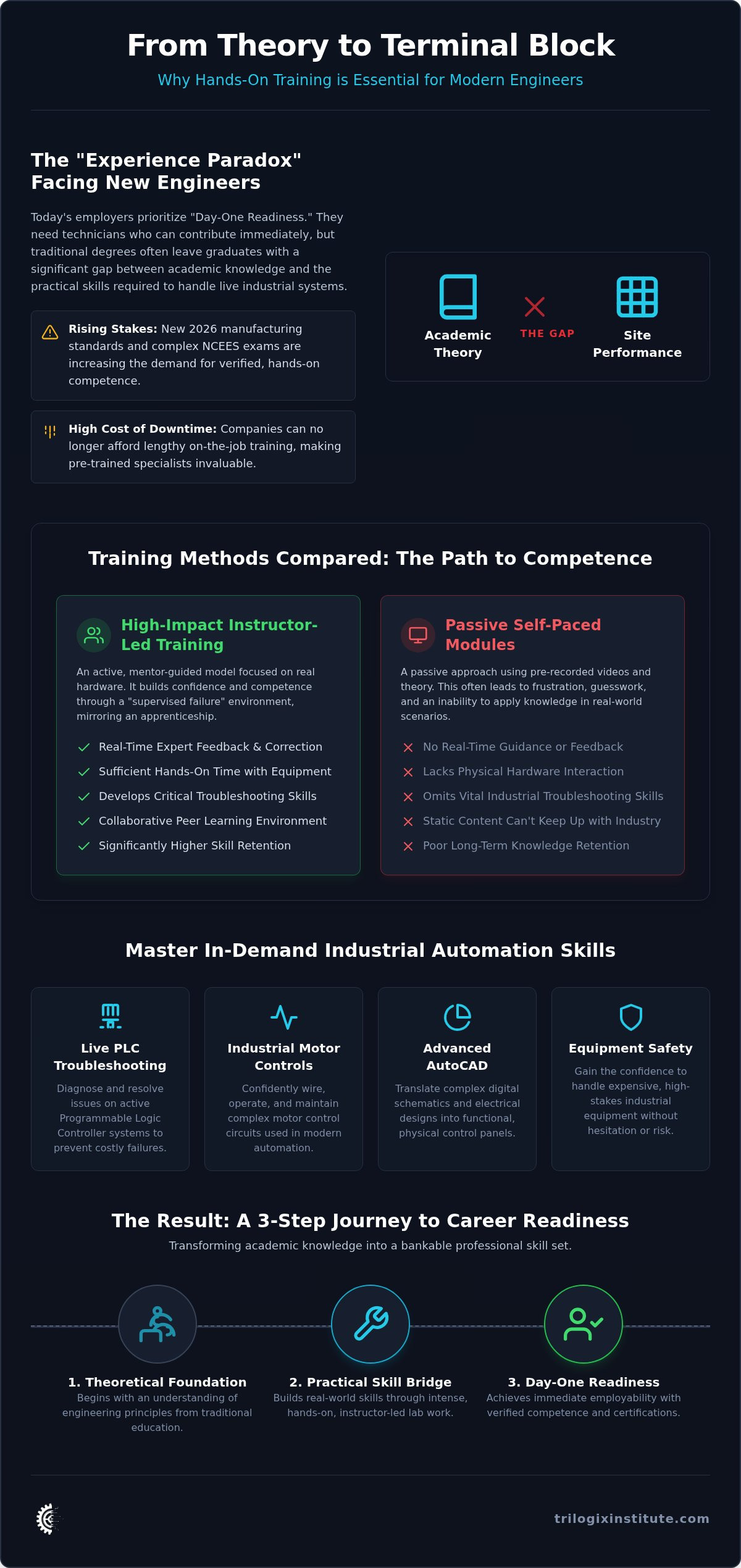
Engineering excellence requires more than a high GPA. It demands a functional understanding of how systems behave under load. We define instructor-led engineering training as a mentor-guided, equipment-focused learning model designed to bridge the distance between a schematic and a functioning circuit. In 2026, the global industrial sector has shifted its focus. Employers now prioritize "day-one readiness" because the cost of downtime is too high to support lengthy on-the-job training periods for new hires. They need technicians who can step onto a site and immediately contribute to the workflow.
This creates what many call the Experience Paradox. Entry-level roles often demand two years of hands-on experience that a traditional degree simply doesn't provide. Vocational education serves as a high-speed bridge here. It allows ambitious professionals to gain that required "field time" in a controlled, expert-led environment. By simulating the pressures and hardware of a real industrial site, this training model turns theoretical knowledge into a bankable professional skill set.
Why Theory Alone Fails the Modern Technician
Textbooks are static. Industrial environments are not. Relying solely on theory in high-stakes settings, like a power plant or an automated factory, is a safety risk. Rapid technological shifts, including the new manufacturing standards published in April 2026, often outpace university curricula by several years. There is also a distinct psychological benefit to "learning by doing." Physical interaction with hardware creates neural pathways that reading alone cannot replicate. This leads to significantly higher long-term retention and the ability to think critically when a system fails.
The Rise of Specialized Vocational Training
The hiring landscape is changing. Specialized certifications are frequently replacing general degrees in technical screening processes. Hiring managers look for verified competency in specific systems, such as PLC logic or industrial motor control. This shift toward competency-based assessment is particularly evident in the UAE, where industry standards now align with global best practices. At Trilogix Institute, we focus on this pragmatic alignment. We ensure that our students don't just know the "why" of engineering; they possess the "how" required for immediate technical employment. Our instructor-led engineering training programs are built to ensure that when you walk into an interview, you're carrying more than just a certificate. You're carrying the confidence of someone who has already mastered the machines.
Defining High-Impact Instructor-Led Engineering Training
High-impact training creates a "supervised failure" environment. It isn't enough to read about a circuit; you must build it, fail at it, and fix it under expert guidance. Instructor-led engineering training provides this critical feedback loop. When an expert catches a wiring error in real-time, they save the student weeks of unproductive self-study. This immediate correction prevents bad habits from taking root early in a career. It mirrors the rigorous structure of a Registered Apprenticeship Program, where mentorship serves as the primary engine for skill acquisition.
Transitioning from an AutoCAD design to a physical motor control panel is a significant cognitive leap. This is where the master-apprentice model, modernized for 2026 industrial standards, proves its worth. Professionals also benefit from peer learning. In a physical classroom, you aren't just learning from the instructor. You're networking with other technicians and engineers who face similar technical challenges on their own sites. This shared environment fosters a level of collaborative problem-solving that digital platforms cannot replicate.
The Role of the Modern Engineering Instructor
In a high-impact setting, the instructor moves from a "lecturer" role to a facilitator of practical challenges. They don't just deliver data; they design scenarios that test your problem-solving limits. This requires instructors with current, real-world field experience who can share the nuances of the industry. They can also customize the pace of the lab. If a student masters a PLC sequence quickly, the instructor can introduce a complex fault to keep the learning curve steep. This ensures that every hour spent in instructor-led engineering training translates directly into professional competence.
Equipment-Based Labs vs. Computer Simulations
Computer simulations have their place. However, they cannot replicate the tactile feedback of physical hardware. A simulation won't show you how a loose connection vibrates. It won't show how a motor smells when it's overloaded. Physical labs allow for genuine troubleshooting. You learn the weight of the tools and the tension of the wires. Safety training is far more effective when taught in a supervised, physical environment. You learn to respect the equipment because the risks are real. If you're ready to move beyond the screen, explore our hands-on engineering courses to see how we bridge the gap between design and deployment.
Instructor-Led vs. Self-Paced: Why Real Equipment Changes Everything
Convenience doesn't always equal competence. While self-paced online modules are popular, they often fail the technician when the pressure of a live site is applied. Completion rates for massive open online courses (MOOCs) are notoriously low. Most students lose momentum without the external drive of a classroom. Instructor-led engineering training solves this through a structured, accountable schedule. You aren't just watching a screen; you're meeting professional milestones alongside peers. This environment ensures you stay focused until you achieve your certification.
Online videos omit the mess. They show systems working perfectly under ideal conditions. Professional instructors do the opposite. They simulate real-world faults, intentionally breaking components to test your diagnostic skills. This "troubleshooting factor" is vital for safety. Self-teaching high-voltage systems or complex automation logic is a high-risk gamble. Without expert oversight, a simple wiring mistake can cause catastrophic hardware failure. Real equipment doesn't have an undo button. Expert supervision is the only way to learn high-stakes industrial work safely.
The Hidden Costs of 'Free' Online Learning
Free content often carries a high price in lost time. You waste hours navigating outdated tutorials or unverified information that doesn't meet 2026 standards. There is also the professional risk of "unlearning." Habits formed without oversight are hard to break and can alienate future employers during technical assessments. When deciding between Vocational Training vs. University Degree options, consider which path offers a curated, industry-aligned curriculum. Expert guidance ensures you learn the right way the first time.
Tactile Learning and Muscle Memory
Engineering is a physical discipline. You cannot develop the muscle memory required for industrial motor control through a mouse click. Tactile interaction with physical hardware is non-negotiable. Your hands must learn the tension of a terminal block and the specific feel of a relay clicking into place. This physical proficiency is the focus of our Industrial Automation Specialization. By training on the actual hardware found in modern manufacturing plants, you gain the instinctive speed needed for rapid fault-finding on the job.
How to Audit an Engineering Training Program for Career Readiness
Selecting the right educational partner is a strategic career decision. You shouldn't settle for a facility that prioritizes lectures over labs. A critical metric to verify is the "Hardware-to-Student" ratio. In a high-quality environment, every learner needs direct, unhurried access to the tools. If a program requires four students to share a single motor control panel, your practical development will suffer. High-impact instructor-led engineering training relies on the "touch time" you get with industrial components. It's the difference between watching a process and mastering it.
Next, evaluate the curriculum for "Pragmatic Alignment." Review current job descriptions for technical roles in 2026. Does the syllabus cover those specific competencies? You also need to verify instructor credentials. An expert who hasn't worked on a live site in recent years may not be aware of the latest safety protocols or hardware nuances. Look for programs that offer modular certifications. These allow you to apply specific skills in the workplace immediately rather than waiting for a multi-year cycle to finish. This modular approach ensures your resume stays updated as the industry evolves.
Questions to Ask During an Institute Tour
Don't be afraid to ask direct questions. Inquire exactly how many hours per week you'll spend in the lab compared to the lecture hall. Ask if the institute uses the latest industry software, such as AutoCAD 2026. A tour is also the perfect time to observe the equipment's condition. Is it the same hardware you'll encounter on a professional site? You can view our specialized training environments by visiting the Trilogix Gallery to see how we prioritize hardware access for every student.
Evaluating Industry-Specific Certifications
Not all certificates carry the same weight. A general certificate in "Engineering" is often too broad to impress a technical hiring manager. Instead, look for targeted programs like Foundation Electrical Engineering. These credentials signal that you've mastered a specific, functional domain. Ensure the program aligns with both national and international technical standards to maintain your global mobility. For a deeper look at specific local opportunities, read our guide on Electrical Engineering Courses in Dubai. If you're ready to see the difference that professional oversight makes, audit our training programs to find your next career milestone.
Accelerating Your Technical Career with Trilogix Institute
At Trilogix Institute, we don't just teach; we prepare. Our philosophy is built on the reality that engineering is a high-stakes, hands-on discipline. We avoid the fluff of purely academic programs to focus on the pragmatic skills required by 2026 industrial standards. Our instructor-led engineering training is designed specifically for adult learners and working professionals who need to bridge their skill gaps without wasting time. We provide a serious, results-oriented environment where the goal is clear: technical mastery that translates to immediate workplace performance. By combining expert mentorship with industry-centric labs, we ensure that every hour of instruction serves your career progression.
Choosing the right training is the ultimate investment for an engineer in 2026. The technical landscape moves too fast for outdated manuals or unguided video tutorials. You need the "Trilogix advantage," which centers on real-world hardware and current field protocols. Our instructors act as partners in your journey, offering the authoritative guidance needed to navigate complex systems. We bridge the gap between ambition and employment by providing the specific keys to meet global market demands. Whether you're a beginner or a seasoned professional, our modular approach allows you to build a portfolio of verified competencies.
Our Specialized Engineering Tracks
We offer targeted programs designed to meet the most critical needs of the modern industrial sector. These tracks focus on high-demand skills that are often underserved by traditional education providers. Our current offerings include:
- TTI Dubai Foundation Electrical Engineering: This program serves as the essential building block for technical roles, providing the groundwork for all future electrical specialization.
- Industrial Automation Specialization: Master the future of manufacturing by learning to program and troubleshoot complex PLC systems and automated workflows.
- TITP Beginner Essential Industrial Motor Control: Gain confidence in operating and maintaining the physical components that power modern industry.
- TTI Dubai Advanced AutoCAD 2D & 3D: Move beyond basic drafting to create precision industrial projects using the latest 2026 software standards.
Ready to Master the Field?
The path from beginner to certified technician is structured and methodical. Enrollment in our upcoming instructor-led cohorts is the first step toward securing your professional future. We provide a clear-eyed, no-nonsense route to success that respects your time and your career goals. You'll leave our labs not just with a certificate, but with the practical experience required to handle expensive industrial equipment safely and efficiently. Don't let your skills stagnate in a rapidly evolving market. View our full course catalog and start your journey toward technical excellence today.
Securing Your Future in the 2026 Engineering Market
The industrial landscape in 2026 leaves no room for technical hesitation. As global standards evolve, the distance between academic theory and site-ready performance continues to widen. We've explored how high-impact instructor-led engineering training provides the critical physical feedback loop necessary to bridge this gap. By prioritizing equipment-based labs over purely digital simulations, you build the muscle memory and troubleshooting instincts that modern employers demand.
Mastery is a deliberate choice. It requires the guidance of expert instructors with current field experience and access to real-world industrial hardware. Our modular courses are specifically designed for rapid career advancement, ensuring your skills remain aligned with pragmatic market needs. If you're ready to move beyond the textbook and establish yourself as a practical expert, the next step is clear.
Enroll in Our Instructor-Led Engineering Programs Today to take command of your technical career. Your journey from ambition to employment starts here.
Frequently Asked Questions
Why is instructor-led engineering training better than online courses?
Instructor-led engineering training provides immediate feedback that online videos cannot match. It allows for supervised failure where an expert catches wiring errors before they become bad habits. You interact with physical terminal blocks and live circuits instead of just clicking a mouse. This hands-on environment builds the specific muscle memory required for industrial site work. It also provides the accountability of a structured schedule to ensure you reach certification.
How long does it take to complete a vocational engineering course at Trilogix?
Duration depends on your chosen track. The TTI Dubai Foundation Electrical Engineering program spans three months with 36 total training hours. For those focusing on motor control, the TITP Beginner Essential Industrial Motor Control program is an intensive five-day course totaling 40 training hours. Each module is designed to provide maximum technical depth in a time-efficient format. This allows professionals to upgrade their skills without long-term academic commitments.
Do I need a university degree to enroll in your engineering programs?
You don't need a university degree to join our programs. We've designed our curriculum to bridge the gap between ambition and employment for everyone from absolute beginners to working technicians. Our focus is on practical competency and industry-specific certifications rather than academic theory. Whether you're starting a new career or looking to specialize in PLC logic, our courses provide the functional tools needed for immediate technical roles.
What kind of equipment will I use during the instructor-led sessions?
Students work with the same hardware found on modern industrial sites. This includes specialized labs for industrial motor control, PLC systems, and physical wiring panels. For drafting tracks, you'll use the latest AutoCAD 2D and 3D software to create precision industrial designs. We prioritize a high hardware-to-student ratio. This ensures you spend more time touching the equipment than watching a lecture. This tactile experience is vital for safety.
Are the certifications provided by Trilogix Institute recognized by employers?
Employers value our certifications because they represent verified, hands-on competency. Our programs focus on industry-specific standards and global best practices rather than general theory. Having a certificate in Foundation Electrical Engineering or Industrial Automation Specialization signals to hiring managers that you possess day-one readiness. We focus on building the practical expert persona that the global job market demands in 2026 by aligning with professional standards.
Can I take these courses while working a full-time job?
We offer flexible scheduling to accommodate working professionals. The Trilogix Seminar 2026 includes weekly Saturday sessions specifically for those with full-time weekday commitments. Our modular course structure also allows you to complete certifications in focused blocks. This pragmatic approach ensures you can advance your technical career without sacrificing your current income. It is a serious, results-oriented path designed to respect the time of ambitious individuals in the field.
What is the difference between vocational training and a traditional engineering degree?
Traditional degrees prioritize academic theory and broad conceptual knowledge. Vocational training focuses on specific, functional skills and equipment-based mastery. While a degree might explain the physics of electricity, our instructor-led engineering training teaches you how to wire a motor control panel safely. We emphasize pragmatic alignment with current job descriptions. This ensures our graduates are immediately employable in technical roles that require hands-on hardware proficiency and troubleshooting speed.
How do I choose between electrical engineering and industrial automation tracks?
Your choice depends on your career goals. If you're looking for a broad building block for technical roles, the TTI Dubai Foundation Electrical Engineering track is the ideal starting point. If you want to master the future of manufacturing and logic-based systems, choose the Industrial Automation Specialization. Both tracks provide the expert mentorship and equipment access needed to excel. Our advisors can help you align your training with specific professional market demands.


