
You can't learn to troubleshoot a high-voltage industrial motor by clicking a mouse on a digital simulator. While software has its place, relying solely on virtual environments creates a dangerous gap between academic knowledge and site-ready competence. For those entering the UAE engineering sector in 2026, equipment-based technical training is the only way to bridge this divide. It's the difference between knowing the theory of a circuit and having the steady confidence to wire one under professional pressure.
We understand the anxiety of investing thousands in a program only to feel useless when standing in front of real machinery. You're right to be skeptical of programs that prioritize lectures over labs. This guide proves why hands-on interaction with physical hardware is non-negotiable for career readiness. We'll examine the shifting OSHA standards for 2026, the specific benefits of instructor-led hardware sessions, and how to choose a path that leads to recognized certification rather than just a digital badge. You'll gain a clear roadmap to becoming a practical expert who is ready for the rigorous demands of a modern industrial workplace.
Key Takeaways
- Understand the fundamental shift toward equipment-based technical training as the primary standard for bridging the gap between theoretical knowledge and site-ready performance.
- Discover how haptic feedback and tactile interaction build the muscle memory required to handle high-pressure industrial emergencies with precision.
- Evaluate the limitations of digital simulations and why physical hardware remains a non-negotiable requirement for true technical mastery in 2026.
- Learn how to vet training institutes by prioritizing a 3:1 student-to-equipment ratio and instructor-led labs that mirror real-world industrial environments.
- Identify the specific hardware standards and laboratory requirements needed to transition effectively into the UAE engineering sector as a recognized professional.
Defining Equipment-Based Technical Training and Its Critical Role
Equipment-based technical training isn't a passive experience. It is the structured, instructor-led process of learning through direct interaction with physical industrial hardware. While traditional academic routes often prioritize abstract formulas, this pragmatic approach focuses on the immediate application of skills. This specialized form of Vocational education bridges the gap between understanding a concept and executing a task. It replaces the "what" with the "how," ensuring that a technician's knowledge is functional rather than just theoretical.
The 2026 job market has undergone a significant shift. Employers in the UAE engineering sector now prioritize verified competency over the prestige of a traditional degree. They need professionals who can troubleshoot a PLC rack or wire a motor control center without constant supervision. This shift makes equipment-based technical training the most direct path to employment. It transforms the student from a passive learner into a capable operator who understands the weight, resistance, and behavior of real-world machinery.
Industry-standard labs are the classrooms of the future. These spaces don't rely on rows of desks and whiteboards. Instead, they feature specialized workstations that replicate the exact environments found in modern manufacturing and energy sectors. By training in these labs, students gain familiarity with the tools and hardware they'll encounter on their first day of work. It is a controlled environment designed to build confidence through repeated, successful interaction with industrial systems.
The Core Components of an Equipment-Based Curriculum
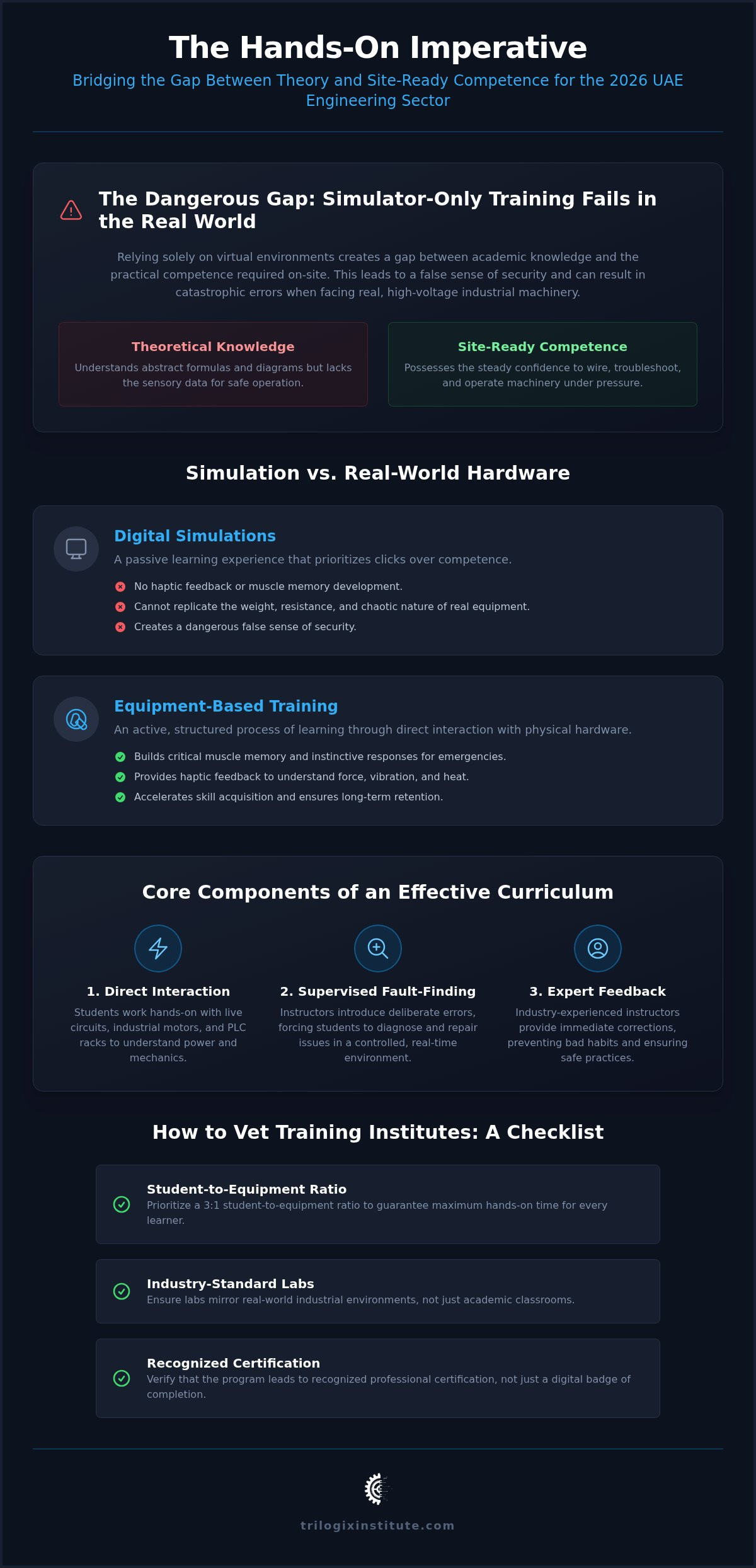
A robust curriculum must prioritize the tactile over the textual. It's not enough to see a diagram of a motor; you must handle it. Effective programs include:
- Direct interaction: Students work with live circuits and industrial motors to understand power distribution and mechanical load.
- Supervised fault-finding: Instructors introduce deliberate errors into a system, forcing students to diagnose and repair issues in real-time.
- Expert feedback: Industry-experienced instructors provide immediate corrections, preventing the development of bad habits or unsafe practices.
Why Theory Alone Fails the Modern Technician
Textbook diagrams are clean, but real-world wiring is often chaotic. A drawing doesn't show you how a wire resists being bent or how a loose connection creates heat. When a student relies solely on theory, they lack the sensory data required for safe operation. This is why instructor-led engineering training is vital for safety. It ensures that the first time a technician encounters a high-voltage environment, they aren't guessing. Relying on "simulator-only" training creates a false sense of security that can lead to catastrophic errors on a job site. True mastery requires the physical presence of the machine.
The Cognitive Advantage: Why Tactile Learning Accelerates Skill Acquisition
Tactile learning is the process of acquiring skills through physical touch and movement. This isn't just a pedagogical theory; it's a neurological reality. When a student engages in equipment-based technical training, they are utilizing haptic feedback. This is the sensory information transmitted through the hands and body when interacting with physical objects. It allows the brain to map the exact force required to tighten a terminal or the specific vibration of a motor that signals a bearing failure. This tactile data creates deeper neural pathways than visual or auditory input alone, leading to faster mastery.
In an industrial emergency, there is no time to consult a manual. Response time must be instantaneous. Muscle memory, developed through repeated physical manipulation, allows a technician to act instinctively. By training on real hardware, the hands learn the layout of a control panel as a physical map. This reduces cognitive load during high-pressure situations. Long-term retention is significantly higher when the body is involved in the learning process, ensuring skills remain sharp long after the course ends.
Developing 'Hand-Eye-Hardware' Coordination
Mastery begins with coordination. In our professional training programs, we see this clearly when students move from digital design to physical implementation. A student might master TTI Dubai Advanced AutoCAD 2D & 3D on a screen, but the true test is translating those coordinates into a physical build. It requires feeling the torque of a bolt and the tension of a cable. Similarly, culinary students must master the weight and heat of professional-grade kitchen equipment to achieve consistent, high-standard results. This physical synchronization is impossible to replicate in a purely digital environment.
From Error to Expertise: The Value of Physical Troubleshooting
Real-world hardware provides honest feedback. If you miswire a circuit in a simulator, you click a "reset" button. If you do it in an equipment-based lab, you hear the snap of a tripped breaker or smell the ozone of a short circuit. This creates a psychological impact that a screen cannot replicate. It forces a deeper understanding of cause and effect. This practical accountability is a key reason many professionals choose vocational training vs university degree paths. It prepares you for the reality of the job site, where mistakes have tangible consequences and require immediate, physical solutions.
Simulation vs. Real-World Hardware: A Comparative Analysis
Digital simulations have become a standard fixture in technical education, often praised for their cost-effectiveness and safety. In 2026, VR and AR tools provide an excellent, safe introduction to dangerous high-voltage concepts or complex mechanical assemblies. However, simulation is a supplement, not a replacement, for equipment-based technical training. Digital environments are fundamentally "clean." They operate on perfect mathematical models that don't account for the chaotic variables of a real job site. A screen cannot teach you the respect required when standing next to a spinning industrial motor.
Real hardware is unpredictable. It experiences wear and tear, thermal expansion, and environmental factors like dust or humidity that a simulator simply cannot replicate. A digital motor always starts perfectly if the code is correct. A physical motor might struggle due to a slightly misaligned shaft or a degraded bearing. Learning to hear, feel, and anticipate these imperfections is what separates a technician from a hobbyist. This unpredictability is a vital teacher, forcing students to develop a higher level of situational awareness and safety consciousness.
Where Digital Simulations Succeed and Fail
Simulations excel at conceptual mapping. They allow a student to visualize the flow of current or the logic of a PLC program without the risk of equipment damage. This "sandbox" approach is ideal for the first few hours of a curriculum. However, they fail when it comes to spatial awareness and realistic resistance. A controller in a VR headset doesn't have the weight of a heavy-duty wrench. It doesn't offer the physical resistance of a stubborn bolt. This creates a "false confidence" trap. A student might achieve a high score in a simulation but freeze when confronted with the physical scale and noise of a real industrial environment.
Real Hardware: The Gold Standard for Career Readiness
Employers in the UAE industrial sectors prioritize candidates who demonstrate "grease on their hands" experience. They understand that a certification earned through physical labs represents a higher level of readiness than one earned behind a screen. This is why our industrial automation specialization course prioritizes laboratory time over purely digital modules. When you transition from a lab to the national UAE industrial workforce, you aren't seeing the equipment for the first time. You've already managed the torque, handled the heat, and successfully navigated the physical risks. This direct experience ensures you are an asset to your team from day one.
Evaluating Technical Institutes: A Checklist for Equipment Quality
Selecting an institute is a strategic decision that requires a critical eye. High-quality equipment-based technical training depends entirely on the availability and condition of the hardware provided. A glossy brochure is no substitute for a physical lab tour. When you visit a facility, look past the marketing materials. You need to see workstations that mirror the current industrial environment. If the equipment looks like it belongs in a museum, your skills will be obsolete before you even begin your career.
The equipment-to-student ratio is the most vital metric of quality. We recommend a ratio of no more than 3:1. When four or five students crowd around a single PLC rack, the learning experience degrades into observation rather than participation. True mastery requires significant time with your hands on the components. If you aren't the one turning the screwdriver or writing the logic, you aren't learning. Additionally, verify the credentials of the instructors. They should have recent field experience; technical standards move fast, and an instructor who hasn't been on a job site since 2020 may be teaching outdated workarounds.
The Equipment Audit: What to Look for During a Visit
Check for industry-standard brands that dominate the global market. In automation labs, look for Siemens or Allen-Bradley PLCs. In electrical sections, verify the presence of modern circuit breakers and variable frequency drives (VFDs). Maintenance matters; a neglected lab often suggests a neglected curriculum. For those focusing on design, ask about the hardware refresh cycle in the advanced AutoCAD 2D 3D course. High-end 3D rendering requires modern GPUs and professional-grade workstations, not aging office PCs.
Curriculum Alignment with National Industry Standards
Equipment is only as useful as the standards it follows. Ensure the electrical programs specifically reflect the latest UAE electrical codes and safety regulations. In the kitchen, tools and workflows should align with international hotel standards used by global hospitality chains. Most importantly, verify that the motor control certification for beginners includes exercises on real-world faults. You need to practice on hardware that can actually fail, teaching you to diagnose the specific issues you'll face on a 2026 job site. Check our full list of equipment-led courses to see how we maintain these high laboratory standards.
Trilogix Institute: Industry-Standard Labs for Professionals
At Trilogix Institute, we operate on a clear "Equipment-First" philosophy. We believe that technical expertise isn't something you read; it's something you perform. While many institutions have shifted toward digital-only modules, we maintain that equipment-based technical training is the only viable path to true site-readiness. Our instructor-led model ensures that you are never left to guess your way through a complex circuit. Instead, you work side-by-side with industry experts who have navigated the same challenges you'll face on the job.
Our TTI Dubai Foundation Electrical Engineering labs serve as the cornerstone for new technicians in the region. These facilities provide direct access to the power systems and safety protocols required by modern UAE infrastructure. For those specializing in mechanical systems, our TITP campus in the Philippines offers intensive training in essential industrial motor control. This dual-campus presence allows us to uphold global vocational standards while providing localized expertise. By choosing our instructor-led sessions over self-paced online alternatives, you gain the benefit of immediate, nuanced feedback that no simulator can provide.
Specialised Labs at Trilogix Institute
Our facilities are designed to be high-fidelity replicas of professional environments. We invest in the same hardware used by leading engineering and hospitality firms to ensure your skills are immediately transferable. These specialized spaces include:
- Industrial Automation Labs: These stations feature real-world PLC and SCADA setups, allowing students to master the Industrial Automation Specialization through rigorous, project-based exercises.
- Advanced AutoCAD Workstations: Optimized for the TTI Dubai Advanced AutoCad 2D & 3D course, these units possess the professional rendering power needed for complex architectural and engineering designs.
- Professional Culinary Facilities: Our TTI Dubai Professional Culinary Arts labs are built for high-volume production, mirroring the pace and equipment standards of international hotel kitchens.
Your Path to Technical Mastery Starts Here
Transitioning from ambition to employment requires a clear, pragmatic roadmap. We focus on delivering equipment-based technical training that respects your time and career goals. By prioritizing short-term, high-impact modules, we help you acquire the specific certifications needed for the 2026 job market without the fluff of a traditional degree program. Our presence in both Dubai and the Philippines ensures that you have access to world-class laboratory facilities regardless of your location.
If you're ready to build the confidence that only comes from hands-on mastery, the next step is simple. Explore our short-term technical courses to find the specialization that fits your career goals. We encourage all prospective students to see our philosophy in action. Contact our admissions team today to schedule a lab tour and see why real hardware makes all the difference.
Master the Machines of Tomorrow
Success in the 2026 industrial landscape requires more than just a theoretical understanding of engineering. It demands the steady hands and instinctive decision-making that only come from equipment-based technical training. By prioritizing physical hardware over digital abstractions, you ensure your skills are grounded in the reality of the job site. You now understand how to audit a facility and why tactile feedback is the gold standard for long-term retention. It's time to put that knowledge into practice.
Trilogix Institute provides the high-fidelity environment needed for professional growth. Our instructor-led labs across Dubai and the Philippines utilize real industrial hardware to deliver industry-aligned certifications. We bridge the gap between academic ambition and technical mastery, preparing you for the rigorous demands of the modern workforce. Don't settle for a virtual approximation of your future career.
Explore our equipment-based technical courses and start your career journey today. We look forward to helping you achieve the practical expertise required to lead in your field.
Frequently Asked Questions
What is the difference between equipment-based training and a standard workshop?
Equipment-based technical training is a comprehensive, instructor-led curriculum centered on the repeated, physical operation of industrial hardware. A standard workshop is often a brief, high-level overview of a single topic. Our training focuses on building deep muscle memory and troubleshooting skills over an extended period. This ensures you leave the lab with the confidence to manage complex systems independently, rather than just possessing a surface-level understanding of the equipment's basic functions.
Can I really learn electrical engineering without a university degree?
You can acquire the practical skills necessary for a technical career through specialized vocational paths. While Trilogix Institute does not offer university degree programs, we provide focused training like the TTI Dubai Foundation Electrical Engineering course. This path prioritizes site-ready competence and industry-aligned certifications over abstract academic theory. It is a pragmatic alternative for those who want to enter the workforce quickly with a verified set of technical capabilities.
How much of the Trilogix curriculum is spent on physical equipment vs. theory?
We dedicate the majority of our curriculum to direct interaction with physical hardware. While theory is necessary for safety and conceptual understanding, we believe true mastery comes from the lab. In our Industrial Automation Specialization, you spend your time wiring real PLC racks and configuring SCADA systems. This hardware-heavy approach ensures that you spend your hours solving physical problems rather than just reading about them in a textbook or watching a presentation.
Is equipment-based training suitable for absolute beginners?
Our courses are specifically structured to accommodate those starting from zero. Programs like the TITP Beginner Essential Industrial Motor Control guide you through the basics of electrical safety and tool handling before moving to complex circuits. You don't need prior experience to succeed. Our instructors provide constant supervision in a controlled lab environment, ensuring that absolute beginners build their confidence and skills safely while working with professional-grade industrial equipment.
Are the certifications from Trilogix Institute recognised by UAE employers?
UAE employers in the engineering and manufacturing sectors highly value practical, equipment-led certifications. Our curriculum is designed to align with the technical requirements of the national workforce. By training on the same hardware used by major industrial firms, you demonstrate a level of readiness that matches current market demands. This practical focus makes our graduates attractive to companies looking for technicians who can contribute to a team from their first day on site.
What happens if I have never used industrial tools before joining a course?
You will receive comprehensive safety induction and tool-handling instruction on your first day. Our labs are designed to be a safe, controlled space where you can learn the physical mechanics of industrial work without the pressure of a live job site. Instructors monitor your progress closely, teaching you how to use everything from basic hand tools to complex motor controllers. We ensure you are comfortable with the hardware before moving to advanced tasks.
Why is instructor-led training better than watching video tutorials?
Video tutorials can't provide the haptic feedback or immediate corrections essential for technical mastery. In an instructor-led environment, you get real-time answers to your questions and a professional eye on your technique. This is especially vital for safety in high-voltage environments. An instructor can feel if a connection is loose or hear if a motor is struggling, providing sensory insights that a digital screen simply cannot replicate for a student.
How often does Trilogix update its industrial automation equipment?
We audit our laboratory facilities regularly to ensure they reflect the current standards of the global industrial market. This includes maintaining workstations featuring brand-name PLCs and motor controllers from leaders like Siemens and Allen-Bradley. Our goal is to ensure that the equipment you use in the lab is the same hardware you will operate in a professional setting. Regular updates prevent your skills from becoming obsolete and keep our training relevant to 2026 standards.


