
In 2026, a theoretical engineering degree is no longer the golden ticket to a high-paying role on the plant floor. You probably feel the weight of this shift already. Many talented individuals across the UAE find themselves "over-educated" but under-skilled, holding certificates that fail to translate into the ability to succeed in a modern industrial automation career path. It's frustrating to realize that the industry has moved faster than the classroom; this leaves a gap between academic theory and the practical demands of troubleshooting a live motor controller or programming a PLC under pressure.
This article provides a definitive roadmap for your professional journey by focusing on what actually matters: equipment-based mastery. We'll strip away the confusion between IT software automation and the rugged reality of industrial hardware. You'll learn how to build a "competency stack" that combines motor controls, PLC operations, and AutoCAD. We'll outline the exact steps to gain the confidence needed to operate real-world systems and identify which certifications hold genuine value in the 2026 job market. This is about bridging the gap between your ambition and a successful career in the field.
Key Takeaways
- Discover why the 2026 industrial automation career path prioritizes modular, equipment-based competencies over traditional theoretical degrees.
- Identify the "Triple Threat" skill stack-Industrial Motor Control, PLC systems, and AutoCAD-needed for immediate workplace transferability.
- Learn why instructor-led training with real industrial hardware is essential for mastering the safety and precision required in modern facilities.
- Follow a clear, two-phase progression roadmap that guides you from an entry-level technician to a high-level automation systems specialist.
- Understand how mastering physical hardware maintenance and digital control systems provides a secure defense against AI-driven job displacement.
What is the Industrial Automation Career Path in 2026?
The industrial automation career path in 2026 is the vital link between traditional electrical engineering and the sophisticated digital systems that run modern production lines. It isn't just about writing code in a clean office. It's the practical application of logic to physical machinery. Your primary objective is to design, maintain, and troubleshoot systems that move, sort, and manufacture products without human fatigue. Success in this field requires a deep understanding of how electricity interacts with mechanical motion.
Many newcomers confuse "IT Automation" with "Industrial Automation." While IT focuses on software scripts and cloud data, industrial automation deals with the rugged reality of the plant floor. You'll work with Programmable Logic Controllers (PLCs), motor drives, and sensors that must survive heat, vibration, and dust. In 2026, the path has shifted from a long academic climb to a modular, competency-based model. Employers now value specific mastery over broad, theoretical knowledge. Navigating your industrial automation career path effectively means prioritizing skills that translate directly to the factory floor.
The Evolution of the Technician Role
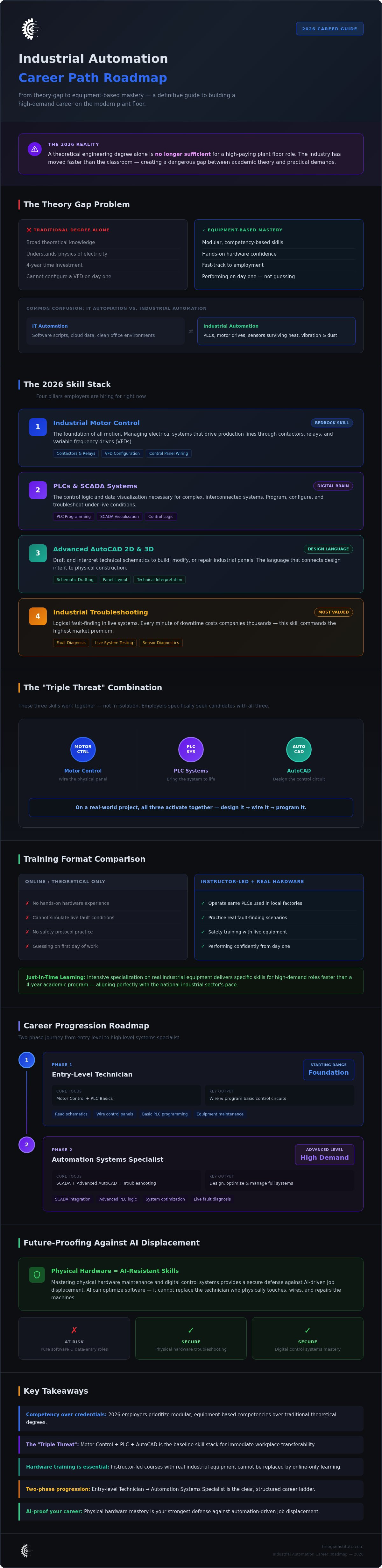
The traditional role of the "Electrician" is rapidly evolving into the "Automation Technician." Modern factories no longer need someone who only pulls wire. They require professionals who can interpret a schematic, wire a control panel, and then program the PLC that runs it. This dual capability is the baseline for recruitment in 2026. Companies are looking for "Triple Threat" individuals who understand motor controls, PLCs, and AutoCAD.
A significant "Theory Gap" exists in the current market. Many graduates understand the physics of electricity but lack the hands-on skill to diagnose a faulty sensor or configure a Variable Frequency Drive (VFD). Industry leaders are prioritizing candidates who can bridge this gap immediately upon hire. They want people who can touch the equipment and make it work.
The ROI of Vocational Specialization
Choosing a practical, instructor-led course offers a faster route to employment than a four-year academic program. While a degree provides broad context, intensive specialization focused on real industrial equipment delivers the specific skills needed for high-demand roles. This "Just-in-Time" learning model aligns perfectly with the fast-paced national industrial sector. It's about getting you into the workforce with skills that matter.
Starting your career with equipment-based confidence is a psychological advantage. When you've already operated the same PLCs and motor controls used in local factories, you aren't guessing on your first day. You're performing. This pragmatic approach ensures you're job-ready and capable of handling the physical hardware that keeps industries moving. You can view our specialized training options on our courses page to see how we bridge this gap.
The 2026 Skill Stack: Essential Competencies for Success
Mastering a modern industrial automation career path requires more than just knowing how to code. You need a specific stack of competencies that allow you to interact with the physical world. While some competitors focus purely on high-level AI, the reality in 2026 is that you can't optimize a system you don't understand how to build. Your skill stack should be built on these four pillars:
- Industrial Motor Control: This is the bedrock of all motion. It involves understanding how to manage the electrical systems that drive production lines through contactors, relays, and variable frequency drives.
- PLCs and SCADA: These are the digital brains. They provide the control logic and data visualization necessary for complex, interconnected systems.
- Advanced AutoCAD 2D & 3D: This is the language of design. You must be able to draft and interpret technical schematics to build, modify, or repair industrial panels.
- Industrial Troubleshooting: This is the most valued skill. The ability to perform logical fault-finding in a live system saves companies thousands in downtime.
The "Triple Threat" of Modern Engineering
Industry leaders look for what we call the "Triple Threat": mastery of Motor Control, PLC, and AutoCAD. These skills don't exist in isolation. On a real-world project, you'll use AutoCAD to design the control circuit, Motor Control principles to wire the physical panel, and PLC programming to bring the entire system to life. Mastering these three areas ensures your industrial automation career path remains resilient against market shifts. You can explore the design side in detail through our Advanced AutoCAD 2D & 3D course.
Beyond the Screen: The Tactile Skills
You can't ignore "tool time." In 2026, the best technicians are those who aren't afraid to handle physical components. You need to know how to wire contactors and sensors before you ever touch a keyboard. Understanding physical hardware integration ensures your digital logic actually works in a sensory industrial environment. You'll deal with noise, vibration, and strict safety protocols that a simulator simply can't replicate. Building these skills requires a hands-on approach that prioritizes real hardware. You can start your journey by reviewing our technical training programs to see which specialization fits your professional goals.
Choosing the Right Training: Equipment-Based vs. Online
Selecting the right training provider is the most critical decision you'll make for your industrial automation career path. While self-paced online modules are popular for software coding, they often fail when applied to industrial subjects. You can't master high-voltage safety or precise hardware integration through a screen. Real-world automation requires a physical understanding of how current flows through a panel and how a motor reacts under load. In 2026, employers aren't looking for digital certificates; they're looking for the ability to handle physical hardware safely and effectively.
Practical labs that mirror the conditions of national infrastructure projects are essential. These environments force you to deal with the complexities of real-world wiring, signal interference, and mechanical constraints. If your training doesn't involve touching a real PLC or wiring a physical relay, you aren't being prepared for the job. You're just learning a theory that might not hold up when you're standing in front of a live production line.
The Fallacy of the Digital Simulation
Clicking a virtual wire on a tablet doesn't prepare you for the resistance of a 2.5mm cable or the heat of a poorly seated contactor. Digital simulations lack the sensory feedback that defines expert troubleshooting. In a physical lab, you learn to hear the hum of a healthy transformer and smell the warning signs of an overloaded circuit. These are the skills that save lives and equipment. Mastering these nuances is why we recommend PLC training with hands-on labs. It's the only way to gain true equipment-based confidence before your first day on site.
The Instructor-Led Advantage
Instructor-led training provides immediate, expert feedback that a pre-recorded video cannot offer. When your control circuit fails to close, a mentor can guide your logical fault-finding process in real-time. This interaction accelerates the learning curve significantly. Beyond technical skills, in-person workshops allow you to build a professional network with peers and industry insiders. Choosing equipment-based technical training ensures you're learning on the same hardware you'll encounter in the field. It's about bridging the gap between ambition and a functional career.
When evaluating an institute, look closely at their laboratory. Does it feature industry-standard hardware like Siemens or Allen-Bradley PLCs? If the training relies on software emulators, it isn't preparing you for the 2026 job market. Employers want to see that you've handled real components. Your industrial automation career path depends on your ability to step onto a site and operate the machinery with precision, not just point and click.
Career Progression: From Beginner to Systems Specialist
The 2026 industrial automation career path is no longer defined by a linear, five-year apprenticeship. Instead, it follows a modular competency stack that allows you to accelerate your professional growth through targeted, equipment-based training. By focusing on specific, job-ready milestones, you can move from a basic support role to a high-level systems designer much faster than traditional academic routes allow. Your progression typically follows four distinct phases:
- Phase 1: Entry-Level Technician: Your focus here is on the physical foundation. You'll master industrial motor control, basic electrical wiring, and safety protocols. This is where you build the confidence to touch live panels and understand the fundamentals of motion.
- Phase 2: Automation Specialist: In this stage, you integrate digital control. You'll move into PLC programming, HMI design, and sensor integration. You aren't just wiring components; you're telling them how to think.
- Phase 3: Systems Designer: This phase leverages technical drafting. You'll utilize Advanced AutoCAD 2D & 3D to design large-scale control systems, creating the blueprints that technicians in Phase 1 and 2 will follow.
- Phase 4: Lead Automation Engineer or Consultant: At the peak of the path, you oversee entire facility upgrades. You'll manage project lifecycles, optimize production efficiency, and consult on national infrastructure standards.
Starting the Journey: The Modular Approach
Most successful professionals in 2026 begin with a motor control certification for beginners. This is the smartest first step because it provides the immediate tactile skills that factories need today. As you stack certifications, you'll find that your value increases significantly. Many technicians report that adding a PLC or AutoCAD specialization to their portfolio allows them to move into a higher salary bracket every six months. This transition from maintaining existing systems to designing new ones is the key to long-term career security.
2026 Job Market Trends
National manufacturing hubs are seeing a surge in demand for the "Hybrid Technician." These are professionals who don't just specialize in one niche but can troubleshoot both the electrical hardware and the digital logic of a machine. Equipment-certified professionals often command higher starting offers than degree-only candidates because they require zero on-the-job training for basic operations. In 2026, the hiring trend is clear: industry leaders prioritize documented competency over theoretical credentials. You can take the first step toward these high-demand roles by exploring our technical specialization programs.
Future-Proofing Your Career in an Automated World
While artificial intelligence continues to reshape digital industries, the physical factory floor remains a domain where human expertise is indispensable. AI can optimize a logic sequence or predict a failure, but it can't physically replace a burnt-out contactor, recalibrate a pressure sensor, or troubleshoot a loose connection in a high-vibration environment. Your industrial automation career path is naturally resilient against displacement as long as you maintain mastery over the physical hardware. The most secure professionals in 2026 are those who act as the final authority on the integration between digital commands and mechanical action.
Staying relevant requires a shift in mindset. You shouldn't view your education as a finished chapter but as an ongoing cycle of modular upskilling. The technology governing national industrial standards moves too fast for a single degree to last a thirty-year career. By refreshing your skills every two to three years, you ensure that your technical knowledge matches the specific equipment currently being installed in local facilities. This proactive approach turns technological change into a career opportunity rather than a threat.
The Role of Continuous Modular Education
A one-time academic credential often loses its practical utility within a few years of graduation. In contrast, modular education allows you to target specific gaps in your knowledge as they emerge. Whether it's learning to integrate new IoT-enabled sensors or mastering a different brand of PLC, short and focused courses provide the highest return on investment. Trilogix Institute specializes in these high-impact modules, ensuring your skills remain sharp and transferable. For those looking to consolidate their expertise, the Industrial Automation Specialization Course provides a comprehensive path to senior-level competency.
Getting Started with Trilogix Institute
Your first practical course at Trilogix Institute is designed to be a transformative experience. You won't spend your time looking at slides; you'll be at a workstation wiring real industrial panels and programming live controllers. Our instructor-led model ensures that you receive immediate feedback, helping you avoid common mistakes and build correct habits from day one. This hands-on intensity is exactly what bridges the gap to employment, giving you the confidence to walk into any facility and contribute immediately. It's time to take control of your professional future. Visit our courses page to view the 2026 intake schedule and find the specialization that aligns with your goals.
Ultimately, the quality of your training institute determines the trajectory of your career. Always choose a provider that prioritizes industry-aligned labs and real-world hardware over simulations. When you train on the equipment used by the nation's leading industrial players, you aren't just learning; you're preparing for the reality of the 2026 job market. Your industrial automation career path starts with the decision to prioritize practical, equipment-based mastery.
Master Your Technical Future
The 2026 industrial landscape rewards those who can troubleshoot a live system with precision. You've seen that a theoretical degree is no longer sufficient. Instead, a modular competency stack of Motor Control, PLC, and AutoCAD is the new standard for professional success. Building a modern industrial automation career path requires a commitment to equipment-based learning and regular upskilling. By choosing instructor-led training with real industrial hardware, you gain the confidence to operate complex systems safely and effectively.
Trilogix Institute bridges the gap between academic theory and workplace reality. Our state-of-the-art labs and modular certifications are specifically designed to prepare you for immediate entry into the national industrial sector. It's time to turn your ambition into a functional, high-demand career. Explore our hands-on industrial engineering courses and start your technical career today. Your journey toward becoming a systems specialist starts with a single, practical step. Embrace the opportunity to become an indispensable expert in an automated world.
Frequently Asked Questions
Do I need a university degree to start a career in industrial automation?
No, you don't need a university degree to launch your career. The 2026 market values modular competency over long-term academic theory. Many technical roles prioritize candidates who can demonstrate immediate skill in wiring and troubleshooting. Instructor-led vocational programs provide a faster, more direct route to employment by focusing on the physical hardware used in the field. This pragmatic approach allows you to enter the workforce with the specific technical abilities that employers require.
What is the average starting salary for an automation technician in 2026?
Starting salaries for technicians depend heavily on their specialized skill set and the complexity of the systems they manage. Equipment-certified professionals in the UAE typically enter the market at a higher bracket than those who only hold academic degrees. Specializing in high-demand areas like PLC programming and motor control significantly increases your earning potential. Employers pay a premium for individuals who can immediately handle expensive industrial machinery safely and without supervision.
How long does it take to complete a practical industrial automation certification?
Most specialized certifications are designed for rapid skill acquisition. Depending on the specific module, you can complete your training in a few weeks of intensive, instructor-led sessions. This modular approach allows you to stack certifications over time without committing to a multi-year program. It's an efficient way to build a professional portfolio while remaining active in the job market. You'll gain the specific mastery needed for immediate workplace transferability in a fraction of the time.
Is AutoCAD still relevant for automation engineers in 2026?
AutoCAD remains a vital tool for any professional on an industrial automation career path. It's the standard language for technical drafting and system design. You'll use it to create blueprints for control panels and map out complex electrical circuits. Without these design skills, you're limited to maintaining existing systems rather than designing new ones. Mastering 2D and 3D drafting ensures you can handle large-scale projects and move into senior design roles.
Can I learn PLC programming effectively through an online-only course?
Learning PLC programming through a purely online course is rarely effective. You can't experience the physical resistance of a wire or the real-world consequences of a logic error on a simulation. Instructor-led labs provide the tactile feedback and immediate expert guidance necessary for precision. Safety is also a major factor; you need to handle real high-voltage components under supervision to build the confidence required for a professional industrial environment.
What is the "Triple Threat" skill set in industrial engineering?
The "Triple Threat" is a powerful combination of three core competencies. It includes Industrial Motor Control, PLC programming, and AutoCAD design. Mastering these three areas allows you to design a system, wire the control panel, and program the logic that runs it. This versatility makes you a resilient candidate. Companies prefer hiring one professional who understands the entire integration process rather than three separate specialists who only know their own niche.
Are Trilogix Institute certifications recognized by national employers?
Certifications in areas like foundation electrical engineering and industrial motor control are designed for immediate workplace transferability. Our focus on instructor-led, equipment-based training ensures your skills align with national industrial standards. Employers recognize that our graduates have spent significant "tool time" with real hardware like PLCs and motor drives. This practical experience reduces training costs and ensures you're a productive team member from your first day on the job.
What kind of equipment will I use in a hands-on automation lab?
You'll train on the same hardware found in modern production facilities. Our labs feature industry-standard PLCs, motor controllers, sensors, and relays. You'll also utilize professional software for AutoCAD drafting and PLC logic design. Working with real components helps you understand the nuances of signal interference and mechanical wear. This hands-on experience is the most critical part of your industrial automation career path, as it prepares you for the rugged reality of the plant floor.


