
You can't learn to troubleshoot a high-speed assembly line by clicking through a slideshow. While digital simulations have their place, the reality of the factory floor is tactile and unforgiving. Most technicians feel a deep frustration after finishing a standard certification only to realize they're still unqualified to touch a live PLC cabinet. This is why choosing a hands-on industrial automation course is the only way to bridge the gap between academic theory and the high stakes of industrial downtime.
We understand that true competence comes from physical interaction with the tools of the trade. This article helps you evaluate and select a program that prioritizes real-world equipment and instructor-led mastery. You'll discover how to transition from simply knowing about systems to actually mastering PLC and SCADA software through practical application. We'll explore the essential hardware requirements, the weight of industry-recognized certifications, and the specific path to becoming a confident troubleshooter in a global market valued at $261.23 billion in 2026.
Key Takeaways
- Understand why physical interaction with hardware is the only way to develop reliable troubleshooting skills for complex industrial systems.
- Identify the critical modules of a professional curriculum, including the integration of PLCs, SCADA, and HMI for data-driven manufacturing.
- Discover how to evaluate a hands-on industrial automation course by prioritizing total lab hours and access to real-world industrial equipment.
- Learn the importance of aligning your technical training with national industrial standards to ensure your skills carry weight in the global market.
- Explore the equipment-based training model as a pragmatic alternative to purely theoretical or self-paced online modules.
Bridging the Gap: Why Hands-On Industrial Automation Training is Essential
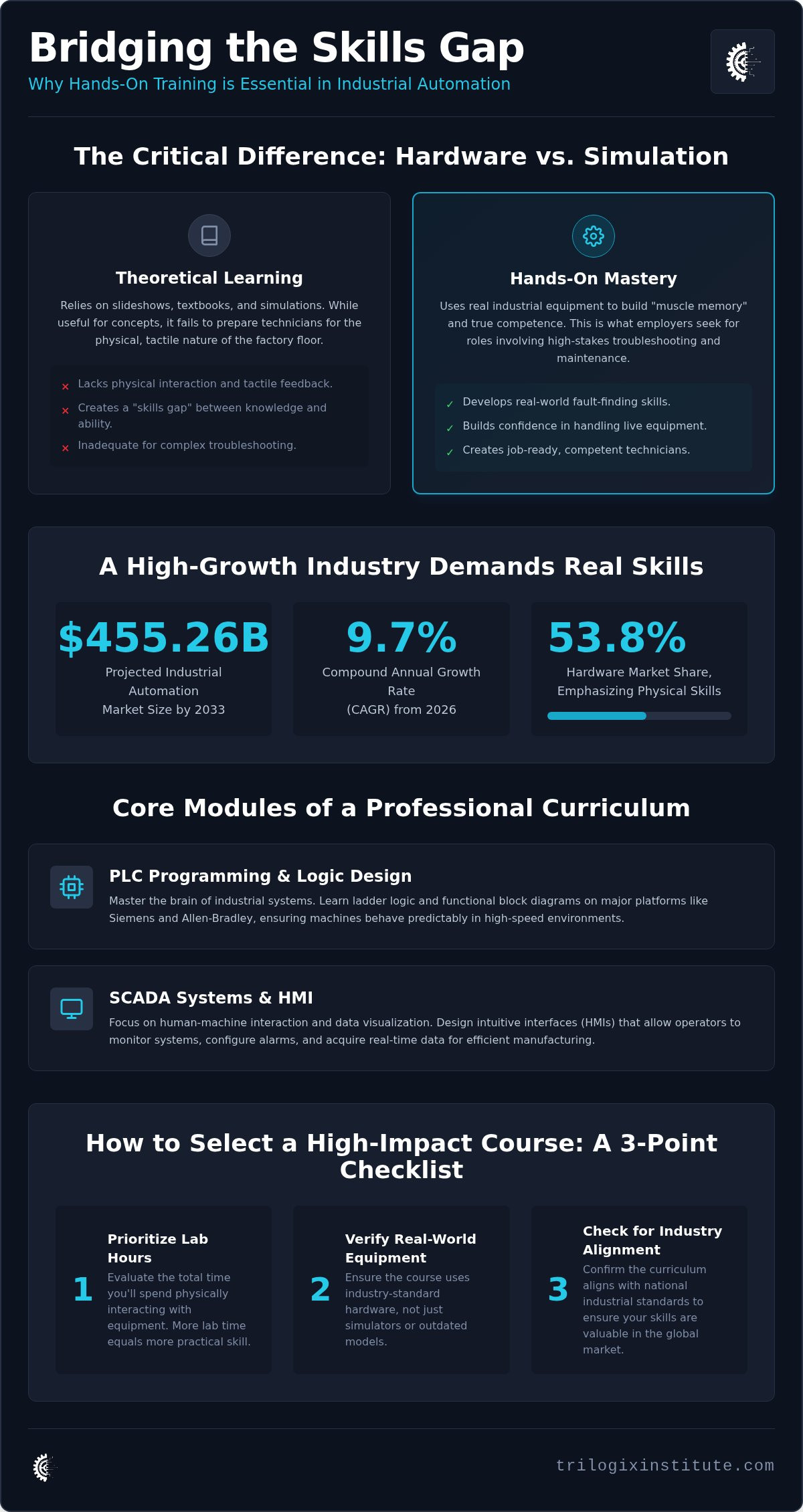
The global industrial automation market is projected to grow to $455.26 billion by 2033, with a compound annual growth rate of 9.7% starting in 2026. This massive expansion reflects a shift toward more intelligent, connected systems. However, a significant disconnect persists between academic engineering theory and the physical reality of the factory floor. Understanding what is industrial automation in a classroom setting is only the first step. The true challenge lies in the physical execution of those concepts.
A hands-on industrial automation course serves as the vital bridge between knowing a concept and performing a task. While the hardware segment currently holds a dominant 53.8% market share, many technicians enter the field with only a digital understanding of these systems. This lack of physical experience creates a "skills gap" that can lead to costly errors, safety risks, and extended downtime.
The Limits of Theoretical Learning
Traditional education often relies on textbooks and manuals. These tools are excellent for learning logic, but they don't teach you the physical resistance of a terminal screw or the correct way to strip a communication cable without damaging the core. Reading a manual is fundamentally different from wiring a PLC panel. In the field of industrial motor control, tactile feedback is essential. You need to feel the mechanical engagement of a contactor and hear the specific hum of a healthy motor to diagnose issues effectively.
This is where many self-paced online courses fail. They provide the "what" but ignore the "how." Employers today are looking for readiness. They prioritize candidates who have already touched the equipment they'll be expected to maintain. By choosing an Industrial Automation Specialization that emphasizes equipment-based labs, you align yourself with the professional standards required for immediate technical roles.
Real-World Scenarios and Fault Finding
Practical mastery is built through repetition and exposure to failure. In a controlled lab environment, instructors can simulate system failures that would be catastrophic on a live production line. This allows students to practice fault finding without the pressure of a multi-million dollar stoppage. Building this muscle memory is crucial. When a system goes down in a real-world manufacturing plant, the response must be rapid and accurate.
Developing troubleshooting skills requires physical interaction with hardware. Instructor-led guidance is superior here because a mentor can point out the subtle signs of a ground fault or a loose connection that a simulation might overlook. This level of preparation doesn't just make you a better technician; it makes you a safer one. Confidence at the tool bench leads to reduced equipment damage and a faster climb up the career ladder in the national industrial sector.
Core Modules of a Professional Automation Curriculum
A high-quality hands-on industrial automation course doesn't just teach software; it integrates hardware mastery into every module. The goal is to produce technicians who can look at a complex system and understand the interplay between the controller, the interface, and the mechanical output. A curriculum modeled after a professional Industrial Automation – PLC and Controls certificate ensures that students are exposed to the exact workflows used in modern manufacturing environments. This modular approach builds a comprehensive skill set that employers recognize as career-ready.
PLC Programming and Logic Design
Programmable Logic Controllers (PLCs) act as the brain of modern industrial systems. Mastery requires understanding ladder logic and functional block diagrams across major platforms like Siemens and Allen-Bradley. Students must learn to integrate real-time control logic with physical sensors, ensuring that the software responds accurately to physical inputs. This isn't just about code. It's about making sure the machine behaves predictably in a high-speed environment. You'll move from basic binary logic to complex sequences that manage entire assembly lines.
SCADA Systems and Data Acquisition
SCADA and HMI modules focus on human-machine interaction and data visualization. You'll learn to design intuitive user interfaces that allow plant operators to monitor systems at a glance. Professional training covers the configuration of alarms and real-time monitoring protocols. This skill set is vital for bridging local automation with national grids or enterprise-level data systems. By mastering these tools, you enable smarter decision-making based on live production data, which is a core requirement for any senior technician role.
Essential Industrial Motor Control
Precision in motion depends on Variable Frequency Drives (VFD) and robust motor control. Technicians must master Essential Industrial Motor Control to handle the heavy machinery that powers modern industry. This involves understanding the relationship between control circuits and mechanical loads. You'll practice wiring and testing industrial control panels safely, ensuring every component meets professional standards. If you're ready to move beyond basic theory, exploring our Industrial Automation Specialization provides the direct path to these critical skills.
Finally, industrial networking ensures robust communication between field devices. Without stable data paths, even the best-programmed PLC is useless. Learning to configure these networks completes your profile as a versatile automation professional.
Hardware vs. Simulation: Choosing the Best Learning Environment
While many training providers promote remote interactive desktops as an equal alternative to onsite labs, this approach ignores the physical complexities of industrial systems. A hands-on industrial automation course must involve physical interaction with components to be truly effective. Virtual simulations are clean environments where everything works perfectly unless programmed otherwise. Real-world hardware is different. It's susceptible to loose connections, electromagnetic interference, and environmental wear that a screen simply cannot replicate.
Relying solely on simulations creates a false sense of security. You can't learn the psychological weight of working with high-voltage industrial equipment through a mouse click. Handling live PLC and VFD hardware demands a level of focus and respect that builds professional discipline. This equipment-based technical training is the gold standard because it forces you to account for the physical variables that cause actual downtime in a factory. It prepares you for the "noise" of a real manufacturing environment.
Evaluating the Training Lab
When choosing a program, look closely at the hands-on motor control lab facilities. The hardware should be industry-standard, featuring brands like Siemens, ABB, or Schneider Electric. Pay attention to student-to-equipment ratios. If you're sharing one PLC kit with five other people, you're observing rather than learning. Practical mastery requires individual time at the tool bench to wire, test, and troubleshoot. A professional lab should feel like a scaled version of a real plant floor, equipped with the same relays, sensors, and controllers you'll find in the field.
The Instructor-Led Advantage
Technical training isn't just about reading a screen; it's about the feedback loop. Instructor-led engineering training provides immediate corrections when you make a wiring error or a logic mistake. Tutors bring "war stories" from the field, offering insights into how systems fail in ways that aren't documented in the manual. This real-world experience is what transforms a student into a competent technician. Self-paced modules can't replace a mentor who watches your technique and guides your problem-solving process in real-time. This guidance ensures you develop the correct habits for safety and efficiency from day one.
5 Steps to Selecting a High-Impact Industrial Automation Course
Selecting the right training provider is a strategic investment in your professional future. A low-quality program leaves you with a certificate but no confidence at the tool bench. To ensure you gain actual mastery, you must look beyond marketing claims and evaluate the technical depth of the curriculum. Choosing a hands-on industrial automation course requires a methodical approach to verify that the training environment mirrors the current demands of the global manufacturing sector.
Step 1: Define Your Career Track
Before enrolling, determine your specific goal. Are you moving into maintenance, design, or system integration? Maintenance roles require deep knowledge of troubleshooting and motor control. System integration roles focus more on networking and SCADA configuration. You should align your course selection with national job market demands to ensure you aren't over-investing in skills that aren't currently sought after. If you're looking for a comprehensive path, consider reviewing a specialized Industrial Automation Specialization to see how different modules fit together.
Step 2: Audit the Lab Facilities
The quality of the lab determines the value of your training. You should ask specific questions about the hardware brands and versions used. For instance, verify if the facility uses current software versions or if they are still training on legacy systems that are being phased out. A high-impact lab environment should also maintain strict safety protocols and professional standards. You can often evaluate these facilities by viewing a gallery of the equipment or requesting a site visit before you commit.
Beyond the facility itself, you must evaluate three additional critical factors to ensure the program meets industry standards:
- Total Lab Hours: A high-impact course should dedicate at least 60% of its duration to physical equipment interaction. Don't settle for "hybrid" models that are mostly theory.
- Instructor Credentials: A tutor with a decade of field experience provides insights that a purely academic teacher cannot. They understand the practical application of current safety standards like the ISO 10218:2025.
- National Standards Alignment: Verify that the curriculum is recognized by relevant industrial bodies. This ensures your certification carries weight when applying for technical roles.
Don't leave your career progression to chance. Explore our equipment-based specialization courses today to secure your place in a program designed for real-world results.
Mastering the Field: The Trilogix Approach to Industrial Automation
Ambition without application is a stalled engine. At Trilogix Institute, we provide the fuel for technical advancement by focusing on pragmatic, results-oriented training. Our hands-on industrial automation course is designed to eliminate the uncertainty often associated with purely academic programs. We understand that the global industrial automation market, valued at $261.23 billion in 2026, requires more than just a passing knowledge of logic diagrams. It demands a workforce capable of managing complex hardware and software ecosystems with precision and confidence.
Our Equipment-First Philosophy
We reject the model of purely online, self-paced courses because they fail to prepare technicians for the physical reality of the job. Our institute invests in real-world PLCs, SCADA systems, and motor controls from global leaders like Siemens and Allen-Bradley. This commitment to hardware ensures that every student develops the tactile skills necessary for rapid troubleshooting and system maintenance. Our instructors aren't just teachers; they are career mentors and industry experts who have navigated the complexities of the modern factory floor.
We believe that mastery is a product of repetition. Our Industrial Automation Specialization course is structured to maximize time at the tool bench. We are dedicated to delivering practical mastery through intensive lab hours that simulate the high-pressure environment of industrial downtime. This prepares you for national certifications and ensures you are industry-ready from the moment you complete the program.
Next Steps for Your Technical Career
Bridging the gap between technical interest and professional employment requires a clear roadmap. You can expand your expertise by enrolling in our upcoming automation and AutoCAD modules, which provide the design skills necessary for advanced system integration. This multi-disciplinary approach makes you a more versatile asset in the competitive industrial sector. We focus on creating a path that leads directly to technical roles without the need for traditional university degree terminology.
Readying your profile for the next level is a straightforward process. You should begin by preparing your documentation for professional training contact with our admissions team. Joining Trilogix means entering a community of technically proficient professionals nationwide who value reliability, seriousness, and functional education. We act as your partner in this journey, offering a clear-eyed, no-nonsense path to success in the fast-moving industries of tomorrow.
Secure Your Competitive Edge in Industrial Automation
Mastering the complexities of modern manufacturing requires more than a digital simulation; it demands the physical intuition developed through repetition and expert guidance. By choosing a hands-on industrial automation course, you ensure that your technical skills are grounded in the reality of the factory floor rather than the limitations of a computer screen. This approach transforms you from a passive observer into a confident troubleshooter capable of maintaining the systems that drive global production. It's the most reliable way to secure your standing in a fast-moving market.
Trilogix Institute remains committed to bridging the gap between technical ambition and professional employment. Our programs prioritize instructor-led lab sessions using industry-standard equipment, ensuring your training meets national vocational alignment standards. This pragmatic focus prepares you for the immediate demands of the industrial landscape with skills that are directly transferable to the workplace.
View our hands-on Industrial Automation courses and start your career today
Your path to technical excellence starts at the tool bench. We look forward to partnering with you on your journey toward professional mastery and long-term career success.
Frequently Asked Questions
What is the difference between a virtual and a hands-on industrial automation course?
A virtual course relies on software simulations, while a hands-on industrial automation course utilizes physical PLCs and real-world wiring. Simulations often fail to capture mechanical faults or subtle wiring errors. Physical interaction builds the muscle memory needed for rapid troubleshooting on a factory floor. We prioritize equipment-based training to ensure you're comfortable handling live industrial components safely and effectively in a professional environment.
Do I need a university degree to enroll in an industrial automation specialization?
No, you don't need a university degree to enroll in our specialization programs. We focus on vocational excellence and practical skill acquisition rather than academic theory. Our curriculum is designed for technicians and engineers who want to bridge the gap between ambition and employment. We provide the specific technical keys required to meet the current demands of the global job market without the need for traditional degrees.
Which PLC brands are most important to learn for the national job market?
Learning industry-standard brands like Siemens and Allen-Bradley is critical for the national job market. These manufacturers dominate the hardware segment, which holds a dominant 53.8% market share in the automation industry as of 2026. Mastering these platforms ensures your skills are transferable across various manufacturing plants. Our training utilizes these specific brands to align your preparation with the hardware you'll encounter in real-world professional environments.
How long does it take to complete a professional automation certification?
Completion times vary depending on the specific module, but most professional certifications are designed for efficiency. A 10-week course is a common standard for in-person technical training. We focus on a brisk, logical progression that respects your time while ensuring comprehensive coverage of core modules. This pace reflects the fast-moving industries we represent, allowing you to move swiftly from the classroom to a technical career path.
Can I learn industrial automation through purely online training?
While you can learn basic logic online, industrial automation is a tactile discipline that cannot be mastered through purely online training. Trilogix Institute avoids the self-paced online model because it lacks the physical feedback of real-world hardware. You need instructor-led, equipment-based labs to develop reliable troubleshooting skills. Physical interaction with live systems is the only way to ensure you're qualified for high-stakes technical roles in manufacturing.
What are the prerequisites for the Beginner Essential Industrial Motor Control course?
The TITP Beginner Essential Industrial Motor Control course is an entry-level program, but a basic understanding of electrical concepts is beneficial. We welcome individuals who have a foundational interest in electrical engineering or those coming from general maintenance backgrounds. Our instructors act as mentors, guiding you through the initial steps of motor control circuits and industrial panel wiring to ensure a smooth transition into advanced automation modules.
Will this course help me transition from a general electrician to an automation technician?
Yes, this training is specifically designed to help general electricians transition into automation technician roles. General electrical work often focuses on power distribution, while automation requires mastery of control logic and data communication. By completing a hands-on industrial automation course, you'll learn to integrate PLCs and SCADA systems with traditional motor controls. This shift expands your career opportunities within the growing $261.23 billion global automation market.
How much time is dedicated to physical lab work versus classroom lectures?
We prioritize a high-impact, equipment-based approach where at least 60% of the training time is dedicated to physical lab work. While classroom lectures provide the necessary logic and safety protocols, the majority of your time is spent at the tool bench. You'll wire panels, program PLCs, and troubleshoot real-world equipment. This modular structure ensures that theoretical knowledge is immediately reinforced through practical application in a professional lab environment.


