
A software simulation can teach you the logic of a program, but it will never prepare you for the high-stakes reality of a live factory floor. True technical authority requires PLC training with hands-on labs, where the tactile experience of wiring and troubleshooting physical hardware replaces digital guesswork. You've likely felt the anxiety of staring at a complex wiring diagram and wondering if your theoretical knowledge will hold up when you're facing actual equipment. It's a common hurdle that separates entry-level hobbyists from the professional experts driving the UAE's industrial future.
We understand that real-world confidence comes from turning a screwdriver, not just a mouse wheel. This definitive 2026 guide explores why physical lab work is the non-negotiable standard for securing high-level automation roles. You'll discover how hardware interaction builds the troubleshooting resilience needed to handle live systems and why certification backed by practical mastery is your most valuable career asset. We'll break down the essential hardware platforms for this year, from Siemens TIA Portal to Rockwell's Studio 5000, and show you exactly how to transition from classroom theory to professional technical mastery.
Key Takeaways
- Understand why theoretical knowledge fails on the production floor and why physical interaction with PLCs is essential for industrial mastery.
- Learn the critical differences between software simulations and PLC training with hands-on labs to bridge the gap between logic and hardware.
- Master the core competencies of troubleshooting and circuit tracing that only real-world equipment can provide.
- Identify the "Lab-First" criteria for evaluating vocational institutes, including the vital importance of low student-to-trainer ratios.
- Discover the roadmap for transitioning from basic PLC programming to high-level roles like Industrial Automation Specialist.
Understanding PLC Training: Why Hands-On Experience is Non-Negotiable
A Programmable Logic Controller (PLC) is the ruggedized industrial computer that serves as the central nervous system for modern manufacturing. It executes the logic required to control machinery, monitor sensors, and manage complex industrial processes. While many beginners attempt to learn these systems through digital simulators, the industry reality is far more physical. You can write perfect code on a screen, but if you don't understand how that code interacts with a physical solenoid or a faulty sensor, the system remains broken. This is why PLC training with hands-on labs has become the essential benchmark for technical hiring in 2026. Employers no longer value theoretical awareness; they demand documented technical competency.
The Role of PLCs in Modern Industrial Automation
In the UAE's rapidly advancing industrial sector, PLCs manage everything from high-speed food packaging lines to massive water desalination plants. We've seen a definitive shift from traditional relay logic to sophisticated, networked automation systems. These modern controllers don't just flip switches. They process massive data streams from field devices to optimize production efficiency in real-time. By 2026, industry standards require technicians to understand more than just basic ladder logic. You must be able to integrate hardware, manage industrial Ethernet networks, and ensure cybersecurity at the controller level. This level of sophistication makes equipment-based technical training the only reliable path to professional readiness.
Knowledge vs. Competency: The Practicality Gap
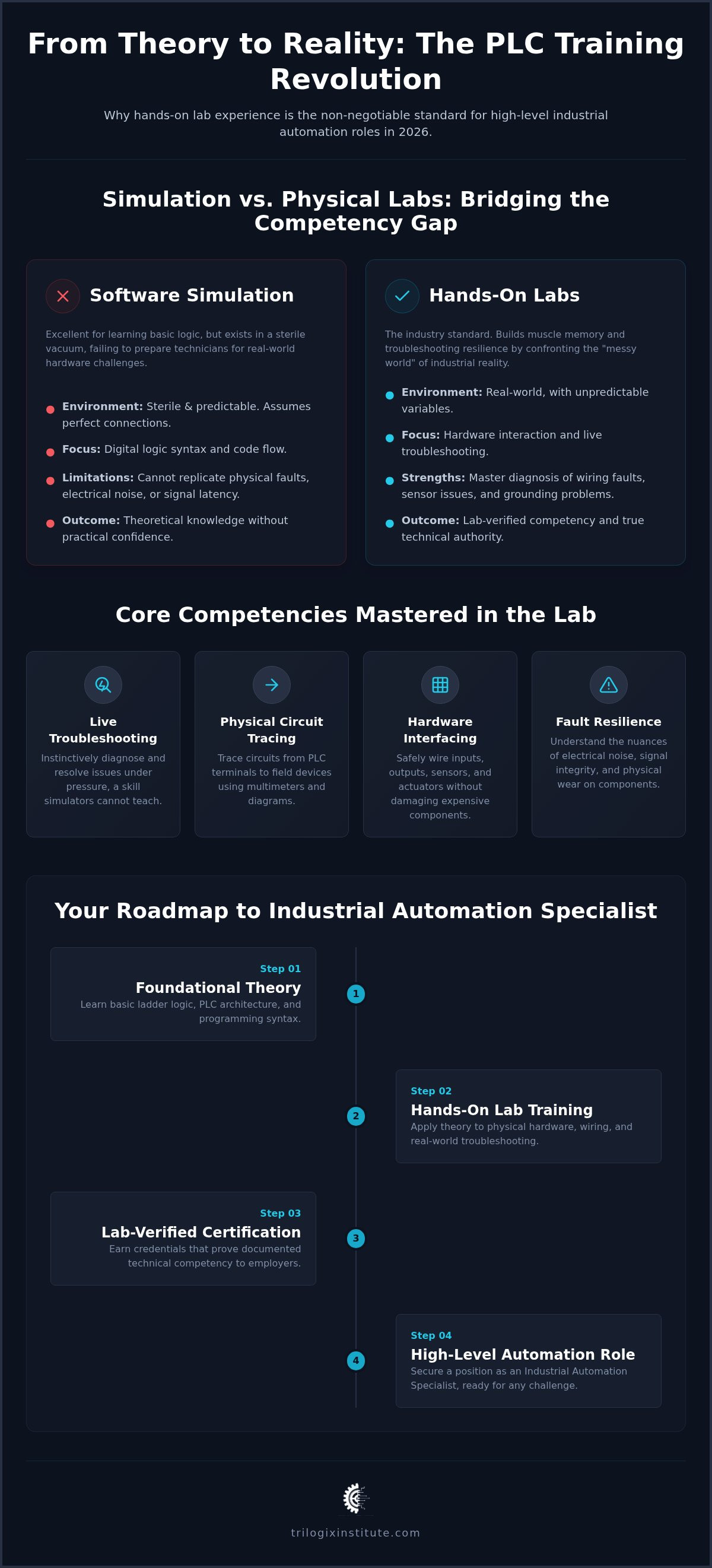
There's a massive difference between passing a multiple-choice exam and diagnosing a faulty input card on a live production line. Theoretical knowledge provides the "what," but only physical interaction provides the "how." Employers in the automation space now prioritize "lab-verified" skills because they can't afford the downtime caused by a technician who is hesitant to touch the hardware. High-pressure environments don't allow for re-reading textbooks when a machine stops; they require the instinctive ability to troubleshoot. PLC training with hands-on labs builds the muscle memory needed to:
- Identify physical wiring faults that simulators never show.
- Understand the electrical nuances of different sensor types.
- Trace a circuit from the PLC output terminal directly to the actuator.
- Handle live hardware interfacing without damaging expensive components.
This practical mastery bridges the gap between ambition and employment. It ensures you don't just know the theory of automation; you possess the steady confidence to keep a production line running. Equipment-based training isn't just an educational preference. It's a career necessity for anyone serious about a high-level role in industrial automation.
Simulation vs. Physical Labs: Why Software Isn’t Enough
Software simulators serve a specific, foundational purpose. They are excellent for learning basic ladder logic syntax and testing code flow without the risk of damaging expensive equipment. However, simulation exists in a sterile vacuum. It assumes every connection is perfect and every signal is instantaneous. In a PLC training with hands-on labs environment, you encounter the "messy world" of industrial reality. This includes loose terminal screws, oxidized contacts, and intermittent sensor signals. These are the variables that cause expensive downtime on a UAE factory floor, and they simply don't exist in a virtual environment.
The Limitations of Virtual PLC Simulators
Virtual environments are inherently sterile. They cannot replicate the tactile feedback of an HMI screen or the specific sound of a relay clicking into place. More importantly, they never fail in unpredictable ways. A simulator won't show you what happens when a 24V DC signal is cross-wired with a 4-20mA analog input. Learners who rely solely on virtual modules often struggle during hardware commissioning because they haven't developed the "feel" for the equipment. They lack the experience of using a multimeter to verify a signal at the terminal block, a skill that is fundamental to the Industrial Automation Specialization path.
Real-World Variables: Noise, Latency, and Physical Wear
Physical labs introduce electrical noise and signal integrity issues that software ignores. You learn to shield cables and ground systems properly to prevent interference from nearby motors or drives. You also face communication latency between the PLC and remote I/O modules, which is a critical factor in high-speed automation. Industrial resilience is the ability to troubleshoot hardware under real-world conditions. Even as AI is integrated into PLC environments for debugging in 2026, the physical layer remains the most common point of failure. Mastering these variables is what separates a programmer from a technician who can maintain a production line.
Instructor-led training provides a layer of mentorship that self-paced virtual modules cannot match. When a physical lab setup doesn't work, an instructor doesn't just give you the answer; they guide you through the logical process of elimination. This real-time feedback is vital when dealing with the high-voltage systems found in modern industrial motor control. While 88% of organizations now use AI in at least one business function, the human ability to diagnose a physical hardware fault remains irreplaceable. Choosing a program that prioritizes physical hardware ensures you aren't just learning a language, but mastering a machine.
Core Competencies Mastered Through Hands-On Lab Work
Mastery in industrial automation isn't just about writing code. It's about ensuring that code translates into physical movement. In PLC training with hands-on labs, you bridge the gap between digital logic and mechanical action. This environment forces you to move beyond the screen and interact with the physical components that drive UAE manufacturing plants. You learn to interpret complex electrical diagrams and translate those lines into physical wiring. Safety remains the highest priority. Working with energized equipment teaches you the critical importance of Lockout/Tagout (LOTO) procedures and proper grounding. You learn to respect the power of industrial systems before you ever step foot on a live production floor. This practical safety awareness is impossible to gain through a computer screen.
Circuit Tracing and Hardware Interfacing
Tracing a circuit is a foundational skill that separates technicians from hobbyists. You'll learn to follow a signal from the PLC output terminal, through the intermediate relays, and finally to the actuator. This process requires deep hardware interfacing. You'll use multimeters to verify signal flow and diagnose voltage drops that could prevent a motor from starting. These practical exercises are central to the Industrial Automation Specialization Course, where students wire sensors and motors to actual I/O modules. This hands-on approach ensures you can identify a blown fuse or a loose neutral wire in seconds rather than hours.
Advanced Troubleshooting and Fault Injection
Real learning happens when things go wrong. Instructors in high-quality programs use fault injection to create controlled system failures. They might introduce a faulty sensor, a broken wire, or a misconfigured communication gateway. Your task is to apply a systematic approach to identify the root cause. This involves:
- Verifying power distribution to the I/O rack.
- Checking the status LEDs on the processor and communication modules.
- Isolating the physical segment where the signal is lost.
- Confirming the software logic matches the physical state of the field devices.
This isn't just about technical skill. It's about developing a professional mindset. There's a significant psychological benefit to breaking and fixing a system in a safe lab environment. It removes the fear of the unknown. When you face a real breakdown in 2026, you won't panic. You'll rely on the muscle memory and diagnostic logic you refined during your lab sessions.
Mastering these competencies transforms you from a student into a technical asset. The ability to read a diagram, wire a controller, and troubleshoot a fault injection scenario creates a level of readiness that employers in 2026 demand. By focusing on the physical layer of automation, you ensure your skills are grounded in reality. This equipment-based approach doesn't just teach you how to use a PLC; it teaches you how to manage an entire industrial system through comprehensive PLC training with hands-on labs.
Evaluating PLC Training Programs: Lab-First Criteria
Selecting a vocational institute requires more than a glance at a brochure. In the UAE's competitive industrial market, the quality of your education directly dictates your technical authority and career trajectory. You shouldn't settle for vague claims of "state-of-the-art" facilities without a checklist to verify them. By 2026, the industrial sector moves too fast for outdated training methods. A true PLC training with hands-on labs program places physical hardware at the center of the curriculum, ensuring every lesson translates into a workplace skill.
Equipment Quality and Student-to-Trainer Ratios
Avoid any program where four or five students crowd around a single PLC trainer. This "observer" model of learning fails to build the muscle memory required for professional troubleshooting. The ideal ratio is 1:1, or 2:1 at most. This setup ensures you spend the majority of your time actually interfacing with the hardware. The components must be industrial grade. Learning on hobbyist kits or simplified educational versions of PLCs won't prepare you for the rugged, high-stakes environment of a real factory. You can verify the quality of a lab setup by reviewing the Trilogix Institute gallery, which showcases the actual equipment used in our specialized tracks.
Instructor Expertise and Real-World Scenarios
An instructor's background is just as vital as the hardware. Look for former field technicians and automation engineers rather than career academics. These professionals understand the variables like electrical noise and intermittent faults because they've solved them on live production lines. A high-quality course should culminate in a capstone project. This is a comprehensive scenario that mimics a full plant operation, requiring you to integrate PLCs, HMIs, and motor controls into a single functioning system. If you're unsure which path fits your goals, consult our Industrial Automation Course Comparison guide.
Industry standards have evolved significantly. Your training must include diverse hardware platforms, such as Siemens TIA Portal and Allen-Bradley Studio 5000, to make you a versatile asset in the global market. Demand a curriculum that reflects current standards and local UAE industrial regulations. Choosing the right PLC training with hands-on labs is an investment in your technical resilience. It's the difference between being a coder and being a master of industrial systems. Ready to begin? Explore our equipment-based training programs to find the right specialization for your career.
Advancing Your Career with Equipment-Based Industrial Automation
Mastering PLC logic is the first step toward becoming a high-level technical professional. In the current UAE industrial landscape, a standalone skill is rarely enough. Success requires a holistic understanding of how controllers interface with human-machine interfaces (HMIs) and supervisory control and data acquisition (SCADA) systems. By choosing PLC training with hands-on labs, you're not just learning code; you're building the foundation for a career as an Automation Specialist. This role demands the ability to see the entire production line as a single, integrated organism rather than a collection of isolated machines. Transitioning from basic logic to full system integration is what defines an industry leader in 2026.
Trilogix Institute’s Industrial Automation Specialization
The Industrial Automation Specialization at Trilogix Institute is designed to bridge the gap between technical theory and industrial reality. This curriculum goes beyond the basic logic of a controller. It integrates vital components such as TITP Beginner Essential Industrial Motor Control and TTI Dubai Advanced AutoCad 2D & 3D. This cross-disciplinary approach ensures you can design a system in AutoCAD, wire the motor control circuits, and then program the PLC to manage the entire process. Earning a certificate from an established vocational institute validates these practical skills to potential employers, proving you possess the technical resilience to perform from day one.
Preparing for Industry-Standard Technical Roles
The demand for equipment-ready professionals spans multiple high-growth sectors in the UAE, from logistics to energy production. With comprehensive PLC training with hands-on labs, you're qualified for several specialized roles:
- Automation Technician: Maintaining and optimizing existing production lines to reduce downtime.
- PLC Programmer: Developing custom logic and hardware configurations for new industrial installations.
- Field Service Engineer: Troubleshooting complex, networked systems at various client sites.
When updating your professional CV or LinkedIn profile, don't just list "PLC knowledge." Be specific about your lab experience. Mention the physical hardware you've worked with, such as Siemens S7-1500 or Allen-Bradley ControlLogix platforms. Highlight your ability to perform circuit tracing and fault injection diagnostics. Employers value these concrete details because they demonstrate a level of readiness that university degrees often lack. Your career in industrial automation is a journey of continuous technical growth. Trilogix Institute acts as your partner in this progression, providing the instructor-led, equipment-based training necessary to stay ahead of industry standards. Contact Trilogix Institute today to schedule a lab tour and see our industrial-grade training environment for yourself.
Secure Your Technical Authority in 2026
The shift toward software-defined automation has only increased the value of technicians who truly understand the physical layer. You've seen how PLC training with hands-on labs bridges the gap between logic and live industrial systems, providing the troubleshooting confidence that simulators can't replicate. Mastery of these systems requires an accredited vocational training environment that mirrors the complexity of a modern UAE production line. This practical approach ensures you don't just understand the theory; you possess the muscle memory to keep operations running.
By focusing on an industry-centric curriculum and instructor-led sessions on real-world equipment, you position yourself as a vital asset in the global job market. The transition from a learner to a specialist starts with the right hardware interaction. Don't leave your professional growth to chance or purely digital modules. Practical experience is the only reliable path to securing high-level roles in the automation sector.
View our Industrial Automation Specialization and book your lab seat today. Your path to technical mastery and career advancement is ready when you are.
Frequently Asked Questions
What is the ideal duration for a hands-on PLC training course?
The ideal duration typically ranges from 40 to 80 instructional hours depending on the complexity of the hardware involved. Intensive troubleshooting labs often span five full days, while comprehensive certifications might extend over ten weeks. This timeframe allows for the necessary repetition of wiring exercises and logic development. Shorter sessions often sacrifice the depth required for PLC training with hands-on labs, leaving students unprepared for the nuances of industrial commissioning.
Do I need a background in electrical engineering to start PLC training?
You don't need a formal university degree in electrical engineering to begin your journey in automation. However, a foundational understanding of basic electrical principles, such as voltage, current, and relay logic, is highly beneficial. Many successful technicians start with a program like the TTI Dubai Foundation Electrical Engineering course to bridge this knowledge gap. This preparation ensures you can safely navigate the physical wiring requirements encountered during equipment-based training sessions.
Which PLC brands are most important to learn in 2026?
In 2026, proficiency in Siemens and Rockwell Automation remains the global industry standard. Siemens TIA Portal is widely used across Middle Eastern industrial sectors, while Studio 5000 is essential for many international standards. Learning these platforms provides the versatility needed to work on diverse factory floors. A quality lab should also introduce CODESYS-based systems, as they support hundreds of different controller models, ensuring your skills are transferable across the entire automation market.
Can I learn PLC programming effectively through online-only courses?
Online courses can teach basic ladder logic syntax, but they cannot replace the physical experience of hardware interfacing. Programming a virtual simulator doesn't prepare you for loose terminal connections, electrical noise, or faulty field sensors. Professional readiness in the UAE industrial sector requires the tactile feedback only found in PLC training with hands-on labs. Employers prioritize candidates who have documented experience troubleshooting actual industrial-grade equipment in a controlled, instructor-led environment.
What equipment should I expect to see in a professional PLC lab?
A professional lab should feature industrial-grade controllers, such as the Siemens S7-1500 or Allen-Bradley ControlLogix series. You should expect to interact with physical I/O modules, variable frequency drives, and various sensors like inductive or ultrasonic types. The presence of actual HMI panels and TITP Beginner Essential Industrial Motor Control stations is also vital. This equipment ensures that the training environment accurately reflects the hardware you'll encounter on a real production floor or utility plant.
How does PLC training differ from SCADA training?
PLC training focuses on the local control logic and hardware interfacing of a specific machine or process. It's about the "brains" that execute immediate actions. SCADA training deals with the supervisory level, focusing on data acquisition, long-term monitoring, and high-level visualization across an entire plant. While PLCs handle the millisecond-level execution, SCADA systems provide the interface for operators to manage multiple controllers and analyze historical production data for better plant efficiency.
Is certification from a vocational institute recognized by employers?
Employers in the industrial automation field heavily value vocational certifications because they represent verified technical competency. Unlike purely academic degrees, a certificate from an established institute proves you've mastered specific hardware and software tools. In the UAE, specialized training that aligns with 2026 industry standards is a primary differentiator during technical interviews. It demonstrates that you can perform troubleshooting and maintenance tasks immediately without requiring the extensive on-the-job training university graduates often need.
What is the typical career path after completing a hands-on PLC course?
Most graduates begin as Automation Technicians or Maintenance Electricians, focusing on keeping production lines running. As you gain experience through the Industrial Automation Specialization, you can advance into roles like PLC Programmer or Systems Integrator. Some professionals choose a path as a Field Service Engineer, traveling to various industrial sites to commission and repair systems. This career trajectory often leads to high-level positions in project management or specialized roles within the global industrial market.


