

A prestigious engineering degree might actually be the slowest route to the factory floor in 2026. While academic programs excel at abstract theory, they often leave graduates staring at a PLC rack they don't know how to wire. You likely recognize that the industry doesn't pay for what you've memorized; it pays for what you can troubleshoot under pressure. This industrial automation course comparison evaluates your training options based on "Time-to-Hardware," focusing on programs that prioritize physical equipment over slide decks.
We'll help you bridge the gap between high-cost certifications and the practical mastery employers require. You'll learn how to distinguish between hollow software simulations and instructor-led training that utilizes current industry standards like Siemens TIA Portal V21 or Rockwell Studio 5000 v38. This guide breaks down how to gain a recognized vocational certification and the specific skills needed to command a premium in the automation market. We'll examine the methodology, equipment access, and curriculum depth you need to move from a curious beginner to a confident technical expert.
Key Takeaways
- Prioritize "Time-to-Hardware" to ensure your training translates directly to factory floor competency rather than just theoretical knowledge.
- Use this industrial automation course comparison to evaluate training providers based on their access to physical equipment and industry-practitioner instructors.
- Avoid the pitfalls of purely software-based simulations by choosing programs that offer tactile experience with real-world motor controls and PLC racks.
- Identify how a cohesive curriculum integrating PLC, SCADA, and motor control systems provides a more efficient career path than fragmented vendor courses.
- Learn to select certifications that align with current 2026 standards, such as Siemens TIA Portal V21 and Rockwell Studio 5000 v38, to maximize your market value.
The Landscape of Industrial Automation Courses in 2026
Industrial automation training acts as the vital bridge between electrical theory and mechanical execution. It's the point where a complex circuit diagram transforms into a functioning production line. To understand the foundational scope of this field, one might ask, What is Industrial Automation? It involves the use of control systems to operate equipment with minimal human intervention, maximizing efficiency and safety. By 2026, the industry has shifted significantly. General engineering knowledge is no longer sufficient to manage modern, AI-integrated systems. This evolution makes a detailed industrial automation course comparison essential for anyone looking to enter or advance in the field.
Training options generally fall into three distinct categories:
- Academic Degrees: These focus on high-level system design and theoretical mathematics, often requiring years of commitment.
- Vendor Certifications: These are deep dives into specific brand ecosystems, such as Siemens or Rockwell, which are excellent for specialists but can be limiting for generalists.
- Vocational Specializations: These offer a pragmatic middle ground, emphasizing cross-platform mastery, troubleshooting, and immediate workplace readiness.
Academic vs. Vocational: Which Path Fits You?
University degrees provide a broad theoretical base but often struggle to keep pace with the rapid hardware cycles seen in 2026. Many academic labs still rely on legacy equipment that doesn't reflect the current state of the factory floor. This gap is a central part of the vocational training vs university degree debate. If your goal is immediate utility and technical mastery, vocational institutes provide a fast-tracked, equipment-focused alternative. These programs prioritize instructor-led sessions where you work with the same PLCs and motor controls you'll encounter on the job.
The Rise of Specialized Automation Certifications
Modern manufacturing environments demand more than basic electrical skills. You need to master specific modules to stay competitive. A comprehensive industrial automation course comparison shows that the most successful professionals focus on a cohesive stack of skills. Key areas include PLC programming, SCADA systems, HMI design, and Industrial Networking. Programs like the Industrial Automation Specialization allow professionals to pivot their careers by focusing on these high-demand technical roles. Instead of learning abstract concepts, you gain the confidence to troubleshoot real-world industrial motor controls and manage complex automation networks.
Your entry point depends on your career goals. Technicians focus on the "how" of maintenance and real-time troubleshooting, requiring heavy hands-on time. Systems designers focus on the "why" of architecture and integration. Both roles now require a level of specialization that general degrees simply cannot provide in a condensed timeframe.
Hardware Mastery vs. Software Simulation: The Critical Difference
Many programs in 2026 lean heavily on "virtual labs" or AI-driven simulations to reduce operational overhead. While these tools offer a safe environment to learn basic syntax, they fail to replicate the unpredictable nature of physical components. An effective industrial automation course comparison must weigh whether a student is simply moving pixels or actually wiring a live PLC rack. Simulation code always runs perfectly if the logic is sound. Real-world hardware introduces variables like signal latency, loose terminal connections, and environmental interference that software simply cannot simulate.
For a technician, the goal is to build muscle memory. This tactile familiarity allows you to react instinctively when a system fails. Trilogix Institute prioritizes this pragmatic approach by providing instructor-led sessions using industry-standard hardware from Rockwell and Siemens. You'll find that having the right training environment makes the difference between being a coder and being a true automation professional.
Why PLC Training Needs Real-World Hands-On Labs
The gap between a virtual simulation and a physical control panel is where most industrial errors occur. When you engage in PLC training with hands-on labs, you learn to identify physical I/O faults that a simulator would overlook. Troubleshooting a physical relay requires more than just checking a line of code; it involves verifying voltage levels and inspecting mechanical contacts. This experience ensures that you're prepared for the complexities of modern manufacturing environments where hardware and software must perfectly align.
Mastering Industrial Motor Control
Logic is useless if it cannot move a physical load. Understanding the intersection of automated logic and physical power is why many beginners should start with an industrial motor control workshop. Mastering motor starters, Variable Frequency Drives (VFDs), and overload protection in a physical environment significantly reduces workplace safety risks. You don't just learn the theory of a three-phase motor; you hear the contactor click and see the shaft rotate. This grounding in hardware ensures that when you step onto a factory floor, the equipment feels familiar rather than intimidating. A thorough industrial automation course comparison reveals that programs skipping this tactile step often leave students unprepared for high-pressure troubleshooting scenarios.
Comparing Top Automation Training Providers
Selecting the right provider requires looking beyond marketing brochures to evaluate the actual delivery model. This industrial automation course comparison highlights three primary channels: vendor-specific academies, online aggregators, and vocational institutes. Each offers a different value proposition depending on your current career stage and technical background. Success in 2026 depends on choosing a path that provides the highest "Time-to-Hardware" ratio.
Vendor-specific training, such as those offered by Siemens or Rockwell Automation, provides deep technical immersion. These are excellent for specialists working in facilities locked into a single ecosystem. However, for a generalist or a career shifter, these can be restrictive. For example, a complete 4-level training track for Rockwell's Studio 5000 Logix Designer can cost approximately $10,000 to $12,000. While the quality is high, the financial and time commitment is significant for a single-brand focus.
Online aggregators like Udemy or Coursera offer the lowest barrier to entry. While these are cost-effective for learning basic ladder logic syntax, they suffer from zero hardware access and notoriously low completion rates. Without a physical PLC to trigger, students often find themselves in "tutorial hell," where they can follow a video but cannot troubleshoot a live system. In contrast, vocational institutes like Trilogix offer a balanced, pragmatic alternative. Key metrics to watch when comparing these providers include:
- Instructor-to-Student Ratio: Does the facility allow for personalized feedback and one-on-one troubleshooting?
- Hardware Accessibility: Will you have a dedicated PLC rack or are you sharing with several other students?
- Curriculum Currency: Is the training using 2026 standards like TIA Portal V21 or Studio 5000 v38?
The 'Vendor-Neutral' Advantage
Automation logic is a universal language. While buttons and menus change between brands, the underlying principles of timing, sequencing, and safety remain constant. Trilogix prepares students for diverse industrial environments by teaching these core concepts across multiple platforms. This approach is particularly effective for those seeking industrial automation for engineers, where the goal is to design systems that might integrate hardware from several different manufacturers.
Instructor-Led vs. Self-Paced Learning
Self-paced modules often lack the critical feedback loop required for complex PLC programming. When your code doesn't execute as expected, an expert instructor can immediately identify whether the issue is a logic error, a wiring fault, or a communication bottleneck. This real-time troubleshooting is vital for building confidence. Being part of a technical training center community also provides networking opportunities that online-only platforms can't replicate. You aren't just a number in a database; you're a professional in training.
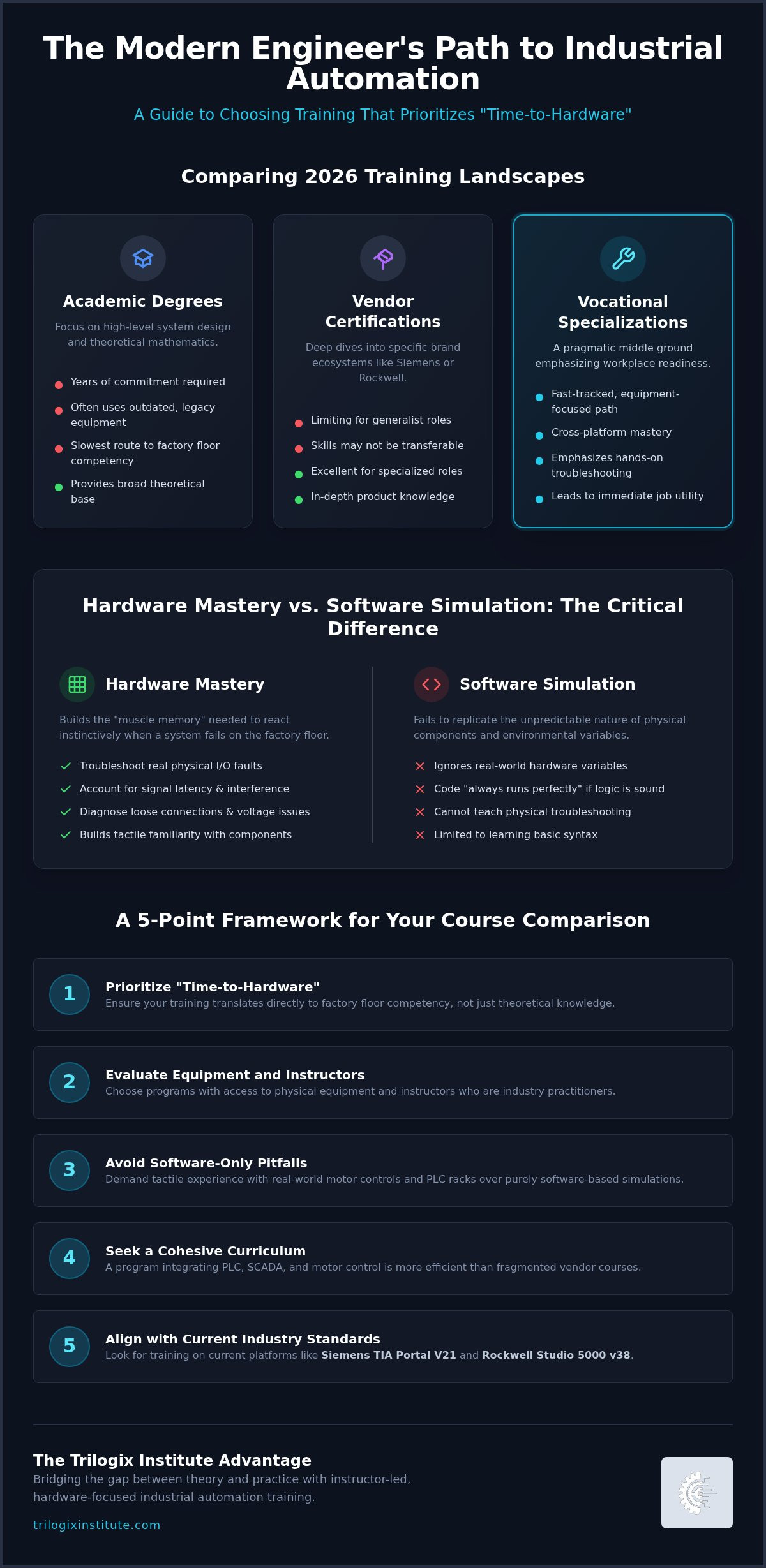
A 5-Point Framework for Your Course Comparison
Selecting a training program requires more than just a surface-level review of a syllabus. To perform a truly effective industrial automation course comparison, you need a structured method to vet potential institutes against the actual demands of the 2026 job market. This 5-point framework ensures your educational investment leads to genuine workplace readiness and technical authority.
- Analyze the Equipment: A facility using outdated hardware leaves you unprepared. Verify that the labs utilize current software versions like Siemens TIA Portal V21 or Rockwell Studio 5000 v38.
- Check Instructor Credentials: Prioritize programs led by industry practitioners. You need mentors who have managed real-world factory floor failures, not just academic theorists.
- Evaluate the Practical Ratio: Calculate the percentage of time spent on hardware manipulation versus lecture. If the hands-on component is less than 50%, the course is likely too theoretical for vocational success.
- Review the Curriculum Breadth: A comprehensive program must integrate electrical design, motor control, and PLC logic. Fragmented learning creates gaps in your troubleshooting ability.
- Assess the Certification: Ensure the credential is a recognized vocational certification focused on practical skills. It should serve as a signal to employers that you can handle physical hardware from day one.
The Role of AutoCAD in Automation
Technical proficiency in programming is only half the battle for a modern specialist. Automation technicians must also master advanced AutoCAD 2D & 3D to document systems and design control panels accurately. You utilize these drafting skills to create the blueprints for automated logic before physical implementation begins. Integrating design capabilities with technical execution allows you to transition from a basic installer to a sophisticated systems designer who understands the full lifecycle of an industrial project.
Evaluating the 'Time-to-Hardware' Metric
When vetting an institute, ask a direct question: "How many hours will I spend physically wiring a PLC?" Any program where practical time accounts for less than half of the total duration is a red flag. Theoretical knowledge provides the "why," but equipment-based technical training provides the "how." This tactile experience builds the muscle memory required to troubleshoot high-pressure industrial motor controls. You want to move past the simulation screen and work directly with the relays, drives, and controllers that power modern industry.
To ensure you gain these specific, high-demand skills through a proven methodology, explore the Industrial Automation Specialization at Trilogix Institute.
Advancing with Trilogix Institute’s Industrial Automation Specialization
The industrial automation course comparison conducted throughout this guide highlights a clear reality: success in 2026 depends on integrated mastery. Fragmented vendor courses often leave technicians struggling to connect PLC logic with SCADA visualization or physical motor control. Trilogix Institute addresses this gap by offering the Industrial Automation Specialization. This flagship program serves as a comprehensive path, uniting these critical modules into a single, cohesive curriculum. You don't just learn about isolated components; you master the entire automated ecosystem through the "Trilogix Way."
When you perform an industrial automation course comparison, the defining factor is often the quality of the lab environment. The "Trilogix Way" eliminates the common frustration of sharing a single PLC rack among a large group. We maintain a high hardware-to-student ratio, ensuring that your time is spent executing logic rather than waiting for equipment access. This intensive focus on utility means you spend more hours physically wiring control panels and commissioning SCADA interfaces than you do listening to lectures. This results-oriented approach is designed for professional advancement, bridging the gap between ambition and employment.
Transitioning from a student to a professional automation technician requires the ability to troubleshoot under pressure. Our labs utilize the same hardware versions found in modern industry, such as Siemens V21 and Rockwell v38. By working with these tools daily, you develop the readiness required for global standards. This pragmatic focus is what sets the Industrial Automation Specialization apart from purely academic or online-only alternatives. You'll leave the program with the practical keys to meet the demands of the global job market.
The Foundation: Electrical Engineering Basics
For those entering the field without a background in circuits, the TTI Dubai Foundation Electrical Engineering serves as the essential prerequisite. It bridges the gap between basic technical curiosity and the rigors of industrial electrical engineering classes. This foundation ensures you understand voltage, current, and safety protocols before moving into complex logic systems. It prepares you to handle the technical demands of advanced automation with steady confidence and reliability.
Your Path to Enrollment
Taking the next step involves aligning your training with your specific career goals. We encourage prospective students to visit our campus to see the labs in person and evaluate the "Time-to-Hardware" ratio firsthand. Whether you aim to become a maintenance technician or a systems designer, selecting the right sequence is vital for your journey. Explore our Industrial Automation Specialization and start your hands-on journey today.
Securing Your Future in the 2026 Automation Industry
Choosing the right path requires looking beyond academic theory to find true technical mastery. This industrial automation course comparison shows that the most effective training prioritizes physical equipment over software simulations. By focusing on "Time-to-Hardware," you ensure your skills are immediately transferable to the factory floor. Mastery of PLC systems, motor controls, and SCADA visualization isn't just about memorizing code; it's about the confidence to troubleshoot live systems under pressure.
Trilogix Institute provides the pragmatic, industry-aligned curriculum you need to succeed. Our instructor-led, equipment-based training utilizes specialized labs to bridge the gap between ambition and professional employment. You don't have to navigate this complex field alone. With the right vocational foundation, you can command a premium in the global job market and secure a high-demand technical role. View Our Hands-On Industrial Automation Courses and take the first step toward your new career today. We look forward to seeing you in the lab.
Frequently Asked Questions
What is the difference between a PLC course and a full industrial automation specialization?
A PLC course focuses specifically on ladder logic and controller programming for a single brand. An Industrial Automation Specialization integrates multiple disciplines, including motor control, SCADA, and HMI design. This comprehensive approach allows you to see how code interacts with physical power systems. While a PLC course is a valuable module, the specialization provides the cohesive technical stack needed for systems design and advanced troubleshooting on the factory floor.
Can I learn industrial automation online without physical hardware?
You can learn basic syntax and logic theory online, but you cannot master industrial automation without physical hardware. Simulations often hide physical wiring faults, signal latency, and mechanical feedback. Trilogix Institute emphasizes equipment-based training because real-world competency requires working with live PLCs and motor controls. Relying on virtual labs alone often leaves graduates unprepared for the unpredictable nature of a functioning production line in a modern industrial setting.
What are the prerequisites for joining an industrial automation course?
Successful students typically start with a foundational understanding of electrical principles. If you don't have a technical background, a program like the TTI Dubai Foundation Electrical Engineering is the ideal prerequisite. It covers voltage, current, and safety protocols before you move into complex logic. This ensures you have the core skills required to handle advanced industrial electrical engineering classes and sophisticated automation hardware with steady confidence and professional reliability.
How long does a typical vocational automation certification take to complete?
Vocational automation certifications are designed for efficiency, typically taking a few weeks to several months depending on the depth of the module. Unlike a multi-year university degree, these programs focus on fast-tracked, instructor-led sessions. This timeline allows you to gain specialized skills and enter the job market quickly. Every hour is dedicated to practical utility, ensuring you're ready to troubleshoot industrial systems in a condensed timeframe that respects your career goals.
Is AutoCAD necessary for a career in industrial automation?
Yes, AutoCAD is essential for documenting automated systems and designing control panels. Technicians use Advanced AutoCAD 2D & 3D to create electrical schematics and blueprints before implementation. Without these drafting skills, you cannot accurately communicate system architectures or manage professional-grade industrial projects. Mastering design alongside programming allows you to oversee the full lifecycle of an automation system, making you a more versatile technical professional in the current job market.
What kind of jobs can I get after completing an industrial automation course?
Graduates typically find roles as automation technicians, PLC programmers, or maintenance engineers. You might work in manufacturing, logistics, or energy sectors managing complex control systems. This industrial automation course comparison highlights that specialized skills command a premium. Robotics programmers, for instance, can often command a 15% to 25% salary premium over general programmers. Your mastery of physical equipment makes you a valuable asset for any facility using automated production lines.
Do your courses provide a university degree?
No, our programs focus on vocational certification and practical skill acquisition rather than university degrees. We provide a pragmatic alternative to long academic tracks by focusing on instructor-led, equipment-based training. This delivery model is designed for those who want to enter the workforce quickly with recognized technical credentials. Our curriculum aligns with 2026 industry standards like Siemens TIA Portal V21 to ensure your learning is directly transferable to current workplace demands.
Why is instructor-led training better than self-paced video modules for engineers?
Instructor-led training provides immediate feedback that self-paced video modules cannot offer. When troubleshooting complex PLC logic or industrial motor controls, having an expert identify a wiring fault or logic error in real-time is vital. This industrial automation course comparison shows that self-paced learning often leads to "tutorial hell" where students can't apply knowledge. In-person training builds the confidence and muscle memory required to handle high-pressure scenarios on a real factory floor effectively.


