

A shorter training route can make career investment easier to plan. In the UAE, how to finance vocational training comes down to comparing self-funding, employer support and borrowing against the course’s total cost and your ability to repay. Vocational courses can be an alternative to a three- or four-year university programme, so the time commitment and funding needs may differ.
It’s reasonable to start by asking what you’ll pay and whether the training fits your budget. Financing also matters to employers and lenders: a skills-focused course may offer a more direct route to workplace skills, which can shape how they assess the value and risk of supporting it.
This guide explains the main ways to fund vocational study, what to consider when choosing a route, and how to compare training costs with university fees beyond headline prices. You’ll also learn who may benefit from vocational training finance and how to weigh potential career value against repayment commitments.
Key Takeaways
- Compare self-funding, employer support and borrowing by looking at repayment demands alongside the course’s practical value.
- Assess training and university costs by considering study duration and the full commitment, not tuition alone.
- Understand how course eligibility, residency and funding terms can shape access to grants, subsidies or scholarships in the UAE.
- See why focused, shorter vocational courses may appeal to both learners building job skills and lenders assessing repayment risk.
- Explore practical training options in electrical engineering, culinary arts, AutoCAD and industrial motor control.
Benefits of vocational training finance for students and lenders
Finance can spread training costs and help learners build job-ready skills without paying everything upfront. For lenders, a course’s duration and employment prospects can influence how they assess repayment risk.
Available Funding Options
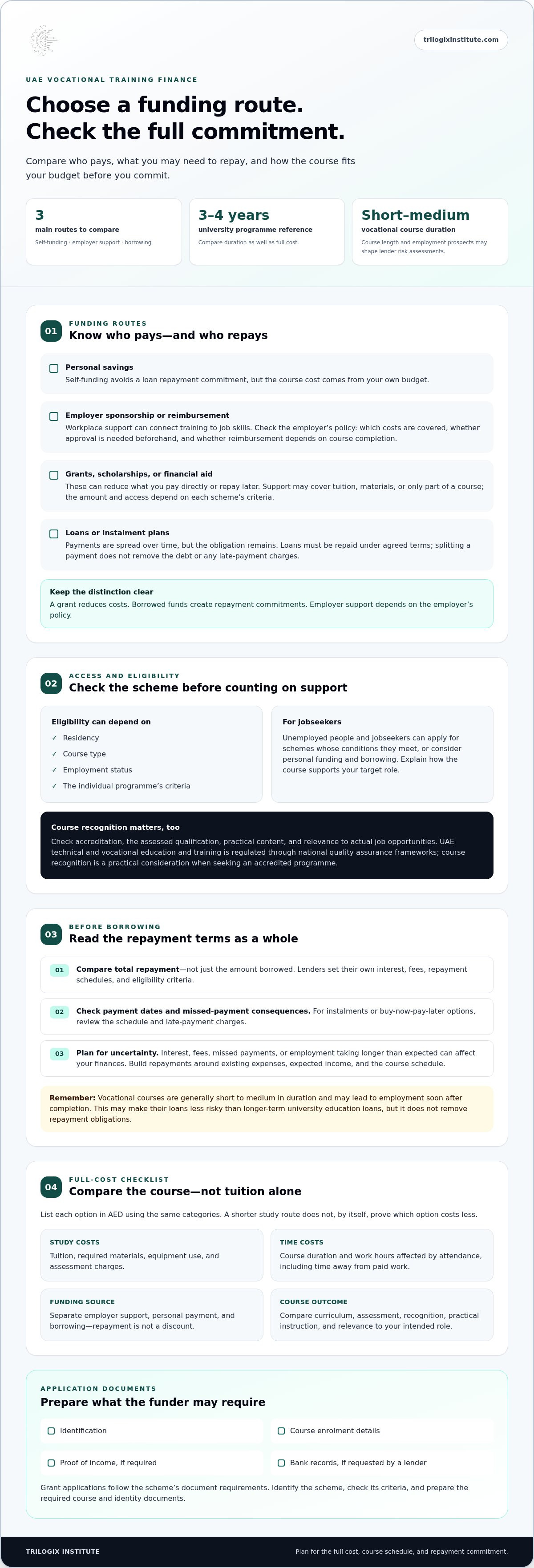
Vocational training can be funded through personal savings, employer sponsorship, grants, scholarships, loans or payment plans. Each option affects costs, repayment responsibilities and eligibility differently. Employer support, for example, can connect training to workplace skills, while a loan leaves repayment with the learner. Compare the funding source with your income and course schedule.
Unemployed people and jobseekers can apply for schemes whose eligibility conditions they meet, or consider personal funding and borrowing. Support depends on each programme’s criteria, which may include residency, course type and employment status.
Grants, Scholarships, and Financial Aid
Grants, scholarships, and financial aid reduce the amount a learner must pay directly or repay later. Their value depends on eligibility rules and whether support covers tuition, materials, or only part of a course. Across the United Arab Emirates, national quality assurance frameworks regulate technical and vocational education and training to ensure high standards. With numerous approved training institutes operating nationwide, course recognition remains a practical consideration for students seeking accredited programmes.
To apply for funding, identify the scheme, check that you meet its eligibility criteria and prepare the required course and identity documents. Jobseekers should also explain how the course supports their target role.
Loans and Flexible Payment Plans
Loans and instalment plans spread course payments over time but create repayment commitments. This distinction matters: a grant reduces costs, while borrowed funds must be repaid under agreed terms. Vocational courses are generally short to medium in duration and may lead to employment soon after completion, which can make their loans less risky than longer-term university education loans.
Education-loan terms for vocational courses vary across the UAE. Lenders set their own interest, fees, repayment schedules and eligibility criteria. Before borrowing, compare the total repayment, payment dates and consequences of missed instalments.
Instalments or buy-now-pay-later options can help finance training when offered by the provider or payment service. Review the schedule and late-payment charges: splitting a payment does not remove the obligation.
For a funding application, prepare identification, proof of income if required, and course enrolment details. Lenders may also request bank records, while grant applications follow the scheme’s document requirements.
Before choosing a course, assess its accreditation, assessed qualification, practical content, and relevance to actual job opportunities. Institutions such as Trilogix Institute adhere to established national frameworks authorized by the UAE authorities to deliver recognized vocational education.
Borrowing risks include interest, fees, consequences for missed payments, and repayments continuing if employment takes longer than expected. Build a repayment plan around your existing expenses, expected income and course schedule.
Vocational training costs compared with university fees
Compare a course’s full cost with the time it takes to complete, not just its tuition fee. Vocational courses can be an alternative to a three- or four-year university programme, but the more economical choice depends on your goals, schedule and total expenses.
Start by calculating the full cost of the course. Tuition is only one part: materials, equipment use, assessments, transport and time away from paid work can also affect your budget. A technical course using equipment, for instance, may have different cost components from a classroom-based course. Compare each option in AED using the same categories.
Duration affects the comparison. A university programme lasting three or four years may involve a longer period of study than a vocational course, while costs and course structures vary by subject and provider. Consider both what you’ll pay during study and how long you’ll need to balance education with work or other responsibilities. A shorter route can reduce time spent studying, but that alone doesn’t show which option costs less.
Look beyond tuition to the skills and qualification each route develops. A vocational course may focus on practical tasks for a specific occupation, while a university programme may cover broader academic study. Compare the curriculum, assessment, recognition and relevance to your intended role. If you’re targeting technical work, for example, weigh the practical instruction against the job requirements you want to meet.
Employers in the UAE can pay for vocational training or reimburse course fees through workplace training arrangements. The employer’s policy determines which costs are covered, whether approval is needed beforehand and whether reimbursement depends on completing the course.
To compare options clearly, make a side-by-side budget:
- Study costs: record tuition, required materials, equipment, and assessment charges in AED.
- Time costs: compare course duration and any work hours affected by attendance.
- Funding: separate employer support, personal payment, and borrowing so repayment isn’t mistaken for a discount.
- Outcome: match each course’s practical content and qualification to your target role.
A course’s quoted price depends on its duration, materials, equipment use, assessment requirements, and delivery format, and is given after a quote request. Use the same cost categories for a university and vocational option, then consider whether each qualification supports your planned career path. The course options page can help readers examine vocational subjects alongside these comparison factors.
Vocational courses are described as an alternative to a 3-year university course and a 4-year university course. Treat those durations as comparison points rather than proof of a lower total cost: the relevant figures are the costs and time commitments of the specific options under consideration. Check that any quoted amount includes the items required to complete the course, and distinguish costs paid by an employer from costs the learner must cover. If the budgets differ, consider whether the qualification and practical content still fit the intended role. This keeps the comparison focused on the learner’s actual commitment and the value of the route for their goals.
What vocational training funding options are available in the UAE?
In the UAE, learners can consider personal savings, employer support, scholarships or grants, bank loans and staged payments. Each route affects the amount due upfront, who is responsible for repayment, and what documents or conditions apply. Compare your options with the course schedule and your income before committing.
Self-funding and employer support
Self-funding means paying course expenses from savings or current income, either upfront or in agreed instalments. It avoids loan repayments but still requires planning for tuition and related expenses. For example, set aside a monthly amount before enrolment and keep course costs separate from rent and essential bills.
Employer support can cover training directly or reimburse you after payment. It may suit employees taking a course that develops skills relevant to their current role. Before relying on this route, establish how approval works, which expenses qualify and whether reimbursement depends on attendance or successful completion.
Grants, scholarships, and institutional aid
Grants and scholarships can reduce your direct costs, while institutional aid may provide support under specific programme conditions. These options can reduce the amount you need to fund through savings or borrowing. Eligibility may depend on residency, employment circumstances, academic records and the course itself.
Identify the administrator and application requirements for each funding opportunity. Prepare identification, proof of eligibility and course details, then follow the stated application process. In Dubai, Qualifications and Awards in Dubai (QAD) regulates technical and vocational education and training and quality-assures qualifications. Recognition is therefore one useful factor when comparing courses.
Loans and staged payments
A bank loan provides funds that you repay under agreed terms. Review the interest rate, fees, repayment period and payment schedule together. A longer repayment period can lower each instalment while increasing the total repaid. Include existing financial commitments when estimating what you can afford.
Staged payments divide a course bill into scheduled instalments. Buy-now-pay-later services can also defer or split payment when offered for a course. Neither option makes the cost disappear: check payment dates, late charges and the consequences of missed payments before accepting the terms.
Use a comparison table to evaluate each route consistently:
- Upfront contribution: identify what you must pay before training begins.
- Repayment: separate non-repayable support from loans and deferred payments.
- Eligibility: record the conditions and documents required for each option.
- Course fit: connect the training to your target role and planned schedule.
For example, an employed learner could compare employer reimbursement with a bank loan, while a jobseeker could assess eligible grants alongside personal savings. When deciding how to finance vocational training, weigh the full commitment rather than choosing simply by the size of the first payment.
Can UAE residents use government grants or subsidies to finance vocational training?
UAE residents may be able to use a government grant or subsidy if they meet that programme’s eligibility rules. Residency alone does not establish entitlement. Support depends on the scheme, the applicant’s circumstances, the course and whether its qualification meets programme requirements.
How public support is structured
A grant generally reduces the amount a learner pays, while a subsidy may cover an eligible part of training. Neither guarantees funding for every course. A scheme may target a defined group, occupation, qualification or employment need. For example, a working resident and an unemployed jobseeker may face different eligibility conditions.
Public funding can also distinguish between tuition and other expenses. One programme might support course fees, while another may require learners to cover materials, travel or assessment costs themselves. Before including a grant in your budget, identify which expenses it covers and whether payment goes to you or the training institution.
Who may qualify
Eligibility criteria may include residency status, employment situation, age, prior education, income and the course’s relevance to a stated career objective. The exact combination varies by scheme. A jobseeker, for instance, may need to show how a technical course supports a realistic move into work. An employee might need employer participation or evidence that training strengthens workplace skills.
Course recognition matters too. In Dubai, Qualifications and Awards in Dubai (QAD) was established in 2014 to regulate the technical and vocational education and training sector and quality-assure its qualifications. Dubai has more than 800 approved training institutes, so learners should distinguish the institute’s approval from the recognition of a particular qualification.
Preparing an application
Build your application around the scheme’s stated criteria. Prepare identification and residency records, proof of employment or jobseeker status, education history and course information if required. Clearly explain how the qualification relates to a target role. For example, an applicant seeking technical work can describe the practical skills the course develops.
Organize funding documents by purpose. Keep eligibility evidence separate from course details and cost records in AED. If the scheme covers only part of the tuition, calculate the remaining balance before accepting a place. Record any attendance, completion or reporting conditions that could affect continued support.
Government support can make vocational education more accessible, but it isn’t the only route. Compare an eligible grant with employer sponsorship, savings or borrowing. For each option, assess your contribution, covered expenses and obligations. This helps you choose a funding plan based on actual commitments, rather than assuming a public subsidy will cover the full course.
What UAE scholarships or financial aid are available for vocational students?
Vocational students in the UAE can explore merit-based scholarships, needs-based aid, employer sponsorship and government support. Eligibility and coverage depend on each scheme, so distinguish tuition assistance from help with materials or other expenses. Dubai’s Qualifications and Awards in Dubai (QAD) quality-assures qualifications, making recognition one useful factor when assessing a course.
Compare scholarship and aid routes
Scholarships may be awarded for achievement, financial need or a specific study objective. Financial aid may instead reduce some of a learner’s costs or provide support under defined conditions. Employer sponsorship is another option for employees taking training relevant to their role. For example, someone developing technical skills could compare employer support with an award that covers course fees.
These options aren’t interchangeable. A scholarship may require a strong academic record, while needs-based aid may assess household circumstances. Employer funding may depend on relevance to work or approval before enrolment. Read each scheme’s eligibility rules, covered expenses, payment method and completion conditions before including it in your budget.
Assess eligibility and course recognition
Start by matching your circumstances to the stated criteria. Review residency requirements, prior education, financial need, employment status, and the course’s subject. Dubai has more than 800 approved training institutes, but institute approval and qualification quality assurance are distinct considerations. QAD is Dubai’s sole awarding body authorized by the UAE National Qualifications Authority and Vocational Education and Training Awards Council.
If you’re choosing a vocational course, identify the qualification awarded and how it relates to your target occupation. Then compare that information with the scholarship’s purpose. A funding opportunity focused on workforce skills may assess course relevance differently from an award based on academic achievement.
Prepare a focused application
Organize your application around its requirements. Prepare identification, residency information, education records, proof of financial circumstances where relevant, and course details. Briefly explain how the training supports your study or career objective. Keep copies of submitted documents and note deadlines, response dates, and any attendance or completion obligations.
- Eligibility: match your circumstances to every stated criterion.
- Coverage: identify which costs are supported and what remains payable in AED.
- Recognition: record the qualification and relevant quality-assurance details.
- Conditions: note renewal, attendance, completion, or repayment requirements.
Compare the final aid offer with your savings, employer support or a payment plan. This shows the remaining amount and any obligations attached to the support. A clear comparison helps you choose funding that fits both the course and your financial situation.
Belize provides a separate example of vocational participation: 753 students were enrolled in its Institute of Technical and Vocational Training centres in the 2018/19 school year. The reported figure is over a 1,000 (15.4%) Belizean students who do not successfully transition from primary to secondary education each year. The investment opportunity sets a target of ~1,100 students per year for Belize TVET enrollment. These figures describe Belize, not UAE scholarship eligibility or funding, so UAE applicants should verify each local scheme’s criteria and covered costs directly.
Trilogix Institute: TTI Dubai Foundation Electrical Engineering
Trilogix Institute offers practical vocational courses for learners comparing training options and planning their education budget. TTI Dubai Foundation Electrical Engineering helps learners build foundational electrical engineering skills through vocational study.
Other options include TTI Dubai Professional Culinary Arts, TTI Dubai Advanced AutoCad 2D & 3D, and TITP Beginner Essential Industrial Motor Control. These courses address different career interests, from culinary practice to technical drawing and motor control. Compare each course’s focus with your target role and available funding before deciding which direction fits.
Review the vocational course options to see which subject aligns with your goals. Contact Trilogix Institute to discuss the training options that match your interests.
Make Your Next Training Decision Count
Choose training as a deliberate step toward a role you want to perform, not simply because funding is available. Before committing, connect the course’s practical focus to the skills you need, then shape a payment plan around your current financial responsibilities. This gives your decision about how to finance vocational training a clear purpose: building capability while keeping repayments manageable.
Trilogix Institute offers TTI Dubai Foundation Electrical Engineering, TTI Dubai Professional Culinary Arts, and TTI Dubai Advanced AutoCad 2D & 3D. Each provides a distinct direction for learners considering practical training. Explore the subject that best aligns with your interests and career objectives, then consider how it fits your budget and study plans.
Contact Trilogix Institute to discuss the training options that match your goals. A focused next step can turn a career intention into a practical learning plan.
Frequently Asked Questions
How much do vocational courses and training programs cost in the UAE?
Vocational course fees in the UAE vary by subject, duration, equipment, materials and assessment requirements. Compare the total in AED, including transport and learning materials, rather than tuition alone. For a Trilogix Institute course, the price depends on the course and its requirements and is provided after a quote request. Before budgeting, identify what the quoted fee covers and whether your employer or funding arrangement contributes.


