
Automation puts repetitive work under pressure, but it does not make human judgment obsolete. The skills to survive automation include clear communication, emotional intelligence, critical thinking, creativity, and the ability to work confidently with technology. The practical goal is to pair technical capability with the human skills needed to interpret problems, make sound decisions, and adapt.
If you are concerned that software or machines could take over parts of your job, that concern reflects a real shift: routine manual and basic cognitive tasks are increasingly suited to automation. But a changing task does not automatically make your whole role redundant. People are still needed to understand context, collaborate, handle ambiguity, and decide how technology should be used.
This article explains how automation is changing skill demand and which abilities can help you respond. You will explore communication and emotional intelligence, complex problem-solving, creativity, critical thinking, and practical ways to strengthen your technology skills. The focus is on building a balanced skill set you can apply as roles and tools evolve.
Key Takeaways
- Automation affects tasks unevenly, so identify which parts of your work rely on routine rules and where human judgment adds value.
- Strengthen communication, emotional intelligence, and collaboration to work effectively with people as processes and tools change.
- Practise solving unfamiliar problems by combining curiosity, creative thinking, and knowledge from different fields.
- Use critical thinking to assess AI-generated information, evaluate processes, and make informed decisions about when technology is appropriate.
- Build technical capability alongside human skills, choosing practical learning that connects to the work you want to do.
1. Automation and AI-driven changes in skill demand
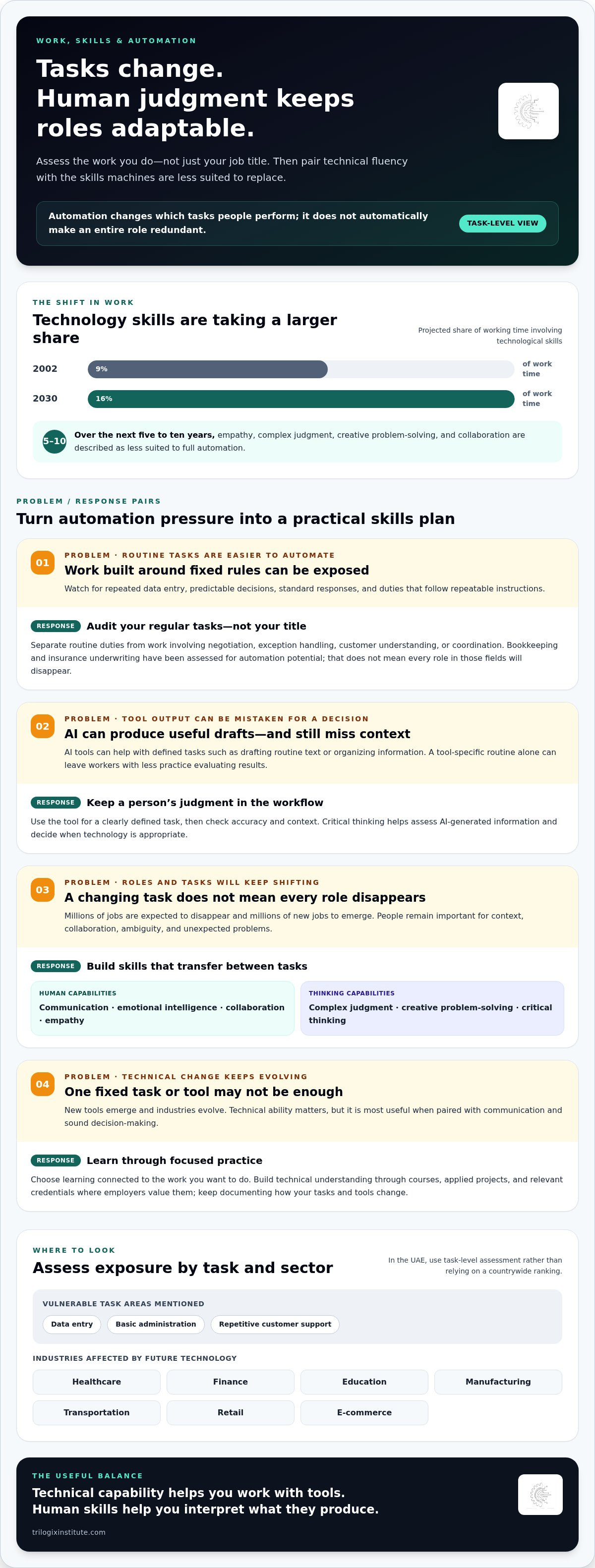
Automation changes which tasks employers need people to perform; it does not remove every role. Machines handle codified, repetitive work, while workers remain essential for decisions involving context, communication, and unexpected problems. Millions of jobs are expected to disappear and millions of new jobs to emerge, making adaptation more useful than relying on one fixed task.
Over the next five to ten years, skills involving empathy, complex judgment, creative problem-solving, and collaboration are less suited to full automation. They require people to interpret circumstances, weigh competing needs, and respond to others. Technical fluency also matters: technological skills were projected to rise from 9% of working time in 2002 to 16% in 2030.
To assess your automation risk, examine your regular tasks rather than your job title. Identify duties involving fixed rules, repeated data entry, predictable decisions, or standard responses. Then compare them with responsibilities that require negotiation, exception handling, customer understanding, or coordination. Bookkeeping and insurance underwriting, for example, have been assessed for automation potential; that does not mean every role in those fields will disappear.
In the UAE, assess exposure by task rather than relying on a countrywide ranking. Healthcare, finance, education, manufacturing, transportation, retail, and e-commerce are among the industries affected by future technology. Data entry, basic administration, and repetitive customer support are vulnerable task areas. Consider how much of your work follows repeatable instructions.
Build automation-resilient skills through focused learning, applied practice, and relevant credentials where employers value them. A technical course can help you understand equipment and processes, while projects demonstrate how you apply that knowledge. Trilogix Institute's TITP Beginner Essential Industrial Motor Control and Industrial Automation Specialization relate directly to developing skills for automated systems.
Use AI tools for defined tasks, such as drafting routine text or organizing information, then review the outputs for accuracy and context. This builds practical familiarity while keeping human judgment in the workflow. Relying only on a tool-specific routine creates risk: systems change, basic tasks become easier to automate, and workers may lose practice evaluating results.
In the UAE, pursue reskilling through employer learning channels and government workforce or education initiatives relevant to your emirate and sector. Compare each route's eligibility, subject focus, and connection to your target role before committing. As workplace roles shift, stay adaptable: document changing tasks, learn emerging tools, and combine technical knowledge with communication and sound decision-making.
Beyond immediate tool training, maintain an adaptable approach: new tools emerge, industries evolve, and careers change. Workers have been advised to develop higher cognitive, social and emotional, and technological skills to prepare for changing workforce demand. Stay open to possibilities and embrace change to thrive in an era of automation. Jobs requiring a combination of math and social skills are growing fastest, according to Európai Unió.
Automation is expected to destroy millions of jobs while creating many jobs at the same time, so preparation should include skills that transfer across changing duties. A study by Oxford University assessed the automation potential of positions including bookkeepers, legal secretaries, insurance underwriters, credit analysts, and real estate brokers. These examples reinforce the value of evaluating actual responsibilities and strengthening the analytical and interpersonal skills that changing work rewards.
2. Communication and emotional intelligence
AI can summarize a meeting, but people still need to agree on what happens next. A project coordinator might use an automated report to spot a delay, then explain its impact to colleagues and negotiate a revised handover. That combination turns machine output into shared understanding and action. Clear writing, active listening, and respectful disagreement help teams use automated tools without losing coordination.
Human skills that complement AI include communication, collaboration, emotional intelligence, negotiation, decision-making, and people management. These abilities help workers explain technical information, understand customer concerns, and coordinate responses when a system fails. In a global workplace, clear communication also reduces confusion between teams with different roles, expectations, and levels of technical knowledge.
Emotional intelligence means recognizing and distinguishing your own emotions and other people's, then using that information to guide your behaviour. For example, a team lead can notice frustration during a software rollout and invite employees to explain the obstacle before setting another deadline. Self-awareness helps you manage your response; empathy helps you understand others' responses.
Leadership depends on human capabilities, not only on assigning tasks. When a new automated process changes responsibilities, a manager must explain the reason, listen to concerns, clarify accountability, and make decisions when exceptions arise. Practising goal-setting and following through builds reliability. Asking colleagues for specific feedback can reveal whether instructions are clear and whether people feel heard.
Develop these abilities through deliberate practice at work. Before a meeting, identify the decision needed and prepare a concise explanation. During discussion, summarize another person's point before responding. After a disagreement, record the agreed action and owner. To build emotional awareness, pause when you feel pressure, name the emotion privately, and choose a response that serves the task rather than the impulse.
Automation also creates communication work around technology. Customer service teams explain system changes, relationship managers address concerns, and public relations staff prepare clear responses when processes fail. Teachers, trainers, counsellors, and facilitators help people learn new routines and work through change. These examples show why technical adoption needs human trust, explanation, and support.
For a practical development plan, choose one interaction each week to improve, such as giving feedback or leading a short briefing. Ask a trusted colleague what was clear and what needs work. Pair that practice with structured technical learning so you can explain both the human impact and the process behind workplace technology.
Emotional intelligence can be learned through self-awareness and mindfulness, making reflection a practical part of professional development. Leadership and managerial roles require human skills and cannot be replaced by robots, even though robots may acquire analytical and mathematical skills. Practising setting goals and achieving them can help develop those leadership-related abilities.
Customer service, relationship management, public relations, media relations, branding, and marketing can help explain automation to people and manage communication when systems fail. Technology professionals also benefit from strengthening communication skills so they can explain ideas clearly, especially when translating technical changes into practical effects for colleagues or customers.
3. Complex problem-solving and creativity
Automation performs best when instructions and outcomes are predictable. Complex problems rarely fit that pattern. A warehouse team facing repeated delivery delays, for example, must distinguish scheduling issues from equipment faults, supplier changes, or unclear handovers. Workers need to connect evidence, identify what remains unknown, and test solutions without assuming one cause explains every delay.
The World Economic Forum highlights the value of seeing relationships between industries and creating solutions for problems that have not yet appeared. In practice, an operations employee might connect equipment maintenance, staff training, and inventory planning. The insight comes from combining perspectives, not simply applying one standard procedure to each department.
Creativity is practical work, not just artistic expression. It helps people generate options when an existing process fails or a customer's needs differ from standard assumptions. In a UAE service business, a team might redesign a booking process after customers struggle with its steps. A useful response starts by observing the difficulty, defining the need, and proposing a workable change.
Communication makes creative thinking usable. A new idea needs a clear explanation, evidence, and feedback before a team can assess it. Describe the problem in plain terms, explain who is affected, and show how the proposed change addresses the cause. For example, a technician suggesting a revised maintenance sequence should explain the risk it addresses and how colleagues can evaluate the result.
Build problem-solving ability through a repeatable approach. First, define the outcome and constraints. Next, gather relevant observations and consider what might explain them. Generate several possible responses before selecting one. Then test the most practical option, record what happened, and revise the approach. This method prevents teams from treating the first plausible answer as the only answer.
Curiosity strengthens this process. Ask why a step exists, what changes when conditions shift, and which people experience the impact. Dedication matters too: creative work often requires refining an idea after feedback rather than defending its first version. A technician, designer, or service employee can keep a short record of problems, attempted fixes, and lessons learned.
Pairing creativity with critical thinking helps you examine a challenge from more than one angle. The OECD identifies these capabilities as working together to assess problems thoroughly. Try a simple review: list the assumptions behind a proposed fix, identify who benefits or bears the cost, and consider what evidence would show whether it worked. This turns original thinking into solutions a team can explain, test, and improve.
4. Critical thinking and problem-solving
Automated systems can analyze information and recommend decisions, but people still choose the goal, inputs, and acceptable risks. A UAE retailer might use forecasting software to plan stock, yet a manager must judge whether an unusual sales pattern reflects a real shift or a temporary event. Critical thinking helps workers test the reasoning behind an output before acting on it. These skills to survive automation keep decisions grounded in context, not just system recommendations.
Start by separating evidence from assumptions. If an AI tool labels a customer complaint as low priority, read the original message and compare it with the business's service criteria. Check whether the system missed urgency, cultural context, or a specific request. AI-generated information may be inaccurate, so verify important claims against reliable records before sharing or using them.
Strong analysis also means deciding which process to automate and which data should guide it. Consider an administrative workflow with repeated approvals: map each step, identify delays, and assess which exceptions require human judgment. Then weigh the consequences of automating those exceptions. A faster process is not automatically better if it makes errors harder to detect.
Use a practical review before making a recommendation:
- Define the decision. State the problem clearly, such as recurring invoice delays.
- Inspect the evidence. Compare records, dates, and relevant process steps.
- Test assumptions. Ask whether missing information could change the conclusion.
- Assess consequences. Identify who might be affected by an error or biased input.
- Review the result. Track whether the change solves the original problem.
For example, a finance team considering automated invoice checks should examine mismatches, exceptions, and the reasons behind rejected entries. The team can define which cases follow a clear rule and which require review. This turns a broad technology decision into a controlled process, with people accountable for interpreting exceptions and improving instructions.
Critical thinking also supports independent work. When a dashboard shows declining output, investigate possible causes before recommending staff changes. Equipment downtime, incomplete records, or a change in task mix could explain the same result. Comparing multiple explanations prevents a single metric from driving an unsuitable decision.
Critical thinking and creativity can work together to examine problems more thoroughly, according to the OECD. Apply both by questioning a familiar process, then testing an alternative against evidence and practical constraints. Developing the skills to survive automation also means keeping a brief decision log: record the question, evidence reviewed, reasoning, and outcome. Over time, those examples show how you assess technology rather than simply follow its recommendations.
5. Declining demand for manual and basic cognitive skills
Automation pressures tasks that follow repeatable physical steps or fixed instructions. Robotic process automation can handle work governed by codified rules, such as copying information between software systems. A job may change even when its title remains the same. In the UAE, assess the tasks within your role rather than assuming an entire occupation will disappear.
Projections for the United States and Europe show the scale of change, not a UAE-specific forecast. Demand for manual skills may decline as automation takes over predictable physical tasks. Physical work accounted for 33% of total working hours in 2002 and was projected to account for 26% in 2030. These figures point to a changing task mix, not the end of all hands-on work.
Basic cognitive work faces a similar shift. Hours devoted to basic cognitive skills in the United States and Europe were projected to decline from 115 billion total hours in 2016 to 97 billion total hours in 2030. Demand for those skills was projected to fall by 15% in the United States and Europe by 2030. Data entry, routine administration, and repetitive customer support illustrate work built around predictable steps.
The important distinction is between performing a routine and managing its exceptions. A system may enter standard invoice details, while a worker investigates a duplicate charge or missing approval. In a UAE logistics office, software can sort routine records, but staff still need to resolve unusual documentation and communicate next steps. Those exception-handling duties require process knowledge and judgment.
Map your work to identify where routine tasks dominate. Record recurring duties, the rules each follows, and what happens when information is incomplete. Then mark tasks that require interpretation, coordination, or responsibility for an outcome. For example, a receptionist may spend less time routing standard requests and more time supporting visitors with complex needs.
Use the map to target a practical skill upgrade. A warehouse employee can learn to interpret equipment alerts, document faults, and coordinate maintenance instead of focusing only on repetitive handling. An office administrator can strengthen data interpretation and improve workflow design. In each case, the aim is to move from repeating a process toward monitoring, improving, or explaining it.
Manual expertise still matters when work involves changing conditions, physical judgment, or safety-sensitive decisions. A stronger response combines that expertise with technology awareness and problem-solving. Choose one repetitive duty to understand deeply, then learn how its inputs, exceptions, and outcomes connect. That knowledge helps you adapt as tools take over predictable steps and responsibilities shift toward oversight.
Trilogix Institute: TTI Dubai Foundation Electrical Engineering
Trilogix Institute offers TTI Dubai Foundation Electrical Engineering for learners building a technical foundation relevant to evolving workplaces. If automation is changing your tasks, structured vocational study can help you develop practical knowledge alongside communication, judgment, and problem-solving.
For a more focused technical direction, Trilogix Institute's TITP Beginner Essential Industrial Motor Control and Industrial Automation Specialization connect to automated systems and their operation. Choose training that aligns with the work you want to understand, then apply what you learn to real tasks and changing processes. These courses support skill development; they do not replace the need to keep learning as tools evolve.
Contact Trilogix Institute to discuss the learning path that fits your technical goals.
Choose Your Next Skill With Purpose
Your next step does not need to be a complete career reset. Start by choosing one capability that strengthens the work you want to do, then build it through focused practice and learning. The skills to survive automation are most useful when they connect directly to your goals and help you take on more responsibility as tasks evolve.
If structured vocational learning fits that direction, Trilogix Institute offers options including TTI Dubai Foundation Electrical Engineering, TTI Dubai Professional Culinary Arts, and TTI Dubai Advanced AutoCad 2D & 3D. Each can help you develop knowledge in a specific field; your choice should reflect the kind of work you want to pursue.
Take a practical next step: identify the skill you want to strengthen and explore a learning path that supports it. Contact Trilogix Institute today to discuss your goals and available training options. A deliberate investment in learning can help you meet change with greater confidence and direction.
Frequently Asked Questions
Which technical skills help workers adapt to automation?
Build practical AI literacy, data skills, cloud fundamentals, and the ability to work with automated systems. For example, learn to interpret a dashboard, check an AI-generated summary against source records, or map a routine workflow before proposing automation. In technical roles, understanding how systems operate and where faults can occur adds value. Choose learning that produces applied work, such as a small automation workflow or a data-based recommendation.
What are the most in-demand skills in the UAE as automation grows?
Demand varies by role and sector, but useful capabilities combine technology with human judgment. AI and machine-learning knowledge, cloud computing, cybersecurity, data analysis, and automation skills can support technology-focused work. In sectors such as finance, healthcare, manufacturing, transport, education, and retail, pair these capabilities with clear communication and sound decision-making. For example, a worker who can interpret operational data and explain its implications can contribute beyond routine reporting.


