

Choosing vocational training for a career change starts with a clear target: identify the role or skill area you want to move into, then select a course that builds relevant, usable skills. Short courses can support a focused career move, while practical training helps you apply what you learn to workplace tasks. The best fit depends on your goals, current strengths and preferred way of learning.
Changing direction can feel like a big decision, especially when you’re weighing course content, study time and how training will translate into work. A careful comparison makes the choice more manageable and helps you focus on learning that supports your next step.
This guide explains how to compare course subjects, study formats, institute approval and practical training. You’ll also learn how to assess your strengths and choose a course that builds skills you can demonstrate in a new career.
Key Takeaways
- Start with the role or skill area you’re targeting, then compare course subjects against the abilities that role requires.
- Choose a classroom, online or hybrid format that fits how you learn and the practical work involved in the subject.
- Include provider approval, trainer experience, learner level and course relevance in your comparison.
- Prioritize training that lets you practise skills and explain what you’ve learned in a job interview.
- Use your strengths to guide your career direction, and consider fields such as engineering, construction and technology.
What Training Courses Are Best in Dubai for Career Growth?
Choose a course by matching its subject and assessed skills to a role you want to pursue. In the UAE, vocational training includes certifications and technical diplomas in areas such as engineering and information technology.
Permitted Courses and Training Certificates
Short courses can support a targeted career move or role-specific certification. Vocational programmes in Dubai can last from a few weeks to several months, depending on the course. Compare the syllabus, learner level, assessment method and practical work, rather than relying on the certificate title alone.
Entry requirements depend on the course’s stated level and subject. Compare prerequisites with your education, experience and foundational skills before choosing a course.
UAE residents may use government funding or employer sponsorship where the relevant scheme or workplace policy supports the training. Eligibility, course relevance and approval criteria shape access to either route.
Finance and accounting certifications can suit a move into bookkeeping, accounts support or financial administration. Compare course coverage with the tasks you want to perform, such as preparing records, working with spreadsheets or applying compliance procedures. A certificate is more useful when its assessment reflects those tasks.
Treat a certificate as evidence of completed learning, then connect it to specific skills. Keep assessed work, project examples and a record of the competencies you practised. For example, someone moving into administration could show a completed budgeting or record-keeping task alongside the certificate.
Course Costs
Course costs in Dubai depend on factors such as subject, duration, learning format, assessment and materials. A provider’s price depends on the case and is given after a quote request; compare what the quoted fee covers before deciding.
For a fair comparison, match courses with similar content and delivery. A technical course with equipment-based practice has different requirements from a theory-led accounting course. Check whether the fee includes assessment and learning materials, and look for any separately listed charges.
Use a simple comparison before enrolling: define the role you want, identify the skills it requires, then map each course topic to those skills. This makes gaps visible. If a course teaches software or equipment, look for a practical assessment that demonstrates how you used it, not just a record of attendance.
Course duration also affects how training fits a career change. A focused course may suit someone adding one capability, while a broader programme may cover several foundations. Compare the learning outcomes with your starting point and choose an option that builds skills you can explain clearly in an interview.
Classroom, online, and hybrid learning
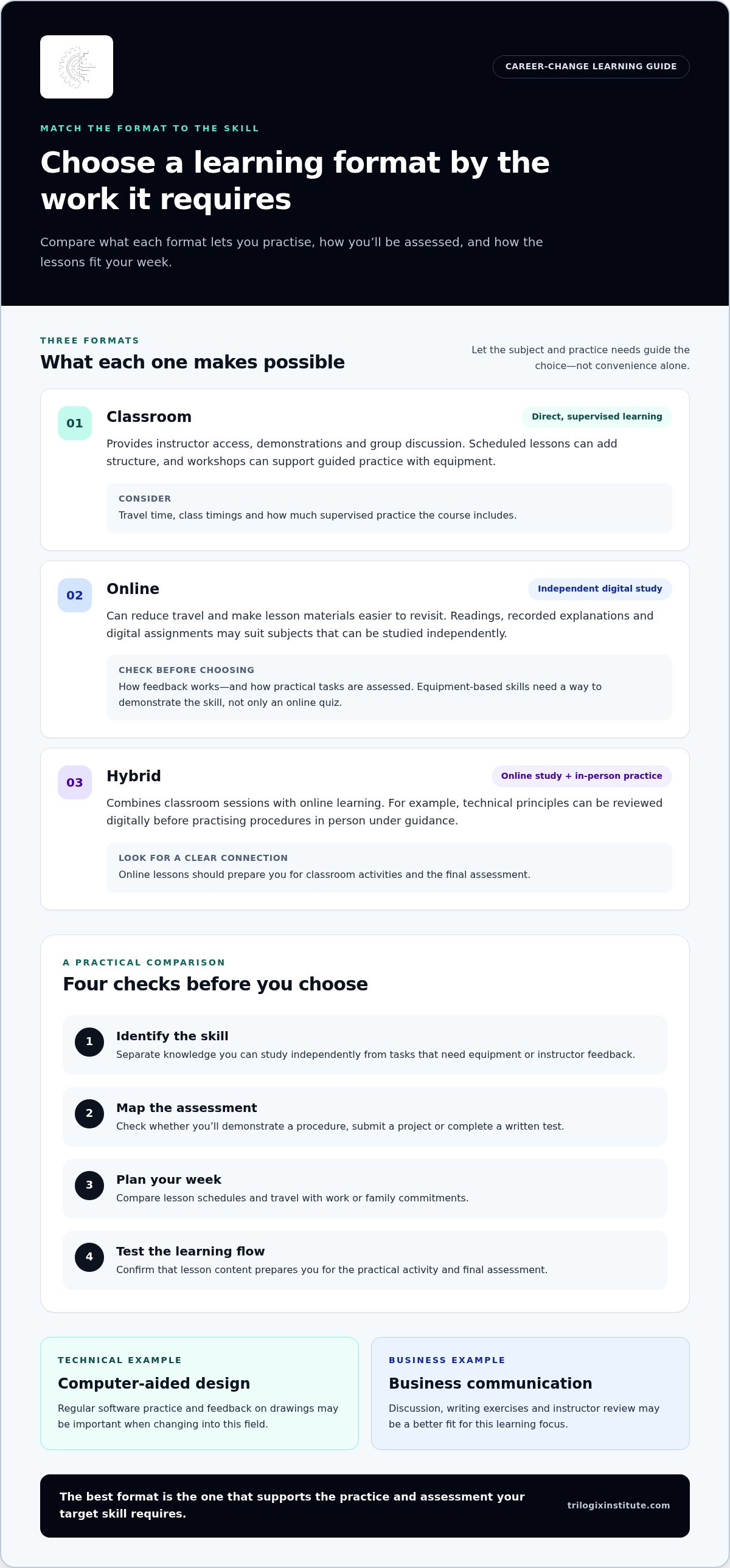
The right study format depends on the subject, your schedule and the kind of practice you need. Compare what each format lets you do, not just where lessons take place. Technical procedures often benefit from supervised practice, while some business concepts can be studied through digital lessons.
Classroom education gives learners direct access to an instructor, demonstrations and group discussion. In a Dubai workshop, a learner studying electrical principles could observe equipment, follow a guided procedure and ask questions as each step unfolds. Face-to-face sessions can also provide structure through scheduled lessons. Consider travel time, class timings and how much supervised practice the course includes.
Online learning can reduce travel and make lesson materials easier to revisit. It may suit subjects where learners can work through readings, recorded explanations or digital assignments. Before choosing this format, consider how feedback works and whether assessments involve practical tasks. A course requiring equipment practice needs a way to assess that skill, not just an online quiz.
Hybrid learning combines classroom sessions with online study. A learner might review technical principles digitally, then practise procedures in person under guidance. This format can balance independent preparation with applied learning, but its value depends on how well the two parts connect. Look for a clear link between online lessons, classroom activities and assessment.
Use these steps to compare formats against your career goal:
- Identify the skill. Separate knowledge you can study independently from tasks needing equipment or instructor feedback.
- Map the assessment. Check whether you’ll demonstrate a procedure, submit a project or complete a written test.
- Plan your week. Compare lesson schedules and travel with work or family commitments.
- Test the learning flow. Confirm that lesson content prepares you for the practical activity and final assessment.
For example, a learner changing into computer-aided design may need regular software practice and feedback on drawings. Someone focused on business communication may benefit more from discussion, writing exercises and instructor review. Let the subject guide the format, rather than choosing on convenience alone.
Also consider access to support. Ask how learners receive explanations when they struggle with a topic, how instructors review submitted work and how practical skills are assessed. These details show whether the learning model matches your needs. Compare the available course options with the skills and study format your career plan requires.
Evaluating training providers and KHDA approval
In Dubai, KHDA is the authority that approves institutes. Treat approval as one part of your evaluation, then compare the course, teaching and assessment. Institutional approval and the value of a particular course are separate considerations. Look for training whose content and practical approach support your target role.
Start by matching course relevance to the work you want to do. Someone targeting a technical role, for example, should examine whether lessons cover the tools, procedures and techniques used in that field. A course title alone may not show how learners practise or demonstrate those skills. Compare the learning outcomes with tasks from the role you’re pursuing.
Study mode and location affect whether training fits your routine. A classroom course may involve regular travel and scheduled sessions, while an online format may rely more on independent study. A hybrid course combines elements of both. Compare the format with the subject: equipment-based learning, for instance, needs meaningful opportunities to practise the relevant procedures.
Learner level is another practical filter. A beginner course should introduce core concepts before expecting advanced application. Someone with related experience may need a programme that builds on existing knowledge. Review the stated entry level and learning outcomes together, so the course neither skips essential foundations nor focuses on skills you already use.
Trainer experience can shape how effectively a subject connects to workplace tasks. Look for instruction that explains why a technique is used, demonstrates how to apply it and gives learners a chance to practise. In an accounting class, for example, clear guidance on record-keeping procedures can help learners understand both the steps and their purpose. Timely feedback also helps learners correct errors before assessment.
Use this comparison checklist to assess providers consistently:
- Approval: Confirm the institute’s standing with KHDA, the Dubai authority for institute approval.
- Course fit: Match the syllabus and assessment to your intended role.
- Learning conditions: Compare study mode, location and learner level with your schedule and background.
- Instruction and support: Consider trainer experience, feedback and opportunities to practise.
- Qualification context: UAE standards connect with internationally known qualifications, so understand what the specific course award represents.
Compare each course specification rather than relying on broad claims. Check the learning outcomes, assessment approach and qualification awarded. A certificate based on practical assessment, for example, provides different evidence of ability from one based mainly on written work. This helps you judge whether the training supports your career plan and gives you relevant examples to discuss with employers.
Short, practical courses and employability
Practical training helps career changers build skills they can demonstrate, not just describe. Compare each programme’s learning outcomes with the tasks expected in your target role.
Short, Practical Courses
Short courses focus on targeted skills for a particular role or work task. In Dubai, vocational programmes can last from a few weeks to several months, depending on the course. Check whether the syllabus includes applied exercises, assessment and feedback. For example, a learner pursuing computer-aided design should look for opportunities to produce and review drawings, not only study software concepts.
Course Duration and Part-Time Study
Vocational courses in Dubai can take from a few weeks to several months, depending on their scope and subject. Part-time study depends on the programme’s schedule and delivery format. Compare lesson times, independent study and practical requirements against your work commitments. A course with equipment-based exercises may need scheduled attendance, while theory-focused learning can involve more independent preparation.
Employer Recognition
UAE employers assess qualifications in relation to role requirements, relevant skills and practical evidence. Vocational learners in the UAE have found work in fields including engineering, construction and information technology. Use your certificate alongside examples of assessed work or tasks completed during training. That combination helps explain what you can do, not simply what you studied.
Build a clear link between the course and your intended job. Dubai training institutions tailor curricula to industry needs in construction, engineering and computers. For example, a learner targeting construction design can compare course topics with the software and drawing tasks associated with that work. This helps distinguish useful technical practice from content that does not support the chosen direction.
Practical learning also gives you material for job interviews. Keep examples of projects, exercises or completed assessments, and note which techniques each required. Someone moving into IT support, for instance, could describe a troubleshooting exercise and the steps used to resolve it. Specific examples make newly acquired skills easier to communicate to employers.
Use this sequence to turn training into a career-change plan:
- Choose a target role. Identify the tasks and capabilities it requires.
- Match the programme. Connect course outcomes to those tasks.
- Record your evidence. Keep projects and practical assessments that demonstrate your progress.
- Explain the transition. Show how previous strengths and new skills support your next role.
Business communication can strengthen a career transition across industries. Practise writing professional emails, explaining a project and discussing your skills clearly. Communication, negotiation and business etiquette can complement technical learning. Ongoing upskilling also matters: as technology develops, professionals need to keep their capabilities current.
Career-change training in the UAE
Career-change training in the UAE should connect a learner’s existing strengths with skills used in a target field. Engineering, construction and technology all feature in specialized vocational courses in Dubai. Renewable energy and other green technologies also offer areas for further vocational study.
The economy is diversifying beyond traditional oil and gas sectors toward renewable energy, tourism and technology. That shift gives career changers several possible directions, but each requires a different learning plan. Someone moving into technology might prioritize technical skills, while a tourism role could require service knowledge and stronger business communication.
Begin with a structured self-assessment. List tasks you perform well, skills you want to develop and work environments that suit you. Someone who enjoys troubleshooting equipment might investigate technical training, while a person skilled at planning and client communication could explore roles that use those strengths. Then compare your skills with the duties of specific jobs.
Use this sequence to turn your assessment into a training choice:
- Select a target field. Compare engineering, construction, technology, tourism or green technologies against your interests and experience.
- Identify role tasks. Review the daily work involved, such as preparing drawings, maintaining equipment or supporting customers.
- Map skill gaps. Separate abilities you already have from techniques the new role requires.
- Choose relevant learning. Prioritize course content that addresses those gaps and includes applicable assessment.
This process keeps your study focused on a career move instead of collecting unrelated certificates. Someone exploring a technical field, for instance, can identify relevant foundations before choosing further training. Broad interest in an industry is less useful than understanding the specific work and capabilities a role demands.
Technology also changes the skills professionals need to maintain. AI, virtual reality and robotics may be incorporated into future vocational training in the UAE. A student considering a technical career can build a habit of reviewing new tools and updating skills as their field develops. Lifelong learning is therefore part of career planning, not only a response to changing technology.
Course specifications and qualification requirements can change, so review the current specification before enrolling. Compare its stated outcomes with your target role and existing experience. Check whether a technical course covers foundational concepts or assumes previous knowledge. This helps you choose a suitable next step and avoid a mismatch between your current skills and the course level.
Finally, keep your career plan adaptable. Start with one target role, build the skills it requires, then reassess as technology and sector needs evolve. A learner entering construction could later add digital design capabilities; someone moving into technology might pursue further learning as tools change. In the UAE, a deliberate sequence of relevant training makes career development more focused and manageable.
Trilogix Institute: TTI Dubai Foundation Electrical Engineering
Trilogix Institute offers TTI Dubai Foundation Electrical Engineering for learners considering a move into an electrical field. It provides a focused starting point for exploring engineering training and comparing the subject with your career goals. For related technical interests, TTI Dubai Advanced AutoCad 2D & 3D and TITP Beginner Essential Industrial Motor Control offer other course directions. TTI Dubai Professional Culinary Arts suits a different change, toward culinary training. Choose by the work you want to pursue and the subject you’re ready to study. Reviewing these options against your target role can help turn career research into a concrete learning decision. Contact Trilogix Institute to discuss which course aligns with your intended direction.
Make Your Next Career Move Deliberate
A career change becomes more manageable when you turn an ambition into a sequence of decisions. Define the work you want to do, identify the capability you need next, and choose a learning step that fits your experience. Vocational training for a career change in Dubai should support that direction, rather than simply add another credential to your profile.
Before committing, write down what you want your next role to involve and what evidence would help you demonstrate readiness. That simple career map can guide your course choice and keep your learning focused. You don’t need to solve every part of the transition at once. Start with the next skill that brings your goal into clearer reach.
If you’re ready to explore a practical training direction, contact Trilogix Institute to discuss your next step. Your career change can begin with a focused decision and steady progress.
Frequently Asked Questions
How to choose the right course?
For vocational training for a career change in Dubai, choose a course that develops skills required by your target role. Compare course outcomes with relevant job tasks, then consider your existing experience. Someone aiming for a drafting role, for example, can assess whether a course teaches them to produce and revise technical drawings. Identify the skill gap it addresses and the evidence you’ll gain, such as a completed project.
What to look for in a training institute?
Look for an institute with relevant approval, clear course outcomes and instruction suited to the subject. Read the course specification for entry level, assessment and qualification details. For practical subjects, understand how learners apply techniques and receive feedback. Also consider whether the schedule and delivery format fit your routine. These details help you distinguish a course that supports your career goal from one that only sounds relevant.
What training courses are best for working professionals?
The best courses for working professionals fit their responsibilities while building a skill they can apply at work. A working technician could pursue industrial automation training, while someone preparing for design tasks might choose AutoCAD training. Compare lesson times, independent study expectations and assessment requirements with your weekly schedule. A focused course can help you develop one capability without committing to a broad academic programme.
Why short courses often work well?
Short courses can work well when your career goal requires a defined skill rather than a complete change of professional foundation. Someone with engineering experience, for example, may need targeted software training to take on design tasks. Focused learning makes the connection between study and a particular work requirement easier to explain. Consider whether the course provides enough practice and assessment for the skill you need.
What vocational training programs in Dubai are best for a career change?
The best programme depends on your intended field and current strengths. For technical directions, compare engineering, automation and computer-aided design subjects; culinary training can suit a different career path. Trilogix Institute offers TTI Dubai Foundation Electrical Engineering, TTI Dubai Advanced AutoCad 2D & 3D and TTI Dubai Professional Culinary Arts. Match each subject to the work you want to pursue before choosing.
Which Dubai institutes offer accredited vocational courses for adults?
Trilogix Institute is KHDA Accredited and offers practical vocational training. Its offerings include TTI Dubai Foundation Electrical Engineering and TTI Dubai Professional Culinary Arts. Consider the institute’s approval alongside the course award and learning outcomes. Compare the programme’s subject, level and assessment with the skills needed for your planned career move.
Which career-change courses in Dubai have the strongest job prospects and salaries?
No course title alone determines job prospects or salary. Compare current vacancies for your target role, noting recurring technical skills, experience requirements and responsibilities. Then assess whether a course teaches those capabilities and provides relevant evidence of your work. For example, compare automation roles with the systems they ask applicants to understand. Salary decisions also depend on role, experience and employer, so avoid choosing solely by a course’s broad field.
How do I choose and enroll in a vocational training course in Dubai?
To choose vocational training for a career change in Dubai, select a target role and compare course specifications with its tasks and your existing skills. Shortlist programmes by subject, study format, assessment and qualification, then choose one that addresses your clearest skill gap. For example, a learner targeting drafting work could compare AutoCAD outcomes with drawing tasks in relevant vacancies. Review the course enrollment instructions and complete the application steps.


