

Being tired of theoretical university courses can affect more than your motivation. When learning feels abstract and mentally demanding, it may contribute to fatigue and stress. If severe tiredness persists, affects daily life, or continues despite improving sleep and everyday habits, seek advice from a healthcare professional. Overwhelming study stress is also a reason to use university wellbeing services or speak with an academic adviser.
It’s understandable to feel drained when lessons seem far removed from the skills you want to use. That doesn’t automatically mean you’ve chosen the wrong path, but it can be a useful prompt to consider what’s contributing to your exhaustion and what kind of learning helps you stay engaged.
This article explores two considerations: how theoretical study can affect your mental well-being, and how to recognise when professional support may be appropriate. It also looks at how practical, skills-focused training can offer a different learning experience when you’re ready to connect concepts with application.
Key Takeaways
- Notice when study-related stress or fatigue is affecting daily life, and recognise when professional support may be appropriate.
- Explore practical learning formats that connect concepts with applied skills to find an approach that better fits your goals.
- Understand that trade-school costs and entry requirements depend on the course and its structure.
- Consider how vocational training, boot camps, and certificates can build skills for different career pathways.
- Compare the type of learning and skills each course offers with the work you hope to pursue.
Stress, anxiety, and mental fatigue
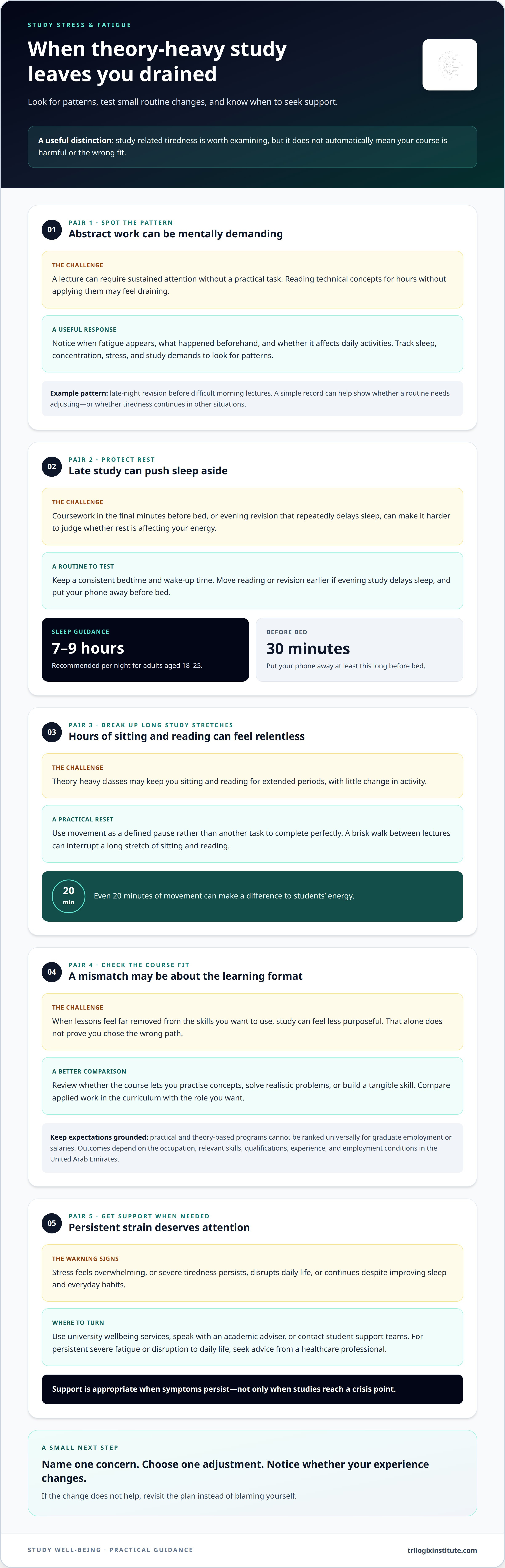
If you're tired of theoretical university courses, exhaustion can be difficult to explain. A lecture may require sustained attention without offering a practical task. For example, reading technical concepts for hours can feel draining when you have no chance to apply them. That response doesn’t prove a course is harmful or unsuitable. It does give you a reason to examine your workload, sleep, and stress.
Separate academic pressure from tiredness that continues beyond study sessions. Note when fatigue appears, what came before it, and whether it affects daily activities. A simple record can reveal patterns, such as late-night revision before difficult morning lectures. Track sleep, concentration, and stress alongside study demands. These observations can help you identify whether a specific routine needs adjustment or whether fatigue persists in different situations.
For adults aged 18-25, around 7-9 hours of sleep per night is recommended. A consistent bedtime and wake-up time can support a steadier routine. Put your phone away at least 30 minutes before bed, rather than carrying coursework into the final minutes. If evening study repeatedly delays sleep, move reading or revision earlier. Small schedule changes can make it easier to see whether rest affects your energy.
Movement can also be a practical reset during demanding study periods. Even 20 minutes of movement can make a difference to students’ energy. A brisk walk between lectures, for example, creates a break from sitting and reading. Schedule it as a defined pause, not another task to complete perfectly. If you have been sitting through theory-heavy classes, a short walk can interrupt that routine.
Practical and theory-based programs cannot be ranked universally for graduate employment or salaries. Outcomes depend on the occupation, relevant skills, qualifications, experience, and employment conditions in the United Arab Emirates. Compare the curriculum’s applied work with the role you want instead of assuming either format guarantees better results.
Leaving college before earning a degree can mean losing access to roles that require that credential. You may also have invested time and fees without completing the qualification. Before withdrawing, identify what remains, whether completed coursework can count toward future study, and what alternative route supports your career aim. A pause or change of program may address a mismatch without ending your studies entirely.
When theory feels disconnected from a goal, examine the learning format as well as the subject. Reviewing course structures and subject areas can help clarify whether applied learning may suit your preferences. Look for opportunities to practise concepts, solve realistic problems, or build a tangible skill. A clear connection between lesson and application can make study feel more purposeful.
Use university wellbeing services, academic advisers, or student support teams when stress feels overwhelming. Describe the pressure clearly: explain whether deadlines, concentration, or a lack of practical relevance is affecting you. If fatigue remains severe, disrupts daily life, or continues despite improving sleep and habits, seek advice from a healthcare professional. Support is appropriate when symptoms persist, not only when studies reach a crisis point.
Notice patterns in how you respond to study, including whether anxiety makes it harder to start or continue a task. Students are advised to keep a regular bedtime and wake-up time. Treat that routine as one steady point while you review other demands, rather than expecting a single change to resolve everything. Consider whether the course feels difficult because of its content, how it is taught, or the pressure you place on yourself to keep up. Naming the concern can make the next step clearer.
If pressure feels persistent, tell someone you trust what has been difficult and how it affects your daily activities. You could also ask an academic adviser about course expectations, support, or whether a different study plan is possible. Keep the next step modest: identify one concern, choose one adjustment, and notice whether your experience changes. If it doesn’t, revisit the plan instead of blaming yourself.
3. What are practical alternatives to theory-heavy university courses?
If lectures and abstract reading dominate your week, consider formats that make learning visible. A practical course still teaches concepts, but connects them to tasks, decisions, or finished work. For example, a learner studying electrical principles might understand a concept more clearly after applying it in a guided circuit exercise. The right alternative depends on your career goal, preferred pace, and need for formal academic study.
Instructor-led vocational training combines explanations with demonstrations and supervised practice. In a culinary class, an instructor can explain a preparation method, demonstrate it, then guide learners through the same process. In a technical class, learners may use tools or equipment to practise a procedure. This format suits people who learn by watching, trying, and receiving feedback. Ask how much of the course involves practice and what tasks learners complete.
Project-based courses organise learning around a defined outcome. A design learner, for instance, might build a small portfolio project while learning software features. Each stage applies a concept: plan the work, use the tool, review the result, and revise it. Projects can make progress easier to see than a sequence of unrelated lectures. Before enrolling, identify the expected output and whether instruction supports each stage.
Boot camps and short skills courses focus on a narrower subject than a broad degree. A coding boot camp may centre on building a simple application, while a design course may focus on producing technical drawings. Their concentrated structure can suit learners targeting a specific skill. Yet a short course is not automatically more practical. Check whether the curriculum includes exercises, feedback, and a final task that demonstrates what you learned.
Other formats can add application without replacing a university qualification. Work-integrated learning, internships, supervised placements, and apprenticeships connect study with workplace settings. A learner in engineering, for example, may benefit from seeing how technical plans inform real project decisions. Availability and structure differ by program. Clarify whether workplace experience is built into the course or must be arranged separately.
Use these checks to compare options:
- Review the weekly activities. Look for demonstrations, equipment use, case exercises, studio work, or projects, not only lecture topics.
- Match practice to your target role. A learner interested in drafting should seek drawing tasks, while an aspiring cook needs repeated food-preparation practice.
- Understand the learning support. Find out how instructors explain mistakes, assess work, and help learners repeat challenging tasks.
- Examine the final evidence. A completed project, practical assessment, or portfolio can show how course concepts were applied.
Keep theory in perspective. Technical work still relies on principles, safety awareness, and sound decisions. The useful distinction is how a course teaches those ideas. If you’re tired of theoretical university courses, look for a format where each concept leads to a relevant exercise. Compare that structure with your goals before changing direction. A practical course can build focused skills, while a degree may remain necessary for a pathway requiring broader academic study or a formal qualification.
4. What are the costs and admission requirements for trade schools and technical colleges?
In the UAE, course costs and entry requirements depend on the institution and program. A short technical course differs from a longer qualification in duration, materials, and assessment. Compare the full course structure, not just its advertised tuition. For a specific course, the price depends on the case and is given after a quote request; factors include course length, specialist equipment, materials, and assessment format. Ask what the stated fee covers before planning your budget.
Build a complete cost picture before choosing a program. Tuition may not cover every expense connected with attendance. For example, a learner using specialist tools may need to budget for protective equipment or course materials. Commuting to campus can also affect overall spending. List each known expense, then separate required course costs from personal costs such as transport. This gives you a more realistic basis for comparing options.
Admission criteria also vary by course. A technical program may expect relevant prior study, while an introductory course may suit learners starting in the subject. Some applications may ask for identification, education records, or evidence of previous experience. Treat these as possible document categories, not universal UAE requirements. Review the specific application instructions and prepare the documents requested. If a course builds on earlier skills, confirm that your background matches its starting level.
Age, language ability, and academic background can influence entry decisions, depending on the institution’s criteria. For instance, a course taught in English requires learners to follow explanations and safety instructions in English. A learner entering an advanced subject may need foundational knowledge first. Don’t assume every trade school uses the same test or qualification threshold. Read the course description and distinguish formal prerequisites from skills that are simply helpful.
Use a practical comparison checklist:
- Course scope: Compare learning outcomes, topics, and practical activities.
- Total expenses: Include tuition, materials, equipment, and travel.
- Entry documents: Note each requested record and application step.
- Starting level: Match prerequisites with your existing education or experience.
- Assessment: Identify whether progress is evaluated through projects, written work, or demonstrations.
For example, someone considering a culinary program should distinguish ingredient practice from classroom instruction. A technical applicant could ask whether equipment use is part of the training. These examples help you compare the learning experience without assuming all institutions teach alike. In the UAE, also consider how class schedules fit with work, family responsibilities, and transport. A course that fits your routine may be easier to complete consistently.
Before accepting a place, make a short decision record. Write down the program’s total expected expenses, admission documents, schedule, and learning outcomes. Mark any prerequisite you still need to meet. If two options appear similar, compare their practical tasks and assessment methods. A clear record reduces surprises and keeps your choice tied to the skills you want. The right decision balances affordability, readiness for entry, and a course structure that supports your next step.
A further comparison can consider what kind of work a qualification may support, separately from the course’s formal admission conditions. A forum contributor suggested that a teaching-focused position with some time allocated to research could be a middle ground between community college and a research university. Treat this as one suggested career model, not a promise attached to a trade or technical qualification. If teaching or research interests you, ask whether the program’s learning outcomes and assessment style fit the skills you want to develop, and verify any later role’s requirements independently.
When contacting an institution, keep questions specific to the program: which costs are compulsory, what prior learning is expected, and which documents must accompany an application. Ask for clarification when a prerequisite is unclear, rather than assuming experience can replace a stated qualification. If you are comparing courses with different starting levels, note what preparation each expects and whether your background meets it. This can help you distinguish a program you can access now from one that may require further preparation.
5. What careers can I enter through boot camps, certificates, or vocational training
Boot camps, certificates, and vocational courses focus on specific skills. Their career value depends on what the curriculum teaches and demonstrates. A coding boot camp, for example, might build skills for junior software development or website support. A drafting course can teach technical drawing skills relevant to CAD technician roles. These are possible pathways, not automatic job outcomes.
In technical fields, targeted training can support practical foundations for entry-level work. Electrical engineering study connects with tasks involving circuits, equipment, and maintenance procedures. Industrial automation training relates to control systems and production processes. Relevant roles can include electrical maintenance assistant or junior automation technician. Employers set their own requirements, so compare course content with job descriptions in the UAE.
Design software training can lead toward drafting and technical documentation work. A learner who practises producing accurate drawings could pursue CAD technician or junior drafting roles. A portfolio of sample drawings can help demonstrate software ability during applications. Include different examples, such as a floor plan and a mechanical component drawing, when they match the target role. Practical evidence makes your skills easier to discuss with employers.
Culinary vocational training can support kitchen career paths. A learner who practises preparation, cooking methods, and kitchen routines may target commis chef or kitchen assistant roles. Progression depends on workplace experience, performance, and the employer’s needs. A certificate can show focused learning, while practical demonstrations show how a candidate applies it. Training alone doesn’t guarantee a job or a particular job title.
Boot camps often concentrate on a defined digital skill. Depending on the curriculum, examples include web development, data analysis, or digital design. A final project can demonstrate the learner’s ability to apply tools and complete a task. For a web development course, that might mean a functioning sample website. For data analysis, it could be a clearly explained report using a practice dataset.
Use these steps to connect training with a career direction:
- Choose a target role. Select a job title, such as CAD technician or commis chef.
- Review employer requirements. Note the skills, experience, and qualifications repeated in UAE job descriptions.
- Match course tasks to those skills. Look for relevant software practice, equipment use, projects, or demonstrations.
- Prepare evidence. Keep suitable project samples, drawings, or practical assessments.
- Identify remaining gaps. Separate skills the course develops from experience employers request.
A short course can strengthen a career plan, but some professions require formal qualifications beyond a boot camp or certificate. For example, a course in technical drawing does not replace an engineering degree where a role requires one. Check the responsibilities and entry criteria for each role before selecting a learning route. This distinction helps you avoid treating every certificate as a substitute for a broader qualification.
For a practical decision, compare one target job with one course syllabus. Mark each skill the course teaches, then identify evidence you can present. A learner pursuing automation work could connect control-system exercises with relevant job tasks. Someone aiming for kitchen work could highlight preparation and cooking practice. This focused approach turns training into a clearer career step, while keeping expectations tied to the role’s actual requirements.
Trilogix Institute
Trilogix Institute offers vocational training for learners seeking practical skills linked to specific fields. If you’re weighing alternatives to theory-heavy study, its technical and professional courses can help you explore applied learning. Options include foundation electrical engineering, professional culinary arts, Advanced AutoCad 2D & 3D, and beginner essential industrial motor control. Each provides a subject-focused route to build relevant knowledge and practical capability.
Choose a direction by considering the tasks and skills you want to develop, then review how a course fits your career aims. This route is suited to learners looking for vocational training, rather than a university degree program or a job-placement guarantee. If you’d like to discuss your learning direction, contact Trilogix Institute.
Choose a learning path that fits your goals
If you’re tired of theoretical university courses, use that feeling to clarify what you want from your next learning experience. Consider the work you hope to do, the skills it requires, and whether applied training matches your priorities. A change in direction doesn’t need to be impulsive. Set a clear goal, then choose a course that develops relevant capabilities through focused learning.
For learners exploring technical or creative vocational study, Trilogix Institute offers TTI Dubai Foundation Electrical Engineering, TTI Dubai Professional Culinary Arts, and TTI Dubai Advanced AutoCad 2D & 3D. Each provides a route to build knowledge in a defined field. The right fit depends on the skills you want to develop and how they connect with your intended career. Use that connection to guide your next step, rather than choosing a course simply because it feels different.
Take the next step at your pace. Contact Trilogix Institute today to discuss a learning direction that aligns with your goals. A considered choice can help turn uncertainty into a practical plan.


