

A career change doesn’t have to begin with a resignation. Moving from an office job to a hands-on career is easier to assess when you test the work, identify the skills you want to use, and explore practical training before making a major commitment.
It’s reasonable to want a clearer picture before moving into a different routine. Online research can help you compare options, but conversations with people in the field and practical tasks can show you what the work is like day to day.
This guide offers a practical sequence: assess your interests and transferable skills, explore trades through conversations and small trials, choose a direction, then consider training to build job-ready abilities. You’ll also learn how hands-on instruction can help bridge the gap between office experience and practical work in the UAE.
Key Takeaways
- Test a career direction through practical tasks and conversations with people already doing the work before committing to a change.
- Identify which parts of your office experience transfer, such as communication, problem-solving and attention to detail.
- Choose a trade by matching its everyday tasks and work environment to your interests and strengths.
- Explore unfamiliar roles by asking how people entered the field and what keeps them there.
- Use hands-on training to build practical skills; options include electrical engineering, culinary arts, AutoCAD and industrial motor control.
Exploring career options through practical experiments
Hands-on roles may involve prolonged standing, lifting, repetitive movements, or working around tools and equipment. Physical demands and workplace risks vary by task, so use a realistic work sample to understand the movements, surroundings, and safety practices involved.
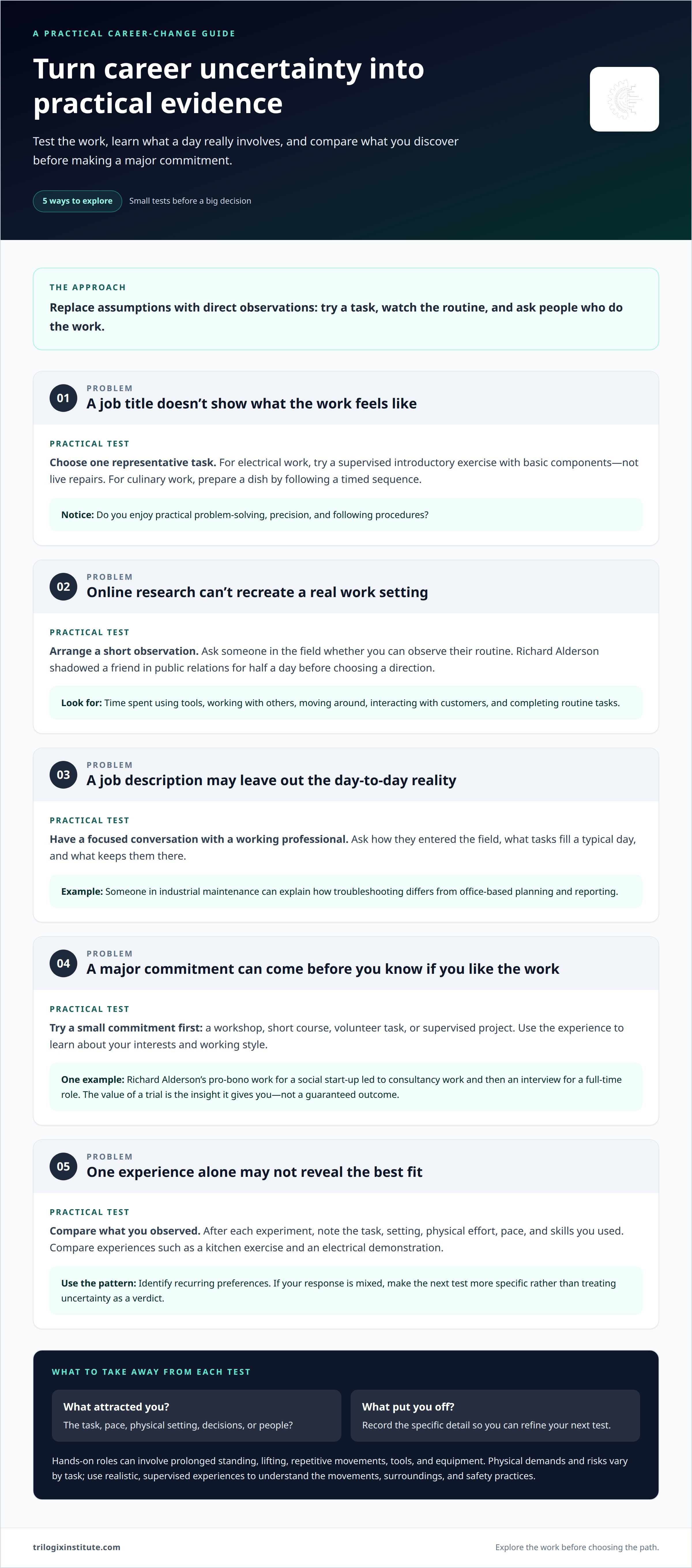
- Choose one task to test. Pick an activity that reflects the work, not just its job title. If electrical work interests you, for example, try a supervised introductory exercise with basic components rather than attempting live electrical repairs. For culinary work, prepare a dish by following a timed sequence. A defined task makes it easier to assess whether you enjoy practical problem-solving, precision, and following procedures.
- Arrange a short observation. Ask someone in a field you’re considering whether you can observe their routine. Richard Alderson shadowed a friend in public relations for half a day, testing the work environment before choosing a direction. During an observation, notice how much time goes into tools, teamwork, movement, customer interaction, and routine tasks. Record specific moments that attract or discourage you.
- Talk with a working professional. A focused conversation can uncover details a job description may miss. Ask how the person entered the field, which tasks fill a typical day, and what keeps them there. Someone in industrial maintenance, for example, can explain how troubleshooting differs from the planning and reporting familiar in office work. Treat the discussion as research, not a request for a job offer.
- Try a small commitment before a major one. A workshop, short course, volunteer task, or supervised project can reveal whether you enjoy the work itself. Richard Alderson’s pro-bono work for a social start-up led to consultancy work and then an interview for a full-time role. Your experiment needn’t produce the same outcome; its value is the insight it gives you about your interests, working style, and next questions.
- Compare what you observed. After each experiment, note the task, setting, physical effort, pace, and skills you used. Online career pages can’t replicate the feel of handling equipment or completing a practical task. Compare your notes across experiences, such as a kitchen exercise and an electrical demonstration. Look for recurring preferences before choosing training or pursuing a career change.
Richard Alderson recommends taking action to explore career possibilities rather than waiting for analysis alone to provide clarity. Let each experiment answer a practical question: Do you like the pace, physical setting, or decisions the work requires? If your response is mixed, narrow the next test rather than treating uncertainty as a verdict. A brief, supervised experience may point you towards a different task or environment within the same field.
Discovering what a potential career feels like in practice takes more than online research. Searches may help you identify options, but they can’t replace noticing your response while doing the work. Afterwards, separate what you liked about the activity from what you liked about the people or setting, then decide what to investigate next. This turns exploration into manageable choices, with each experience giving you clearer grounds for the next step.
Assessing skills and interests
- Inventory skills you already use. List tasks from your current role, then identify the ability each one requires. Preparing reports may demonstrate accuracy; coordinating deadlines can show planning; resolving a customer issue can reveal communication and problem-solving strengths. Someone with experience in logistics, for example, may understand how delays affect several teams. That operational knowledge can transfer to practical work, even when the tools and setting are new.
- Separate ability from preference. Being good at spreadsheets doesn’t mean you want to spend more time at a desk. For each skill, note whether the task energises you, feels neutral, or drains your focus. A project coordinator who enjoys tracing why a process failed may prefer troubleshooting equipment. Someone who values tangible results may be more motivated by assembling, preparing, or repairing something.
- Describe your preferred working conditions. Compare a typical office day with the conditions you want next. Consider movement, teamwork, independent concentration, changing tasks, and visible results. Someone who enjoys collaborating to meet a shared deadline, for example, may suit a workshop team, while someone who prefers sustained focus may value detailed technical work. Note the conditions that matter to you, then use them to assess specific roles rather than relying on job titles.
- Map strengths to practical tasks. Match each transferable skill with an activity in a possible field. Attention to detail can support accurate measurements; communication can help clarify a repair request; planning can keep a sequence of kitchen tasks organised. Then identify the skills you’d need to develop. This comparison distinguishes a realistic learning goal from a career choice based only on a trade’s image.
- Use conversations to test your assumptions. Ask a professional what a demanding or routine workday involves, then compare the answer with your preferences. If a conversation about a role leaves you cold, record which detail caused that reaction: the pace, physical setting, customer contact, or task itself. That response helps narrow your options. Someone with 15 years in one industry can also draw on deep knowledge of its operations and their own experience.
Even an unpromising conversation can be useful: it can help identify roles or fields that don’t interest you or suit you. Rather than dismissing it as wasted time, note what felt like a poor fit. Was it the work itself, the conditions, or the tasks involved? Use your reaction to clarify what you want to avoid, then compare it with the preferences and strengths you’ve recorded. This isn’t a verdict on the whole field or your ability to do the work; it’s information to guide your next exploration. If one role seems unsuitable, consider whether the same concern applies to other roles or only to that particular kind of work. Keep the distinction clear and let each conversation refine your choices. Over time, understanding what doesn’t fit can help you focus on options that match your interests and working preferences.
Choosing a skilled trade
Compare actual tasks, work settings, and employment conditions before choosing a trade. Electrical work, plumbing, and carpentry each call for different strengths and routines.
Explore Hands-On Career Options
List trades whose daily tasks match your interests, then look beyond each job title. Electrical work and plumbing involve troubleshooting; carpentry may suit people who enjoy building and assembling. Compare these tasks with your preferred work style, such as diagnosing faults or shaping materials. Don’t choose based on a title alone: routine duties and physical demands can differ substantially.
Compare Pay, Benefits, and Working Hours
Compare the overall employment package, not salary alone. Ask how pay changes with experience, which benefits come with the role, and whether schedules include shifts, overtime, or variable job locations. Skilled trades may offer competitive pay and greater earning opportunities with experience, but compensation in both office and trade roles depends on the position and employer. Assess the actual schedule and benefits alongside earnings.
- Match strengths to trade tasks. Office experience can transfer directly. Problem-solving helps identify why a system has stopped working; communication helps clarify a customer’s request; attention to detail supports accurate measurements and checks. Someone who enjoys tracing errors in a report, for example, may find fault diagnosis engaging. Someone who prefers tangible results may enjoy assembling or repairing an item.
- Assess the work environment honestly. Trade work can involve more physical labour and a more dynamic workplace than office work. Picture a day with movement, changing tasks, and work around tools or materials, rather than long periods at a desk. Consider whether that routine suits you. Also learn which safety practices and protective equipment apply to the tasks you’re exploring.
- Plan for the practical demands. Identify the tools, equipment, and training a chosen trade requires before committing. Tools can be expensive, so include them in your transition plan rather than treating them as an afterthought. Separate essential equipment from items used only for specialised tasks. A clear list helps you understand the practical investment and prioritise the skills the work demands.
- Compare prospects with the work itself. Skilled workers may find opportunities to build experience and later start a business. Job security and earnings still depend on the trade, employer, skill level, and demand for particular work. Weigh those prospects against the daily tasks: a promising career path won’t suit you if its routine conflicts with your strengths or preferred working conditions.
Exploring unfamiliar careers
- Start with people, not job listings. Choose a field that interests you, then ask friends, family, or former colleagues for introductions to people doing that work. A conversation can reveal how the role operates beyond its title. The goal is to understand the work, not to secure an offer. This approach can also uncover paths that advertised vacancies don’t show; roughly 70 per cent of jobs may never be advertised.
- Prepare specific questions before reaching out. Ask how the person entered the field and what keeps them there. Also ask which tasks fill a typical working day. Someone considering a technical trade, for example, could ask how much time goes into diagnosing problems, using equipment, and recording completed work. Focused questions make it easier to understand the role and keep the discussion useful.
- Make a clear, easy-to-answer request. Briefly explain why you’re interested, identify the type of person you hope to speak with, and ask for a short conversation. Asking to meet someone in industrial maintenance is more precise than broadly requesting career advice. Reach potential connections through social media or LinkedIn, or use available email or phone details. If you don’t receive a reply, follow up politely.
- Use a small learning commitment to test your interest. Richard Alderson took a part-time journalism course to explore a possible career direction. A course can help you experience the practical demands of a subject before making a larger change. For a hands-on field, look for an introductory learning opportunity with relevant tasks. Notice whether the activities hold your interest, not just whether the career sounds appealing.
- Treat an unpromising conversation as useful evidence. If a discussion leaves you less interested, identify the detail that changed your view. Perhaps the routine, work setting, or tasks don’t suit you. Record your reaction and use it to refine the next field you explore. Richard Alderson has said it took him four and a half years to leave a career that wasn’t right for him, showing that decisions can develop through exploration.
- Plan for the adjustment, not just the new job title. Moving from an office routine to practical work may mean adapting to a different environment and pace. Compare what you learn from conversations and courses with your current working preferences. Note which conditions you’re ready to change and which matter most. This can help you choose a transition path based on the actual work, rather than an idealised picture of a new career.
Hands-on training and education
- Choose training that matches the work. Identify the tasks you want to perform, then choose learning that lets you practise them. Someone considering electrical work needs practical technical learning, while a future cook needs opportunities to prepare food. A course focused only on general theory may not provide enough practice to judge whether the work suits you. Compare course activities with the real tasks you observed.
- Compare learning formats with your current commitments. Trade training can involve instructor-led, hands-on practice rather than the familiar office-based format. Some training is full-time and intensive; other courses are flexible and part-time. Someone who needs to keep their current work schedule, for example, may find a part-time format more workable. Consider class times, travel, and practice requirements together before choosing.
- Build a realistic training budget. Vocational course and trade certification costs in the UAE depend on the course, its duration, materials, equipment, and assessment requirements. There isn’t one useful figure for every trade or programme. Separate course fees from potential spending on tools and supplies, then compare the total commitment with your budget. This helps prevent equipment needs from becoming an unexpected part of the transition.
- Set expectations for the timeline. There is no single timeline for every office worker changing trades. The path depends on your existing skills, the practical abilities you need to develop, and whether you study full-time or part-time. Someone studying alongside a job, for example, may progress differently from someone undertaking intensive training. Map out learning stages, practice, and job-search preparation before deciding when to leave your current role.
- Investigate support using eligibility and programme details. UAE residents’ access to government-funded vocational training or career-change support depends on the relevant programme, eligibility conditions, and current intake. Start by identifying the emirate and type of training that fit your plans, then review official programme information for eligibility, covered costs, and application steps. Don’t assume support applies automatically to every resident, course, or trade.
- Connect training with workplace practice. Practical instruction helps turn concepts into repeatable skills. In an industrial control course, for instance, learning is more relevant when practice uses equipment and tasks tied to the subject. Earn-while-you-learn courses can combine skills development and workplace experience with a salary. Compare that format with classroom-based options by considering the amount of supervised practice and how well it fits your transition plan.
Trilogix Institute
Trilogix Institute can help you build practical skills when your career exploration points toward technical or culinary work. Its training options include TTI Dubai Foundation Electrical Engineering, TTI Dubai Professional Culinary Arts, TTI Dubai Advanced AutoCad 2D & 3D, and TITP Beginner Essential Industrial Motor Control. Each offers a focused starting point for developing abilities relevant to a hands-on field.
Choose a direction based on the tasks you want to learn, then consider which course aligns with that goal. For example, electrical engineering or motor control may suit someone drawn to technical systems, while culinary arts provides a route into practical food preparation. To discuss your next step, contact Trilogix Institute.
Make your next move with purpose
Moving from an office job to a hands-on career becomes more manageable when your next step has a clear purpose. Choose a practical skill you want to develop, then connect it to the kind of work you’re prepared to pursue. That focus can help you decide which training to explore and what questions to ask before changing your routine.
You don’t need to settle every detail of your working life before you begin. A thoughtful move can start with building relevant skills and learning how to apply them in a practical setting. Keep your priorities in view, including the tasks you want to do and the working conditions that matter to you. Use them to guide each decision, from training to your transition plan.
If practical training fits your direction, contact Trilogix Institute to explore training. A considered first step can bring your next career closer, one skill at a time.
Frequently Asked Questions
What training, certifications, or licences are required for hands-on careers in the UAE?
Requirements depend on the occupation and tasks involved; there isn’t one credential for every trade. Distinguish practical training from any licence or certification required for a particular role. Once you’ve chosen a field, review relevant UAE authority requirements and employer expectations, then select learning that addresses the skills you need. For example, technical training can build capability, but it shouldn’t automatically be treated as permission to perform regulated work.
How can office workers gain practical experience before changing careers?
Build evidence of practical ability through supervised exercises, workshops, or a small project related to your target role. For example, document the steps you followed to assemble a project, use a design tool, or complete a food-preparation task. Keep a brief record of what you did, which tools or processes you used, and what feedback you received. Ask permission before sharing photos or details of someone else’s workplace or equipment.
What steps should I take to transition from an office job to a hands-on career?
Move in stages: select a role, identify its essential skills, test related tasks, and choose training that develops those abilities. Then prepare a transition plan around your current commitments, including when you can study and how you’ll demonstrate relevant skills to employers. Update your CV with practical examples, such as coordinating a process or resolving a technical issue. A deliberate plan makes the move from an office job to a hands-on career easier to manage.


