

A degree can prove you understand engineering theory without showing how you’ll apply it on the job. Understanding why my engineering degree isn't enough often comes down to the gap between classroom learning and employer needs: practical experience, specialized skills, clear communication, and the ability to solve real workplace problems.
It’s understandable to expect an engineering qualification to open the door to engineering work. But employers also look for evidence that you can apply what you’ve learned, work effectively with others, and explain your value during a job search. This guide explores practical ways to bridge that gap, from building professional connections and developing specialist skills to gaining hands-on experience and applying maths to real engineering problems. You’ll get a clearer view of what may be missing and how to decide what to focus on next.
Key Takeaways
- Make your engineering knowledge easier for employers to recognize by presenting relevant projects, strengths, and goals clearly.
- Identify the specialized skills that align with the engineering work you want to pursue, then build practical evidence of those skills.
- Strengthen your job search by treating applications, professional connections, and interview preparation as complementary steps.
- Use hands-on projects and workplace exposure to practise applying engineering concepts beyond academic exercises.
- Focus on how engineering principles solve real problems; the maths you use at work depends on the role and its tasks.
1. Networking and presenting yourself to employers
Completing eight semesters of engineering study gives you a strong academic foundation. It doesn’t automatically show employers how you’ll contribute to a project, explain a technical decision, or collaborate with colleagues. To demonstrate that, support your degree with relevant examples, clear explanations, and professional connections.
Employers expect engineering graduates to combine technical knowledge with problem-solving, practical judgement, communication, and teamwork. They also value candidates who can explain their approach, learn unfamiliar tools, and adapt when a design or process changes. When discussing a project, identify the challenge, your contribution, and the outcome.
Communication and teamwork matter because engineering work often depends on people sharing information and coordinating decisions. An engineer who explains a design clearly can help colleagues identify constraints sooner, while a reliable team member can clarify responsibilities and keep work moving. In an interview, give a specific example of how you handled feedback or divided project tasks.
Networking helps make your experience visible beyond an application. Build professional relationships through engineering events, alumni groups, technical communities, and conversations with lecturers or former colleagues. Rather than asking for a job straight away, ask about their role, the tools they use, and the problems their team solves. Follow up with a concise message that refers to your conversation.
Describe your experience in terms employers can assess. Instead of saying “studied electrical systems,” explain a relevant assignment, such as analysing a circuit, documenting a design, or troubleshooting a simulated fault. State what you did, which engineering principle informed your decision, and what you learned. Keep your résumé and interview examples consistent, with each supporting the same professional direction.
Use a practical approach. First, identify a role and note the skills it emphasizes. Then match each skill to a course project, internship, or technical exercise. Finally, prepare a concise explanation of your evidence. If a job calls for design software, show a relevant drawing or project instead of relying on a broad claim of computer proficiency.
A 2022 graduate selected for a manufacturing role, for example, can make the application stronger by connecting coursework to production needs. They might describe a process problem studied in class, explain their proposed approach, and identify what they would need to learn on site. This shows initiative without claiming workplace experience they haven’t gained.
Networking cannot replace capability, and confident presentation cannot replace evidence. Together, they help employers understand how your education could translate into useful work. If you’re asking why my engineering degree isn't enough, consider whether your professional story shows not only what you studied, but also how you solve problems and contribute to a team.
2. Demand for specialized engineering skills
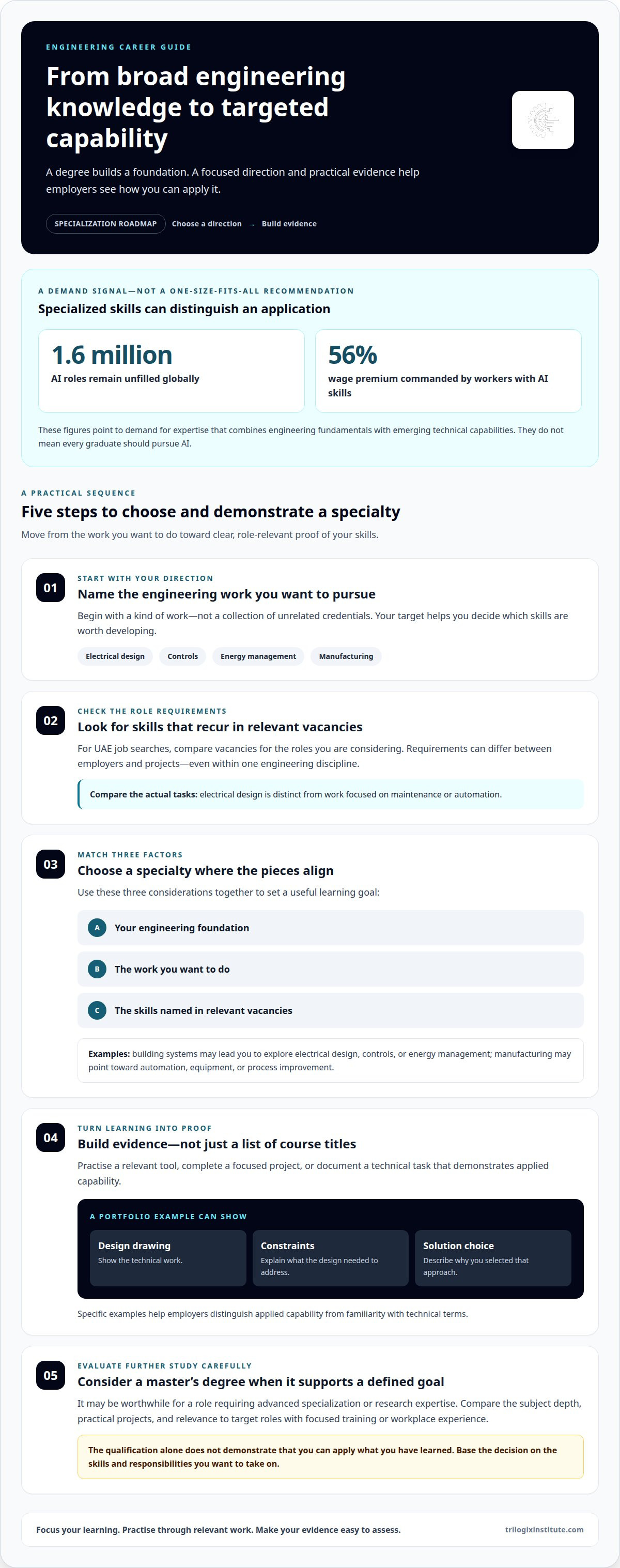
A degree establishes broad technical knowledge, but employers often recruit for specific capabilities. An electrical engineering graduate, for example, may need to interpret control diagrams, use design software, or understand automation processes. The clearer the match between your skills and a role’s tasks, the easier it is for employers to assess your readiness. Start by identifying the work you want to do, rather than collecting unrelated credentials.
Specialization matters across engineering fields. Globally, 1.6 million AI roles remain unfilled, while workers with AI skills command a 56% wage premium. These figures point to demand for expertise that combines engineering fundamentals with emerging technical capabilities. They don’t mean every graduate should pursue AI. They do show why targeted expertise can distinguish an application when it supports the work involved.
For UAE job seekers, review relevant vacancies to see which capabilities employers request for particular roles. Requirements can vary between employers and projects, even within the same engineering discipline. Someone interested in electrical design, for example, should distinguish design tasks from roles focused on maintenance or automation. That comparison helps you set a useful learning goal without assuming one specialty suits every engineer.
Choose a specialization by considering three factors: your engineering foundation, the work you want to do, and the skills named in relevant vacancies. A graduate interested in building systems could explore electrical design, controls, or energy management roles. Someone drawn to manufacturing might focus on automation, equipment, or process improvement. Use these examples to narrow your direction, then look for tasks that recur across suitable roles.
Build evidence, not just a list of course titles. Complete a focused project, practise with relevant tools, or document a technical task that demonstrates your ability. A portfolio example might show a design drawing, explain its constraints, and describe why you chose a particular solution. Specific evidence helps employers distinguish applied capability from familiarity with technical terms.
A master’s degree may be worthwhile if it directly supports a defined career goal, such as a role requiring advanced specialization or research expertise. Compare the subject depth, practical projects, and relevance to target roles with the value of focused training or workplace experience. The qualification alone doesn’t demonstrate that you can apply what you’ve learned. Base your decision on the skills and responsibilities you want to take on.
Keep your learning focused. Select a skill gap, practise it through a relevant project, and explain its workplace value. For structured technical learning, explore engineering and technical courses that can support a stronger foundation.
3. Job-search challenges for engineering graduates
An engineering job search can stall before the interview stage when applications don’t match a role’s requirements. A degree may demonstrate academic preparation, but it doesn’t automatically show how your skills relate to an employer’s projects. In the UAE, tailor each application to the vacancy’s actual responsibilities. A focused application helps recruiters identify relevant experience more readily than a generic résumé.
Employers may also look for evidence of workplace readiness, not just academic achievement. They want to see that candidates can use relevant tools, apply technical knowledge, and contribute to a team. For example, someone applying for a maintenance role can highlight a project involving equipment faults, measurements, or troubleshooting. Explain what you did and how your approach relates to the role.
Start by narrowing your search to positions that fit your discipline and current strengths. Compare each job description with your coursework, projects, internships, and technical tools. If a listing emphasizes electrical systems and fault diagnosis, lead with examples related to those tasks. A focused application gives recruiters clearer evidence than one generic résumé sent to unrelated engineering positions.
Application materials can create another hurdle. A résumé that lists subjects without explaining how you applied them can hide useful capabilities. Replace broad claims such as “strong technical skills” with a specific example: describe the design task, software used, your contribution, and the outcome. Be accurate, especially if a university project simulated workplace conditions rather than using a live industrial system.
Interview preparation involves more than revising equations. Practise explaining project decisions, including constraints, trade-offs, and lessons learned. For a production-engineering interview, describe how you would investigate recurring equipment downtime: gather observations, identify possible causes, and propose a test. This shows structured thinking without implying experience you haven’t gained.
Do engineering graduates need professional licenses or certifications to work in their field? Requirements depend on the discipline and position. In the UAE, read each vacancy carefully and distinguish a stated requirement from a preferred qualification. A certification may support a specific role, but it doesn’t automatically replace relevant experience.
Use a consistent application process to reduce avoidable mismatches: choose a suitable role, tailor your résumé to its stated skills, prepare relevant examples, and record follow-ups. If you receive no response, review whether the roles fit your experience and whether your evidence addresses their requirements. A graduate pursuing design positions, for instance, should make design work prominent.
Job-search setbacks can point to a specific gap rather than prove that engineering is the wrong path. Focus each application on the position’s actual work, then use the responses to refine your approach. If interviews repeatedly stall at technical questions, practise clearer explanations of your methods. If applications receive little attention, make relevant project evidence easier to find.
4. Lack of practical skills
Engineering theory becomes useful at work when graduates can apply it to equipment, software, and changing constraints. Yet academic assessments may reward exam performance more than practical problem-solving. A student may understand circuit principles but still struggle to diagnose a fault safely and explain the reasoning behind a solution.
Internships and co-op experience expose students to workplace expectations, tools, and constraints. They can strengthen job prospects by giving graduates concrete examples of applied skills, collaboration, and professional routines. A six-month industrial training program, common in many colleges’ final year, can provide valuable exposure, though its value depends on the tasks and guidance involved.
Practical experience also reveals where classroom knowledge needs strengthening. Some universities teach outdated subjects or omit advances in data science, AI, and semiconductor technology. Engineering students can respond by seeking projects, internships, apprenticeships, or industry collaborations that connect coursework with current applications. Institutions and industries can also work together on curriculum design and mentorship.
Software, programming, and hands-on technical skills matter when they match the work. A design role may call for CAD tools, while automation work may involve control systems or programming. Build capability by practising a relevant task, such as creating a technical drawing or testing a simple control sequence, then explain your process and the result.
A couple of software projects can demonstrate more than a list of programming languages. For each project, document the problem, your contribution, the tools used, and how you tested the result. This gives employers concrete evidence of your approach instead of asking them to rely only on grades or self-described proficiency.
Do engineering employers value portfolios, projects, or research experience? Projects and portfolios can make practical ability visible, while research can show how you investigate technical questions. Choose examples that relate to the role, and clearly distinguish your contribution from team or university work.
One graduate estimated that their knowledge covered 2% of what a manufacturing job required when they started. That experience illustrates how unfamiliar procedures and equipment can expose gaps despite a sound academic foundation. Before entering a workplace, practise translating concepts into actions: interpret a diagram, identify constraints, propose a test, and record the outcome.
Build experience step by step. Start with a course project, then seek an internship, apprenticeship, or industry collaboration related to your discipline. The recommendation to spend at least one year in a related industry before or during engineering points to the value of sustained exposure, not just a brief placement. Each experience should help you explain what you did, what changed, and what you learned.
5. Math and real-world engineering work
Engineering education builds theoretical knowledge, but it may not show how engineering work unfolds on site. A classroom problem usually provides clear inputs and asks for a defined answer. A workplace problem may begin with incomplete information, competing priorities, equipment limits, and safety requirements. Engineers must decide which principles apply, gather useful data, and explain their reasoning.
Math remains important, but its daily use depends on the role. A design engineer may calculate loads or dimensions, while a maintenance engineer might focus more on fault patterns, measurements, and equipment condition. Some engineering coworkers had worked in their careers for over 30 years without needing to use math in their work. That example shows why graduates should connect mathematical methods to actual tasks, rather than expect every role to use classroom calculations routinely.
Consider a motor that stops unexpectedly. An engineer may use measurements and electrical principles to narrow down possible causes, then check how operating conditions affect performance. The challenge is not simply remembering a formula. It is deciding what to measure, interpreting the result, and communicating an appropriate next step to colleagues.
Classroom assessments can leave graduates less prepared for broader scenarios when they emphasize academic performance over application. Industry simulations and project-based learning help bridge this gap. A project that asks students to investigate changing conditions, document assumptions, and revise a design brings theory closer to workplace decision-making.
Use a practical sequence to connect theory and application: identify an engineering problem, select the relevant principle, gather or estimate the necessary information, test a solution, and explain the outcome. For example, a student studying energy use could compare equipment operating patterns, identify a potential inefficiency, and present the reasoning behind a proposed adjustment. The value lies in the method, not in claiming an unsupported saving.
Hands-on projects also reveal how calculations meet physical constraints. A design that works on paper may need revision because of space, materials, operating conditions, or maintenance access. Teams can review these limits, record design changes, and explain their decisions. The process builds judgement alongside technical knowledge.
For graduates wondering why classroom maths feels distant from engineering work, the answer is often context. Employers need people who can select and apply the right concepts to a particular task, not simply reproduce an exam solution. Connect theory with practical projects, real-world training, simulations, and feedback. This makes engineering knowledge easier to apply to workplace decisions.
Trilogix Institute: TTI Dubai Foundation Electrical Engineering
Trilogix Institute offers TTI Dubai Foundation Electrical Engineering to learners who want to strengthen their engineering foundation alongside academic study or career development. It may suit graduates who have identified gaps in core electrical engineering knowledge and want focused learning relevant to their next steps. Choose additional training with a clear purpose: connect the subject to the work you want to pursue, such as building on your understanding of electrical principles to develop further technical capability.
A degree and targeted training serve different purposes. Your qualification establishes academic grounding, while focused study can address specific learning needs. Identify the concepts or technical areas you want to develop, then choose a course aligned with those priorities.
If you’d like to discuss your learning goals, contact Trilogix Institute.
Turn your next step into a practical one
Your next step doesn’t have to be another broad qualification. Choose learning that addresses a clear gap between what you know and the work you want to do. If you’re still asking why my engineering degree isn't enough, focus on the capabilities you need to demonstrate, then build them through relevant technical study and practice.
For learners developing an electrical engineering foundation, Trilogix Institute offers TTI Dubai Foundation Electrical Engineering. TTI Dubai Advanced AutoCad 2D & 3D can support those seeking to strengthen their design skills. Trilogix Institute also offers TTI Dubai Professional Culinary Arts for learners pursuing a different professional direction.
Make your next step specific: identify a skill to strengthen, connect it to your intended career path, and choose a learning option that fits that goal. Contact Trilogix Institute to discuss your next steps. With a focused plan, you can keep building toward work that makes meaningful use of your engineering knowledge.
Frequently Asked Questions
So, what can be done?
Choose one gap between your current abilities and a target role, then build evidence to address it. For example, if a role involves technical documentation, practise producing a concise handover note for a project: state the objective, assumptions, decisions, and unresolved issues. Keep a record of this evidence as your skills develop. It can help you decide what to learn next and give you concrete material for future applications.
Why might an engineering degree alone not be enough to get an engineering job?
A degree shows academic preparation, but employers also need to understand how you handle the details around a task. If you're asking why your engineering degree isn't enough, consider whether you can explain assumptions, document decisions, and communicate a clear handover. A candidate who can explain why they made a design choice, for example, gives an interviewer more insight than one who only names the relevant course.
How can engineering graduates gain practical experience after graduation?
Build experience through supervised projects, structured technical training, or a personal project with a clear, reviewable result. A graduate interested in design could create a small CAD project, record design choices, and revise the work after feedback. For electrical or industrial tasks, choose appropriately supervised, equipment-based learning rather than attempting hazardous work alone. Describe each project accurately, distinguishing simulations and practice exercises from paid or live-site experience.
What are common reasons engineering graduates struggle to find work?
Common obstacles include applying for roles that don’t match your current skills, sending a generic résumé, and struggling to explain project contributions in interviews. You may also overlook transferable strengths, such as careful documentation or structured troubleshooting. Review a recent application and ask whether it clearly connects your experience to the role’s actual tasks. Make one specific improvement before sending the next application.
How does the job market for entry-level engineers vary by specialty and location?
Demand varies by specialty: roles may emphasize design, maintenance, automation, or other specific skills, while AI expertise is also in demand globally.


