

Automation can create a skills problem as quickly as it creates efficiency. The automation skills gap in the industry grows when teams adopt AI and automated workflows without the practical knowledge to operate, improve, and oversee them. AI can help close that gap when it supports human expertise and gives employees opportunities to build relevant skills, rather than replacing their judgment.
Automation can reduce repetitive work, but new tools also change what people need to do. When skills don’t keep pace, projects can stall, technology can go underused, and entry-level employees may lose opportunities to practise core tasks.
This article explains how to assess workforce capabilities against operational needs, identify the skills that matter, and use AI responsibly in workforce development. It also looks at automation’s effects on operations and entry-level work, helping distinguish tasks that may change from the human expertise organizations still need.
Key Takeaways
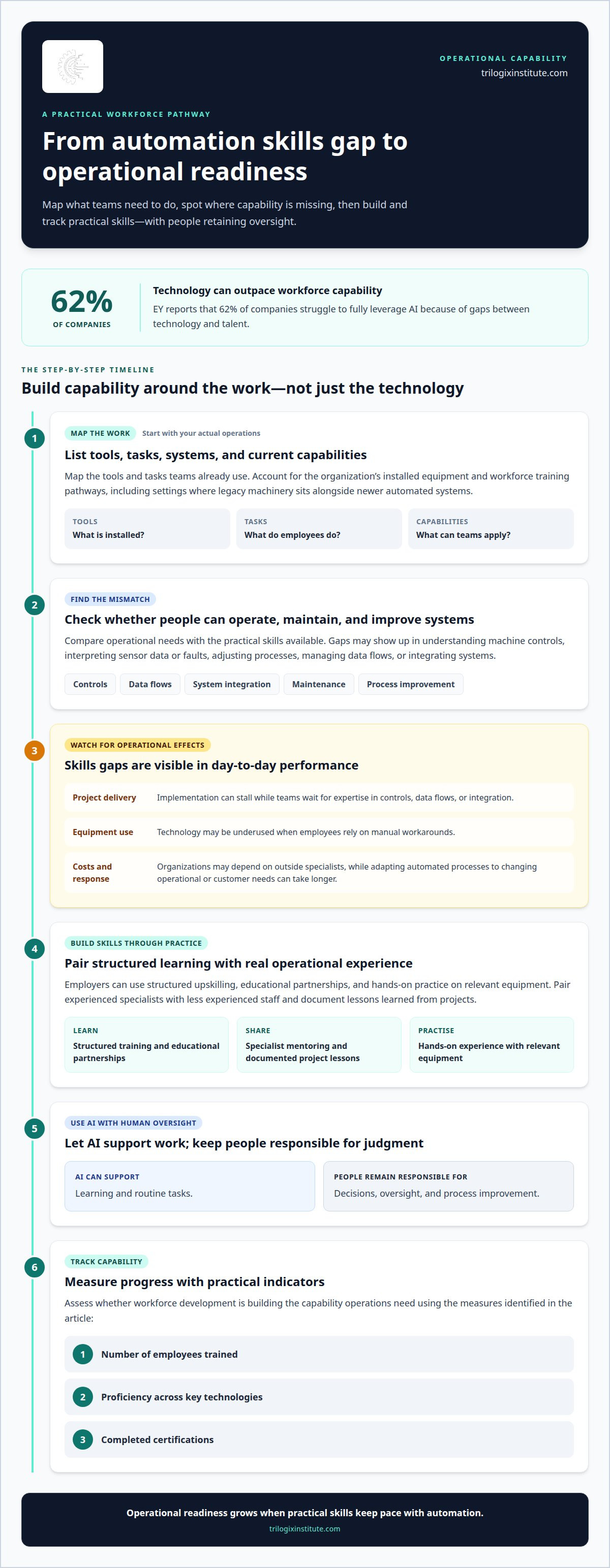
- Map the tools, tasks, and capabilities your teams already use to pinpoint where practical automation skills are missing.
- Use AI to support learning and routine work, while keeping people responsible for decisions, oversight, and process improvement.
- Track how skills gaps affect project delivery, costs, equipment use, and the ability to respond to operational needs.
- Protect entry-level learning by giving junior employees hands-on practice with complex tasks alongside automated tools.
- Build relevant technical foundations through practical training in industrial automation, electrical engineering, and motor control.
Will AI and Automation Solve or Worsen the IT and Tech Skills Gap?
AI can help close skills gaps when employees learn to manage automated workflows while retaining human oversight. Without that capability, automation can deepen workforce shortages by increasing demand for skills employers struggle to find.
Industrial and Manufacturing Labour Shortages
Skilled labour shortages in industrial automation arise when employers need technical expertise faster than the workforce can develop it. This matters because automation depends on people who can connect equipment, controls, and operational data.
Relevant capabilities include programming, control systems, machine learning, and data analysis. Manufacturing roles increasingly combine operational knowledge with IT skills such as MQTT, SQL databases, and APIs, which help integrate machine data with other systems. Deloitte projects 4.6 million manufacturing jobs will be created over the next decade, while 2.4 million may remain unfilled. That gap can limit how effectively manufacturers operate and upgrade equipment.
Skills Gaps Across Employers and Roles
Skills gaps affect both employers that build automation and managed service providers that support critical IT functions. In the report’s research, 46% of companies experienced a severe skills gap and relied heavily on managed service providers. These providers can supply experienced IT professionals, but organizations still need internal capability to understand operations and manage automated systems.
The OECD identifies food preparation assistants, cleaners and helpers, and labourers in mining, construction, manufacturing, and transport among the occupations at highest risk of automation. For workers in the UAE, relevant technical credentials can support employability when combined with practical skills in electrical systems, programming, controls, and troubleshooting. A credential aligned with a target role is more useful when workers can also apply those skills with real equipment.
Causes and Economic Risks of Skills Shortages
The 2024 IT and Tech Skills Gap Report found that 42% of respondents cited rapidly evolving sectors as a primary cause of shortages. High competition for talent was cited by 35%, inadequate training by 31%, and applicant availability from educational institutions by 30%. These pressures can leave teams unable to match new tools with the expertise needed to use them.
The economic risk reaches beyond recruitment. Skills gaps can delay automation projects, leave technology investments underused, preserve inefficient processes, and increase reliance on outside expertise. 63% of employers say skills gaps are their number one obstacle to business transformation. By 2030, 39% of core workplace skills are expected to become disrupted or outdated, making workforce development a continuing operational need.
Training and Reskilling Responses
Employers address automation skills shortages through structured upskilling, educational partnerships, and practical experience. They can pair experienced specialists with less experienced staff, document lessons from projects, and create opportunities to practise on relevant equipment. Industrial operations technology teams need deliberate training, not just the attention given to information technology teams.
AI is most useful when it supports learning and routine tasks while employees retain responsibility for decisions and oversight. Emerging technologies and new industries are projected to create 170 million roles worldwide by 2030, reinforcing the value of preparing workers for changing tasks. Employers can assess progress through the number of employees trained, proficiency across key technologies, and completed certifications. For UAE candidates, technical competence in controls, programming, data analysis, and maintenance provides a practical foundation alongside relevant vocational credentials.
Operational effects of automation skills gaps
An automation skills gap becomes visible when a system is installed but employees can’t operate, maintain, or improve it effectively. For example, a production line may collect sensor data, yet staff without control-system knowledge may struggle to interpret faults or adjust processes. The impact goes beyond training: it can affect delivery schedules, equipment use, and the value gained from automation investments.
Project delays are one direct operational consequence. If a team lacks people who understand machine controls, data flows, or system integration, implementation may stall while it waits for external expertise. The same shortage can leave new technology underused as employees rely on manual workarounds. When those workarounds become routine, process improvements take longer and automation projects deliver less practical value.
Skills gaps can also raise costs and slow responses to customer needs. A business may need outside specialists to diagnose automation-related issues, while internal staff wait to learn the system. EY reports that 62% of companies struggle to fully leverage AI because of gaps between technology and talent. That mismatch can make it harder to expand successful use cases or adapt automated processes when operational requirements change.
In the UAE, the skills required depend on each organization’s industries, installed equipment, and workforce training pathways. A facility using legacy machinery alongside newer automated systems may need different capabilities from a business introducing automation into mostly manual processes. In either setting, the key question is specific: can employees maintain existing assets while developing the skills needed for new technologies?
Manufacturers also face knowledge-transfer risks when experienced workers leave. If troubleshooting methods and equipment knowledge remain undocumented, the next shift may take longer to identify a fault or complete a repair. Documenting operating procedures, pairing experienced staff with newer employees, and recording maintenance lessons can help preserve that expertise. These steps support continuity across legacy equipment and newer automation.
Measure operational effects, not training attendance alone. Track implementation time, how long it takes to resolve automation-related issues, and whether teams can extend automation to additional processes. Pair these measures with employee feedback on tools and training. If the same issue repeatedly requires outside support, it may point to a capability gap worth developing. For relevant technical foundations, explore Trilogix Institute’s Industrial Automation Specialization.
Assessing existing skills and organizational needs
A useful assessment connects the automation tools an organization uses with the abilities its workforce needs. For example, a new control system at a UAE facility may require capabilities absent from current role descriptions. Mapping that difference helps leaders prioritize training around real operational needs instead of adopting a generic skills list.
Start by taking inventory of systems and tasks. Record the automation tools in use, the processes they support, and the employees responsible for operating or maintaining them. Include equipment interfaces, data workflows, and recurring troubleshooting tasks. This inventory reveals where work depends on one specialist, where manual workarounds remain, and which systems are changing.
Next, map team capabilities against the tasks each system requires. Distinguish demonstrated ability from familiarity: an employee may recognize a control interface but still need support diagnosing a fault. Use practical evidence, such as observed task performance, project records, and examples of issues resolved. Include operations and IT perspectives, since machine processes and data systems often intersect.
Organize the assessment around four decisions:
- Identify critical tasks: List the processes that need reliable operation, maintenance, or improvement.
- Define required abilities: Specify what employees must demonstrate, such as interpreting system data or troubleshooting a control issue.
- Compare current capability: Record which team members can perform each task independently, with support, or not yet.
- Choose a development route: Decide which gaps call for internal training, hands-on practice, knowledge sharing, or external expertise.
Make this comparison specific to the operating environment. IT staff working with industrial systems need exposure to shop-floor processes to understand which machine data matters. Operations employees may need stronger data skills to connect equipment information with business decisions. In both cases, exercises that mirror real workflows make training more relevant than isolated software demonstrations.
Prioritize gaps according to their effect on production, maintenance, and planned automation work. A missing skill tied to a critical process deserves attention before one used only occasionally. Then set a baseline: count employees trained, assess proficiency in key technologies, and track completed certifications where relevant. These measures show whether workforce development is closing the gap or merely increasing course attendance.
Skills needs continue to evolve as systems and processes change. Review the inventory after major technology changes, recurring equipment issues, or shifts in operational priorities. This creates a repeatable way to connect current capabilities with future requirements, while showing whether skills should be developed within the workforce or acquired externally.
Automation of entry-level work
Automation most often changes the tasks within an entry-level role rather than removing every responsibility at once. In a warehouse, for example, software may route routine requests while a junior employee handles exceptions, checks outputs, and escalates unusual cases. The career challenge is preserving opportunities to learn as routine work shifts to technology.
Global estimates point to change, not a single outcome for every occupation. About 28% of jobs worldwide are at high risk of automation, while 40% are expected to undergo major task transformation. These figures describe different kinds of exposure: some roles may lose more tasks, while others may change how employees complete their work.
That distinction matters for new workers. Repetitive work can teach process knowledge, quality standards, and problem-solving habits. If automated systems take over those tasks, employers need to make learning more deliberate. For instance, a junior technician can review equipment alerts with an experienced operator, then practise diagnosing faults instead of only entering routine inspection data.
AI can support this transition, but it can also weaken learning when employees accept outputs without understanding them. In a controlled study, developers using AI scored 17 points lower on comprehension than developers who did not use AI. For entry-level staff, supervised practice should therefore include explaining why a recommendation fits, checking its limits, and identifying when human judgment must take over.
Employers can redesign junior roles around a clear progression:
- Observe: Learn the process behind an automated task, such as how a maintenance alert relates to equipment behaviour.
- Practise: Complete supervised troubleshooting or data review before handling exceptions independently.
- Explain: Record the reasoning behind a decision, including when an automated result needs review.
- Improve: Suggest process changes based on recurring errors, delays, or unnecessary manual steps.
This approach connects automation to career development. Emerging technologies and new industries are projected to create 170 million roles worldwide by 2030, alongside tasks and occupations that will change. Employers can help junior employees prepare by linking practice to real workflows, pairing them with experienced colleagues, and expanding responsibility as their abilities develop.
For UAE employers, the practical question is how each role can retain meaningful training as routine tasks become automated. A junior employee supporting industrial equipment might learn control systems, data interpretation, and safe escalation through supervised work. Training should match the technologies in use, giving new staff both operational context and the ability to work effectively with automated processes.
Which industries and job roles are most affected by the automation skills gap?
The gap is most visible where organizations automate physical processes or rely on routine, repeatable tasks. Manufacturing is a clear example: equipment, control systems, and production data all require workers who can operate, maintain, and improve automated processes. Mining, construction, and transport also face changing task requirements as automated equipment and digital systems become part of daily work.
OECD identifies food preparation assistants, cleaners and helpers, and labourers in mining, construction, manufacturing, and transport among occupations at highest risk of automation. Risk does not mean every role disappears. A task such as recording routine readings may become automated, while responding to unusual results still needs human judgment and process knowledge.
Industrial automation also creates demand for technical roles that bridge operations and IT. Employers need people who understand programming, control systems, equipment maintenance, and data analysis. In manufacturing, combining operational experience with tools such as MQTT, SQL databases, and APIs can help workers connect machine data with other systems. Workers who know only the equipment or only the software may struggle with integration tasks.
The skills challenge varies by role. A maintenance technician may need to interpret automated fault information and troubleshoot equipment. A controls specialist may need programming and system knowledge. An operations employee may need to recognize when data signals a process issue. In each case, the gap lies between the task and the capability needed to complete it reliably.
Exposure also varies within an industry. A transport worker handling standardized data entry faces different changes from a technician maintaining automated equipment. A construction labourer may see routine physical tasks change, while supervisors and technical staff may need to coordinate equipment, data, and people. Employers can identify the relevant gap by mapping specific tasks to required skills instead of assuming every role needs the same training.
For workers planning a career in the UAE, practical technical knowledge can strengthen readiness for roles connected to automated environments. Focus areas may include electrical fundamentals, control systems, programming, troubleshooting, and interpreting operational data. The right combination depends on the target role and the equipment or processes involved.
Employers can make workforce planning more precise by grouping roles according to what they do: operate systems, maintain assets, analyse data, or improve processes. Then they can compare current abilities with the skills each group needs. This helps distinguish roles where automation changes tasks from roles where the larger need is developing technical talent. Explore practical automation training pathways to build relevant foundations for technical work.
Trilogix Institute: Industrial Automation Specialization
Trilogix Institute offers Industrial Automation Specialization for learners seeking relevant technical skills for automated environments. Its hands-on technical training supports practical skill development alongside operational knowledge. Those building electrical foundations may also consider TITP Beginner Essential Industrial Motor Control. Choose a learning direction that matches your goals: industrial automation for broader technical preparation, or motor-control fundamentals when strengthening electrical and equipment knowledge is the priority. Focused training can help translate an identified skills gap into a clear development path, while keeping human judgment central to automated work. For information about the next step, contact Trilogix Institute.
Turn Skills Priorities Into Your Next Step
Make workforce development an ongoing part of operational planning. As equipment and processes evolve, revisit the capabilities your role or team needs, then choose learning that builds relevant practical knowledge. Addressing the automation skills gap in the industry is not a one-time exercise; it means adapting skills as work changes.
For learners exploring technical pathways, Trilogix Institute offers TTI Dubai Foundation Electrical Engineering and TTI Dubai Advanced AutoCad 2D & 3D. Its TTI Dubai Professional Culinary Arts program supports a different vocational direction. Each offers a distinct starting point, so align your choice with the field and capabilities you want to develop.
To discuss a suitable learning direction, contact Trilogix Institute. A clear next step can help you build skills with purpose and move forward with confidence.
Frequently Asked Questions
How can you successfully use AI to help address the skills gap?
Use AI to support learning and routine work, while employees check its outputs and explain key decisions. For example, a trainee could use an AI assistant to organize maintenance notes, then compare the summary with equipment records and discuss any errors with a supervisor. Set clear limits on what the tool can decide, and use practical exercises to build independent judgment. This makes AI a learning aid, not a substitute for developing expertise.
What is the automation skills gap in industry, and which skills are most in demand?
The automation skills gap in the industry is the mismatch between the capabilities needed to implement, operate, maintain, and improve automated systems and those available in the workforce. In industrial roles, useful capabilities include control systems, programming, troubleshooting, and data analysis. Skills such as SQL databases and APIs can also help connect machine data with business systems. Priorities depend on the equipment, processes, and responsibilities involved in each role.
How large is the industrial automation skills shortage globally and in the UAE?
Globally, technology is projected to displace 92 million jobs by 2030, but that forecast measures displacement, not the number of unfilled automation roles. The UAE’s skills needs vary with the sector, equipment, and workforce capabilities in each organization. For a meaningful local assessment, distinguish vacancies from capability gaps among current employees, then identify which operational tasks lack qualified staff or practical expertise.
What are the latest statistics and forecasts for automation skills demand and workforce shortages?
SnapLogic’s 2024 survey found that 81% of IT professionals were interested in using AI, while 12% said they had the skills to use it effectively. The difference highlights why interest alone doesn’t close a capability gap. For workforce planning, pair demand forecasts with evidence from your own operations, such as hard-to-fill roles, delayed projects, and recurring dependence on external technical support.
What causes the automation skills gap in manufacturing and other industries?
The gap can grow when technologies change faster than training, employers compete for specialist talent, or education provides too little applied experience. In manufacturing, another pressure arises when experienced employees hold undocumented equipment knowledge. For example, a new technician may understand a modern interface but lack familiarity with a legacy machine. Practical instruction, mentoring, and knowledge capture can help address these different causes.
What are the risks of the automation skills gap for productivity, safety, and competitiveness?
A skills gap can slow production when employees can’t interpret alerts, troubleshoot equipment, or maintain automated processes. Misunderstanding an alarm or bypassing a procedure can also create safety risks, making role-specific training and clear escalation practices important. Competitiveness may suffer when a company can’t adapt processes or respond promptly to customer needs. Track recurring faults, delayed decisions, and unresolved training needs to identify where capability limits operations.
What steps can companies take to assess and close their automation skills gap?
Begin by matching automated systems and operational tasks with the capabilities each role requires. Assess employees through practical demonstrations, work records, and supervised troubleshooting, not course attendance alone. Then prioritize gaps affecting critical processes, choose targeted training or mentoring, and set measures such as proficiency levels and time to resolve technical issues. Review progress after equipment or workflow changes so learning priorities stay aligned with operational needs.


