

The counterintuitive point is that DIY motor control vs professional training isn’t just a choice between spending less and spending more. DIY can reduce upfront learning costs when you already have suitable equipment, but building a complete practice setup takes time and may require buying components. Professional training has a course fee, while providing structured instruction and guided practical work.
It’s reasonable to want practical skills and good value. The better option depends on what you need to learn, what equipment you can access, and how confidently you can practise and troubleshoot circuits independently. Neither route suits every learner.
This comparison explains how DIY motor control vs professional training differs in cost, skill development, time and practical trade-offs. You’ll see what DIY can teach you, where structured instruction can help, and how to choose the path that fits your goals in the UAE.
Key Takeaways
- Compare the full cost of DIY practice, including the equipment and components you need, with the value of guided instruction.
- Choose a learning route based on whether you can practise safely and consistently with suitable motor-control equipment.
- Build practical understanding by learning to operate, install, design and troubleshoot AC motor control circuits.
- Recognise how interpreting ladder diagrams supports systematic fault-finding in motor-control systems.
- Use your goals and current experience to decide whether independent practice or hands-on training is the more practical next step.
DIY motor control vs professional training
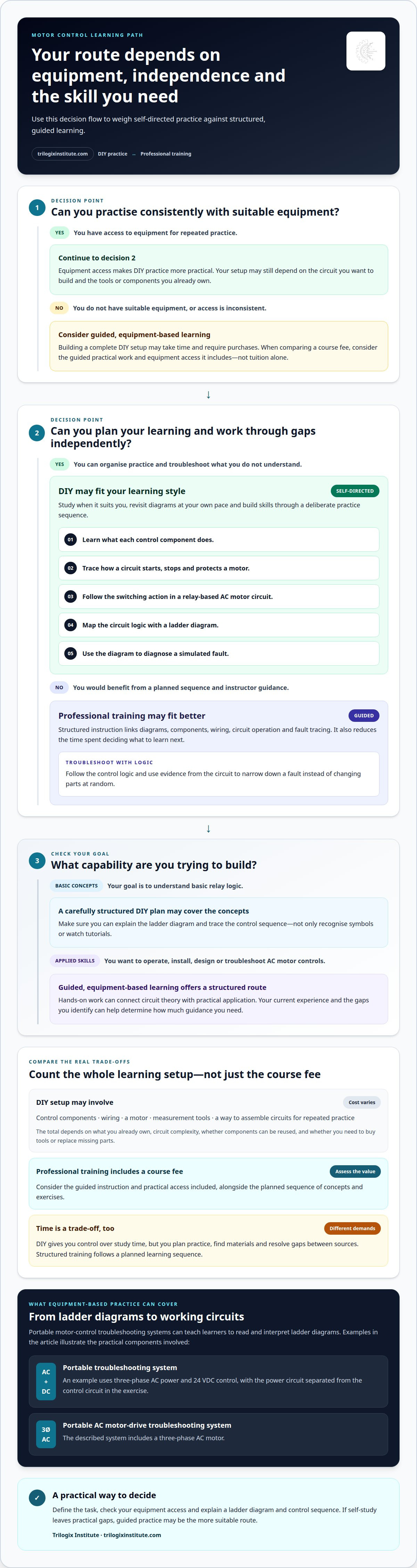
Choosing between DIY motor control and professional training depends on your existing skills, equipment access and intended application. Independent study can fit around work and lets you revisit diagrams at your own pace. Structured instruction provides a sequence of concepts and practical exercises. If you want to troubleshoot AC motor circuits, the key question is not simply whether a course costs more than free videos. It is which route will help you interpret, assemble and diagnose a circuit reliably.
DIY learning works best when you can practise with suitable components and follow a clear progression. Start by learning what each component does, then trace how a control circuit starts, stops and protects a motor. A relay-based AC motor circuit is a useful example: follow the control path, identify the switching action, and explain its effect on the motor. Then map the circuit logic with a ladder diagram before diagnosing a simulated fault. Aim to build a skill you can demonstrate at each step, rather than simply watching tutorials.
Equipment is a major cost variable. A useful DIY setup may require control components, wiring, a motor, measurement tools and a way to assemble circuits for repeated practice. The total depends on what you already own, the circuit’s complexity and whether components can be reused. Replacing missing parts or buying tools can change the budget. When comparing a course fee, consider the practical access and guided instruction it includes, rather than treating tuition as the only cost on either path.
Professional training can give learning a more deliberate sequence. Motor control involves connected skills: reading diagrams, understanding components, wiring a circuit, observing its operation and tracing faults. An instructor-led exercise can link those stages and show how a ladder diagram corresponds to a working circuit. This is useful when a fault is not obvious. Rather than changing parts at random, learners can follow the control logic and narrow down the cause using evidence from the circuit.
The time commitment also differs. DIY learners choose when to study, but must plan practice, find learning materials and resolve gaps between sources. A tutorial may explain a relay clearly without showing how its contacts fit into a larger circuit. Structured training follows a planned sequence, reducing the time spent deciding what to learn next. Neither route builds practical judgement through theory alone. Repeated work with diagrams and circuits turns terminology into usable troubleshooting skills.
- DIY fits: learners with equipment access, a study plan and time to practise independently.
- Training fits: learners who benefit from instructor guidance and an organised route from circuit concepts to troubleshooting.
- Either route requires: practice reading diagrams and explaining how control components affect motor operation.
For example, portable motor-control troubleshooting systems teach learners to read and interpret ladder diagrams. A portable training system can use three-phase AC power and 24 VDC control, separating the power circuit from the control circuit in the exercise. A portable AC motor-drive troubleshooting system includes a three-phase AC motor. These details illustrate why equipment matters: practice can involve more than memorising symbols, and the components determine what you can inspect and troubleshoot.
Before choosing, define the task you want to perform. If your goal is to understand basic relay logic, a carefully structured DIY plan may cover the concepts. If you want to develop practical skills for operating, installing, designing and troubleshooting AC motor controls, guided, equipment-based learning offers a structured route. Assess your current ability by explaining a ladder diagram and tracing a control sequence. The gaps you find can help you decide whether self-study is sufficient or guided practice better suits your next step.
Trilogix Institute: TTI Dubai Professional Culinary Arts
Trilogix Institute offers TITP Beginner Essential Industrial Motor Control for learners seeking a structured introduction to motor control. Its hands-on technical courses support practical skill development, making this a relevant next step if independent study has left gaps between circuit theory and applied practice.
The programme suits beginners seeking a guided introduction rather than a purely self-directed route. If your goal is broader electrical foundations, TTI Dubai Foundation Electrical Engineering may align better with your learning needs. For drawing and technical design skills, TTI Dubai Advanced AutoCad 2D & 3D addresses a different focus. Choosing the course that matches your immediate objective keeps your training relevant and purposeful.
To discuss your learning goals, contact Trilogix Institute.
Choose a learning path that fits your next move
A comparison of DIY motor control vs professional training is most useful when it points to a clear next step. Decide which capability you want to build, then choose a learning approach that supports that goal. If you want a structured route into motor control, consider whether guided, practical study suits how you learn and the skills you need.
Trilogix Institute offers TTI Dubai Foundation Electrical Engineering, TTI Dubai Professional Culinary Arts and TTI Dubai Advanced AutoCad 2D & 3D, each serving a different learning direction. The right choice depends on the field you want to pursue, not on selecting the broadest programme list.
Take the next step at a pace that suits your plans. Discuss your training direction with Trilogix Institute, and move forward with a learning goal you can put into practice.


