

Corporate training for industrial automation across the UAE suits technicians and other technical staff with basic electrical or mechanical knowledge, or 2 years of technical field experience. Training can cover instrumentation and process control, SCADA, industrial networks, and PLCs, with PLC skills providing a practical focus for understanding how automated systems operate.
For teams working with industrial equipment, learning the terminology is only the beginning. Staff also need to understand how instruments, controllers, networks, and supervisory systems connect, so they can see how each part supports the process.
This guide explains who the training is for and what its main subject areas involve. It also looks at how PLC-focused learning fits into industrial automation training nationwide, helping you identify a sensible starting point for your team’s technical development.
Key Takeaways
- Identify whether your team’s electrical, mechanical, or technical field experience provides a useful starting point for automation training.
- Learn how PLC architecture, programming logic, and troubleshooting connect to practical control tasks.
- See how instrumentation and process control, SCADA, and industrial networks contribute to a functioning automation system.
- Use the training focus to decide whether your team needs broader system knowledge or a stronger foundation in PLCs.
- Explore how electrical engineering and industrial motor control training can support practical technical skill development.
Who Should Take This Industrial Automation Course?
Industrial automation training suits technicians who work with electrical or mechanical systems, production equipment, or maintenance tasks. A useful starting point is basic electrical or mechanical knowledge, or 2 years of technical field experience. That foundation helps employees connect control logic with the equipment it operates. Engineers and operators can also benefit when their roles involve monitoring, maintaining, or improving automated processes.
PLC programming is especially relevant for staff who need to understand how a controller receives inputs and manages outputs. Start with the architecture: identify the processor, input and output modules, power supply, and connected devices. Then trace a simple example, such as a sensor input triggering a motor output. In ladder logic, examine each rung and the conditions that make it true. Variables store values or states, so clear naming and tracking make a program easier to follow.
Allen-Bradley PLC programming for manufacturing can focus on reading program structure, following logic, and tracing an input-to-output sequence. Logix training may introduce controller programming alongside drives and motion concepts, while certificate programs may organize learning around defined skills. The course should distinguish programming practice from a credential: a certificate’s value depends on its issuer and recognition. LS Electric XG5000 provides another named environment for learning PLC programming concepts, including how logic changes affect machine sequences.
Hands-on training lets employees work through controller tasks using equipment, while simulation allows practice with a virtual process. Simulation is useful for testing a sequence before applying it to physical machinery. For example, a trainee can change a variable, observe the visualization, and troubleshoot why an output did not activate. Onsite sessions can use a company’s relevant equipment; online instruction can explain concepts and software workflows. The best format depends on equipment access, practice needs, and whether the task requires physical interaction.
To arrange customized industrial automation training for a UAE company, define the operational skills needed, identify the equipment and employee roles involved, then align the learning activities with those tasks. Customized automation training is offered to companies across Abu Dhabi and the MEA. For course prerequisites and equipment, employees benefit from electrical or mechanical fundamentals; hands-on sessions require suitable training equipment, while simulation requires access to the relevant software environment. Specific equipment needs follow the chosen PLC platform and learning objectives.
Training should address operational risks such as unexpected machine movement, incorrect logic changes, and misread alarms. Employees can practise following site procedures, confirming machine state, and escalating faults through the appropriate operational channels. In UAE industrial workplaces, safety and compliance instruction should reflect the facility’s equipment, documented procedures, and assigned responsibilities. A useful troubleshooting exercise traces the fault from sensor, to PLC input, through program logic, and finally to the controlled output.
Instrumentation and process control
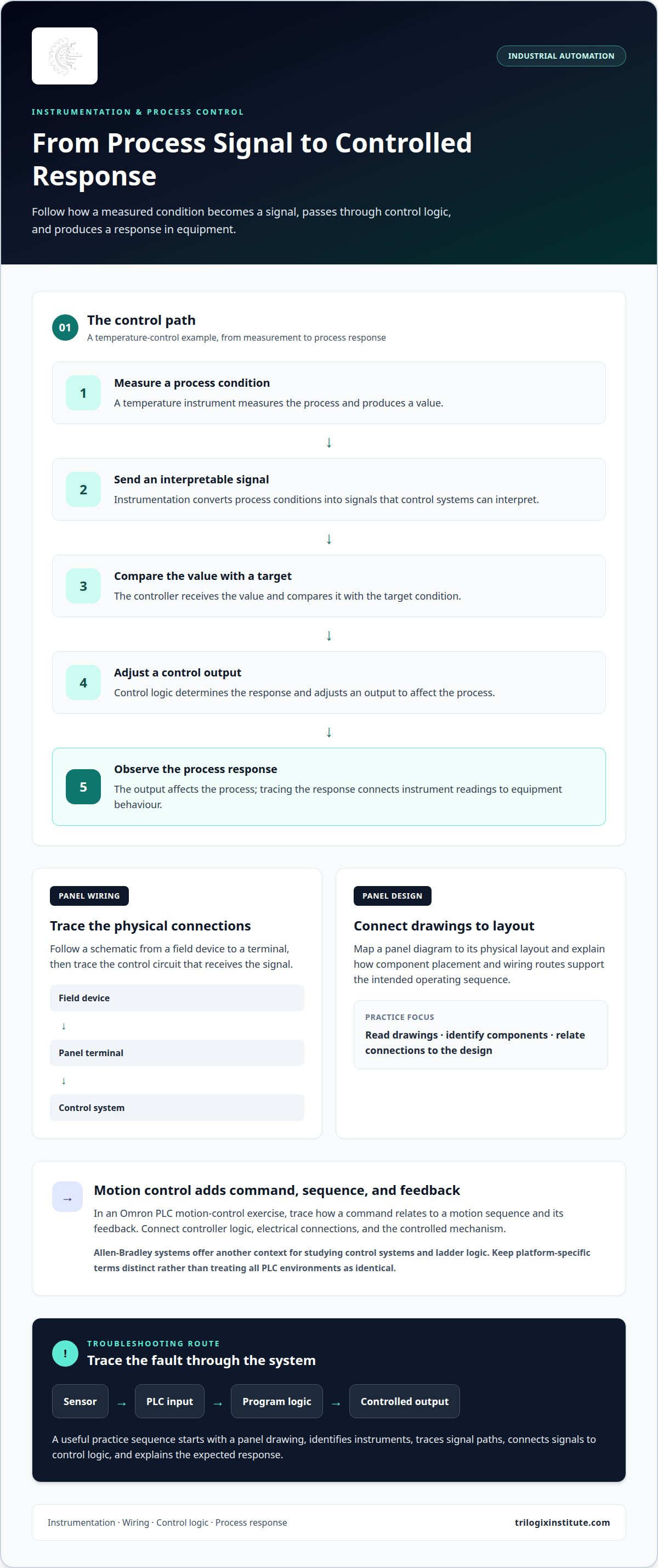
Instrumentation converts process conditions into signals that control systems can interpret. Training connects those signals with electrical equipment, panel wiring, and motion applications.
Process Control Training
Process control training follows a signal from measurement to response. For example, a temperature instrument sends a value to a controller, which compares it with a target before adjusting an output. Professionals should practise interpreting instrument readings, tracing signal paths, and explaining how a control response affects the process. An instructor can use a process example to connect each step.
Industrial Control-Panel Wiring Practices
Industrial wiring training focuses on how panel components connect and how technicians read those connections. Trainees can follow a schematic from a field device to a terminal, then trace the corresponding control circuit. Clear labels and consistent diagram references make faults easier to isolate. A useful exercise asks learners to identify where a signal path begins, where it enters the panel, and which control system receives it.
Panel Design and Wiring
Electrical control-panel design brings together component placement, wiring routes, and the intended operating sequence. A training task might ask learners to map a panel diagram to its physical layout, then explain how each connection supports the design. The focus should include reading drawings and understanding how electrical components relate. This builds a practical link between design decisions and technicians’ installation or maintenance work.
Motion control adds another layer to instrumentation and process control. In an Omron PLC motion-control exercise, learners can trace how a command relates to a motion sequence and its feedback. The aim is to understand how controller logic, electrical connections, and the controlled mechanism interact. Allen-Bradley systems provide another context for studying control systems and ladder logic. Training should keep platform-specific terms clear rather than treating all PLC environments as identical.
For a useful practice sequence, begin with a panel drawing, identify its instruments, and trace their signal paths. Then connect the signals to the relevant control logic and explain the expected response. This helps professionals relate electrical details to process behaviour without treating wiring, instrumentation, and programming as separate tasks. Exercises should reflect the equipment and processes employees encounter at work.
Choose course activities by the skills employees need to apply: reading diagrams, understanding instrument signals, or following motion-control logic. For structured technical course options, select learning that supports those electrical foundations.
The industrial automation diploma is available as classroom training in Abu Dhabi and as virtual instructor-led sessions. Course instructors are described as having over 10 years of experience in the field and holding a master's degree in the subject matter.
SCADA configuration, visualization, alarms, and security
SCADA training connects PLCs, field devices, and operator displays into a working monitoring system. Courses can also cover robotics and the Industrial Internet of Things (IIoT), alongside configuration, data acquisition, alarms, and security.
PLC and Field-Device Integration
Integration training follows a field signal through the control system. A sensor sends a value to a PLC, the controller applies programmed logic, and SCADA displays the resulting status. Learners should practise matching device tags to PLC addresses and screen labels. For example, a pump status should appear consistently in the controller and operator visualization, making discrepancies easier to trace.
RTU Configuration and Integration
Remote Terminal Unit (RTU) training covers configuring remote signals and connecting them to SCADA for monitoring. A UAE course on RTU configuration for automation and control power systems lasts 21 hours. Exercises can trace a field value from the RTU to its SCADA point, then test whether status changes appear correctly. The key criterion is whether training explains both configuration and end-to-end integration.
SCADA configuration establishes how system points, screens, and data relate. A practical exercise begins by defining a tag, linking it to a PLC value, and placing it on a process display. The screen should help an operator distinguish equipment states, such as running, stopped, or faulted. Consistent naming also makes it easier to follow a signal from hardware through ladder logic to visualization.
Data acquisition turns controller and field-device values into information operators can interpret. Training can use a tank-level example: acquire the measurement, display its changing value, and compare it with the operating state. Learners should examine how missing or inconsistent data affects the display. This step-by-step approach clarifies the difference between collecting a value and presenting it usefully.
Alarm exercises should connect a defined process condition to a visible notification. For example, trainees can configure a high-level alarm, observe its appearance, and trace its source to the relevant PLC or RTU point. They should also practise acknowledging the alarm and identifying what changed. This sequence helps distinguish an actual process event from a display or signal-mapping problem.
Security instruction can address user access, careful configuration changes, and the separation of monitoring tasks from control actions. A training institute can use a simulated SCADA screen to demonstrate how an incorrect tag or unauthorized change affects visibility. Completing the exercise means tracing the issue, correcting the configuration, and confirming that the intended device status returns to the display.
Industrial communication networks
An industrial network carries information between controllers, instruments, drives, and monitoring systems. An introduction to protocols helps engineers trace a value from a field device to an operator display, then identify where communication problems begin.
Begin with the network’s role in the automation system. A sensor may send a measurement to a PLC, while a drive returns operating status. A SCADA station can use those values for monitoring. Training should make each connection visible: identify the device, trace its data path, and distinguish communication failure from incorrect controller logic.
Industrial communication protocols define how devices exchange information. Examples include Modbus TCP, EtherNet/IP, PROFINET, and OPC UA. Their use depends on the equipment and communication task. A useful course compares how a PLC, drive, or supervisory system sends and receives data without treating protocols as interchangeable. Engineers should practise reading device settings and matching addresses, tags, or data points across connected systems.
A practical exercise can trace one value through the network. First, identify the source device and the value it produces. Next, follow its route to the PLC and receiving system. Then compare the value at each point. If a pump status appears incorrectly in monitoring, learners can check the device signal, controller mapping, and displayed tag in sequence. This method narrows the fault instead of prompting random configuration changes.
Network troubleshooting also depends on recognizing symptoms. A missing value, delayed update, or inconsistent device status suggests different checks. Learners can inspect configuration, connection status, and data mapping, then document the result. For example, if a drive appears offline, verify its configured identity and communication path before changing PLC logic. Controlled changes and clear records help another technician understand what was tested.
Protocol instruction becomes more useful when tied to the plant’s devices and tasks. A training plan can identify the controllers, drives, instruments, and monitoring applications employees encounter. It can then use a representative data path to practise configuration and fault tracing. This grounds learning in actual automation systems rather than protocol names alone.
For career development, network skills help technicians and engineers explain how device communication supports production monitoring. A clear introduction might begin with one PLC and one connected device, then progress to a SCADA data path. Each exercise should involve tracing information, locating a communication break, and explaining the evidence. This practical sequence builds a stronger understanding of protocols in industrial environments.
PLC industrial automation training in Dubai
PLC training in Dubai gives participants a structured way to connect controller knowledge with manufacturing tasks. A listed industrial automation course runs for 24 hours and is offered monthly. The clearest takeaway is to choose learning that links programming practice with the equipment and processes employees need to understand.
In the UAE, customized automation training is offered to companies across Abu Dhabi and the MEA. Available training formats include batchwise or one-on-one hands-on sessions. The useful choice depends on whether employees need shared instruction, focused practice, or work with equipment relevant to their roles.
A well-planned PLC course starts with a work-based objective. For example, a manufacturing team might need to understand how a controller manages a motor sequence. Participants can progress from recognizing controller inputs and outputs to reading logic and testing how a changed condition affects the sequence. This builds knowledge in a practical order.
Hands-on practice gives students the chance to apply techniques rather than only hear explanations. An instructor can set a defined task, such as tracing why a simulated output remains inactive. Participants inspect the input state, follow the program logic, and identify where the expected condition fails. Simulation offers a controlled setting for testing changes before applying concepts to physical equipment.
Course structure also matters. The Industrial Automation Using PLC course in Dubai has 4 sessions. That format gives participants multiple opportunities to revisit programming tasks and build confidence with each stage. Teams can use a session sequence to move from basic operation toward fault tracing, while keeping practice tied to their manufacturing responsibilities.
Frequency is another planning factor for company teams. Monthly course availability can help employers coordinate staff participation around operational schedules. Before choosing a format, define the employees’ starting knowledge, the equipment or process examples that matter, and the practical task they should be able to explain by the end.
Choose a learning arrangement based on the task and the experience employees need. Shared instruction can cover common concepts, while focused practice can address specific operational responsibilities. Trilogix Institute’s instructor-led technical training combines instruction with hands-on activities using real-world equipment.
Use these criteria to turn training into a workable development plan: set a learning objective, choose relevant PLC tasks, and align participant schedules with the monthly course frequency. To explore practical technical course options, start with the skills your team needs to apply.
Trilogix Institute: TTI Dubai Foundation Electrical Engineering
Trilogix Institute offers a practical learning path for employees building electrical knowledge before advancing into automation topics. TTI Dubai Foundation Electrical Engineering develops a foundation in electrical engineering, while TITP Beginner Essential Industrial Motor Control introduces motor-control skills relevant to industrial equipment.
For learners seeking a broader focus, Industrial Automation Specialization supports continued development in the field. These options suit people strengthening technical foundations or building skills around industrial control, rather than those seeking a university degree or a job placement guarantee.
Choose the course that best matches your current knowledge and the tasks you want to understand. To discuss which learning path fits your goals, contact Trilogix Institute.
Build Your Next Technical Step
Turn a broad interest in automation into a focused learning objective. Decide whether your priority is strengthening electrical foundations, developing motor-control knowledge, or building skills for a specific industrial role. That choice makes corporate training for industrial automation more relevant to the work your team performs.
Trilogix Institute offers TTI Dubai Foundation Electrical Engineering, TTI Dubai Professional Culinary Arts, and TTI Dubai Advanced AutoCad 2D & 3D. For an industrial direction, consider the technical path that best fits your current skills and intended development. A clear objective gives your training discussion a practical starting point.
Contact Trilogix Institute to discuss training and identify a suitable next step. Your development can begin with a focused decision and grow from there.
Frequently Asked Questions
Frequently Asked Questions?
Industrial automation training helps learners connect technical knowledge with the systems they support at work. The right path depends on current experience, role, and practical learning goals. These answers explain how to select a suitable course, which employees may benefit, what training options Trilogix Institute offers, and how companies can identify capability gaps before planning workforce development.
How do I decide what automation training is right for me?
Choose training by matching its subject matter to a task you need to perform. If you’re new to industrial electrical concepts, begin with foundational learning; if your role involves maintaining motor-driven equipment, prioritize motor control. For corporate training for industrial automation, identify the systems employees use, then select learning objectives that address their responsibilities. Specific objectives make course comparisons more meaningful.
Who Should Attend?
Employees who operate, maintain, support, or improve automated equipment are strong candidates. This can include maintenance technicians, production personnel, electrical staff, and engineers whose work intersects with control systems. Team leads may also benefit when they coordinate technical work or interpret operational issues. For example, a maintenance technician and a production supervisor may need different learning goals despite supporting the same manufacturing line.
What industrial automation training programs are available for corporate teams in the UAE?
Trilogix Institute offers Industrial Automation Specialization and TITP Beginner Essential Industrial Motor Control among its relevant technical programs. TTI Dubai Foundation Electrical Engineering may suit employees who need stronger electrical fundamentals before progressing to automation-related work. Companies can align their choice with team responsibilities: foundational electrical learning, motor-control skills, or broader development in industrial automation.
What certifications are available for industrial automation training, and are they recognized in the UAE?
Training and certification are not automatically the same. Trilogix Institute offers Industrial Automation Specialization and TITP Beginner Essential Industrial Motor Control, but a course title alone does not establish a specific certification or its recognition. Recognition depends on the credential’s issuing and accrediting bodies, as well as the requirements of the employer or role. Review those criteria before treating any credential as a formal requirement.
How can a company assess employee skill gaps and choose the right automation training program?
Start by mapping each role to the technical tasks employees perform, then compare those tasks with demonstrated capability. A company might review maintenance records, observe routine work, and discuss recurring difficulties with employees and supervisors. Group the gaps by subject, such as electrical fundamentals or motor control, and set a practical learning objective for each group. This connects course selection to operational needs rather than job titles alone.


