

The certificate is not the only factor in the cost. The cost of technical certification in the UAE depends on the course, training format, instructor input, equipment needs, and assessment requirements. Course fees vary by course, and Trilogix Institute provides pricing after a quote request. The course scope and delivery shape the fee.
It’s reasonable to want a clear figure before committing. But a fee is only useful when you know what it covers: guided instruction, practical training, learning materials, assessments, or certificate-related charges can affect the overall value and what you may need to budget for separately.
This article explains how course fees are structured, what can influence them, and how to compare training options by practical value. You will also learn how instructor expertise, hands-on learning, and assessment design shape a course, helping you judge whether it fits your skills goals and budget.
Key Takeaways
- Compare course fees by what they include, not by the headline amount alone.
- Separate training charges from assessment and certificate-related costs to understand the full commitment.
- Consider how practical equipment, instructor expertise, and course structure shape the learning value.
- Match the course format and skills taught to the work you want to perform, so your training investment supports a clear goal.
- Learn how ISO certification fees differ from individual technical training course fees before comparing options.
Engineering training and certification courses
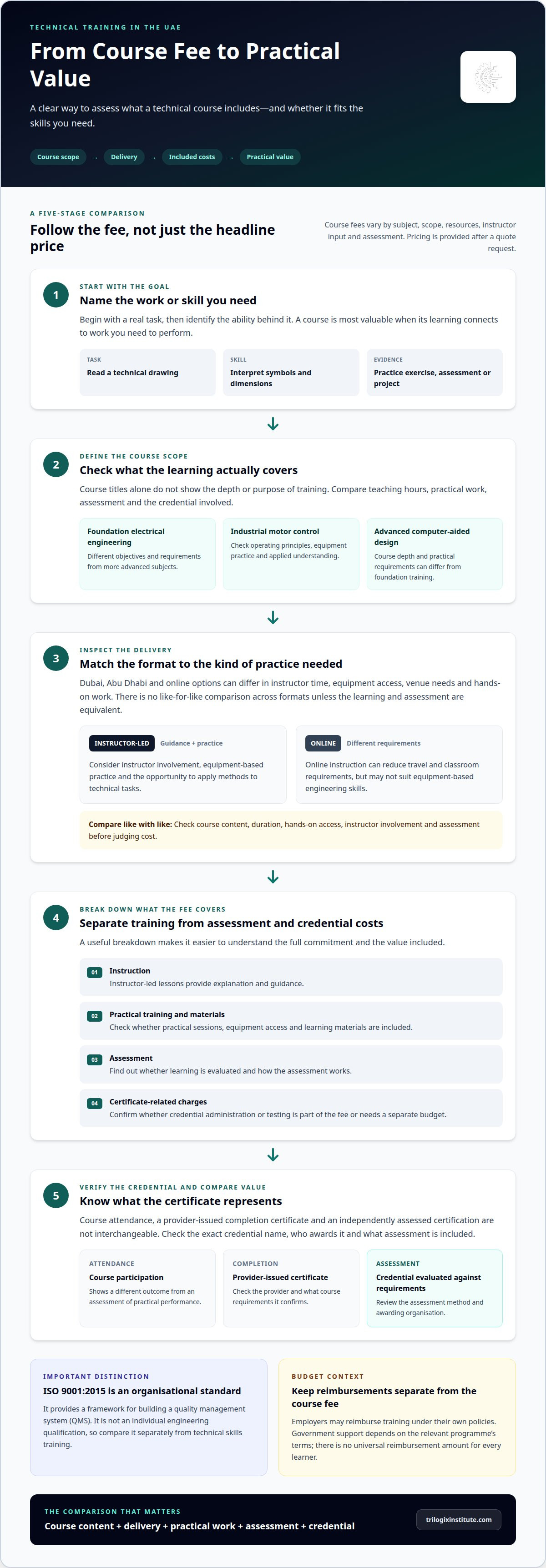
Engineering courses can develop practical skills, prepare learners for assessment, or support an organisation’s management system. The fee depends on course scope and delivery. To assess the cost of technical certification in the UAE, compare teaching hours, practical work, assessment, and the credential involved, rather than relying on the course title alone.
Provider and Location Price Differences
Provider and location price differences reflect delivery choices and course resources. Dubai, Abu Dhabi, and online options may vary in instructor time, equipment access, venue needs, and practical work. Online instruction can reduce travel and classroom requirements, but may not suit equipment-based engineering skills. Compare equivalent course content and assessment before judging the cost of technical certification in UAE across formats.
There is no like-for-like price comparison across different course formats. Duration, hands-on access, instructor involvement, and assessment all affect what training provides. An instructor-led course with equipment practice and a self-paced online option may not offer equivalent learning.
Professional course fees reflect the subject and depth of learning. Foundation electrical engineering, industrial motor control, and advanced computer-aided design have different objectives and may require different equipment, instructor input, and practical work. Trilogix Institute offers instructor-led technical training with hands-on practice, and course pricing is provided after a quote request.
Employers may reimburse training under their own policies, while government support depends on the terms of the relevant programme. There is no universal reimbursement amount for every learner. Distinguish the course fee from any contribution an employer or programme may provide.
Booking a technical certification exam generally involves selecting the relevant exam, meeting its entry requirements, submitting candidate details, and completing the exam provider’s booking and payment process. Requirements depend on the exam and credential. Check the exam details to understand the subject and preparation required.
Accreditation and Recognition
Accreditation and recognition describe how a course or credential aligns with a named standard or awarding body. This matters because course attendance, a provider-issued completion certificate, and an independently assessed certification are not interchangeable. Compare the credential’s exact name and the organisation responsible for awarding it.
ISO 9001:2015 provides a framework for building a quality management system (QMS), according to the International Organization for Standardization. It is an organisational standard, not an individual engineering qualification. Learners should distinguish technical skills training from certification that assesses a person or an organisation.
Professional course offerings can include technical instruction, practical exercises, and formal assessment, but the components vary. A learner studying motor control, for example, can examine whether the course teaches operating principles, includes equipment-based practice, and assesses applied understanding. Those details show what the fee supports more clearly than the word “certification” alone.
A useful breakdown separates instruction, assessment, and credential administration. Instructor-led lessons provide explanation; practical sessions let learners apply methods to technical tasks; assessment evaluates learning against course requirements. A course limited to instruction serves a different purpose from one that also evaluates practical performance.
For learners across the UAE, match the course to the skill or credential needed. Compare subject matter, delivery format, assessment method, and awarding organisation. An international credential may suit a specific role, while focused technical training may better address a workplace skill.
Review the credential name, who awards it, what assessment is included, and whether the fee covers preparation as well as testing.
Different benchmarks serve different audiences and formats. These figures are broad reference points, not a substitute for comparing course content, delivery, practical work, and credentials.
Career and skills benefits
A technical course is most valuable when its learning connects to a task you need to perform. For example, someone aiming for electrical maintenance can focus on interpreting circuits, identifying components, and following a structured troubleshooting process. Those capabilities provide more concrete evidence of skills than a certificate title alone.
Translate training into workplace capability
Start with the work activity, then identify the skill behind it. An engineering role may involve reading a drawing, operating control equipment, or documenting a technical change. A course can build the relevant knowledge through explanation, guided practice, and assessment. The value lies in being able to describe what you learned and where you can apply it.
For example, a learner studying computer-aided design can use a sample drawing to show how they interpret dimensions and revise a layout. Someone learning industrial controls can explain how a control circuit responds to an input. These examples give a manager or interviewer specific skills to discuss, without suggesting that course completion automatically secures a role.
Use a simple three-part structure to connect learning to career goals:
- Task: Name a work activity, such as reading a technical drawing.
- Skill: Identify the ability needed, such as interpreting symbols and dimensions.
- Evidence: Describe a practice exercise, assessment, or project that demonstrates it.
This approach also helps experienced workers identify a focused next step. A technician who understands basic electrical principles may need applied control-system knowledge, while a beginner may first need foundational concepts. Choose training that addresses the skill gap, rather than simply adding another credential to a CV.
Make skills relevant across the Emirates
Career goals can differ across the emirates and industries, so the intended application matters. A learner interested in facilities maintenance may prioritise safe equipment operation and fault-finding. Someone working with design documentation may benefit more from drawing interpretation and computer-aided design practice. These examples show why a course should be assessed against real duties, not just its location.
Use the same decision process wherever you are in the UAE: identify the target role, review its technical tasks, and select training that addresses a specific skill gap. For work connected to trading or manufacturing operations, relevant knowledge may include equipment processes, technical records, or production controls. The right course depends on the work you are targeting.
Build a credible record of learning
A certificate can document participation or assessment, but its meaning depends on what it represents. Keep the credential name, course subjects, and completed practical work together. For example, a CV entry supported by a drawing exercise or a control-system task gives a clearer account of your skills than a course title alone.
Before enrolling, write down a role or work task the training should support. Compare the course outline with that task and note the skills it covers. After training, record an example of how you applied each skill. This gives you a focused account for a performance review, internal role discussion, or future application.
Technical training can strengthen a career plan by making skill development deliberate. Match learning to a role, practise relevant tasks, and keep evidence of your progress. This helps you judge whether a course supports your next step, rather than treating certification as an outcome in itself.
Certification fee inclusions
A certification fee can cover several distinct services, not just an exam seat. For an organisational standard such as ISO 9001, costs may involve preparation, implementation support, audits, certification-body services, and ongoing surveillance. That differs from a technical course fee, which may cover instruction, practical learning, and an individual assessment. Separating these cost categories makes the total easier to understand.
In the UAE, small businesses can obtain ISO 9001 certification for د.إ 5,000 to د.إ 8,000, including consultancy and certification-body fees. The total can include consultation, implementation, internal and external audits, appointing a certification body, certificate issuance, and surveillance audits. Which components apply depends on the certification scope and the organisation’s existing processes.
- Consultation and implementation: Support to establish or adapt processes before an audit.
- Internal audit: A review that helps identify gaps before external assessment.
- External audit: Independent evaluation of the management system against the applicable standard.
- Certification-body services: Appointment, assessment, and certificate issuance.
- Surveillance: Follow-up audits that support continued certification.
For example, a company seeking ISO 9001 may need to document how it manages customer complaints, checks work, and corrects process failures. A consultancy fee may cover guidance on those procedures, while the external audit evaluates the implemented system. A qualification or training course for an individual is a different purchase, even if both relate to quality management.
Exam fees in the UAE may be quoted in AED or another currency, depending on the exam issuer. Compare the final amount payable in AED and distinguish the exam charge from any applicable tax shown on the invoice.
Separate the exam from additional charges
An exam fee may be separate from course tuition, study materials, practical sessions, or certificate issuance. A retake can also carry a separate charge under the exam provider’s rules. Do not assume that classroom preparation includes the initial exam attempt or a later attempt.
Before budgeting, identify the fee components and what each one covers. A useful breakdown distinguishes training, assessment, credential administration, and any follow-up requirement. This distinction matters in sectors such as tourism, where service standards can involve multiple teams, and infrastructure, where organisations may need documented operational processes.
Renewal and ongoing costs
Renewal is not always the same as an initial certification fee. In the UAE, ISO certification renewal typically costs 60 to 80 percent of the initial certification cost. Annual surveillance audits for small businesses typically cost د.إ 2,500 to د.إ 5,000, depending on the standard. These ongoing charges belong in a multi-year budget, not just the first-year estimate.
Annual surveillance audit fees for maintaining ISO certification in the UAE typically range from د.إ 3,000 to د.إ 8,000 per year per standard. The fee reflects continued assessment, rather than a new course or an individual exam. Businesses maintaining separate standards should account for each standard’s surveillance requirements; the scope and audit work influence the total.
For an individual candidate, the main distinction is between preparation and assessment. A technical course develops knowledge and practical ability; an exam tests a defined qualification or competency. A clear fee breakdown helps learners and employers identify whether they are paying for instruction, the examination, certificate administration, or ongoing organisational certification.
Cost drivers such as instructor rates and assessment
Course fees reflect the teaching resources and assessment needed to meet the learning objectives. An instructor-led electrical engineering course, for example, may include demonstrations, guided problem-solving, and equipment practice. A theory-focused course follows a different format. Compare fees only when teaching hours, practical work, and assessment demands are similar.
Instructor expertise and teaching format
Instructor expertise affects how training is designed and delivered. A specialist teaching industrial motor control needs to explain circuit behaviour and guide learners through practical tasks. Fees may also reflect preparation time, course materials, and the support built into instruction. These are separate from exam or certificate charges.
Format matters, too. A classroom session can provide live demonstrations and direct feedback, while equipment-based learning requires access to suitable tools and supervised practice. A corporate course designed around a company’s processes may need tailored examples. Choosing between formats means weighing the instruction and practice required, not simply the number of scheduled sessions.
Assessment design and technical scope
Assessment adds work beyond teaching. A written test can measure technical knowledge, while a practical evaluation may require a learner to demonstrate a task against defined criteria. For example, an assessment of a control circuit could evaluate whether a learner can interpret its components and explain its operation. The more skills assessed, the more preparation and evaluation the course requires.
Course scope also shapes assessment. An introductory course may focus on foundational concepts, while advanced training can cover how several technical skills work together. Check whether assessment is included in tuition or charged separately. That distinction helps you compare the learning and evaluation provided.
Equipment, materials, and course structure
Equipment-based learning has resource requirements that a lecture alone does not. A motor-control exercise, for instance, needs appropriate training equipment, task materials, and instructor guidance. Computer-aided design instruction can include practice with relevant software and files. These needs help explain why related courses can have different delivery costs.
A course framework connects learning outcomes, instruction, practice, and assessment. If learners must complete practical tasks before evaluation, the course needs time for demonstrations and feedback. Course materials also influence preparation: a set of technical drawings supports design practice, while circuit diagrams support electrical learning. Reviewing these elements reveals what the fee contributes.
When comparing an individual technical course with a corporate programme, distinguish learner tuition from organisation-level certification work. ISO certification involves organisational processes and audits, while a technical course develops individual skills. A business seeking a quality management framework must consider its operational scope; a learner should assess course content and personal learning needs.
Use this comparison sequence to assess value:
- Match the scope: Compare courses teaching the same technical skills.
- Review instruction: Note instructor involvement, practical sessions, and learning materials.
- Compare assessment: Identify whether evaluation is written, practical, or both.
- Separate charges: Distinguish training tuition from examination or certification costs.
This framework turns a headline fee into a useful comparison. A course with limited practice may not meet the needs of someone developing equipment-handling skills. A more practical course may include guided exercises and applied learning. Compare the training structure with the capability you need to build.
Trilogix Institute: TTI Dubai Foundation Electrical Engineering
Trilogix Institute offers TTI Dubai Foundation Electrical Engineering for learners building a grounding in electrical concepts and practical technical skills. It’s a relevant next step if you want structured training before pursuing more specialised engineering work. For design-focused learning, TTI Dubai Advanced AutoCad 2D & 3D develops a different skill set, while TITP Beginner Essential Industrial Motor Control focuses on industrial motor control fundamentals.
Choose based on the tasks you want to learn, rather than the course title alone. Consider whether your goal is foundational electrical knowledge, design practice, or an introduction to motor control. This makes it easier to connect the course content to a clear skills objective and assess whether the format suits your needs.
For details about course content and focus, visit trilogixinstitute.com or contact Trilogix Institute.
Choose training that supports your next move
Make your next decision around the capability you want to build, then connect that goal to a relevant course. Understanding the cost of technical certification in the UAE is only one part of planning; the more useful question is how the learning fits your next professional step. Trilogix Institute offers TTI Dubai Foundation Electrical Engineering, TTI Dubai Professional Culinary Arts, and TTI Dubai Advanced AutoCad 2D & 3D. These options span different fields, so focus on the subject that matches your intended direction.
A clear objective makes course comparisons more purposeful. You might want to strengthen your engineering foundation, develop design skills, or pursue culinary training. Identify the capability you want to gain and consider how you will apply it in your work or career development.
For a practical next step, contact Trilogix Institute to discuss your options. A focused conversation can help you explore which learning path aligns with your goals. Choose deliberately, and move forward with confidence.
Frequently Asked Questions
How much do UAE training providers charge for technical certification courses?
Fees vary by course, so there is no standard rate for technical certification in the UAE. A foundation course and an advanced credential are not direct comparisons: course scope, practical requirements, instructor input, and assessment all affect the fee. Trilogix Institute provides course pricing after a quote request. Compare courses by the skills and learning they cover, not the headline fee alone.
How do technical certification costs compare between Dubai, Abu Dhabi, and online providers?
There is no single comparison across Dubai, Abu Dhabi, and online providers. Fees vary with course duration, instructor involvement, equipment access, practical work, and assessment; online instruction may reduce travel and classroom requirements but may not suit equipment-based skills.
What are the most popular technical certifications in the UAE?
ISO 9001:2015 is identified as the most common certification standard, but it is an organisational standard, not an individual engineering qualification. Technical training examples include electrical engineering fundamentals, industrial motor control, and computer-aided design.


