

The strongest case for vocational school isn’t a promise of an easy career. It’s a clear plan your parents can assess. Convincing my parents about vocational school means explaining what you want to learn, how the training connects to work, and how you’ll approach the costs. Be ready to discuss what might make them hesitate, not just why you’re excited.
It’s reasonable for parents to ask whether a course is worth the investment and fits your long-term goals. Take those concerns seriously. A practical conversation works better when you bring specific information and listen to what matters most to your family.
This guide will help you explain your reasons, assess career prospects, discuss costs in the UAE, and respond thoughtfully to your parents’ questions. You’ll also learn how to compare training with other education routes and prepare a plan that shows you’re ready to make an informed decision.
Key Takeaways
- Build your case around a specific trade, the skills you want to gain, and how those skills connect to possible career paths.
- Ask your parents what concerns them most, then address each concern with relevant information instead of trying to win the discussion.
- Compare education costs by looking beyond tuition to the full study plan, including related expenses and how you could contribute.
- Explain why hands-on training suits your goals, while staying realistic about employment prospects and the effort needed to build experience.
- Before choosing a program, examine its training approach and any internship arrangements so your family can weigh the commitment clearly.
Skilled-trades career demand and job outlook
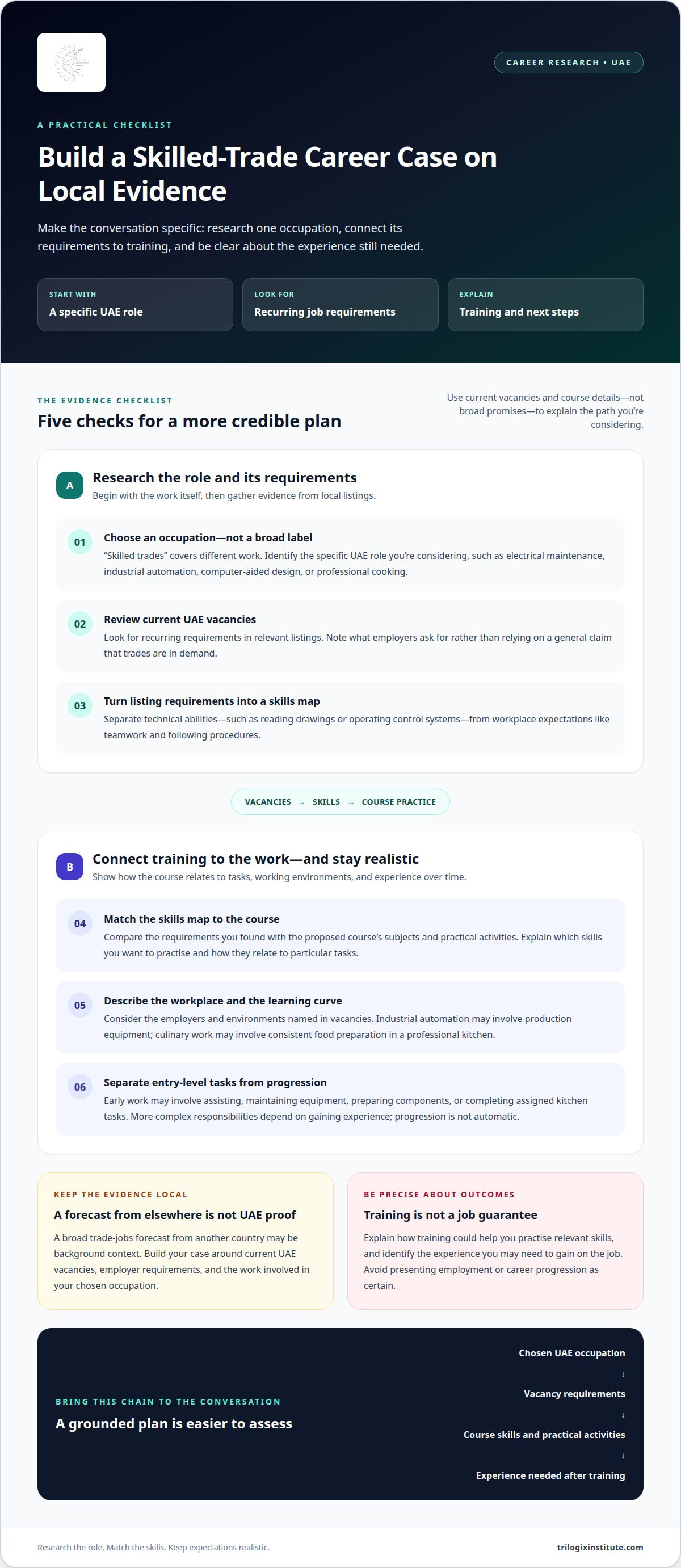
- Research demand by occupation, not broad label. “Skilled trades” covers many kinds of work, so identify the role you’re considering in the UAE. Electrical maintenance, industrial automation, computer-aided design, and professional cooking, for example, each require distinct skills. Search current UAE job listings for the specific role and note recurring requirements, such as equipment knowledge, technical drawing, or kitchen practice. This gives your parents concrete opportunities to discuss instead of a general claim that trades are in demand.
- Turn job listings into a skills map. Choose relevant UAE vacancies and record the skills that appear repeatedly. Separate technical abilities, such as reading drawings or operating control systems, from workplace expectations, such as teamwork and following procedures. Then compare those requirements with the subjects and practical activities in your proposed course. A clear match shows how training could prepare you for particular tasks without suggesting that completing a course guarantees employment.
- Check how the role fits local workplaces. Look at the type of employer and working environment named in each vacancy. An industrial automation role may involve production equipment, while a culinary position may require consistent food preparation in a professional kitchen. These examples help you explain what the work involves, not just its title. For a Dubai-focused discussion, connect your role research with the vocational training context in Dubai, then describe which practical skills you want to develop.
- Separate entry requirements from longer-term progression. An entry-level role may involve assisting, maintaining equipment, preparing components, or completing assigned kitchen tasks. With experience, workers can deepen their technical skills and take on more complex responsibilities. Don’t present progression as automatic. Show your parents which skills you expect to practise during training and what experience you’ll need to gain on the job. That distinction makes your career plan more credible.
- Present evidence, not a sweeping forecast. A claim about trade shortages in another country doesn’t prove demand in the UAE. Build a local picture from current vacancies, employer requirements, and the work involved in your chosen occupation. Bring examples that show what employers seek and how the course relates to those skills. This gives your family a grounded basis for judging the outlook and helps you explain why the field suits your interests and strengths.
One page says that millions of trade jobs in the United States will need to be filled in the coming years. Treat that figure as background, not evidence of the outlook for a particular UAE occupation. It may explain why people discuss trade careers, but your case should rest on local vacancies and employers’ stated requirements.
When speaking with your parents, distinguish between a broad forecast and evidence related to your chosen role. Point to the tasks you’ve researched, the skills your course could help you practise, and the experience you may need after training. This keeps the conversation focused on a realistic pathway, not a promise of a job. If local listings change, revisit your skills map and adjust your plans to reflect what employers are seeking.
Understanding parents' concerns
- Ask what is driving their hesitation. Invite each parent to name their main concern before you respond. One may focus on course costs, while another may wonder whether the training leads to suitable work. Listen without interrupting, then restate the concern in your own words. For example: “You’re concerned I might finish without a clear next step.” This shows you understand the issue and keeps the conversation from becoming a debate about vocational education in general.
- Separate practical worries from assumptions. A parent might question the academic value of vocational training or wonder whether you’re prepared for its demands. Ask what evidence would help address that concern. If they worry about your readiness, explain how you’ll manage attendance, assignments, practice, and feedback. If they question the learning approach, describe how practical exercises can develop skills alongside classroom study. Specific examples give you a useful basis for discussing your plans, rather than relying on broad promises.
- Address safety with a concrete plan. If your parents are concerned about commuting or the learning environment, discuss the route, daily schedule, and who to contact in an emergency. For training involving tools or equipment, ask what safety procedures and supervision apply, then share the details. Explain how you’ll travel, what you’ll do if arrangements change, and how you’ll keep your family informed. Clear answers make safety a practical discussion, not a vague reassurance.
- Discuss family finances without minimizing them. Ask which costs concern your parents most, then build a written budget together. Include tuition, transport, meals, equipment, and any other expenses relevant to your study plan. Separate essential costs from optional spending, and consider whether you can contribute through savings or a manageable household arrangement. Family circumstances matter, so listen to what your parents can reasonably consider. A transparent discussion is more constructive than insisting a course is affordable.
- Agree on what would make the decision feel responsible. Your parents may want to see academic preparation, emotional readiness, or a plan for balancing study with other duties. Turn those concerns into actions: prepare a weekly schedule, outline how you’ll handle missed lessons, or set a date to review your progress together. Ask what information they still need before deciding. This respects their role while showing you’re willing to take responsibility for the commitment.
Comparing trade school and university costs
- Compare the full cost of each route. For a UAE-based decision, list tuition in د.إ alongside transport, materials, equipment, and other study expenses. Compare the total commitment, not just the advertised tuition. For a university degree, include the full program period; for vocational training, include every required course stage. Then compare what each route teaches and the work it may prepare you to pursue. This is fairer than comparing one course fee with one university semester.
- Compare vocational programs with apprenticeships and community college by structure. An apprenticeship combines learning with workplace experience, while a vocational program may focus on instructor-led study and practical exercises. Community college is a term used in some education systems, so compare the specific UAE program you’re considering by duration, subjects, practical training, expenses, and qualification. Put those details side by side before deciding which pathway fits your goals.
- Ask about financial support before finalizing your budget. In the UAE, ask each institution about scholarships, grants, installment arrangements, and employer sponsorship. Find out who qualifies, which documents are needed, when applications close, and whether support covers tuition or other expenses. Eligibility and terms depend on the scheme, so record the answer for each program. Don’t include potential support in your family budget until you understand its conditions.
- Check recognition and program credibility directly. Ask the school which authority recognizes the institution or qualification, then verify the answer through that authority’s official information. Request the program name, curriculum, learning outcomes, and practical training details in writing. For example, if a course teaches electrical skills, compare its stated content with the competencies you want to develop. Clear documentation helps your family assess the program instead of relying on a broad marketing description.
- Use focused questions to assess fit. Ask what skills the program teaches, how much practical work it includes, what equipment students use, and how progress is assessed. Also ask about attendance expectations, materials, total fees, payment dates, and any internship arrangement. Record the answers in a comparison table for each school. Specific details, such as the balance between classroom learning and workshop practice, can reveal whether the course matches your preferred way to learn.
- Map the admission steps before applying. Ask the school for its entry requirements, application documents, assessment process, and deadlines. Requirements may include prior education records or an interview, depending on the program. Prepare the requested documents, submit your application through the stated process, and note when the school expects to respond. Share this checklist with your parents so they can see the steps, timing, and commitments before you decide.
Explaining why you want to study it
- Prepare clear answers to three questions. Explain what you’ll study, why you want to study it, and where you plan to study. Make each answer specific. Name the trade, describe which tasks interest you, and identify the course you’re considering. Then connect your interest to a practical learning goal, such as reading technical drawings or preparing dishes consistently. Convincing my parents about vocational school starts with a plan they can understand and assess, not a general statement about wanting a practical career.
- Show why the subject matches your strengths. Use examples from school, hobbies, or responsibilities to demonstrate your interest. If you enjoy solving practical problems, describe a time you diagnosed an issue or followed a process carefully. If you’re drawn to culinary work, explain which preparation tasks you enjoy and why. Don’t claim that one example proves you’ll succeed. Use it to show what you’ve tried and what you want to develop through structured training.
- Explain how you learn best. Describe the difference between understanding a concept and applying it. Someone interested in electrical work, for example, may want to connect classroom principles with supervised equipment practice. Explain which practical activities appeal to you and how they support your goals. Convincing my parents about vocational school also means being specific about the learning environment where you expect to thrive, rather than claiming vocational study is right for everyone.
- Link the course to a sequence of next steps. Explain what you plan to learn first, how you’ll practise those skills, and what kind of entry-level work you’ll research afterward. A student interested in computer-aided design, for example, can identify drawing skills to develop, then explore roles that use technical drawings. Keep the sequence realistic. Training can build capability, while workplace experience and further development shape the responsibilities you can take on later.
- Present your reasons and invite specific questions. Summarize your plan in a short document covering the trade, course, learning goals, and career research. Ask your parents which part needs stronger evidence. If they question your commitment, propose a practical measure, such as tracking attendance and completing assignments on schedule. If they’re unsure about your chosen field, explain how you’ll learn more about its daily work before committing. This turns your motivation into a plan they can discuss with you.
Why parents may hesitate about trade school
- Find out whether their concern is about the pathway or its conditions. Parents may support hands-on learning but worry about a particular school, course, or internship arrangement. Ask them to name the detail that feels uncertain. For example: “Are you concerned about what I’ll learn, or what happens after training?” This separates doubts about vocational education in general from questions you can investigate, such as course content, workplace practice, and student expectations.
- Look closely at any internship before treating it as a benefit. An internship can offer workplace exposure, but its structure matters. Some vocational schools may arrange factory assembly-line internships and require students to pay tuition during that period. Ask what tasks students perform, how the work relates to course learning, whether supervision is provided, and what fees apply. A clear explanation helps your family judge whether the arrangement supports your goals.
- Discuss the difference between training and a job promise. A course can teach relevant skills, but completing it doesn’t mean a particular job will follow. Show your parents how you’ll connect learning with an employment plan. Identify entry-level roles, note the skills they request, and explain how you’ll build experience after training. This realistic distinction can address employment concerns without overstating what a school or qualification can deliver.
- Consider whether the working environment fits you. Trade careers can involve specific settings, schedules, physical tasks, or customer interactions. A kitchen role, for example, may require focused preparation and coordination during busy service. Technical work may involve careful procedures around equipment. Research the daily duties of your chosen role and identify which demands appeal to you and which require preparation. Parents may feel more comfortable when you’ve considered the routine, not just the course title.
- Turn each concern into a decision point. Write down your parents’ questions, then match each with evidence or an action. If they question internship quality, examine its tasks and terms. If they worry about your commitment, propose a study schedule and progress review. If they question whether the field suits you, explore the role’s daily duties. Discussing these points one at a time keeps the conversation practical and shows you’re evaluating risks, not dismissing them.
Compare practical subjects and course formats as you assess whether vocational learning fits your plans. Explore vocational course options as one step in that comparison.
Trilogix Institute: TTI Dubai Foundation Electrical Engineering
Trilogix Institute offers TTI Dubai Foundation Electrical Engineering for learners considering a technical vocational pathway. It may suit your plans if you want to explore foundational electrical engineering training. For other interests, the institute also offers TTI Dubai Professional Culinary Arts, TTI Dubai Advanced AutoCad 2D & 3D, and TITP Beginner Essential Industrial Motor Control. These options give you specific programs to compare with your interests and the goals you’ve discussed with your parents.
Use the program name that matches your direction when continuing the family conversation. For example, compare an interest in electrical engineering with the foundation program, or a focus on design with Advanced AutoCad 2D & 3D. Visit trilogixinstitute.com to explore the programs and consider which one fits your plans.
Take the Next Step With a Clear Plan
The next conversation doesn’t need to settle your entire future. Aim for a practical step you and your parents can take together, such as reviewing a course outline or discussing the skills you want to develop. If you’re convincing my parents about vocational school, focus on making the decision together: explain what you hope to gain, invite their questions, and agree on what information would help you move forward.
Give your family time to consider the path. Their questions can help you refine your plan, while your preparation shows you’re treating education as a serious commitment. A thoughtful discussion can lead to a more informed choice, even if everyone needs another conversation before deciding.
If you’re ready to explore practical training options, contact Trilogix Institute and take the next step at a pace that works for you. You can move forward with purpose, preparation, and your family’s perspective in the conversation.
Frequently Asked Questions
What are the benefits of vocational school compared with a four-year college?
Vocational school can focus learning on specific occupational skills, while a four-year college usually offers a broader academic program. For a student aiming to work with electrical systems, technical drawings, or culinary methods, targeted training may align more directly with that interest. Compare curriculum, qualification, and learning format rather than assuming one route is best for everyone. The right choice depends on your career direction and preferred way of learning.
What careers and salaries can vocational school graduates expect?
Vocational training can support pathways into roles such as electrical technician, CAD drafting, industrial maintenance, or culinary work, depending on the course and further experience. Salary depends on the occupation, employer, responsibilities, relevant skills, and work history. To form a realistic UAE outlook, compare current vacancies for a specific role and note the duties and experience employers request. Treat advertised salary details as specific to the role, not as a guaranteed result of completing training.
How can I explain my career goals and vocational school plans to my parents?
Bring a concise plan that connects your interests to a specific occupation and the skills it requires. Add a practical example, such as a sample technical drawing or a short description of a dish you want to learn to prepare professionally. Then ask your parents to review the plan and identify one question they want answered before deciding. A concrete work sample can make your interest easier to understand than an abstract career statement.
What concerns do parents commonly have about vocational school, and how can I address them?
Parents may question whether the course suits your goals, how the training works, and what options follow graduation. Address each concern with relevant evidence, such as a curriculum outline, sample practical task, or examples of job requirements. If a question remains unresolved, write it down and investigate it together rather than making broad promises. This keeps the discussion focused on the specific program and the choices your family needs to consider.


