

A culinary diploma can be worthwhile when structured training fits your career goals, but it isn’t required to become a chef. The practical question is: is a culinary diploma worth it for the skills and direction you want?
It’s reasonable to compare formal study with learning in a working kitchen. Culinary training offers guided practice, while workplace experience develops through real service demands.
This article explores what culinary training can teach, which career paths it may support, and how formal study compares with on-the-job learning. As you consider enrolling, ask again: is a culinary diploma worth it for your preferred learning style and professional plans?
Key Takeaways
- A culinary diploma can provide structured skills training, but formal education isn’t a strict requirement for becoming a chef.
- Training may cover practical kitchen skills alongside food hygiene, storage and temperature control.
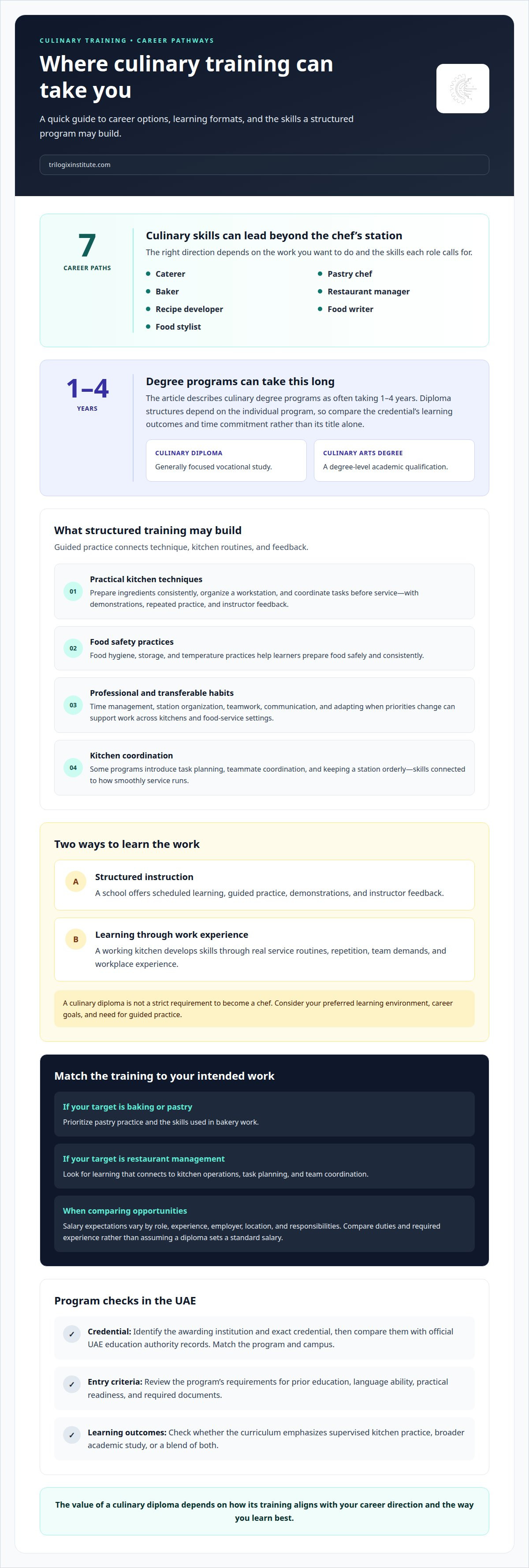
- Culinary skills can support career paths beyond chef roles, including catering, baking, pastry, restaurant management and food styling.
- Compare structured instruction with workplace learning by considering your preferred learning environment, career goals and need for guided practice.
- For practical culinary training in Dubai, TTI Dubai Professional Culinary Arts offers a focused route to build culinary skills.
Career opportunities for culinary graduates
Culinary training can support kitchen roles and wider food careers, but the right path depends on your goals. Compare the work you want with the skills and experience each role requires.
Career options and goals
Graduates may pursue roles such as caterer, pastry chef, baker, restaurant manager, recipe developer, food writer, or food stylist. A pastry-focused student, for example, may target bakery work, while someone drawn to service operations may prefer restaurant management. These roles use culinary knowledge differently, so choose a direction before weighing a diploma’s value.
Your preferred learning environment matters, too. A school offers structured instruction and guided practice; a working kitchen exposes you to service routines and team demands. Some culinary degree programs take 1–4 years, while workplace learning develops through experience. Consider whether you learn best through scheduled lessons, immediate repetition, or a combination of both.
To check a culinary diploma’s accreditation in the UAE, identify the awarding institution and exact credential, then compare them with official UAE education authority records. Match the program and campus rather than relying only on a school’s general description.
Admission requirements are set by each program. Review its entry criteria for prior education, language ability, practical readiness, and required documents to determine whether you meet the requirements.
Set a career target, then map the skills it calls for. A future baker may prioritize pastry practice, while an aspiring restaurant manager may focus on kitchen operations and team coordination. This comparison helps you assess whether a diploma’s training matches your intended work.
Industry Networking and Opportunities
Industry networking means building professional relationships with chefs, classmates, instructors, and food businesses. Those connections can reveal workplace expectations, specialist roles, and potential opportunities. For example, a student interested in catering can learn how event kitchens organize preparation and service by engaging with professionals in the field. Treat networking as a way to understand career options, not as a promise of employment.
Use conversations to learn which practical skills employers value in your target role. Ask about a typical shift, the path from junior kitchen work to leadership, and how teams divide responsibilities. These details help connect classroom practice with the demands of a specific workplace.
Salary Expectations in Culinary Careers
Salary expectations vary by role, experience, employer, location, and responsibilities. A pastry chef, restaurant manager, and food stylist follow different career paths, so their pay shouldn’t be treated as interchangeable. In the UAE, compare opportunities by role and workplace rather than assuming a diploma sets a standard salary.
For a practical comparison, look at each job title’s duties and required experience. A role involving team supervision or kitchen operations carries different responsibilities from an entry-level production position. Use these factors to assess how a career may develop, and weigh formal training against the experience needed to progress.
What is Culinary School?
Culinary school provides organized instruction and guided practice for people preparing to work with food. Its value comes from connecting technique, kitchen routines, and feedback in a learning environment.
Culinary and Kitchen Management Skills
Structured culinary training teaches practical techniques through demonstrations, repeated practice, and instructor feedback. A student might learn to prepare ingredients consistently, organize a workstation, and coordinate tasks before service. This structure helps learners understand not only how to perform a technique, but also when and why it fits a kitchen’s workflow.
Some programs also introduce kitchen-management skills, such as planning tasks, coordinating with teammates, and keeping a station orderly. These skills matter in restaurants because preparation and communication affect how smoothly service runs. Mentorship adds context: an instructor can identify where a learner’s method needs adjustment and explain how to improve it.
Professional and Transferable Skills
Professional kitchen skills are the techniques and work habits used to prepare food safely and consistently. Training can cover food hygiene, storage, and temperature practices to help protect customers from food-borne illnesses. Learners also practise time management and station organization, skills that transfer to catering, bakeries, and other food-service settings.
Teamwork is another practical skill. During a mock service, for example, students must communicate task progress and coordinate preparation without disrupting a teammate’s station. Feedback helps them assess their work, respond to direction, and adapt when priorities change. These habits support professional development across different kitchen teams.
Diplomas and Culinary Arts Degrees
A culinary diploma generally represents focused vocational study, while a culinary arts degree is a degree-level academic qualification. The distinction matters because the credentials may differ in scope, learning objectives, and time commitment. Culinary degree programs often take 1–4 years, while diploma structures depend on the program.
In practical terms, compare a credential’s learning outcomes rather than its title alone. Review whether the curriculum emphasizes supervised kitchen practice, broader academic study, or a blend of both. Someone seeking concentrated skills training, for example, may prioritize hands-on instruction, while a learner pursuing wider academic study may prefer a degree pathway. The best fit depends on the intended work and learning priorities.
Culinary school curriculum and practical training
A culinary school curriculum combines guided practice with instruction about the decisions behind each dish. Content varies, so examine how classroom learning connects with kitchen tasks, specialist techniques, and business skills.
Hands-on kitchen practice
Practical training gives students repeated opportunities to apply techniques, receive feedback, and refine their work. One culinary student attended four-hour classes each weekday morning, showing how scheduled practice can become part of a consistent routine. In a kitchen session, students can focus on preparation, timing, workstation organization, and producing a dish to a set standard.
Instruction can also cover food hygiene, storage, and temperatures to help protect customers from food-borne illnesses. These subjects connect directly to everyday decisions: storing ingredients appropriately, keeping work areas orderly, and following safe handling practices. Understanding the reasons behind each procedure helps students apply it across different dishes and kitchen settings.
Look for a clear connection between instruction and practice. A lesson on preparing ingredients, for example, becomes more useful when students apply the method to a recipe. Instructor feedback can pinpoint uneven preparation or inefficient sequencing, giving learners a specific skill to improve before taking on more complex tasks.
Baking and pastry training
Specialist culinary courses can focus on patisserie, cake decorating, artisan bread-making, or chocolate-making. Each area develops distinct techniques: cake decorating requires controlled finishing, while artisan bread-making emphasizes shaping and texture. Students interested in bakery work can use this focus to build relevant practice rather than treating every culinary specialty as interchangeable.
Hands-on certificate programs typically emphasize practical training. For a pastry learner, that may mean practising a technique, assessing the result, and adjusting the next attempt. Repetition develops precision and helps students recognize how small changes affect appearance and consistency. These skills can support work in bakeries, pastry kitchens, or dessert production.
Business and entrepreneurship
Business instruction matters to students who want to develop a food venture, manage a kitchen, or understand how dishes fit into a commercial operation. Useful topics can include menu planning, ingredient costing, purchasing, and workflow. For example, a proposed café menu must balance preparation demands with available ingredients and equipment.
Entrepreneurial learning connects a food concept with practical operating decisions. A student developing a catering idea might plan a sample menu, estimate ingredient quantities, and organize preparation tasks. These exercises reveal the operational demands behind a creative concept and clarify which skills need more practice before taking responsibility for a food business.
Compare each curriculum’s practical hours, specialist options, and business content with your intended work. A program with bakery practice may suit a pastry goal; a broader kitchen curriculum may better match varied food-service interests. This comparison shows whether the training emphasizes the capabilities you want to develop.
Culinary school versus learning through work experience
Culinary school provides structured instruction; workplace learning develops through real service demands. The stronger route depends on whether you need guided practice, immediate kitchen exposure, or a mix of both.
Starting Culinary Study Without Experience
Prior kitchen employment isn’t a strict requirement for becoming a chef, so beginners can build foundational skills through study. A culinary program gives students a place to practise techniques, receive feedback, and learn how kitchen tasks connect. This can make a first professional role feel less unfamiliar, especially for learners who haven’t worked during a busy service.
Starting from scratch also means building confidence through repetition. For example, a new student can practise organizing ingredients before preparing a dish, then use instructor feedback to improve their method. Consider how a program teaches beginners: clear demonstrations and supervised practice can help you learn tasks before applying them under workplace pressure.
Professional Kitchen Experience
Professional kitchen experience means learning while contributing to a working food operation. It exposes new staff to service timing, team communication, and changing priorities. A trainee helping with preparation, for example, learns how completing one task affects the next person’s workflow. This practical context is difficult to reproduce fully in a classroom.
Workplace learning also depends on the tasks assigned and the guidance available. A new team member may repeat a narrow set of duties before taking on broader responsibilities. Formal instruction can provide a more organized introduction to techniques, while professional experience shows how teams use them during service. Each route develops different strengths.
The two approaches needn’t be treated as opposites. Students can use structured study to practise foundational skills, then build speed and adaptability in a professional kitchen. Someone already working in food service can identify gaps on the job and use further training to address them. The choice depends on current experience, desired pace, and preferred feedback.
Think about the environment where you learn best. A campus can bring learners together around shared interest; Adam Crocini described the feeling of being among at least 2,000 people passionate about food. For some students, that community makes practice and discussion more engaging. Others may prefer the immediate pace and team responsibilities of a working kitchen.
Before choosing, list the skills you already use and the situations that challenge you. If you can prepare confidently but struggle to coordinate tasks, seek instruction with structured practice. If you understand techniques but lack service exposure, workplace experience can show how professionals apply them under pressure. This comparison helps match your learning route to your next career step.
There’s no single path for every aspiring cook. A culinary school program suits learners who value guided instruction; work experience suits those ready to learn through daily kitchen responsibilities. A combination can connect technique with service practice, helping you develop competence and a realistic understanding of professional work.
Whether formal culinary education is worthwhile
Formal culinary education is worthwhile when guided practice develops skills you’ll use in your intended career. Since there’s no strict educational requirement to become a chef, the decision is about the value of structured learning, not a mandatory credential. Ask what techniques you’ll learn, how often you’ll practise them, and whether they match your goals.
Evidence offers a useful perspective, but not a universal verdict. In interviews with more than 50 kitchen workers, Ellen T. Meiser found that over three-quarters of culinary school graduates said their education was worth the cost. That finding reflects those graduates’ views, not a guarantee about outcomes for every learner.
A diploma can provide a planned sequence for learning cooking techniques, receiving instructor feedback, and practising with focus. A beginner, for example, can build core methods before facing the pace of a restaurant kitchen. A working cook may instead value training that addresses a specific gap, such as pastry skills or consistent preparation. The benefit depends on what the program teaches and what you can apply afterward.
The main drawbacks are the financial commitment, time away from earning, and the risk that a course’s content won’t match your target role. Paying for instruction also doesn’t replace the need to perform in a professional kitchen. Compare the curriculum with real job duties, and weigh tuition and schedule against workplace learning through daily responsibilities.
To make a grounded decision, write down your target role and the techniques it requires. Then compare those requirements with the course curriculum, practical sessions, and feedback structure. A future pastry cook might prioritize repeated pastry practice; someone pursuing kitchen leadership may need broader operational skills. This makes the diploma’s value specific to your career plan.
Also consider how you learn best. Structured lessons provide a planned environment for practice and correction, while a job exposes you to live service priorities. If you’re already working, identify which skills your current role doesn’t teach. If you’re new to kitchens, assess whether guided instruction can provide a useful foundation before workplace experience.
For a UAE learner, the practical takeaway is to judge training by how well it fits the work you want, not by the credential’s title alone. TTI Dubai Professional Culinary Arts offers focused formal training to build culinary skills. Explore hands-on culinary training as you compare structured study with learning on the job.
Trilogix Institute: TTI Dubai Foundation Electrical Engineering
Trilogix Institute offers TTI Dubai Professional Culinary Arts for learners seeking focused culinary training. It can suit you if you want structured practice to build cooking skills and prepare for food-service work, rather than relying only on experience gained on the job.
Compare the program’s practical focus with your career goals: the techniques you want to develop, the learning environment you prefer, and the kind of kitchen work you’re considering. This helps you decide whether formal culinary study fits your next step. The electrical engineering course named in this section heading is a separate offering, not a culinary qualification.
For more information, contact Trilogix Institute to discuss your training interests.
Choose the skills that move you forward
Deciding whether a culinary diploma is worth it starts with the work you want to pursue and the skills you still need to build. Set a clear goal, then choose a learning path that helps you develop those capabilities and apply them with purpose. Your next step isn’t simply selecting a credential; it’s committing to the practice that supports your direction.
Trilogix Institute offers TTI Dubai Professional Culinary Arts for learners focused on culinary training. Its other practical programs include TTI Dubai Foundation Electrical Engineering and TTI Dubai Advanced AutoCad 2D & 3D. Choose the subject that aligns with your professional interests, then explore how its training fits your plans.
Contact Trilogix Institute to explore culinary training and take a considered step toward your next career goal.
Frequently Asked Questions
Is culinary arts a hard major?
Culinary arts can be demanding because students must combine precise technique with consistent timing and focused practice. A class exercise may require preparing several components while keeping a workstation organized. The challenge isn’t only cooking; it’s also responding to feedback and repeating methods until results improve. People who enjoy hands-on tasks and learning through practice may find this style of study engaging.
What Can You Do With a Culinary Degree?
A culinary degree can support work in kitchens, bakeries, catering, and food-related creative roles. A graduate might develop recipes for a food business, prepare desserts in a pastry kitchen, or coordinate meals for events. The credential itself doesn’t determine a career path. Your specialty, practical ability, and experience help shape which roles suit you and how your responsibilities may grow.
What Education Do You Need to Be a Chef?
There’s no strict education requirement to become a chef. You can build skills through workplace experience, formal culinary study, or a combination of both. A beginner might study foundational methods before applying for an entry-level kitchen role, while an experienced cook could seek focused training in a specialty. Choose education based on the techniques and responsibilities you want to develop.
How long does a culinary diploma take to complete?
Completion time depends on the diploma’s structure, training schedule, and practical components. Some culinary certificate programs take less than one year, but that timeframe shouldn’t be assumed for every diploma. Compare the stated course duration with the number of supervised sessions and topics covered. A shorter course may focus on specific skills, while a broader qualification may require a longer study commitment.
What subjects and practical skills are covered in a culinary diploma?
Curricula vary, but culinary training can include food hygiene, ingredient storage, and temperature practices, alongside cooking techniques. Specialist options may cover patisserie, cake decorating, artisan bread-making, or chocolate-making. To judge a course’s relevance, match its practical exercises with your intended work. Someone aiming for bakery production, for example, should look for training that develops precision in baking and finishing.
What jobs and starting salaries can culinary diploma graduates expect in the UAE?
UAE graduates may pursue roles in kitchens, pastry, bakeries, catering, or restaurant operations. Starting pay varies with job duties, prior experience, employer, and workplace. A junior kitchen role and a position with supervisory responsibilities have different expectations, so compare compensation with the actual scope of work. Consider whether the role offers relevant experience and a path toward the specialty or responsibility you want.
Do UAE employers require a culinary diploma for chef jobs?
A culinary diploma isn’t a universal requirement for becoming a chef, but individual employers may set their own criteria. A formal qualification can demonstrate focused study, while work history can show how you perform in a kitchen. For an entry-level application, make relevant practice and responsibilities clear. For specialist positions, highlight training or experience that directly matches the cuisine or production area.
How does a culinary diploma compare with an apprenticeship or on-the-job training?
A diploma organizes learning through a curriculum; an apprenticeship or job develops skills in a working kitchen. In a diploma program, learners can focus on techniques before applying them during service. On the job, they encounter live team routines and changing priorities. Compare the feedback, practice, and workplace exposure each route offers, then choose the mix that addresses your current skill gaps.


